Please give it a few seconds to render. The first few seconds may render in low quality.
The Basics
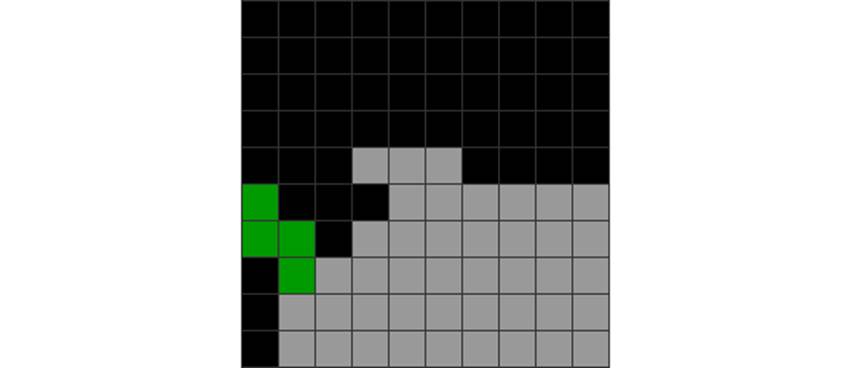
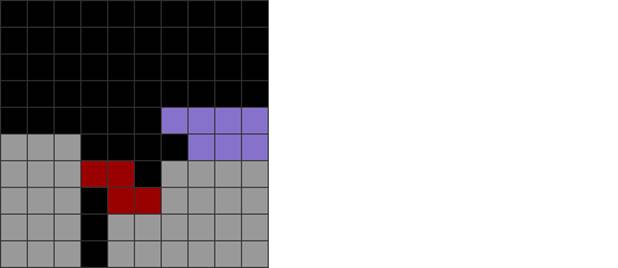
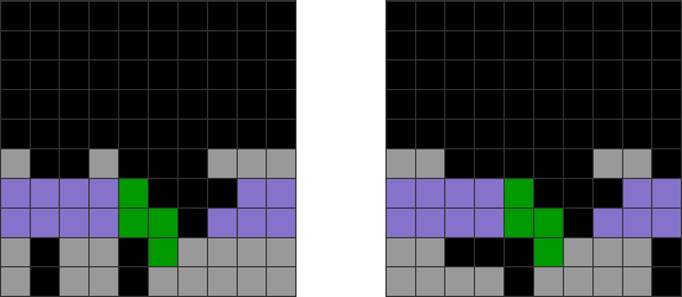
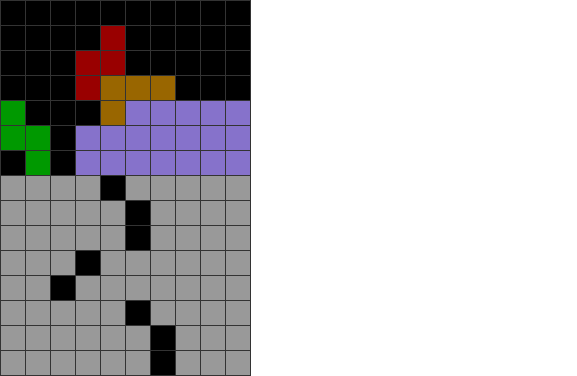
Kaidan is a T-spin double setup created using a vertical S or Z as a prop to make its base:
Diagram Set 1-1
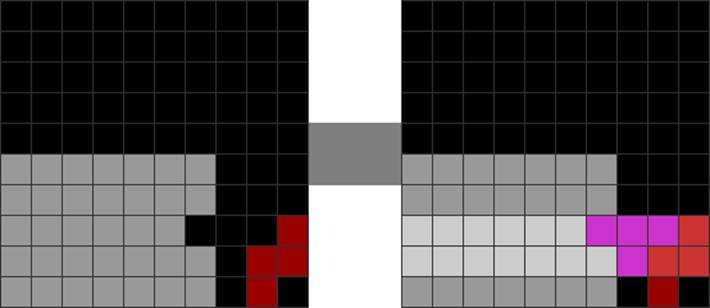
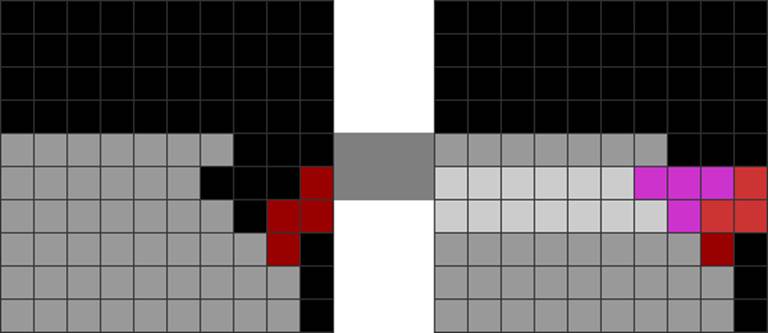
Kaidan’s main purpose is to save Ts by minimizing T wastage in the stack:
Diagram Set 1-2
1
2
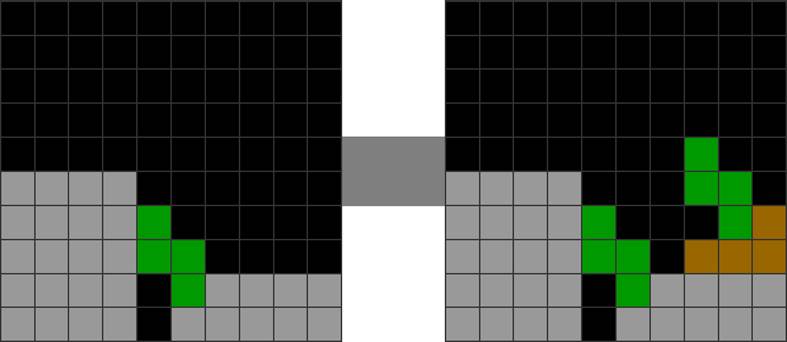
This sequence shows a typical way to make a T-spin double by wasting a T in the stack.
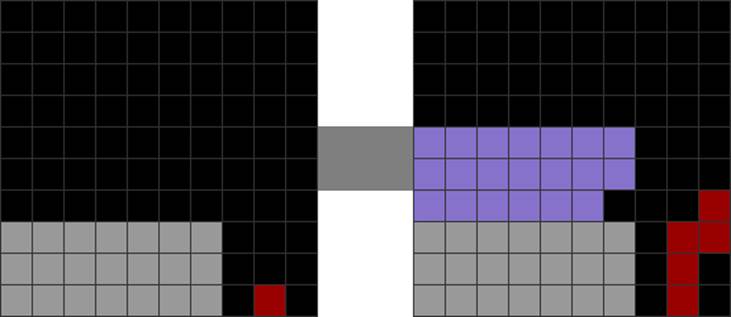
Conversely, you could do this to save a T piece for the actual T-spinning:
Diagram Set 1-3
1
2
This shares the same starting condition as diagram set 1-2’s step 1. A player does not waste a T piece in the stack.
Hence, by using a Kaidan, you might resolve the field unevenness issues without wasting a T in the stack. Therefore, Kaidan T-spins are excellent.
Common Mid-Game Chances
Kaidan is incredibly versatile, having many mid-game situations besides stair-like patterns.
1. Stair-Like Situations
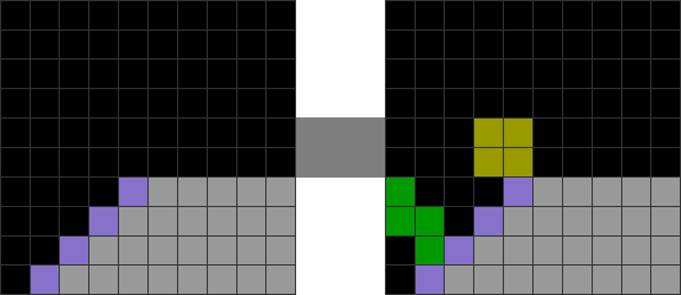
When one first learns to use Kaidan, it is easiest to start by spotting a stair-like pattern in 9-0 stacking (the garbage hole is in the far-left-most or far-right-most column).
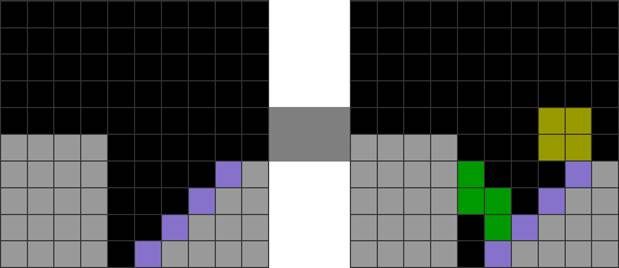
Diagram Set 1-4
1
2
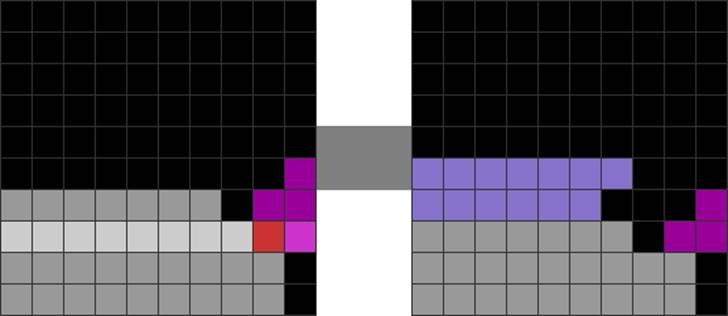
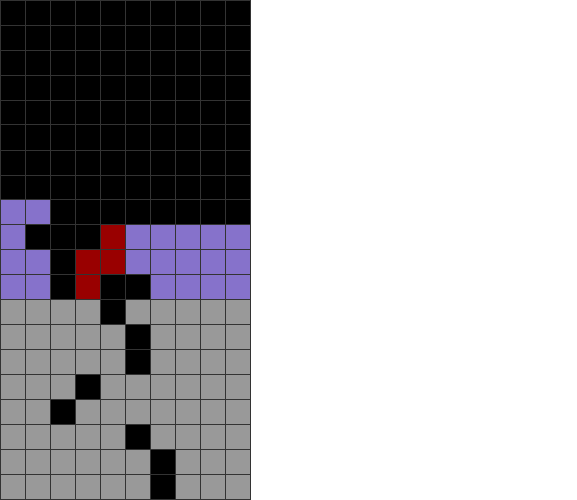
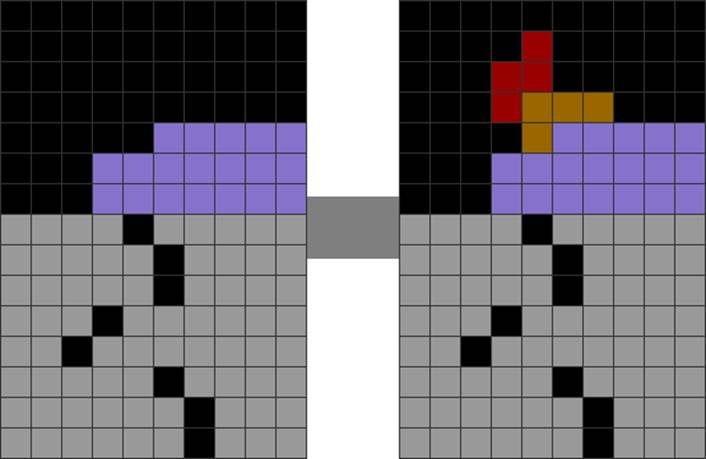
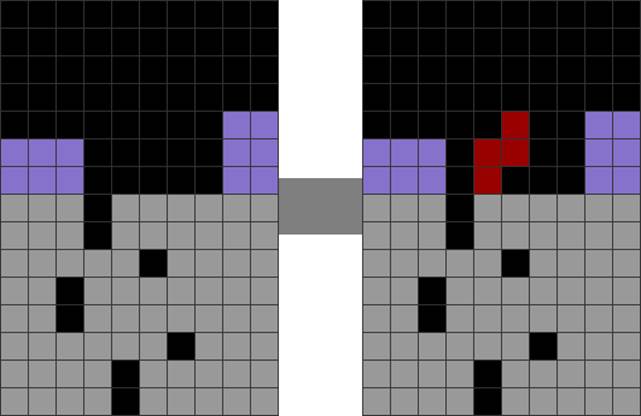
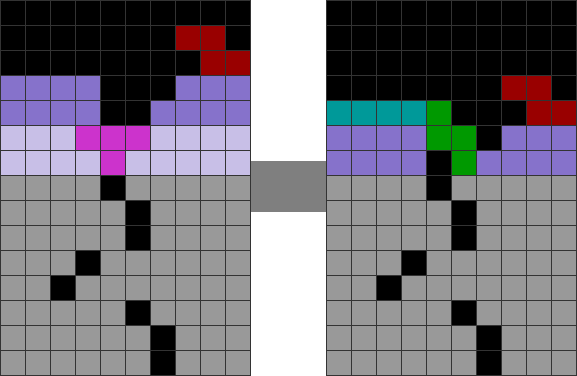
Recognize this stair-like mid-game pattern (in lavender blocks) during 9-0 stacking.
Put a vertical S and make an overhang for a Kaidan T-spin double.
Once you have familiarized yourself with the above method, you can transition to where the main Tetris hole is in the mid-lane:
Diagram Set 1-5
1
2
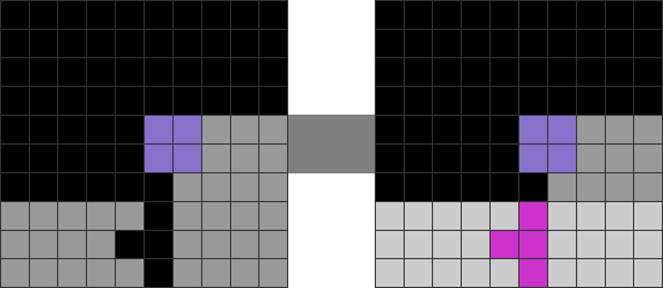
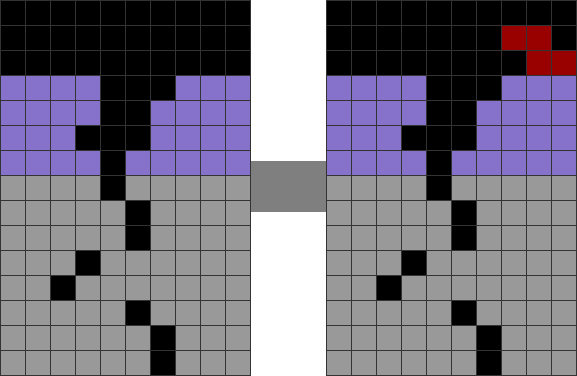
You can make mid-game Kaidans in the mid-lane by spotting a stair-like pattern.
This subsection’s 2 methods are the most commonly used in making a Kaidan.
2. Fixing Height Imbalances
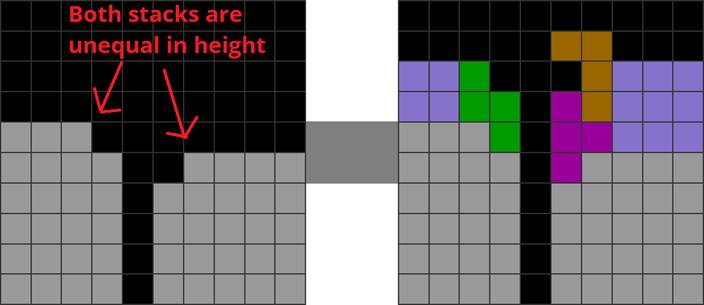
Kaidan is mainly used to fix a height imbalance issue in the following cases:
Diagram Set 1-6
1
2
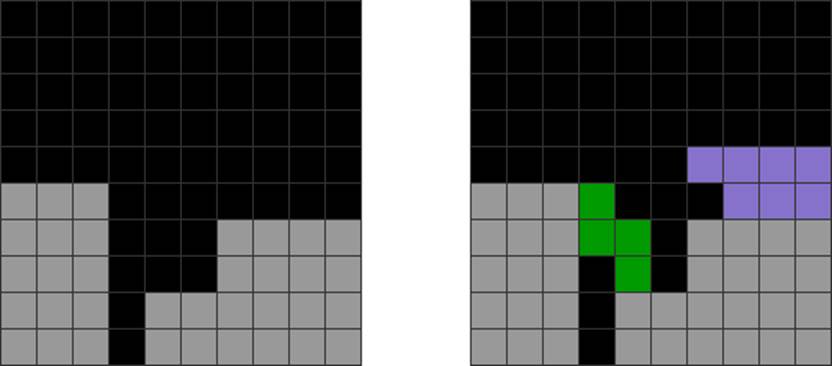
A starting field with uneven stacks left and right of the garbage hole in column 5.
The player places a vertical T to balance both sides of the field, making the T-spin doubles again. However, placing a T is inefficient and may lead to a T drought.
Alt. A
This shows a Kaidan resolving this without putting a T in the stack. This increases one’s efficiency.
3. S/Z Prop
A sub-variant of Kaidan is the S/Z T-spin prop. I categorized them under the same technique because it is so similar to traditional Kaidan. Here are common mid-game situations to use it:
Diagram Set 1-7
1
Alt. A
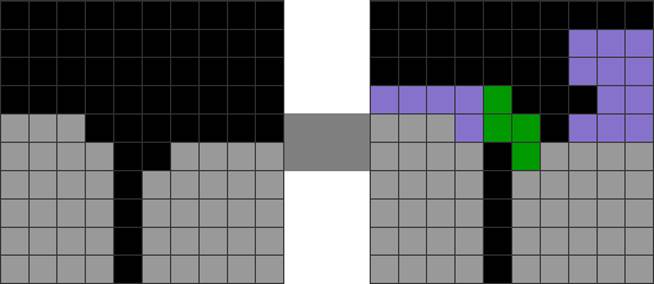
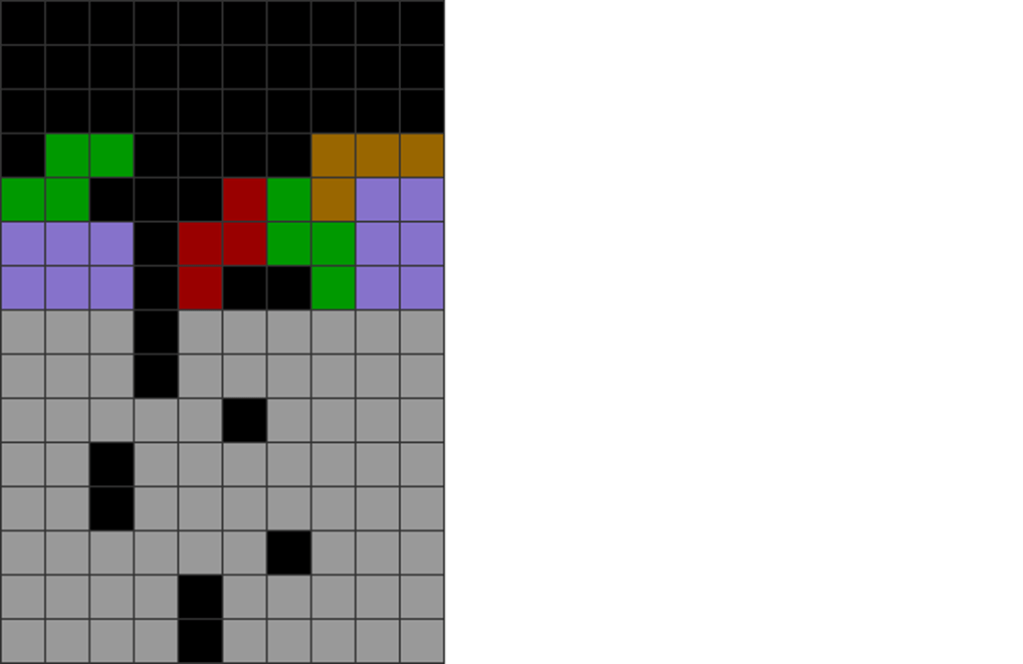
See how the left and right stacks of column 4’s hole differ in height by 2 blocks. The player has 2 choices.
The player can easily put the vertical S to create a T-spin double base and finish it with an overhang.
Alt. B
The player can make a horizontal Z placement to create a T-spin single!
If the player is astute, he will recognize these as the beginning foundations of a Hamburger and ST stacking sequence, explained in The Easiest T-spinning Methods chapter of Book 2.
Continuations and Follow-Ups
Kaidan is excellent as it is straightforward and can be followed up with mid-game ST stacking, Yoshihiro T-spins, and many other methods later. Here are some follow-ups:
1. Kaidan to ST Stacking
Kaidan can lead to ST stacking, a common T-spin double spamming method.
This is easiest if the garbage hole is in the third or eighth columns.
Diagram Set 1-8
1
2
3
4
The player starts with a Kaidan prop to a T-spin double. This then leads to ST stacking.
2. Kaidan to Yoshihiro
Kaidans can easily lead to Yoshihiros, especially in 9-0 stacking scenarios:
Diagram Set 1-9
1
2
This method involves completing a usual Kaidan T-spin double during 9-0 stacking.
The T-spin double line clear concludes.
3
4
The player makes a T-spin mini with the Yoshihiro method.
He tops the newly formed T-shaped cavity with an overhang (lavender blocks) to make a new T-spin double.
3. Following Up T-Spin Triples with Kaidans
Kaidans can follow up certain T-spin triples cleanly:
Diagram Set 1-10
1
2
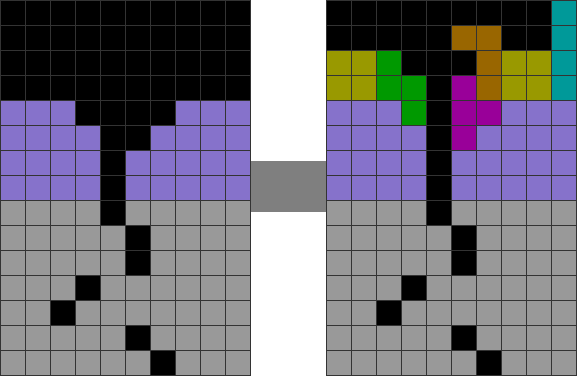
A useful application of Kaidan is to easily follow up on T-spin-triple-like setups. The above is a normal T-spin triple. The lavender overhang is 2-blocks-thick.
3
4
Something interesting happens after the T-spin triple when the lavender overhang is 2 blocks high: you can follow up with a clean Kaidan T-spin without using soft drops!
Here is an actual mid-game sequence:
Diagram Set 1-11
1
2
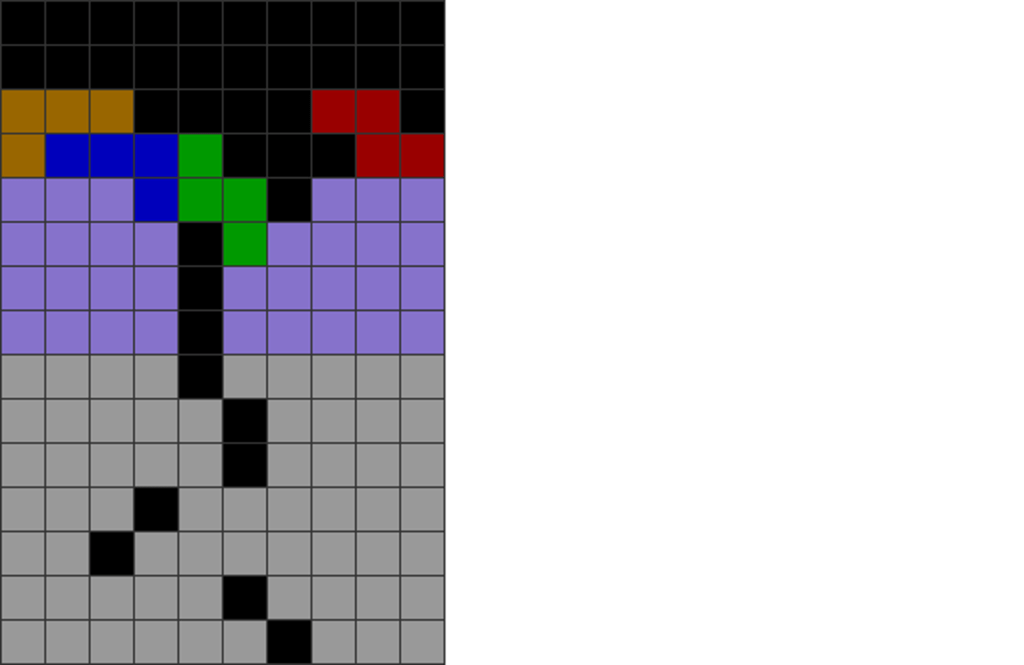
This shows a T-spin triple setup.
The T-spin triple line clear concludes.
3
The player puts a vertical Z to make a Kaidan.
See how clean it is? Back-to-back bonus is also sustained using this method!
This method can save an extra line clear from having to skim off the dirty overhang left by a T-spin triple.
It also may save some soft drops from tucking a piece to fill the cavity under the T-spin triple’s leftover overhang.
Advanced
Kaidans have advanced variants, such as non-linear and complex prop variations.
1. Suspensions & Complex Donations
Kaidan can be used in more advanced ways by suspending the lavender parts cleanly over holes, like below:
Diagram Set 1-12
A
B
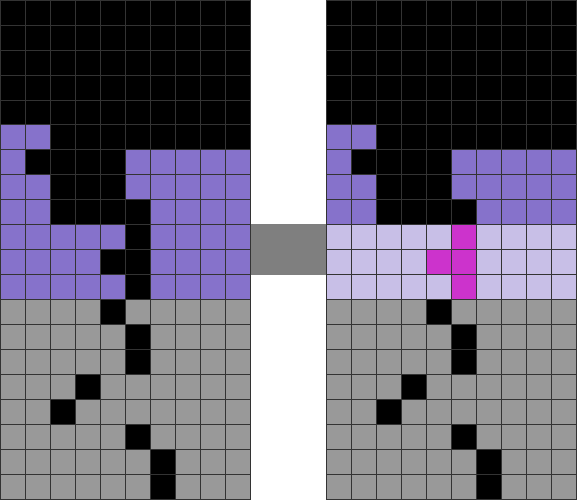
Notice that there are no dirty places on the lavender parts? After the line is cleared, you get a clean field.
This is extremely difficult, and I encourage players to experiment.
2. Non-Linear Construction
Kaidans can also be constructed out of order:
Diagram Set 1-13
1
2
The above places the S (as the base) first before constructing the right side, without needing a stair-like mid-game pattern.
Hence, Kaidans can be created nonlinearly by constructing the overhang or the base in either order. Here are a few more examples:
Diagram Set 1-14
1
2
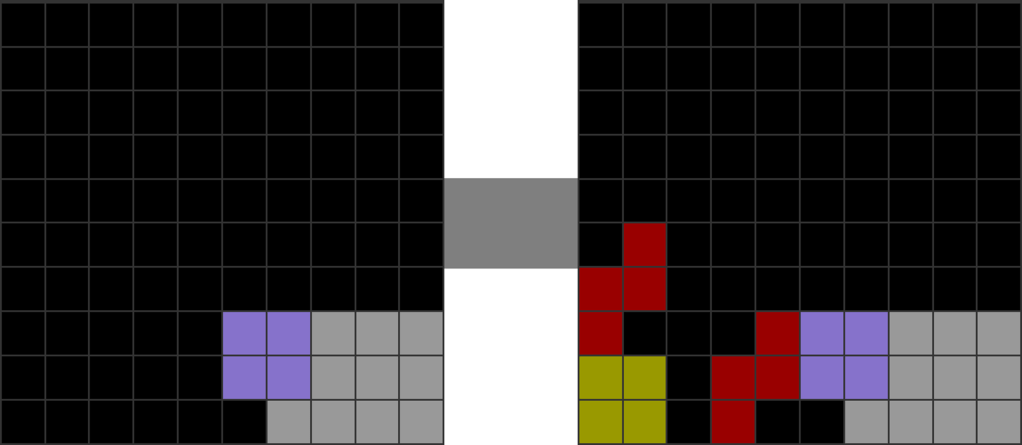
The starting field with a Kaidan opportunity.
The player first builds an overhang with L and Z pieces.
3
He later puts the vertical S as the Kaidan T-spin double’s base.
Doing this comes with experience.
Here is a more advanced execution:
Diagram Set 1-15
1
2
No immediate Kaidan opportunity seems to exist.
However, the player puts a vertical Z to create the base.
3
Then, he constructs the right side and overhangs simultaneously to make the Kaidan T-spin double.
Therefore, Kaidans can be built out of order by expert players.
A Kaidan’s overhang can also be forecasted in this common situation:
Diagram Set 1-16
1
2
A T-spin double exists.
The player puts a Z overhang on the right side first.
3
4
The T-spin double concludes.
The player puts a vertical S, creating a forecasted Kaidan.
In a Nutshell
Overall, Kaidans are among the most practical and versatile mid-game T-spin setups. This is why I have made this the first chapter: learning just this one method heavily expands your T-spin foresight.
Pros and Cons
Pros
Kaidan leads to high back-to-back T-spin double chaining continuations.
Its mid-game stair-like pattern happens frequently.
It can balance both sides of the stack, preventing T wastage.
Cons
Blocking the Tetris hole may make you vulnerable to spikes.