Introduction
To train at Tetris, you first need to understand the game’s developmental stages.
Here, I develop a 5-stage model, based on my years of Tetris experience. I have found it to be a very accurate description of how Tetris players progress.
Each stage requires a different training approach, which I will explain in concrete terms so you can apply it easily.
The 5-Stage Model of Tetris Development
In my experience, Tetris mastery has 5 stages.
I will illustrate them using a well-known Tetris method called the DT Cannon.
Stage 1: The Familiarization Phase
The player knows only concrete, specific methods. This is the concrete stage. It is largely memory-based, and the player first learns to assemble specific piece combinations to make some basic setups:
| Diagram Set 1-1 | |
| 1 | 2 |
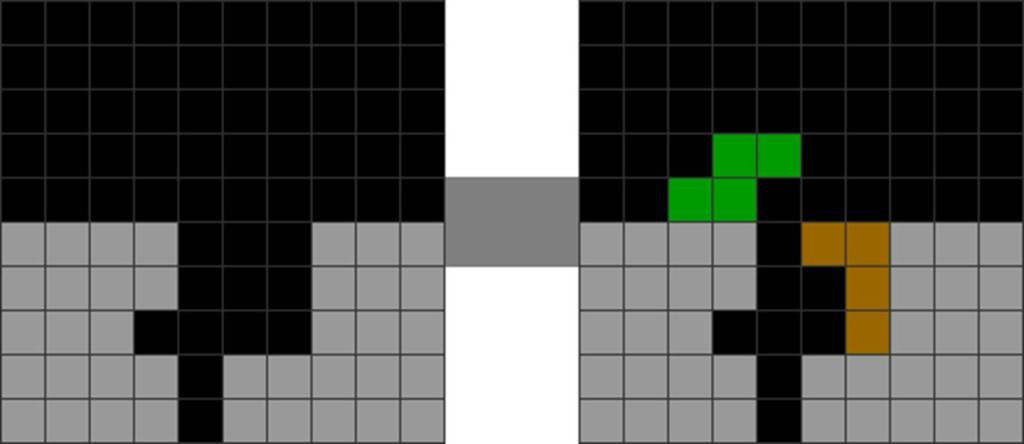
| A mid-game DT Cannon chance. | The player needs to combine the S and Z pieces to complete the DT Cannon. |
The player also learns to control the pieces and place them accurately with their muscle memory.
Application for Training
A Tetris player at the first stage should focus on several things:
- Muscle Memory: One should focus on learning the means to coordinate between their mind and fingers in placing pieces accurately and quickly.
- Learning Fixed Piece Patterns: Since the player has not yet cultivated any spatial intuition in Tetris (like how pieces fit together into generic shapes), the player can focus on learning fixed pattern setups such as openers.
The focus should not be on the mid-game yet. The player should get adjusted to the game first.
Cultivating muscle memory matters because the brain first needs to automate the extremely cognitively demanding task of consciously placing every piece with the right muscle input.
It is like learning to ride a bike: the initial phase requires you to consciously think through every move, and that takes a lot of brainpower.
At this stage, because your brainpower goes to placing pieces consciously, you will not have spare brainpower for tactical and strategic choices.
Hence, the player should not learn mid-game tactical or strategic decision-making yet.
Stage 2: The Building Phase
In this stage, the player knows a specific class of methods, such as a DT Cannon, quite well. They can create that method through many different paths. This is the building phase:
| Diagram Set 1-2 | |
| A | B |
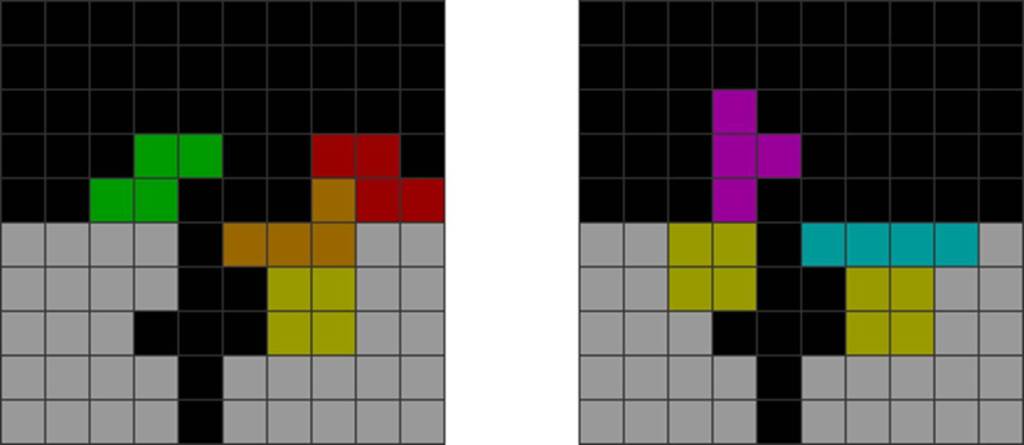
| An adept player now knows how to construct a mid-game DT Cannon in many specific and concrete ways. |
Typically, a player at this stage enters a memorization frenzy of learning as many methods as possible. They may go to various Tetris Wiki sites to memorize specific methods like Kaidan or Fractal.
Application for Training
By stage 2, the player should have automated much of the muscle memory for piece placements. This frees up more brainpower for the next task: learning many concrete ways to set up certain mid-game patterns.
The player should move beyond fixed pattern placements, such as openers.
They should do the following:
- Pattern Recognition: They should recognize and memorize mid-game situations for various setups.
- Mid-Game Setup Creation: They should learn the various ways to create mid-game setups when they recognize the situation. For example, diagram set 1-2 covers 2 or more ways to set up a mid-game DT Cannon.
The focus now transitions to the mid-game.
The player should learn 2 to 3 methods at once, such as DT Cannon, Fractal, or STSDs. Learning too many methods simultaneously leads to brain overload.
Now is not the time for deep tactical or strategic thinking.
Think of it this way: you are a military strategist in training. You have no experience leading your platoons, managing their logistics, or understanding the enemy’s strategy.
As such, your brain would lack the technical knowledge and experience to plan anything tactical or strategic.
You must first fill your brain with these small details to build the mental resources you can draw on.
Hence, stage 2 focuses on learning and applying as many mid-game setups as possible. Do not worry about their risks or complex tactical decision-making yet.
Stage 3: The Tactical Phase
The player now has a solid understanding of the method’s pros, cons, risks, and how to use mid-game opportunities. They can assess a mid-game situation, know when to use a method (or not), and choose tactically whether it is optimal. This is the tactical stage:
| Diagram Set 1-3 | |
| 1 | 2 |
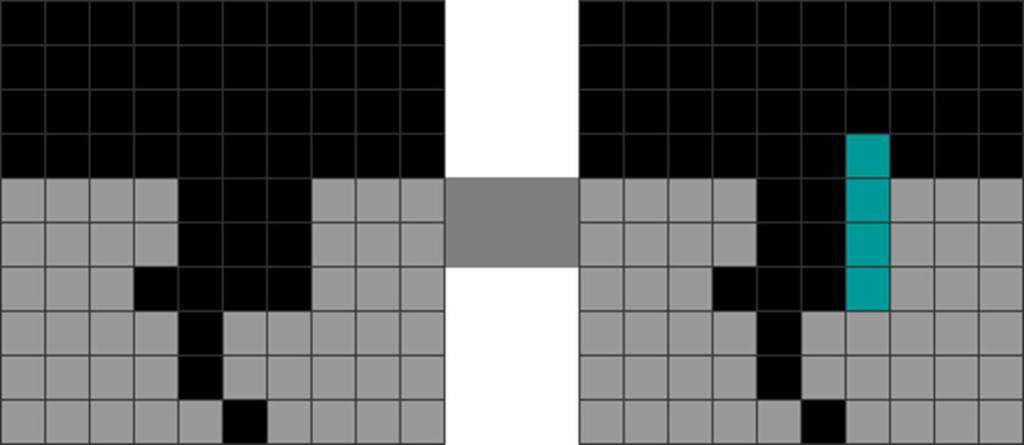
| Starting field. | The player places the I piece this way to make a T-spin double. |
A more tactical player can weigh various possibilities. They can spot better alternatives to the above set’s choice, such as:
| Diagram Set 1-4 | |
| 1 | 2 |
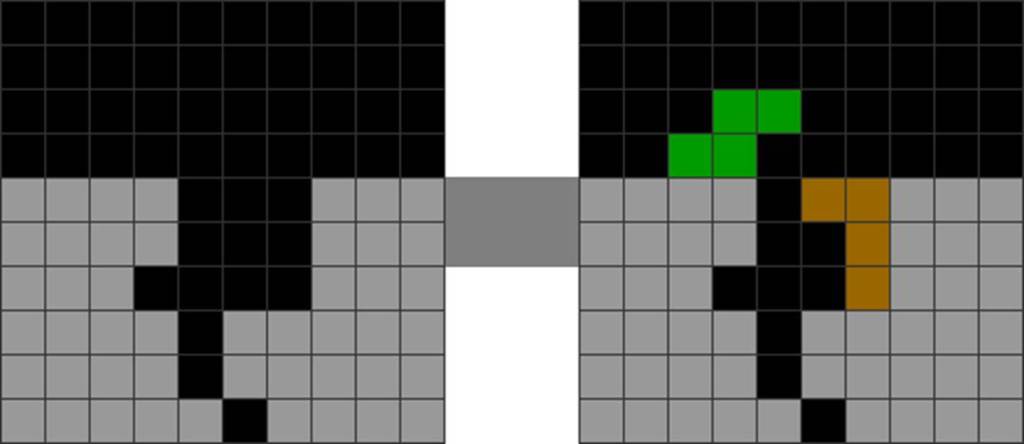
| The same starting field as the last diagram set. | The player sets up more efficiently by creating a DT Cannon instead of a T-spin double. |
In this phase, many players spend a long time finding online Tetris puzzles with mid-game situations they have to solve to find the most optimal placements.
Application for Training
By now, the player should have learned a wide range of specific Tetris methods, such as Kaidan, Fractal, and Imperial Cross.
With this, the player has the mental resources to start making tactical decisions.
As shown in the last few diagram sets, the player can now see a situation and spot 2 or more alternatives. The player can then choose between them.
i) Study Theoretical Concepts
To choose better, the player should now study theoretical concepts more deeply, such as parity management, field harmony, efficiency, and downstacking, all covered in my books.
For instance, a player can choose a setup that is (i) cleaner, (ii) safer, (iii) leads to a better stack, and (iv) is more efficient.
However, at this stage, the player is not ready for grand strategic thinking yet. The focus should be on the small micro-decisions in the last paragraph.
ii) Slow, Deliberate Thinking
The player would benefit most from Tetris puzzles that force them to think slowly and deliberately.
They would also benefit from playing slowly to think through every option.
This conscious and slow, deliberate effort forces the brain to make new connections and memories.
The player should not worry about speed or mistakes. I encourage them to make mistakes so they will know how not to play Tetris. They should also experiment with fancy setups to expand their setup knowledge.
Stage 4: The Strategic Phase
True Tetris mastery comes when you reach this stage and can choose the optimal method for the situation and execute it quickly, while maximizing follow-ups and continuations.
The Tetris master can do this while ensuring that their fields are field-harmonized and parity-balanced:
| Diagram Set 1-5 | |
| A | B |
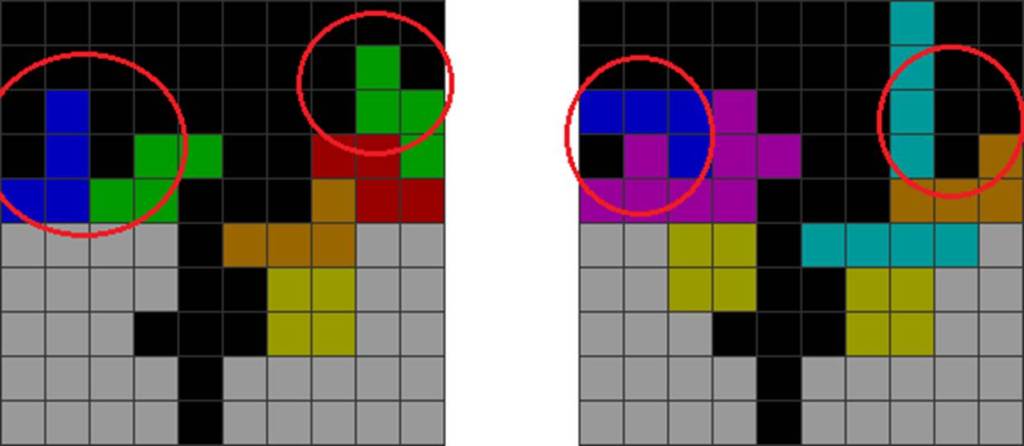
| An inexperienced player creates a successful DT Cannon. However, they stack the red-circled parts poorly. The field is field-disharmonized (divided with poor stacking follow-ups) and parity-imbalanced (very jagged). |
A more skilled player can instead do this:
| Diagram Set 1-6 | |
| A | B |
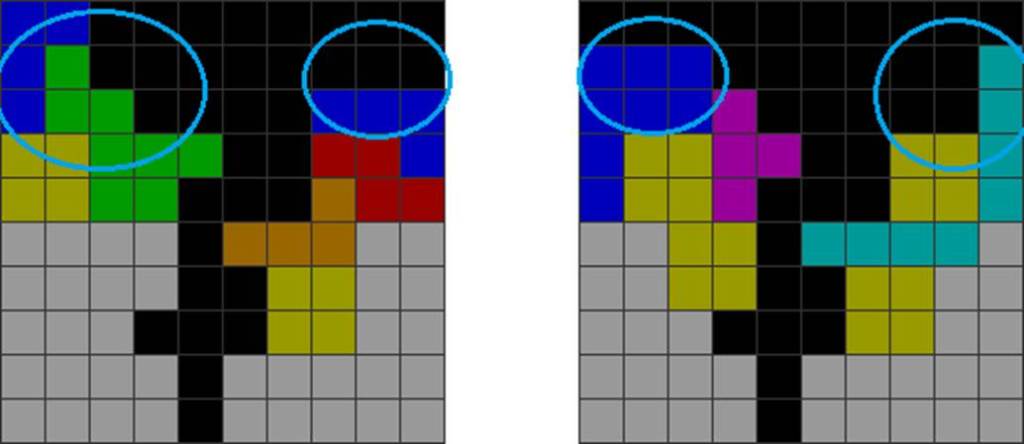
| The experienced player makes a DT Cannon. This time, they stack the blue-circled areas in a field-harmonized, parity-balanced way (i.e., flat, clean, smooth, and safe). |
Focus on optimizing stacking. Without stacking, all other setups will fail.
Application for Training
By now, the player should have a proficient grasp of the core Tetris concepts, such as parity management, cleanliness, and field harmony.
They would also have sufficient mastery of many mid-game setups and understand the micro-level tactical decisions well.
Now, the player can move towards grand strategizing.
They can think beyond micro-level decisions toward longer-term choices, such as maximizing follow-ups and continuations that create even more setups.
The player can then choose a distinct style, such as (they are not exhaustive):
- Being Aggressive: A player can choose to prioritize back-to-backs and maximal T-spin pressure.
- Being Defensive: A player can play defensively and prioritize downstacking, combos, skims, cleanliness, and safe stacking.
- Being Balanced: A balance between the two.
- Using Counter-Attacks: A player can turn an opponent’s garbage into fuel for a counter-attack.
Altogether, the player can now choose their strategic playstyle.
Stage 5: The Automation Phase
Finally, once the player has mastered the earlier stages, they can prune less efficient, unused setups to streamline decision-making.
They can then keep practicing and automate all their knowledge and setups until they get faster and faster.
This is Tetris mastery at peak proficiency.
Application for Training
In this stage, a player should perform the following:
- Pruning: If you ever reach a point where you have to spend many seconds to think through 4 or 5 possibilities to solve a mid-game situation, it is probably better to slowly identify the sub-optimal ones and prune them. This leaves you with perhaps just 1 to 3 choices, freeing up brain resources so you can get faster.
- Practice: Once you have pruned unnecessary methods, keep practicing until you automate everything and become terrifyingly fast.
The Big Picture and You
A Visual Summary
Here is a visual summary of the core points:
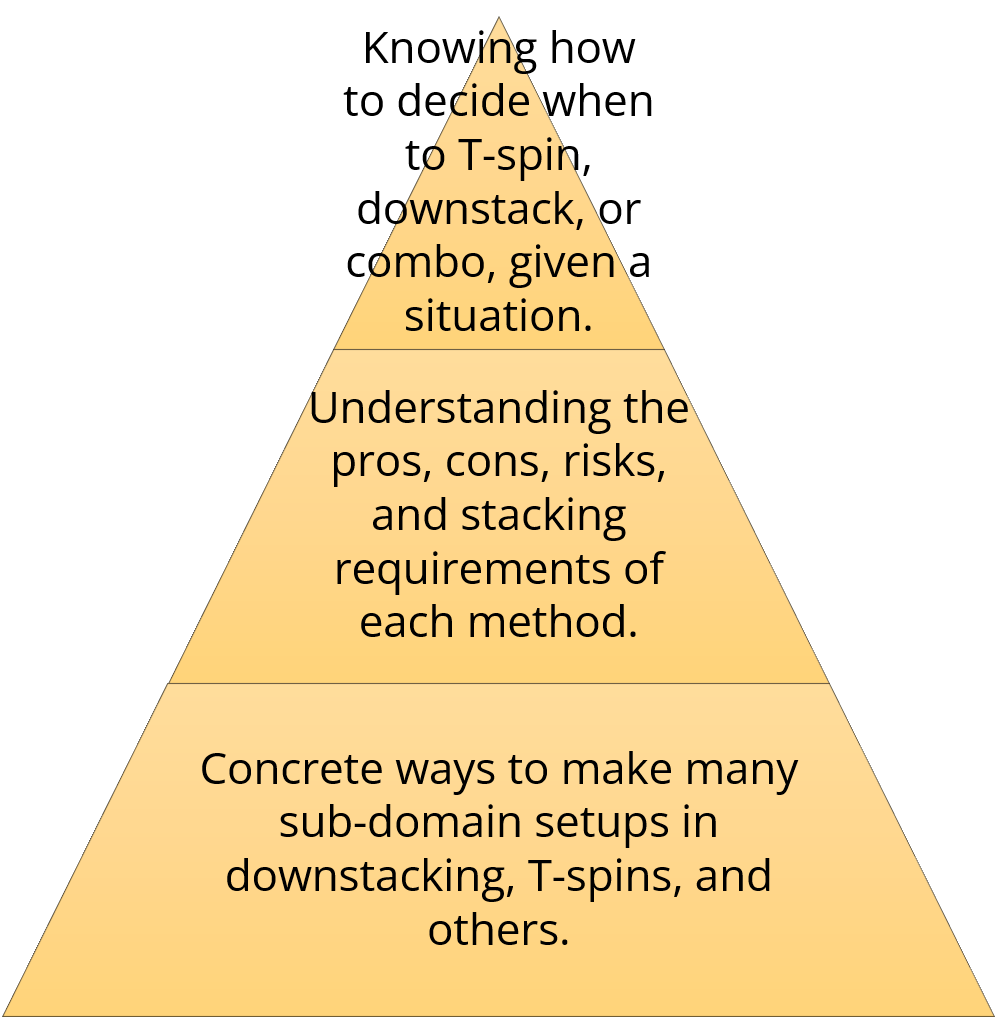
The lowest base of the above pyramid: The player now knows many specific sub-methods in all domains (like DT Cannon, C-spin, etc.), including downstacking, skimming, timing, 4-wide, T-spins, all-spins, prophecy methods, Tetrises, doubles, triples, perfect clears, openers, stacking, field harmony, and parity management, among others. This entails concrete decision-making.
This corresponds to stages 1 and 2.
The middle tier: The player understands the pros and cons of each method. He knows when to use certain techniques and when not to. This entails tactical decision-making.
This corresponds to stage 3.
The top layer: Now the choice comes in seeing a situation and then deciding whether to downstack, upstack, T-spin, or stall, etc. For instance, once a player decides to T-spin instead of downstack, he recalls knowledge of the pyramid’s lowest tier and constructs specific T-spin setups. This entails strategic decision-making.
This corresponds to stage 4.
Here, the player is freed from the bonds of overthinking and excessive conscious deliberation, as seen in stage 1’s control finesse, stage 2’s foundational methods, and stage 3’s nuanced and specific approaches.
Now, the player’s brain has automated everything before stage 4. This is where the true fun and mastery of Tetris begins. The player must now employ all their resources to make the right decisions when faced with a situation, given the previews and all possibilities.
Stage 4 players who become extremely proficient can automate many of these Stage 4 processes and move on to the true mastery stage at Stage 5.
The 5-Stage Model’s Relevance
With this panoramic view of Tetris development, you can reflect and identify which of the 5 stages you are in.
Then, you can tailor your training to that stage and speed up your progress.
You will also get a big-picture view of how far along you are in this model and where to go next to improve.
It is also clear why some generic Tetris coaching suggestions do not work at certain stages.
If a player is at stages 1 or 2, generic advice like “stack better” would not work, because such players have not memorized enough specific Tetris knowledge to know what stacking means.
If a player is at stage 3 and is just learning micro-tactics, generic advice like “be more aggressive” means little, since they have yet to develop the strategic knowledge to choose different playstyles. They would not know what “aggressive” means or how to apply it beyond a tactical level.
In a Nutshell
| Key Points |
| Tetris progression advances through 5 stages of growth. Each stage has a different training methodology. I recommend adhering to them. Tetris progression develops from pure muscle memory and memorization to high-level tactics and strategizing. Some generic pieces of Tetris advice do not work at some levels, as the player is not ready. |

