“The mind is everything. What you think you become.”
—Buddha
Introduction
We Cannot Escape From Growth
The soul can never be destroyed in any way. Existence is its eternal quality. You cannot cease to exist.
What is, simply is. You cannot change that.
And as fragments of an undying cosmic consciousness, none of us may truly be destroyed.
The physical form may perish upon death, but the spirit remains, standing as a testament to the eternal life that exists thereafter.
As such, a human may end their life in the physical realm, but their spirit remains eternal and undying.
René Descartes once said, “I think, therefore I am.” I propose something far more radical: “I exist, therefore I must grow.”
Hence, individual souls, being fragments of divinity, are posed with the ultimate realization: that they are condemned to grow spiritually.
Per the findings of near-death experiences and afterlife studies by Victor Zammit, Raymond Moody, Michael Newton, Dolores Cannon, Walter Semkiw, and many others, the spirit is eternal.
People who have committed suicide (but survived) and experienced near-death experiences often find their souls drawn to gray realms. Melancholic souls surround them until they choose to be no longer drawn to hopelessness and darkness.
Souls who did not survive their suicide eventually realize they had purposely chosen their life’s difficult mission. Hence, they often reincarnate again voluntarily, reliving the same problems until they have overcome them.
According to some near-death experiences, some severely troubled souls wished they could cease existing. However, they could not, since their souls are immortal.
And, thus, the soul can choose to either stagnate by doing nothing or improve one’s life and grow in spiritual awareness, understanding, and application.
This is why the law of existence is a law: that one cannot cease to exist. Eternity is ahead of us. One must therefore make use of this gift of existence wisely and prosper from within.
What We Are
What is existence?
The essence of existence is not materiality or observation. Instead, it is experience.
You are not your thoughts, feelings, or beliefs. You are the cosmic and divine awareness that observes and experiences those.
You are the cosmic being that currently assumes the concrete form of a person—you, James, Mary, Lao Tzu, or whatever—to manifest the infinite in finite form to complete the whole.
You are not your status, caste, class, prestige, career, race, gender, ideology, or other groups. You are that which you are—pure consciousness and a finite spark of the eternal and infinite cosmic mind.
Therefore, there is no reason to be overly attached to your worldly or external form. Spirit is within and is the true reality.
Here is a more profound metaphysical and ontological take on existence and reality:
Reality has two components: (i) the actual manifestation and (ii) its underlying, abstract processes that create and sustain it.
The former is like the display of a monitor, while the latter is like the unseen codes of 0s and 1s in a CPU.
What we perceive and manifest physically is the finite expression of an unseen, infinite, and absolute reality that no mortal form may touch. This is what the ancient Vedic and sages refer to as ‘Maya’ or illusion.
However, with sufficient spiritual practice and mastery, one may partly uplift the veil of illusion that prevents us from perceiving this cosmic unity that undergirds all existence.
The goal of all spiritual practice is to seek eventual union with the cosmos. In doing so, we dispel the illusion of separateness that is responsible for so many wars and conflicts worldwide.
When we realize we are the awareness and experience behind our material forms, something extraordinary happens.
We begin to focus our growth on spiritual, mental, intellectual, creative, artistic, emotional, social, and philosophical dimensions.
After all, it is the only part of us that is permanent and carried over to the world of spirit when we perish.
Tetris as an Analogy
Like real life, Tetris is not a puzzle to be solved, but a reality to experience.
One may spend many years studying Tetris, but if one does not play it much, one will miss the essence of the game.
It is akin to a person who stops the flow of reality by looking down at his feet to analyze things. However, this analysis’s thoughts and ideas are only representations of reality. The true reality is spirit or conscious experience.
Hence, one can only look forward, immersing and flowing with experience until one has become one with reality.
Let us understand the relevance and significance of this through Tetris.
In Tetris, whenever a game begins, a player may be faced with tumultuous or unfortunate situations:
| Diagram Set 1-1 | |
| Step 1 | |
| You | Opponent |
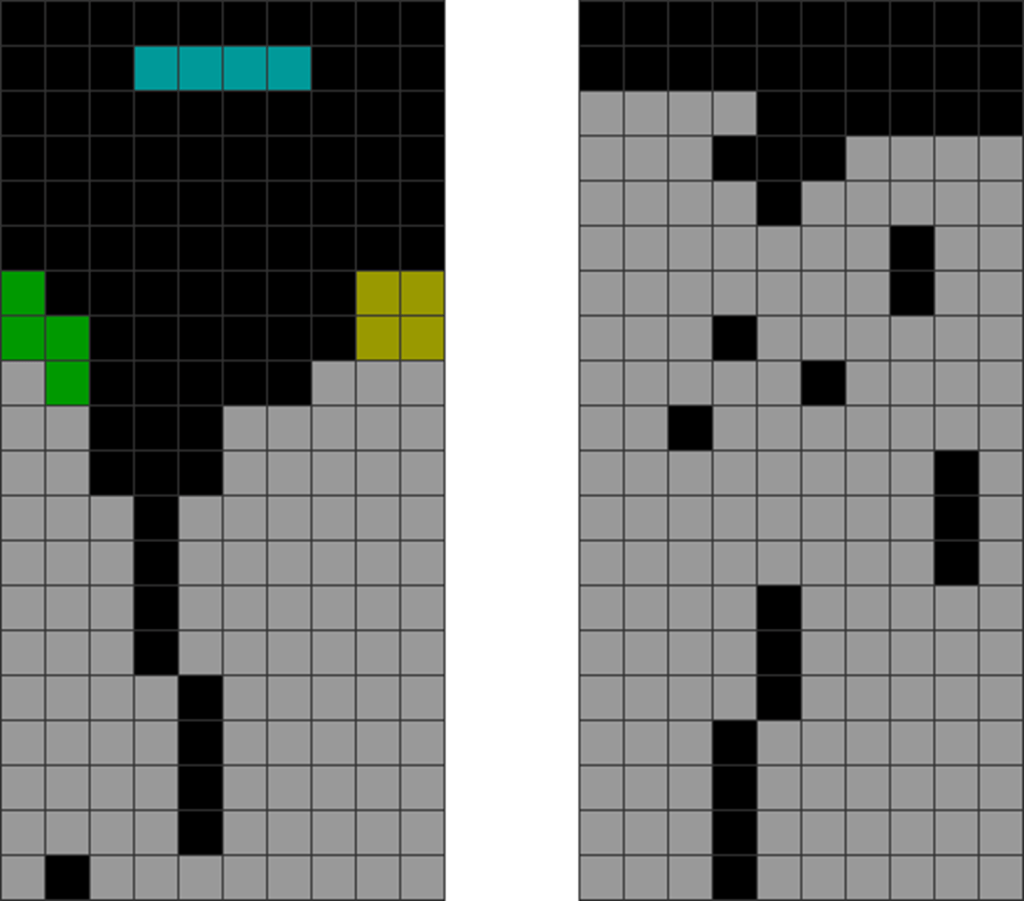
| You stall and do not make a Tetris line clear with the I piece. You delay the Tetris by putting pieces around (the O and S). |
Here, above, a player faces an opponent who has a T-spin double ready.
| Diagram Set 1-2 | |
| Step 2 | |
| You | Opponent |
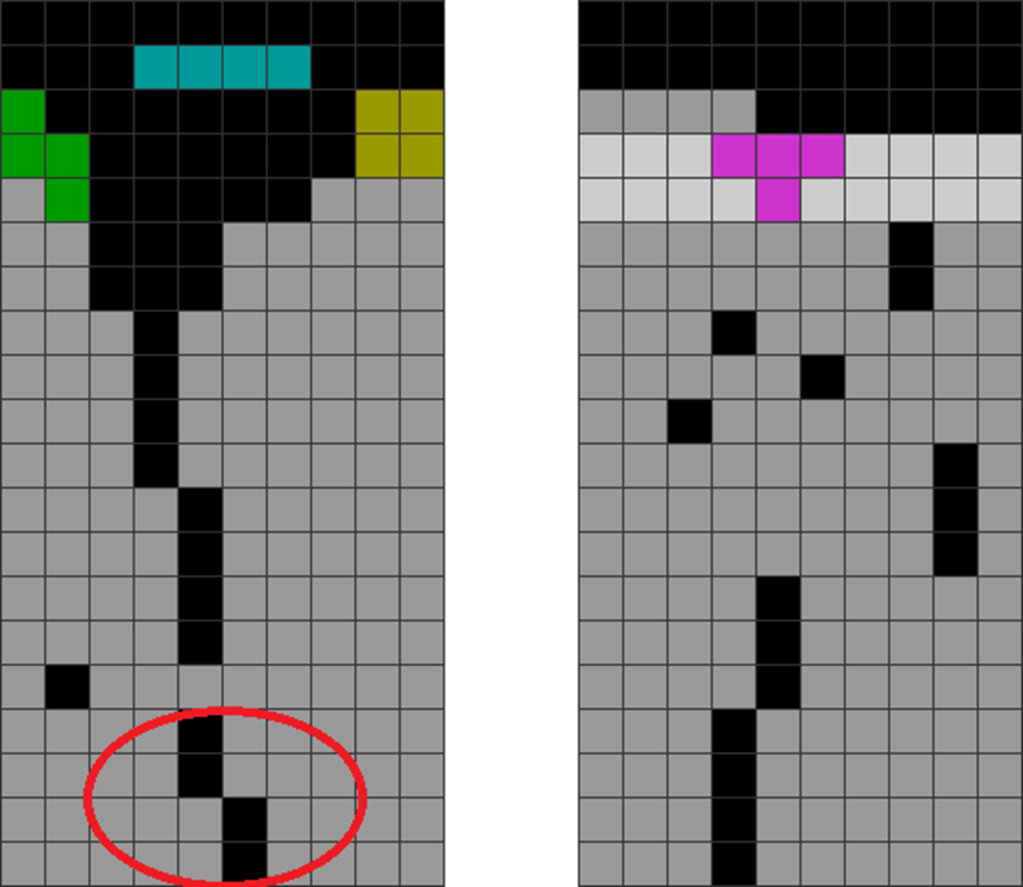
| Your opponent uses a T-spin double and sends four garbage lines (red circle). You accept the garbage. |
Hence, above, the opponent makes a T-spin double, which sends four lines of garbage over to one’s field. The board then rises, nearly topping you out.
This seems like a dead-end, and you are about to give up. Instead, you do this:
| Diagram Set 1-3 | |
| Step 3 | |
| You | Opponent |
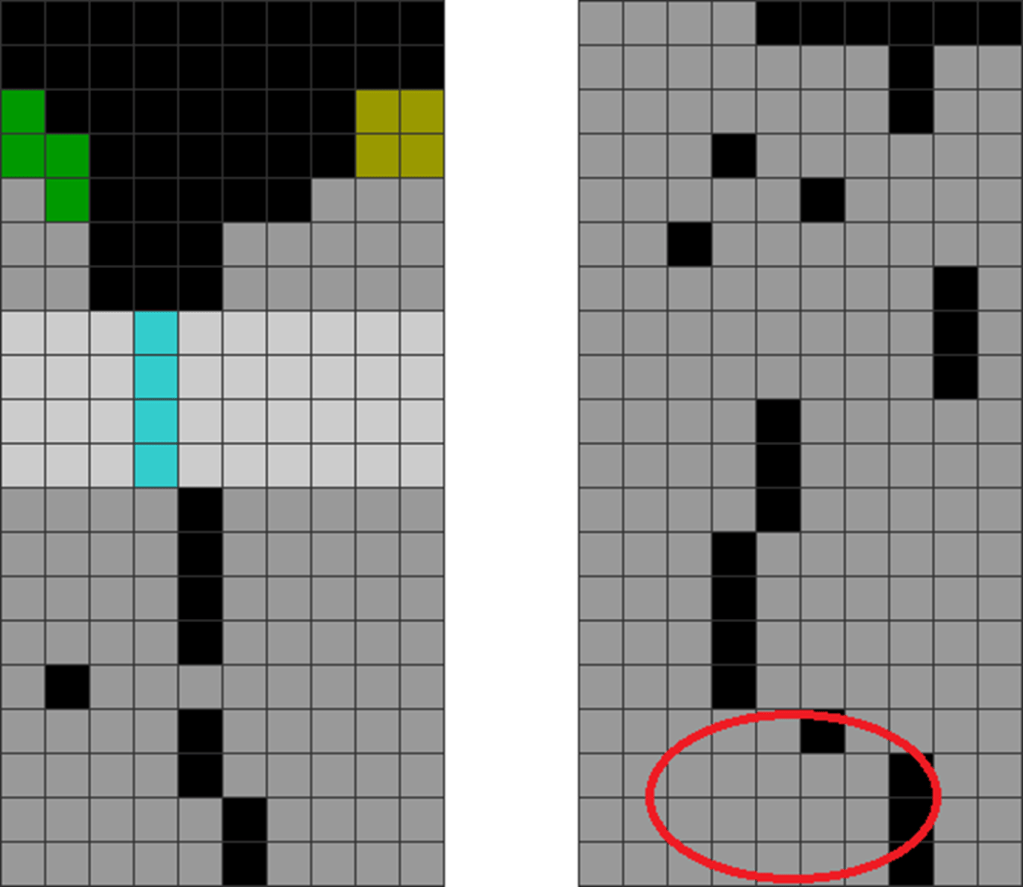
| You send the Tetris line clear and attack the opponent with four lines of garbage (red circle). This ends the opponent. |
You send a Tetris attack over, which creates four garbage lines for the opponent. This tops him out and defeats him.
If you had merely gotten frustrated and forfeited the game, you would not have seen the end of the story, where you won.
If you had forfeited the game, you would have carried forth your inexperience to the next game.
Everything that is not resolved in one’s current game is carried forth to the next, until one learns from their mistakes and transcends them.
It is impossible to ‘perish’ permanently in Tetris. After you top out, the game simply brings you over to the next game until you have learned from your flaws.
This is true of life as well: because you cannot cease to exist, your problems will continue until you resolve them and grow from them.
Personal Applications
Likewise, on Earth, even if you should give up on life and perish physically, your soul will continue to exist.
You will continue to carry forth the unresolved traumas and negative tendencies to the afterlife or the next life until they are resolved.
Existence is eternal.
Hence, why not embrace your current life to grow spiritually, instead of merely doomscrolling on your phone or watching endless TikTok videos or Instagram reels?
Make use of your current life’s opportunities to see what you are lacking. Then, reflect on them and see how you can improve your circumstances.
Since we cannot flee from existence and we cannot be extinguished permanently, why not embrace all of life’s wonders and beauty?
Likewise, we sometimes cannot change our external circumstances.
We may suddenly be struck with calamities, such as a massive earthquake or the loss of a dear one. We may feel shaken and saddened by such disasters or terrible situations.
However, pain is twofold: the initial pain of the problem, and the depression that comes after when we attach ourselves to the problem.
The former cannot be changed, but the latter, regarding how you react and manage the consequences, can be. If you cling to pain and resist it further, the second wave of pain will endure until you cease.
Since you sometimes cannot change your outward existence and circumstances, you can always change within.
You can see adversity as an opportunity and grow from it, enlarging your spiritual perspective.
Hence, you will only endure the first wave of pain and minimize the second one. In turn, you can grow in wisdom from overcoming the former.
Social and Global Applications
One may not change the cards given to oneself at birth. However, one can always make the best use of them.
This Stoic philosophy, paralleled in figures such as Epictetus and Marcus Aurelius, offers great wisdom and application in the current world.
Just as the mind cannot stop a bullet gushing at you, we do not possess powers of telepathy that can change the world at large.
The world already exists as it is—a roiling, turbulent landscape filled with wars, conflicts, intense competition, chaos, and strife.
One may ponder why we have chosen to incarnate in this world. It is to experience duality at a large scale, such as the manifestation of our inner darkness.
We cannot change the external world. However, we can always change how we react to them.
For instance, when we see, on the news, a tragic image of the war that is continuing in the Middle East, such as Gaza, we will naturally be saddened.
However, this gives social activists opportunities to campaign against similar tragedies to save people and stop suffering. New United Nations policies may form to avert such future wars.
Without darkness on the larger scale, there would be no opportunities for souls to choose and outgrow the darkness.
Hence, see the external world as an opportunity to grow from and manifest love.
 How to Tetris