“We are what we think. All that we are arises with our thoughts. With our thoughts we make the world.”
— Dhammapada
Introduction
The Basis of Reality is Experience
What is existence?
The essence of existence lies neither in physicality nor in intellectual analysis. Instead, it is experience.[1]
You are not your thoughts, feelings, or beliefs. You are the cosmic and divine awareness that observes and experiences them.[2]
You are the cosmic being that currently assumes the concrete form of a person — you, James, Mary, Lao Tzu, or whatever — to manifest the infinite in finite form to complete the whole.
You are not your status, caste, class, prestige, career, race, gender, ideology, or other groups. You are that which you are — pure consciousness and a finite spark of the eternal and infinite cosmic mind.[3]
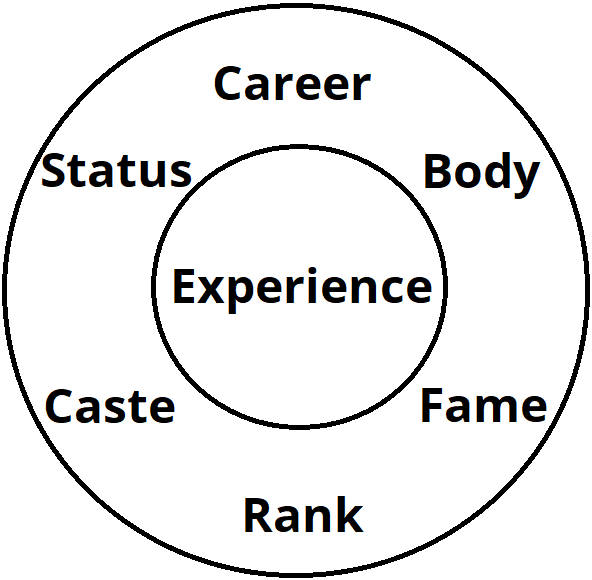
| The inner circle (experience or consciousness) is your actual reality. The rest in the outer circle is Maya, or illusion. |
Therefore, there is no reason to be overly attached to your worldly or external form.
Spirit is within and is the true reality.[4]
When we work on the spirit, our inner lives flourish, and our external noise gets silenced.
Digging Deeper and More Technically
Reality has two components: (A) the actual manifestation and (B) its underlying, abstract processes that create and sustain it.[5] The latter is the absolute.
The former is like a monitor’s display, while the latter is like the unseen 0s and 1s in a CPU.
What we perceive and manifest physically is the finite expression of an unseen, infinite, and absolute reality that no mortal form may touch. This is what the ancient Vedic sages refer to as ‘Maya’ or illusion. This is reality’s actual manifestation (part A).
However, according to Theosophy and Buddhism, with sufficient spiritual practice and mastery, one may partially lift the veil of illusion that prevents us from perceiving the cosmic unity that undergirds all existence.[6] This lets us approach the absolute component of reality (part B).
The goal of many spiritual practices is to seek eventual union with the cosmos. In doing so, we dispel the illusion of separateness that drives so many wars and conflicts worldwide.[7]
Consciousness is not part A. It belongs to part B — the absolute foundation beneath all illusion.
When we realize we are the awareness and experience behind our material forms, something extraordinary happens.
A civilization can focus its attention away from wars, excessive competition, and material hoarding.
We begin to focus our growth on spiritual, mental, intellectual, creative, artistic, emotional, social, and philosophical dimensions.
The arts, sciences, philosophy, culture, and broader socio-economic systems can flourish and become fairer.
After all, consciousness is the only part of us that is permanent and carried over to the world of spirit when we perish.
The Immortality of the Soul
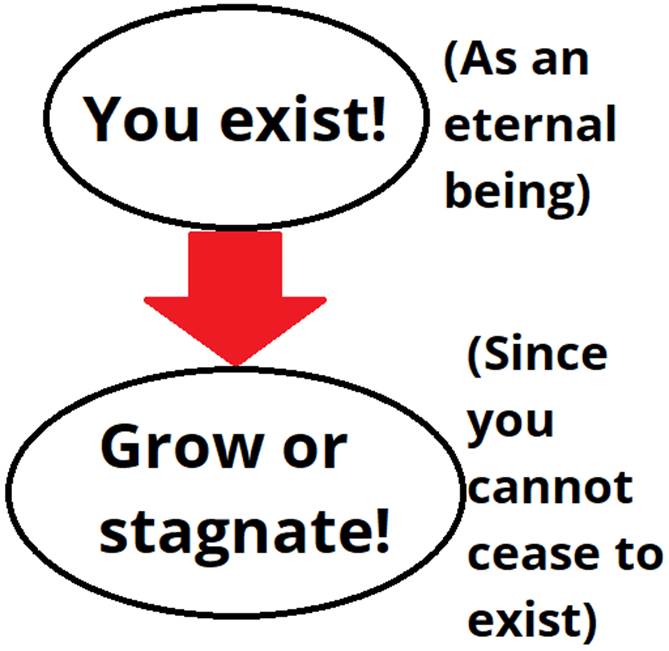
Existence is your eternal quality. You cannot cease to exist.
Near-death experiences (NDEs) involve people on the verge of dying who report their souls leaving their body and appearing on the other side.
There, they report gaining information about the secret nature of spirit and the cosmic architecture that transcends the material world.
According to them, the soul can never be destroyed. We are all fragments of an undying cosmic consciousness; none of us may truly be destroyed.
The physical form may perish upon death, but the spirit remains, standing as a testament to the eternal life that exists thereafter.
As such, a human may perish in the physical realm, but their spirit remains eternal and undying, continuing its spiritual evolution.[8]
This spiritual immortality implies that we can either stagnate or grow.
Eternal Spiritual Growth
René Descartes once said, “I think, therefore I am.” I propose something far more radical: “I exist, therefore I must grow.”
Hence, individual souls, being fragments of divinity, are presented with the ultimate realization: that they are destined to grow spiritually.
People who have committed suicide (but survived) and experienced NDEs often find their souls drawn to gray realms. Melancholic souls surround them until they choose no longer to be drawn to hopelessness and darkness.[9]
According to past-life regression and between-lives research, souls who did not survive their suicide eventually realize they had purposely chosen their life’s difficult mission. Hence, they often voluntarily reincarnate, reliving the same problems until they have overcome them.
Some NDE accounts involve some severely troubled souls who wished they could cease existing. However, they could not, since their souls are immortal.
And thus, the soul can choose to either stagnate by doing nothing or improve one’s life and grow in spiritual awareness, understanding, and application.
This is why the law of existence is such: that one cannot cease to exist.
Eternity is ahead of us. One can therefore make use of this gift of existence wisely and prosper from within.
Tetris as an Analogy
Like real life, Tetris is not a puzzle to be solved, but a reality to experience.
One may spend many years studying Tetris, but if one does not play it much, one will miss the game’s essence.
It is akin to a person who stops the flow of reality to look down at his feet and analyze things. However, his analytical thoughts and ideas are only representations of reality. True reality is spirit, or conscious experience.
Hence, one can only look forward, immersing and flowing with experience until one has become one with reality.
Let us understand the relevance and significance of this through Tetris.
In Tetris, whenever a game begins, a player may face unfortunate situations:
| Diagram Set 1-1 | |
| 1 | 2 |

| You are close to the top. If you receive just a few more lines of garbage from an opponent, you lose. | However, you skim off the topmost layer using a J piece. |
Here, a player faces an opponent about to send garbage lines over. In the diagram above, step 1 shows you almost on the brink of losing.
However, in step 2, you play defensively.
The following then happens:
| Diagram Set 1-2 | |
| 3 | 4 |
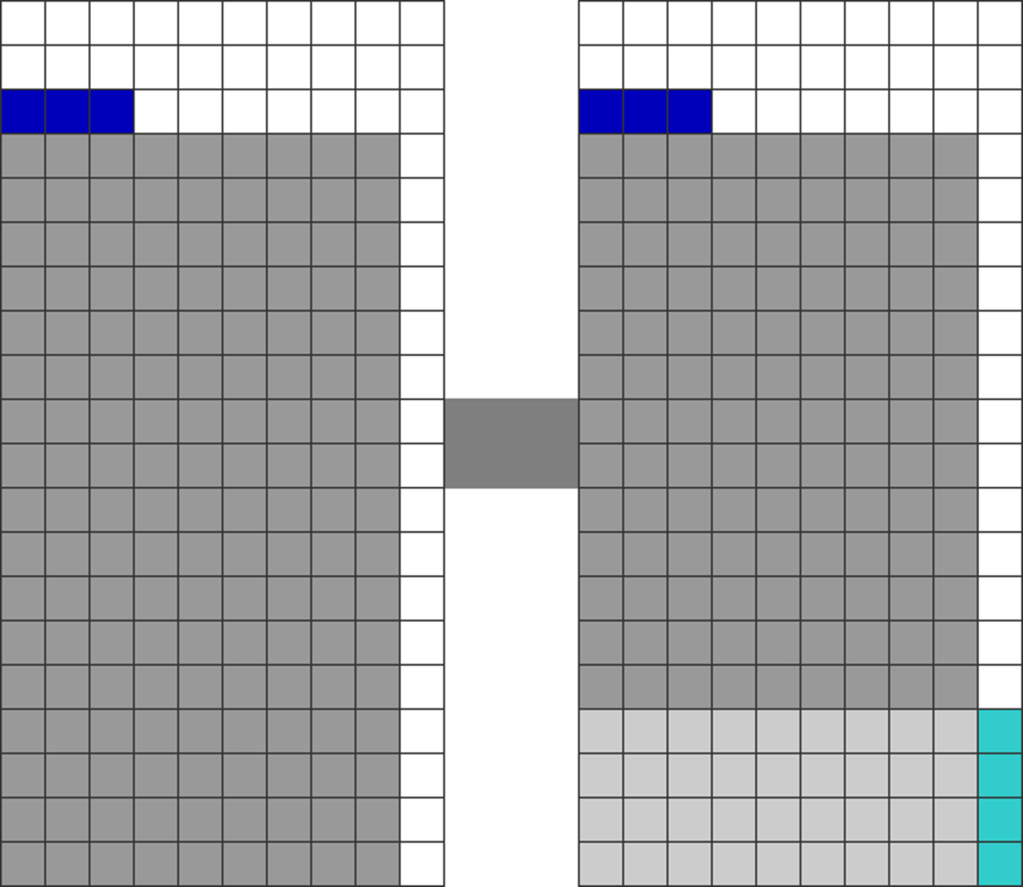
| The rightmost clean garbage line is exposed. | You then insert an I piece into it. This scores a Tetris, lowers your stack, and sends garbage lines to your opponent. |
In step 4, you send a Tetris attack, creating four garbage lines for the opponent. This lowers your stack, and you survive.
Subsequently, the garbage you sent over defeats your opponent.
If you had merely gotten frustrated and forfeited the game, you would not have seen the end of the story, where you won.
If you had forfeited the game, you would have carried forth your inexperience to the next game.
Everything that is not resolved in one’s current Tetris game is carried forth to the next, until one learns from their mistakes and transcends them.
It is impossible to ‘perish’ permanently in Tetris. After you top out (lose), the game simply brings you over to the next match until you have learned from your flaws.
This is true of life as well: because you cannot cease to exist, your problems will continue until you resolve them and grow from them.
Personal Applications
Making the Best Use of One’s Time on Earth
NDE accounts and afterlife research report that even if you give up on life and perish physically, your soul will continue to exist.[10]
You will continue to carry unresolved traumas and negative tendencies into the afterlife or the next life until they are resolved.
Existence is eternal.
Hence, people can embrace their current lives to grow spiritually, instead of merely doomscrolling on their phones or watching endless TikTok videos or Instagram reels.
The Ancient Stoics’ Answer
The ancient Stoics, such as Epictetus and Marcus Aurelius, share the same general conviction:
You cannot change your external circumstances.
Whether Mount Vesuvius will erupt and bury Pompeii under ash is beyond human control.
Whether the Tōhoku earthquake and tsunami would awaken and strike Japan with a massive flood is beyond even the best Japanese geologists to predict or the best structural engineers to fix.
However, the Stoics had a solution: instead of brooding over these adversities, we use them as an invitation to spiritual growth and expansion.
When we encounter adversity, we experience pain.
Pain is twofold: the initial pain of the problem, and the depression that comes after when we attach ourselves to the problem.
The former cannot be changed, but the latter, regarding how you react and manage the consequences, can be. If you cling to pain and resist it further, the second wave of pain will endure until you cease.
You can see adversity as an opportunity to grow and broaden your spiritual perspective.
Hence, you will only endure the first wave of pain and minimize the second one. In turn, you can grow in wisdom from overcoming the pain or misfortune.
A Personal Example
My master’s degree at Nanyang Technological University (NTU) focused on existential sociology.
It applies existential philosophy, drawing on the works of Jean-Paul Sartre, Albert Camus, and Martin Heidegger, to understand people going through cancer.
In my studies, I realized that people who were first diagnosed with cancer were shaken and paralyzed by denial.
However, they often enter common spaces, such as forums, where cancer patients at various stages gather.
Former patients who have conquered cancer (been cured and psychologically well) often serve as mentors to reframe these new cancer patients.
They guide them through the treatment process. And in the process, many take on new challenges, such as scaling Mount Kilimanjaro.
The outcome was that many saw their cancer as an opportunity to explore areas they had never explored.
One successful businesswoman would then open up to relationships and a newfound hobby in art. After she had cured her cancer, she would realize that life is beyond material pursuits.
However, there is always a darker side: some may never expand beyond their grooves, instead succumbing to unending depression.
Between surrendering to depression and reigniting hope, many patients ultimately chose the latter and prioritized growth.
The Absurdity of Human Life
Existential absurdity is a term that I am very familiar with, because it was one of my sub-specializations for my master’s degree.
In layperson’s terms, it means the clash between our deep human desire to find a clear purpose in life and the cold, silent universe that gives us no answers.
Occasionally, the cosmos may beset us with uncontrollable life circumstances that obstruct our ability to self-actualize or find happiness.
In Tetris, this is demonstrated by how the garbage line patterns that one receives are almost totally governed by randomness, as shown here:
| Diagram Set 1-3 | |
| A | B |

| Garbage lines are perfectly aligned and “clean.” | Garbage lines do not align at all and are, hence, “dirty.” |
If you are fortunate enough, the empty holes align as a single line, and you can easily use an I piece to clean it up:
| Diagram Set 1-4 | |
| 1 | 2 |

| A clean garbage line. | You can insert a single I piece into it, clearing 4 rows quickly. |
If not, you may get a clustered and unpredictable amount that impedes your ability to dig through them, expending many placements:
| Diagram Set 1-5 | |
| 1 | 2 |

| A very dirty garbage pattern. | The player tries to dig through it using a starting J piece to clear 1 row. |
| 3 | 4 |

| The resultant field. The player has not dug down to the bottom yet! | So he digs again with the Z piece, clearing 1 more row. |
| 5 |

| The resultant field. The player has still not reached the bottom! |
This is upsetting. But that is how Tetris is. You have almost no control over many “good” or “bad” situations. Existence just is, and one cannot change these situations. You just have to deal with them, like in real life.
However, as you get more proficient in Tetris, you will have more chances to turn these negative episodes into opportunities.
The following example shows a player facing a terrible situation after misplacing the L piece, which covers a hole. This blockage makes it hard to dig in.
However, he spots an opportunity to create an offensive method called a Tetris.
A Tetris is just a mighty attack. It is the most basic attack in modern Tetris.
It involves creating a 4-block-tall rectangle in the steps below (steps 2 to 3). One then inserts an I piece into it to clear four rows and send an attack to the opponent:
| Diagram Set 1-6 | |
| 1 | 2 |
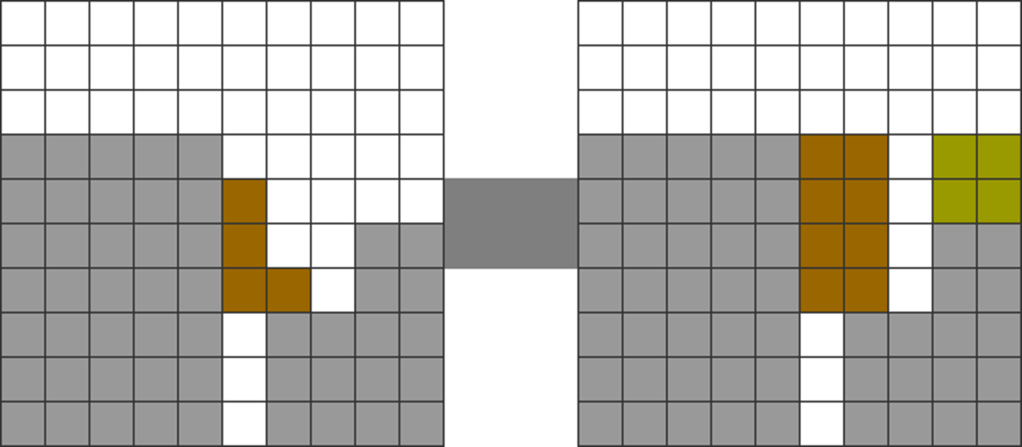
| The player places the L piece incorrectly. It blocks the central hole in column 6. This prevents the player from digging further downwards. | But the player does not panic. He places the subsequent L and O pieces like this. This forms a perfect 4-block-tall rectangle. |
| 3 | 4 |

| He inserts an I piece into the vertical column in column 8, scoring a Tetris. This clears 4 rows. | After the mighty Tetris, the central hole is exposed. The player can now freely dig down through the hole. |
Not so threatening, right?
Now, your main Tetris education is complete, and you can dominate opponents with the mighty Tetris attack method!
Here, I turned a mistake into a Tetris opportunity. This generates massive garbage output to attack my opponent.
Similarly, in real life, this means the absurdities we encounter can sometimes become opportunities.
I suffer from a mild form of obsessive-compulsive disorder (OCD).
I sometimes have to check whether I have locked a door up to twenty or more times, avoiding “bad” numbers such as four (representing death) or five (representing fire) in Chinese.
Other times, I am terrified whenever I go to a resort in a tropical country, for fear of seeing lizard poop on the walls. I constantly catastrophize, fearing I might see one when I change hotels while traveling to a new location.
However, it turned out that my OCD was a superpower on its own that I never realized. It gave me the infinite patience to edit my authored books word-for-word many times.
What was a case of hypervigilance ironically became a power I could draw on to ensure high editorial standards in my books.
The key is to not outright label an event as a “fortune” or “misfortune.” Fortunes may, ironically, turn into misfortunes, and vice versa, and we simply have to accept the flow of reality rather than resist it.
Social and Global Applications
What applies personally also applies on a larger, societal scale.
Seeing Social Problems as Opportunity
The world already exists as it is — a roiling, turbulent landscape filled with wars, conflicts, intense competition, chaos, and strife.
Just as the mind cannot stop a bullet gushing at you, we do not possess the power of telepathy that can change the world at large.
One may wonder why we chose to incarnate in this world. It is to experience duality on a large scale, such as the manifestation of our inner darkness or light.
We cannot change the external world. However, we can always change how we respond.
For instance, when we see, on the news, a tragic image of the war that is continuing in the Middle East, such as Gaza, we will naturally be saddened.
However, this gives social activists opportunities to campaign against similar tragedies, save people, and stop suffering. New United Nations policies may form to avert such future wars.
Even so, without darkness on the larger scale, there would be no opportunities for souls to choose and outgrow the darkness.
Concrete Examples in Social Housing and Architecture
I provide several concrete examples to illustrate large-scale applications of this law:
Example 1:
After World War II, most of Europe was in ruins because of Nazi Germany’s invasion.
Many cities, such as Berlin, were severely damaged or nearly decimated. Labor and construction materials were also scarce, making it hard to rebuild these cultural centers.
Before the war, many cities, such as London and Paris, took great pride in artisanal designs. Their manors and homes often featured neoclassical pillars, bas-relief, and elaborate architraves.
However, after the war, many war-torn nations could not afford such luxury.
As a result, Modernist and Brutalist architecture emerged. Architects working in the tradition of Ludwig Mies van der Rohe and Walter Gropius led the movement.
Their architectural design emphasized modern, inexpensive materials such as glass, cement, reinforced concrete, plastic, and steel.
Their designs also focused on minimalist elements. They removed walls to create an open concept, such as fusing the kitchen with the living room.
They maintained that “form followed function,” and that ornate designs should only follow when the building’s core function had been served.
As a result, many Brutalist and Modernist buildings took on simple oblong and squarish forms, without elaborate neoclassical designs or pillars.
The result was highly practical: mass housing became affordable, easing Europe’s housing crisis.
While the tragedy of World War II can never be reversed, it has created new problems and given humanity a chance to fix them.
Example 2:
When I was at Clarke Quay Central Mall in Singapore in 2025, I saw the exhibits of the National University of Singapore (NUS) architecture faculty.
Many honors thesis projects were on display. However, one of them caught my attention.
It was a project to design a building to house hikikomoris in Japan.
Hikikomoris are Japanese social recluses who live in isolation at home for years, without ever leaving, as a stressful reaction to Japanese corporate and nomikai (compulsory after-work socializing) culture.
The project designed simple cubicles with shared common spaces that pedestrians had to go through.
It also included shared facilities that encouraged interaction, such as desks and work areas.
The design also ensured maximum natural sunlight and air circulation to ventilate the area, creating a humanistic environment.
This project encouraged hikikomoris to interact and break their self-imposed isolation, integrating them into the community.
Hikikomoris are here to stay, and we cannot reverse it.
However, their presence opens new opportunities for architects to step in and solve the problem.
Conclusion
Ultimately, while we may live on a difficult planet, these challenges create opportunities for others to solve them.
In doing so, we can grow spiritually.
[1] Alan Watts, The Way of Zen (1957). Watts argued that existence is fundamentally experiential.
[2] Deepak Chopra, The Seven Spiritual Laws of Success (1994); see also his broader body of work on consciousness and non-duality.
[3] Ramana Maharshi, Who Am I? (1902). Maharshi defines the cosmic self as pure, non-dual reality (Sat-Chit-Ananda), where the individual ego dissolves into universal consciousness.
[4] Adi Shankaracharya, Vivekachudamani (8th century). Shankaracharya establishes Atman (pure consciousness) as the primary reality, with the material world as Maya.
[5] Chris Langan, Cognitive-Theoretic Model of the Universe (2002).
[6] Helena Blavatsky, The Key to Theosophy (1889); and Thich Nhat Hanh, Interbeing (1987). Both describe the lifting of illusion to perceive underlying cosmic unity through spiritual practice.
[7] Swami Vivekananda, Jnana Yoga (1902). Vivekananda argues that realizing the unity of all existence dissolves the ego-driven separateness responsible for human conflict.
[8] For further reading, see Victor Zammit, A Lawyer Presents the Case for the Afterlife; Raymond Moody, Life After Life; Michael Newton, Journey of Souls; Dolores Cannon, Between Death and Life; Walter Semkiw, Return of the Revolutionaries.
[9] Pamela Rae Heath and Jon Klimo, Suicide: What Really Happens in the Afterlife? (2006).
[10] For firsthand near-death experience accounts, see the following YouTube channels: The Other Side NDE; NDE Accounts — Afterlife Stories; Coming Home; NDE Journey. These channels compile hundreds of NDE testimonies that corroborate the afterlife research cited throughout this book.

