“We see the world not as it is, but as we are.”
—Anaïs Nin
Introduction
The breadth of one’s perspective reflects and is reflected by the collective consciousness of the entire planet.
We now come full circle by merging the laws of cause and effect, connectivity, and manifestation with the next law: the law of perspective.
It is the idea that one’s degree of conscious development affects many of one’s actions.
Ken Wilber’s seminal studies on the evolution of consciousness parallel this idea. Even in many psychological theories, such as those of Susan Cook-Greuter and Loevinger, this has been reflected. The same goes for channelled spiritual teachings, such as the Michael Teachings.
I condense these revelations into six stages of conscious development. There are no “better” or “worse” stages—every soul goes through them in the same manner that a bud grows into a mighty oak tree.
A soul is “succeeding” just by manifesting the positive aspects of each stage and learning from it. The focus is on the present, on growth, and not on comparisons.
Soul evolution begins when the One fragments itself into individual souls. Each soul incarnates on Earth and goes through six stages of spiritual growth, becoming more broad-minded with each stage.
This growth model may not apply to other planets, dimensions, or universes where the laws of biology, psychology, and physics differ.
The underlying mechanism that underlies each stage’s growth comes from the synergy between a soul’s (i) perspective and (ii) the means to apply that perspective into action. Only when perspective and action are united can a soul firmly establish itself in a current stage.
Tetris as an Analogy
I illustrate each spiritual stage in parallel using real-life and Tetris examples.
The Early Beginner Stage
Souls begin with a highly narrow-minded, egoistic perspective. They operate primarily by instinct and experience their separation as self versus the non-self.
In this stage, the soul focuses on survival needs, a characteristic of very few primitive and isolated tribes on this planet. About 2% of the world’s population functions at this stage.
A soul at this stage is governed by instinct, and morality operates based on the immediate benefits and gratifications to the self.
Their worldview is confined mainly to the self (being solitary in a cave) or one’s immediate family.
In the positive manifestation of this spiritual stage, the soul learns independence and specific skills required for later stages. In the negative aspect, the soul may manifest extreme fear and prejudice towards others, often resulting in violence.
This perspective manifests, per the law of perspectives, as simple tribal communes that hunt, forage, and perform simple rituals.
It can sometimes be perilous, as the soul may perceive non-selves or non-family members as enemies. This results in actions such as skirmishes and the killing of other families, clans, or tribes.
In Tetris, I illustrate this with the following diagram set.When one first learns Tetris, one’s perspective is narrow, focusing on the most immediate muscle-memory-related moves:
| Diagram Set 10-1 | |
| 1 | 2 |
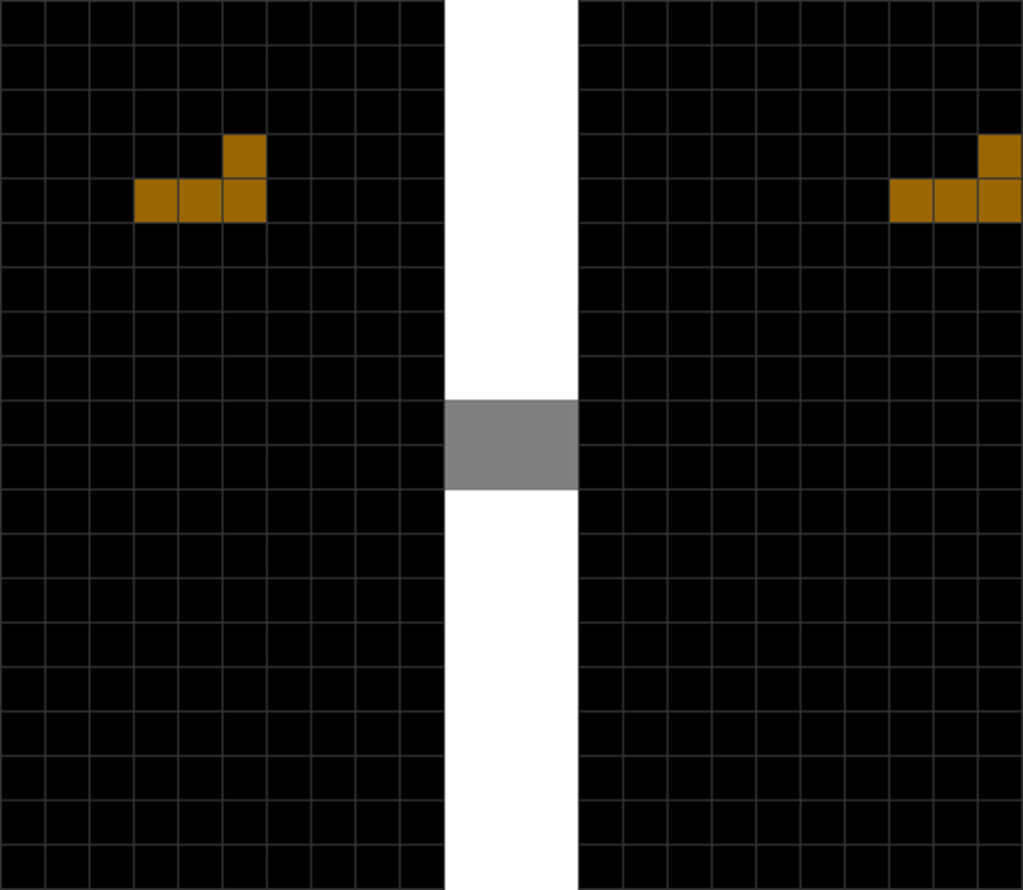
| L spawns in its default location. | The player holds down “move right” for a while. The L piece rushes to the right. |
| 3 |
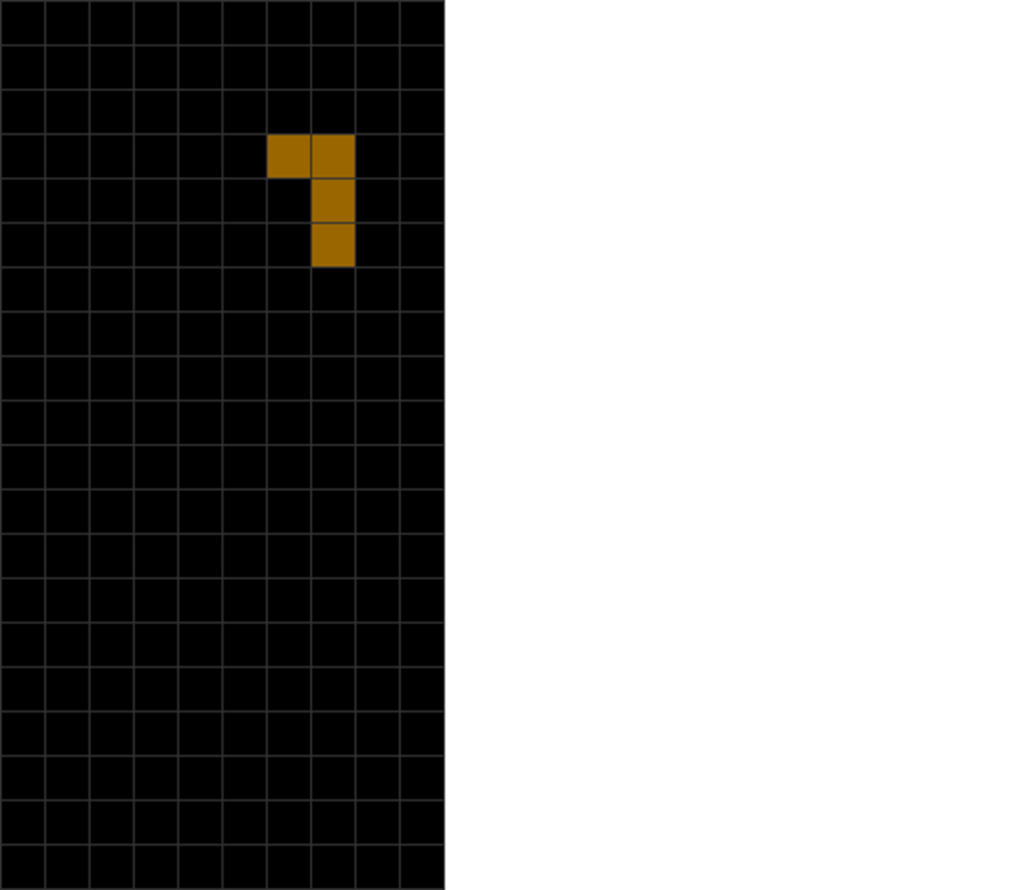
| The player presses rotate and “move left” simultaneously. The L kicks off the wall and reaches its intended position. |
The above features 2-step finesse, a movement scheme that minimizes finger presses to place each piece optimally at its desired location.
When one first plays Tetris, one’s worldview is focused entirely on the lower-level aspects of cultivating muscle memory to play the game. High-level strategizing is not possible yet.
Additionally, many Tetris beginners are often focused on survival in their first versus matches. They are unable to create offensive abilities to attack the opponent.
The Late Beginner Stage
In the next stage, a soul enlarges their perspective from beyond the self and immediate family to the broader community.
The soul focuses on order and structure, sometimes adhering staunchly to their societal or religious order.
Such souls often inhabit rural or suburban parts of developed countries. However, in countries with deeply rooted religious traditions, they can be prominent. About 18% of the world operates at this stage.
They often operate according to conventional morality, using simplistic concepts or dichotomies of right versus wrong. Their moral worldview tends to be black-and-white.
In the positive manifestation, the soul can become a model citizen or use its adherence to structure to achieve vital societal feats.
In the negative pole, the soul manifests bigotry, racism, prejudice, or ostracism towards other groups. They may impose their beliefs on others and not accept others for who they are.
This spiritual stage can manifest, per the law of perspective, in many ways at the societal level.
For instance, if a people adheres strictly to order and structure, demanding strict adherence to fundamentalist dogmas, their social system would parallel that. This was the case in the fifteenth century, during the Spanish Inquisition and the age of expansion.
Many Spanish explorers firmly believed that the word of Christ was the only way, and they sought to spread their teachings to every civilization they encountered.
Those who did not adhere to such were burned or erased, such as the Aztecs, Mayans, and Incas.
This dogmatic mindset persisted throughout much of Europe, where many who dared offer a more expansive worldview were burned, imprisoned, persecuted, or excommunicated.
This was the tragic case of people such as Giordano Bruno, Galileo Galilei, and Meister Eckhart.
In Tetris, from my observation, many late beginner players often harbor a form of arrogance.
They fall into what psychologists call the Dunning-Kruger effect, where they believe their abilities are far higher than they actually are. Therefore, many players fall into conceit, thinking that that is all to Tetris.
Even more conspicuous is that many Tetris players fall into extreme adherence to dogma. They genuinely believe in simple rules that, if followed, will make them rise to the ranks of the elites.
For instance, in my early days, I was often bombarded with Tetris dogmas, such as the idea that one should never waste a T piece in the stack, as it reduces efficiency.
I mindlessly adhered to such, which led to a catastrophe, as T pieces are needed to flatten jagged areas. Not doing so leads to overstacking. The following shows this:
| Diagram Set 10-2 | |
| 1 | 2 |
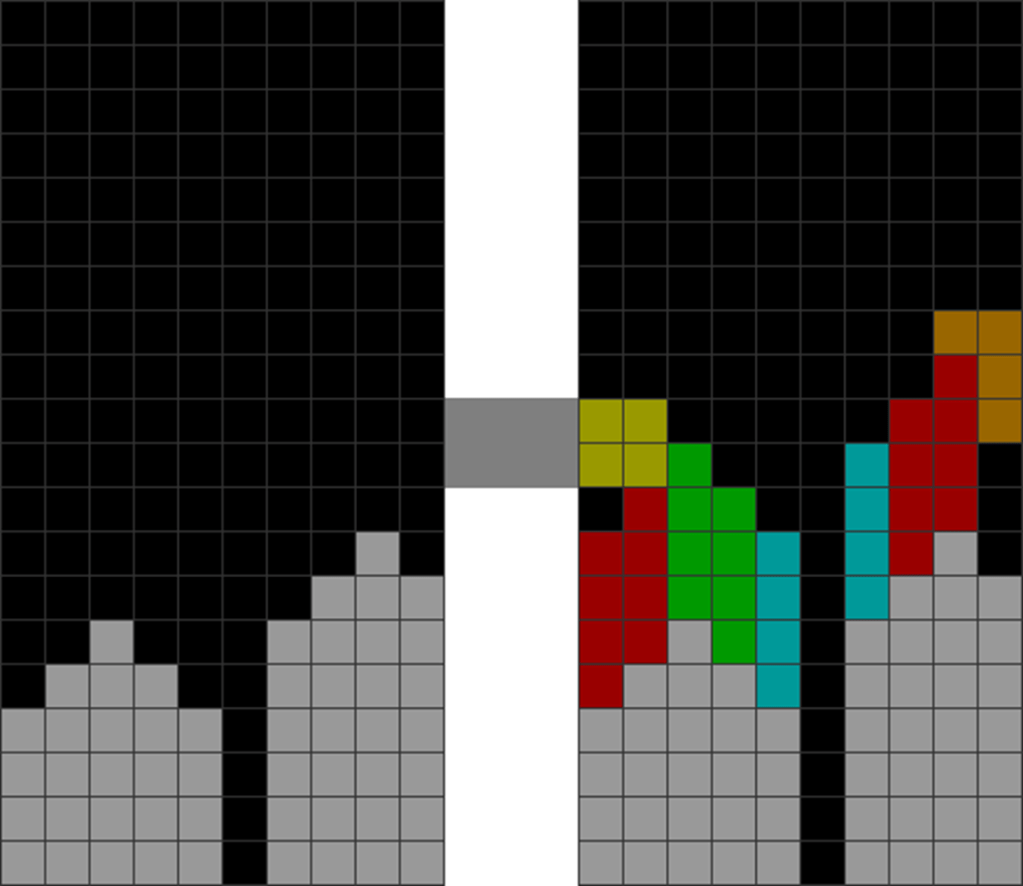
| This field is parity-imbalanced and jagged. It needs Ts to flatten the jagged parts. | This causes only vertical S, Z, and I pieces to be placed. Flatter placed O and L pieces will cover the holes. |
Here, the player does not put Ts in the stack to even out the jagged areas in step 1. This leads to the disaster in step 2.
Dogmatism and arrogance run high in this stage, where people truly believe there are only fixed, universal rules to play Tetris.
The Intermediate Stage
The leap in consciousness occurred when many European societies entered the next soul age.
It was when many people no longer subscribed to rigid dogmas and instead realized that one could aspire to be anything. They started questioning the rules, leading to the formation of new social and technological systems that benefited humanity.
This characterizes the next spiritual stage, which is achievement-oriented. Souls at this level have their perspectives enlarged to that of the nation or their respective corporation or organization.
About 35% of the world functions at this stage, and it is almost the dominant expression of the current planetary consciousness. China, the United States, and Japan manifest this stage.
They desire to win and dominate the world. They aspire to master the physical and alter the world. However, they rarely look within and can be psychologically empty inside.
Their morality is based on social contracts, mutual benefit, and instrumentalism.
In the positive manifestation, souls can achieve monumental technological and societal feats. One can imagine the impact of souls, such as the Roman Empire’s Julius Caesar or Tesla’s Elon Musk, who operate from this perspective.
On the negative side, souls can resort to Machiavellian methods to achieve whatever they want, sometimes through crime. This is evident in people like Al Capone or Bernie Madoff. They can act with little regard for others to accumulate vast amounts of wealth. They then become so identified with them that they fail to look within.
Societies that manifest this soul stage can achieve levels of material, scientific, and technological wealth that confer vast benefits to humanity.
Think of the development in advanced chips, AI, robotics, energy, and automation in powerful countries such as China and the United States.
However, on the negative side, this can manifest as uncaring, zealous exploitation of the world’s resources and people. This leads to extreme inequality and hardships for the lower rungs of society. Humanity is undergoing the throes of late-stage capitalism.
The following showcases this spiritual stage, using Tetris as an analogy. In this Tetris developmental stage, the player has mastered basic muscle memory and can move on to the core fundamentals:
| Diagram Set 10-3 | |
| A | B |
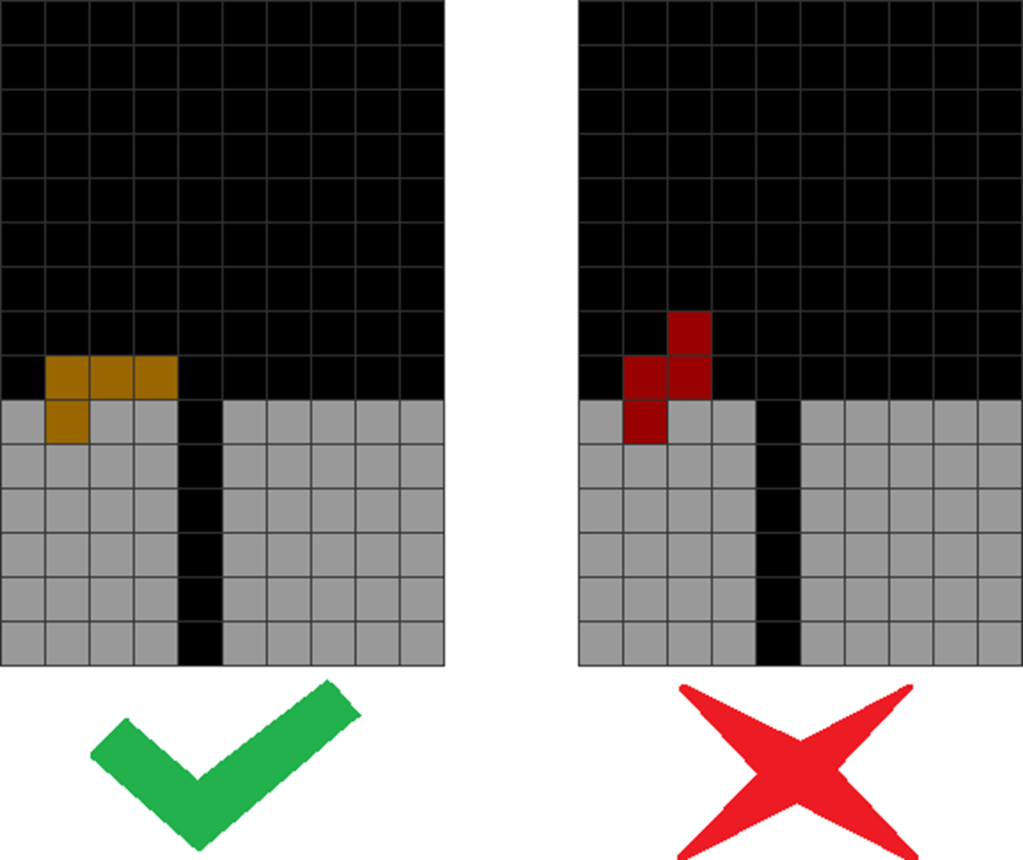
| This is a field-harmonized pattern, as the L placement makes the field flat. | This is not field-harmonized, as the Z placement makes the field jagged. |
The above illustrates the principle of field harmony, which states that some pieces combine better to form a more cohesive aftermath shape. This aftermath shape leads to safer and more consistent stacking and downstacking.
| Diagram Set 10-4 | |
| 1 | 2 |

| The field is parity-imbalanced (jagged). | He inserts a T in the cavity, which flattens the field and makes stacking easier. |
The above shows the principle of parity management, where jagged areas are flattened by placing T pieces in the latter.
Understanding these two core fundamentals streamlines many thought processes and elevates one to an intermediate player. Win rates start to increase exponentially.
In this stage, per my observation of intermediate Tetris players, many may fall into elitism, reveling in their newfound abilities and power.
They may succumb to arrogance, believing that there is only one way to play Tetris: to win. They do not like to lose.
The entire ego complex around this level revolves around getting an outstanding 40-line sprint time, ultra score, or one’s rating or level in games like Puyo Puyo Tetris, Tetris 99, and TETR.IO.
Many players have a narrow-minded view of Tetris. They can impose their worldviews on others, disparaging people who are less skilled than they are.
It is an entirely achievement-oriented stage of Tetris development.
The Early Advanced Stage
Currently, the world is undergoing a seismic shift to the next collective spiritual stage.
In this stage, emotions, inner expression, internal soul seeking, relations, and community become the core focus of one’s life.
People at this stage enlarge their perspectives to a transnational or even global level in the later sub-stages of this development.
Morality at this stage is based on trust, harmony, and reciprocity. It transcends ego for the first time, where souls see each other not as worldly traits or achievements, but as souls.
About 34% of the world is at this level of perspective. Because of planetary shifts, this level has recently matched the number of souls in the previous spiritual stage. Britain, Germany, and Finland manifest this stage.
Souls at this level often lead affluent, urban, cosmopolitan lifestyles in central cities. They may be found in the higher ranks of academia, the corporate world, politics, or science.
At this stage, something incredible happens: the soul turns inwards for the first time, culminating in many deep philosophical and spiritual developments. The works of Dostoevsky, Leo Tolstoy, Henry David Thoreau, David Foster Wallace, and Hermann Hesse reflect this tumultuous stage.
When a soul here manifests at the positive axis, they are genuine, kind, altruistic, loving, empathic, and radiate joy. However, a soul manifesting negatively can become dramatic, overly attached to people, groups, or outcomes, or caught in many emotional maelstroms.
People at this stage find it difficult to let others be themselves. Still, they paradoxically can embrace and tolerate many different views. It becomes the first tier that embraces a cosmopolitan and pluralistic social reality.
It is also the first stage, in which the ego begins to dissolve, and the self turns outward to identify with the goals of a transnational or global community beyond any earlier stage.
At the societal level, the collective expression of this stage leads to revolutions in the economic, political, and sociological systems. Countries can become highly socialist, providing universal basic income and free healthcare for all. Environmental awareness arises in this stage, leading to the adoption of clean energy.
The increased nuance in one’s perspective can be reflected in the following Tetris examples:
| Diagram Set 10-5 | |
| A | B |
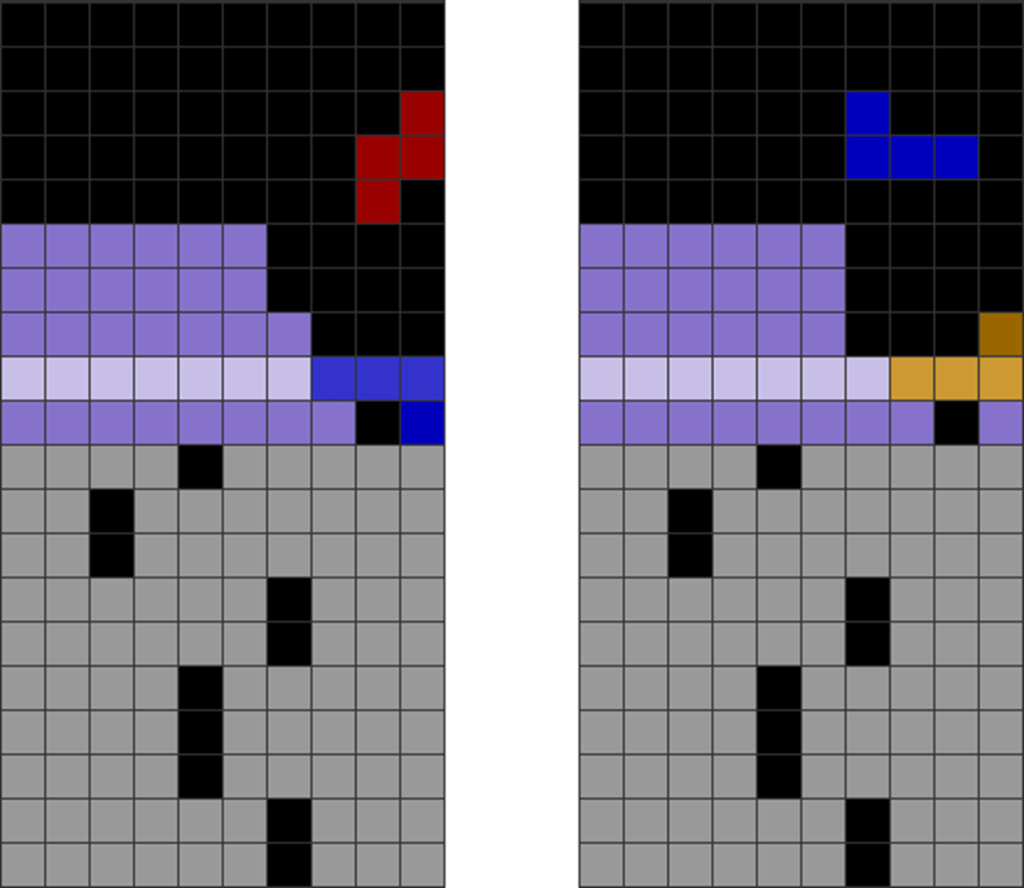
| Ways of combining specific pieces to downstack through cavities. |
The above shows how downstacking can be achieved using unusual combinations of pieces to improve efficiency.
Many intermediate Tetris players cannot see such maneuvers or read the “in-betweens” of moves.
Players at this level also begin optimizing their gameplay to spot dead-ends that they can avoid to maximize their stacking smoothness:
| Diagram Set 10-6 |
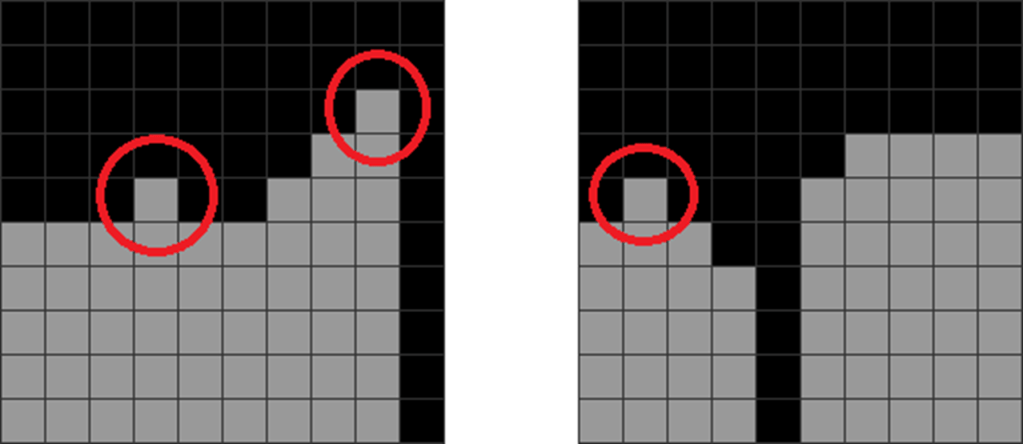
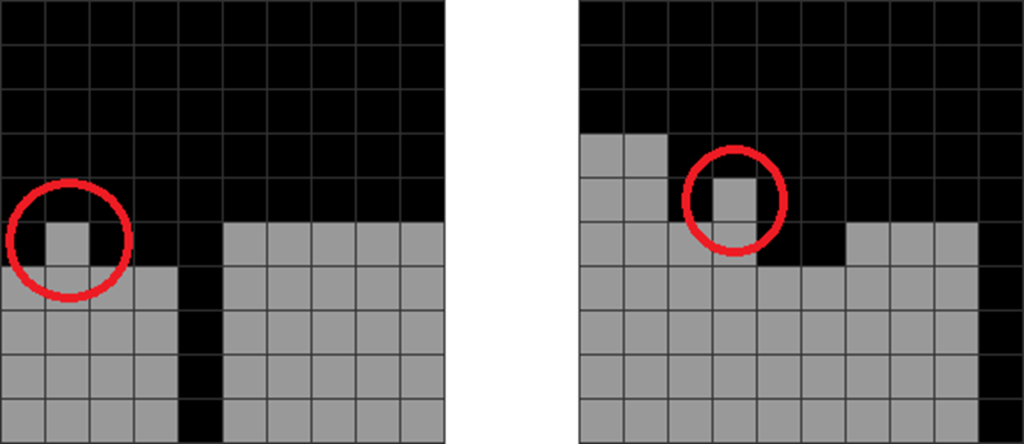

| Fields with many local parity imbalances (red circles). These are sometimes dead-end patterns. |
The above shows jagged patterns that one should minimize creating in the mid-game. They lead to poorer stacking and downstacking follow-ups.
Players also make their gameplay more efficient by following simple heuristics, like in A, and avoiding impractical ones, like in B:
| Diagram Set 10-7 | |
| A | B |
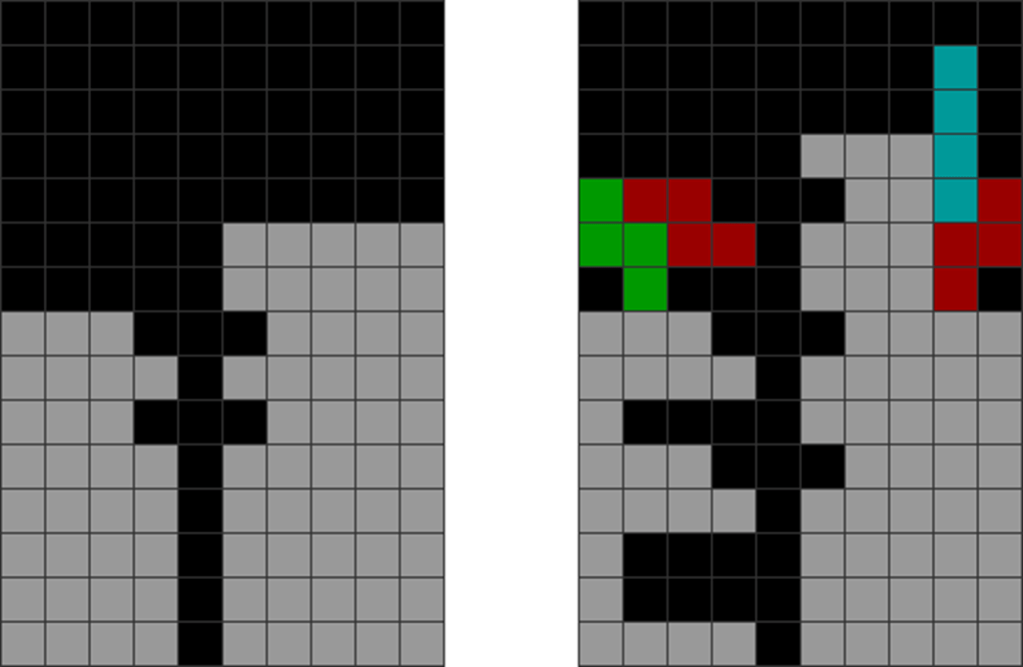
| This is a simple, compact, and efficient Fractal setup. Hence, one should use it often. | This is a dirty and loosely packed T-spin setup. One should prune excessive usage of such. |
They go for simpler, safer setups rather than extremely fancy or complex ones.
Players at this stage have already achieved many accomplishments, such as a decent 40-line sprint time and a good win-to-loss ratio.
Hence, many may start playing Tetris in unorthodox ways if they find such methods more fulfilling. They may try other, more casual Tetris games or modes, such as the secret mode. This mode involves making specific shapes out of tetrominoes and line clears like this:
| Diagram Set 10-8 | |
| A | B |
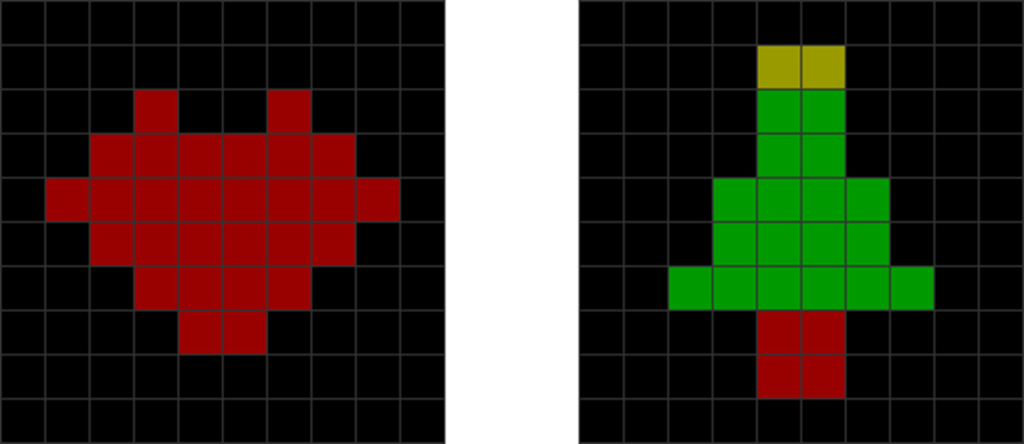
| The player creates a heart shape. | A Christmas tree. |
As shown above, secret mode involves using line clears to make any artistic shape.
To the experienced Tetris player, there is no single fixed way to play. They begin to see more varieties to seek fulfilment from the game.
Hence, many intermediate players may question the actions of such a player, wondering whether they have gone off-beat.
The Mid-Advanced Stage
At this tier, the soul, after having gained independence and empathy from the earlier stages, is now at peace with itself.
The soul continues turning inwards, but slowly detaches itself from the emotional dramas and material occupations of the earlier stages.
The soul expands its perspective, for the first time, beyond a global level to a cosmic one.
It can transcend the narrow divisions of caste, class, wealth, gender, status, ethnicity, religion, or ideology. Here, the soul expands outward, continuing one’s trans-egoic evolution.
As the soul develops, so does the diminishment of one’s ego. While a soul can still maintain a strong individual identity, it slowly comes to realize the inherent unity and interconnectedness of the entire cosmos.
Such a soul’s morality would become planetary, ecological, or galactic in scope, transcending the narrow frontiers of earlier soul stages.
About 12% of the world is at this level of perspective. They are often scattered across the globe, rarely found in established domains as high-ranking officials. Because of their renunciation of the world, they can most often be found in quieter communities. Countries that operate at this level are Iceland and the Netherlands.
In the positive expression of this soul stage, the individual can become authentic, universally loving, enlightened, and wise. In the negative variant, the soul can become withdrawn, entirely detached, isolated, reclusive, and uncaring about the world.
On a global and societal level, this collective soul stage manifests, ironically, as simplicity once more, in line with Taoist beliefs that less governance is more. The world becomes an aggregation of people, loosely grouped by interest and united firmly by the universal creed of embracing all beliefs.
In Tetris, this stage correlates with the expert level. As said earlier, the earlier stages involve learning the basics, such as muscle memory and core principles like field harmony.
In the Tetris expert stage, the player would have known how to create many specific and concrete Tetris methods. These form a base to draw forth for their higher-level strategizing. Here is an illustration:
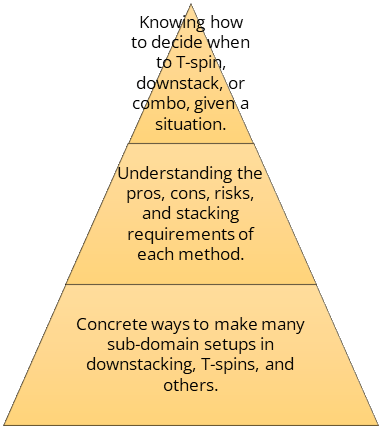
The lowest base of the above pyramid: The player now knows many specific sub-methods in all domains (like DT Cannon, C-spin, etc.), including downstacking, skimming, timing, 4-wide, T-spins, all-spins, prophecy methods, Tetrises, doubles, triples, perfect clears, openers, stacking, field harmony, and parity management, among others. This entails concrete decision-making.
The middle tier: The player understands the pros and cons of each method. He knows when to and when not to use some techniques. This entails tactical decision-making.
The top layer: Now the choice is to see a situation and decide whether to downstack, upstack, T-spin, or stall, etc. For instance, once a player has decided to make a T-spin instead of downstack, he then remembers the pyramid’s lowest tier’s knowledge and constructs specific T-spin setups. This entails strategic decision-making.
Here, the player is freed from the bonds of overthinking and excessive conscious deliberation, as seen in the earliest stage’s control finesse, the mid-tier stage’s foundational methods, and the next stage’s nuanced and specific approaches.
The player now has mastery over the entire spectrum of sub-skills. They now preside over the world like a Buddha atop a lonely mountain.
Here, the player detaches themselves from attachments, no longer seeking external or social validation of any form. They become the word of Tetris, embodying it, not because they wish to become, but simply because they just want to be.
The Late-Advanced Stage
Very few souls in the physical plane manifest the next stage, where their perspective shifts from a planetary or galactic level to a truly all-that-there-is, beyond-cosmic level.
This is a stage at which the soul begins its psychic merger with the all-there-is.
The soul begins to transcend its ego, perceiving others as oneself. When this happens, the individual sees the One in the many, and the many in the One.
Universal love becomes second nature because one is the other, and the other is oneself.
From this point on, any studies about what is at or beyond this stage are vague at most.
Ego-developmental and transpersonal psychology sometimes classify this as the post-egoic stages, indigo, or cosmic consciousness tiers of soul development.
According to channeled spiritual teachings like those of Yarbro’s, souls no longer need a physical form to spiritually grow to or beyond this stage.
Hence, the percentage of the world that manifests at this stage is almost zero percent.
When these souls manifest here, they appear as benevolent teachers, such as Jesus, Buddha, Gandhi, Socrates, or Lao Tzu. They are the One descended into a human, and a human ascended to the One.
And perhaps, in Tetris, the analogous parallel to this stage is retirement and teaching, as I am now doing.
Personal Applications
Every spiritual stage comes with traits, problems, and advantages that one can be aware of to direct one’s life.
This has been extensively covered in many ego-developmental and transpersonal psychological theories.
Ken Wilber’s, Loevinger’s, and Susan Cook-Greuter’s model covers many stages of growth through spiral dynamics.
The soul alternates between individuation and group assimilation with each stage.
The Michael Teachings also cover seven soul ages (five in the physical realm): infant, baby, young, mature, old, transcendental, and infinite.
Covering all these in depth in this book is not possible. However, I encourage the reader to read them.
Every soul, at every age or spiritual stage, has its problems. For instance, the mature soul age in the Michael Teachings may make it difficult for people to detach from emotional and social dramas. The solution is to learn to let go slowly and flow with life.
The same is true for all other spiritual stages.
Social and Global Applications
Civilization is a reflection of our collective spiritual development.
According to the models mentioned earlier, earlier stages correspond to highly organized, structured religious systems. People there may subscribe unquestioningly to dogma.
As one matures, civilization becomes achievement-based, as it is today for superpowers like China and the USA. Many technological marvels arise from them. Yet, they may suffer the malaise of modern society, such as inequality and alienation.
However, we are now moving from the old Earth into a new one based on empathy and equality. Perhaps, in the next fifty years, civilization will become socialist-based.
We cannot predict how the future will unfold. However, we are at the cusp of a new Earth. We can contribute by growing spiritually.
When enough people gain spiritual awareness, we may reach a demographic threshold for worldwide social revolution towards greater welfare.
 How to Tetris