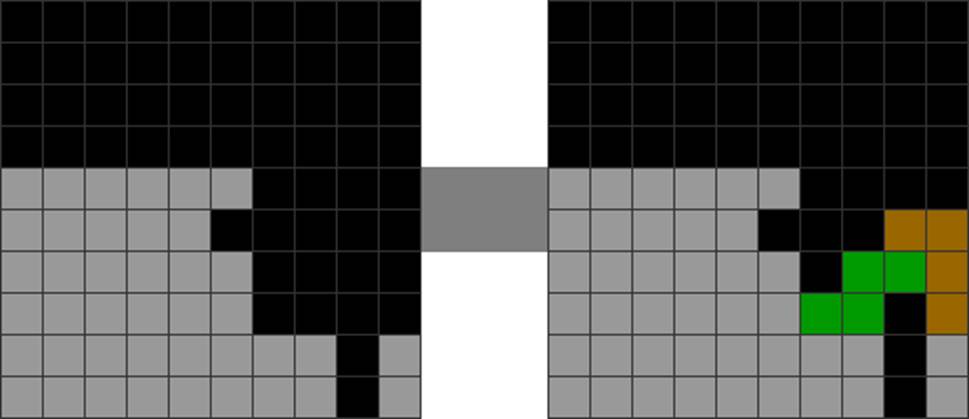
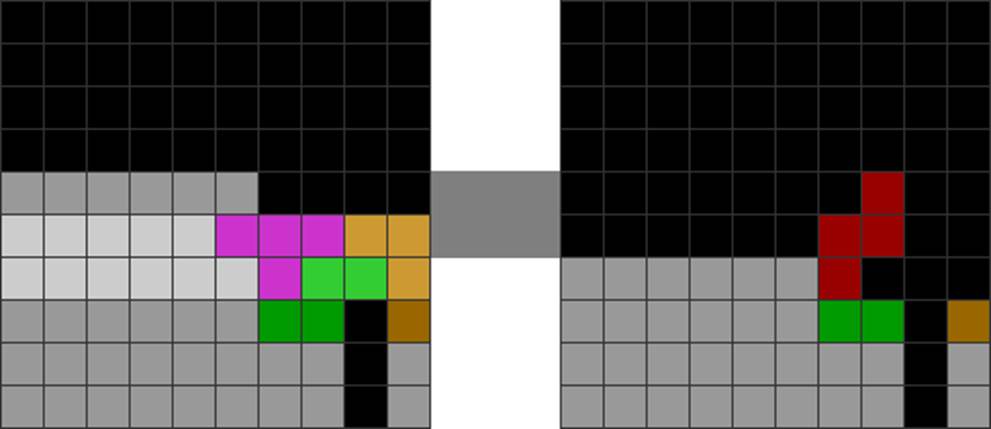
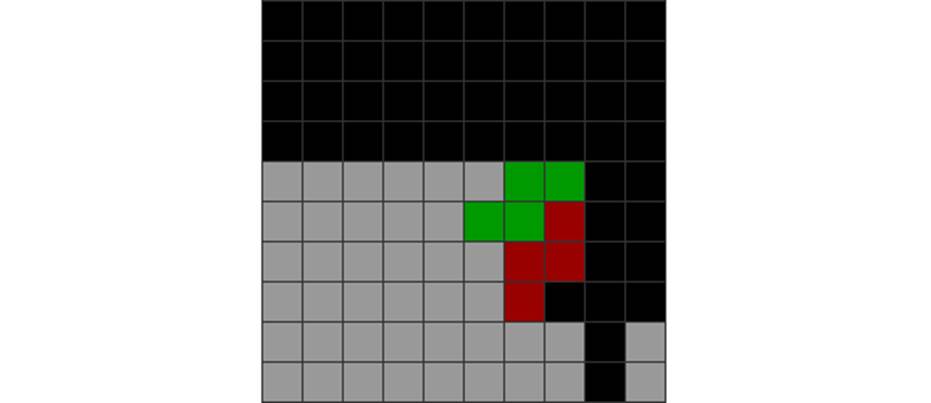
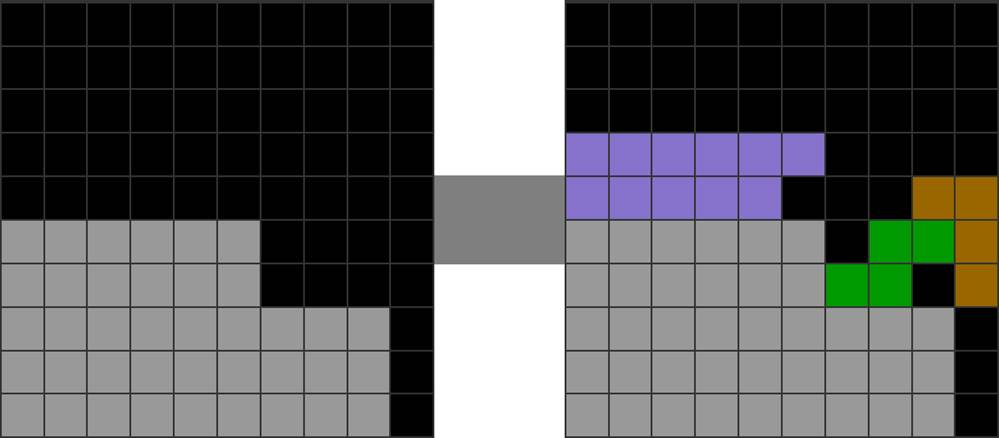
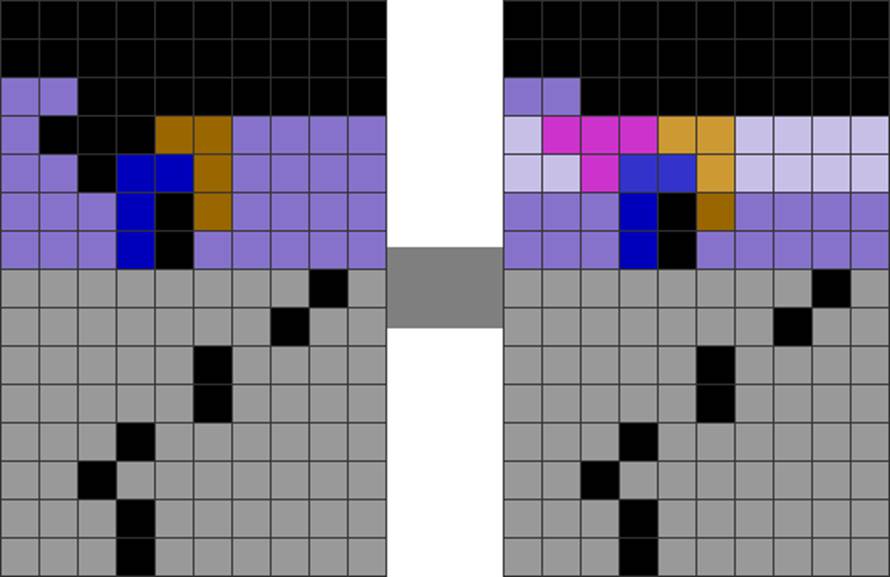
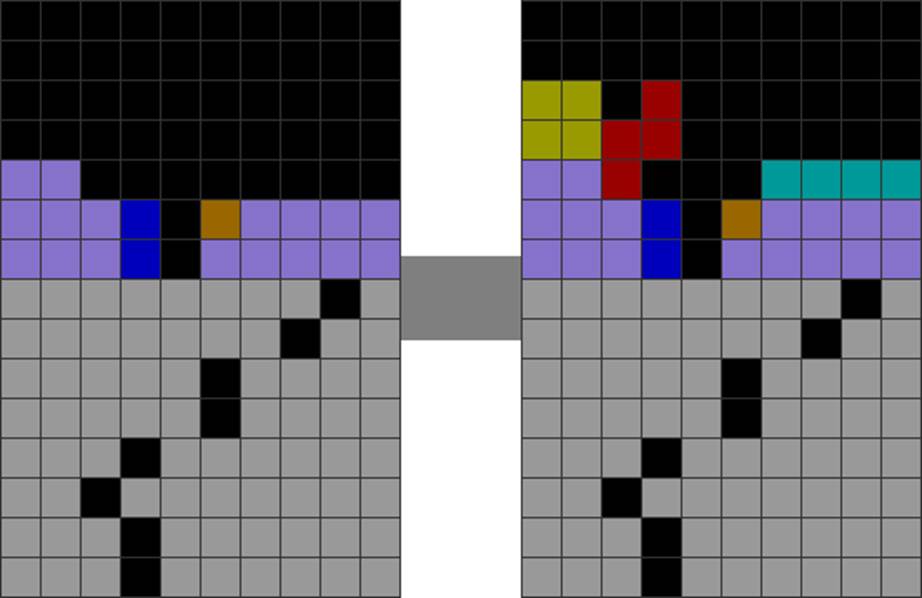
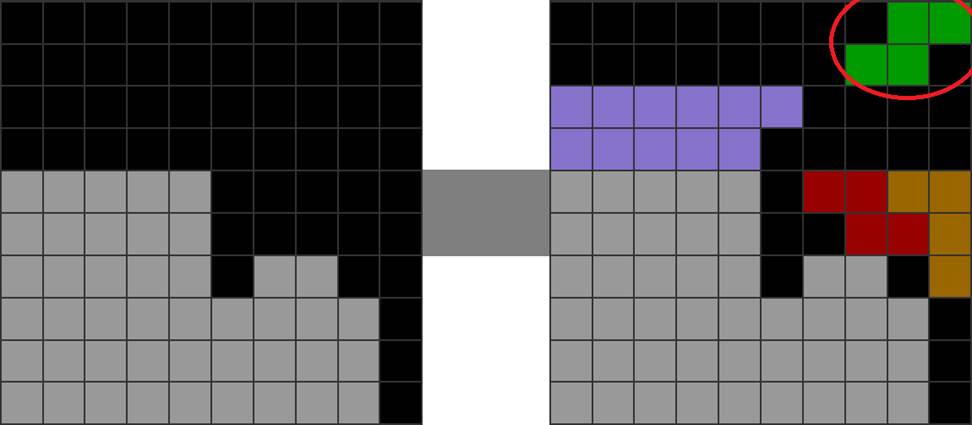
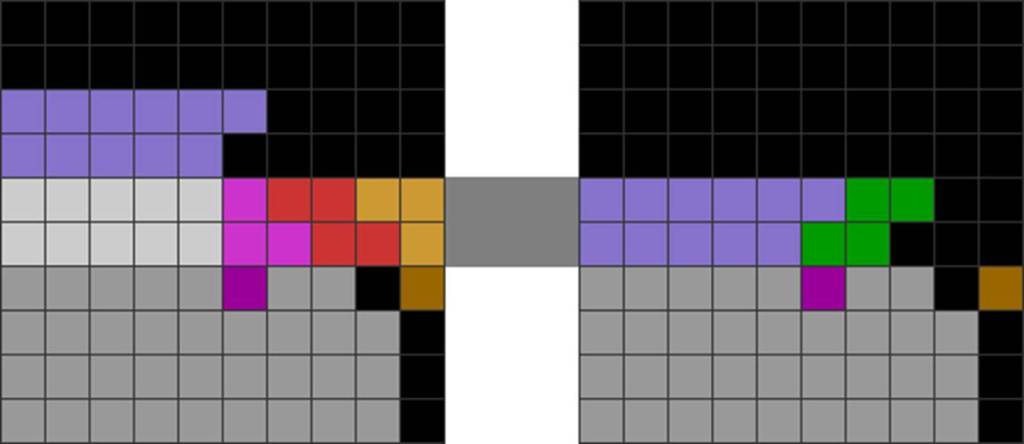
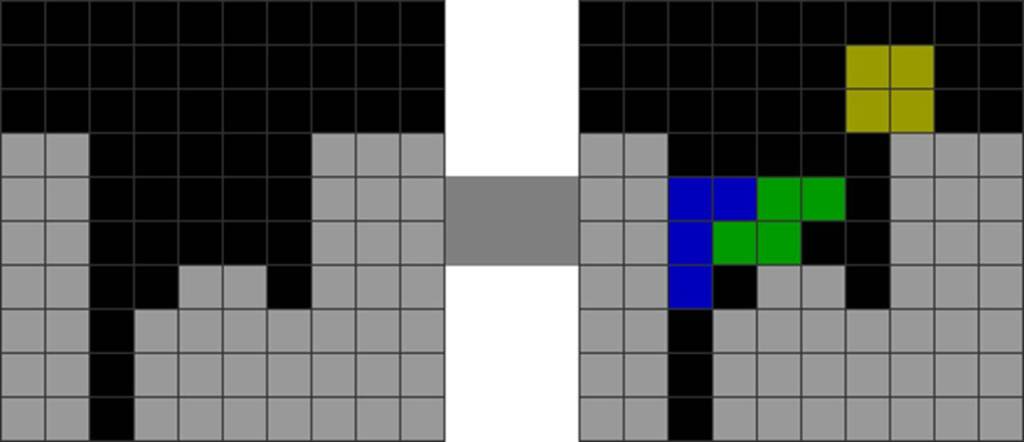
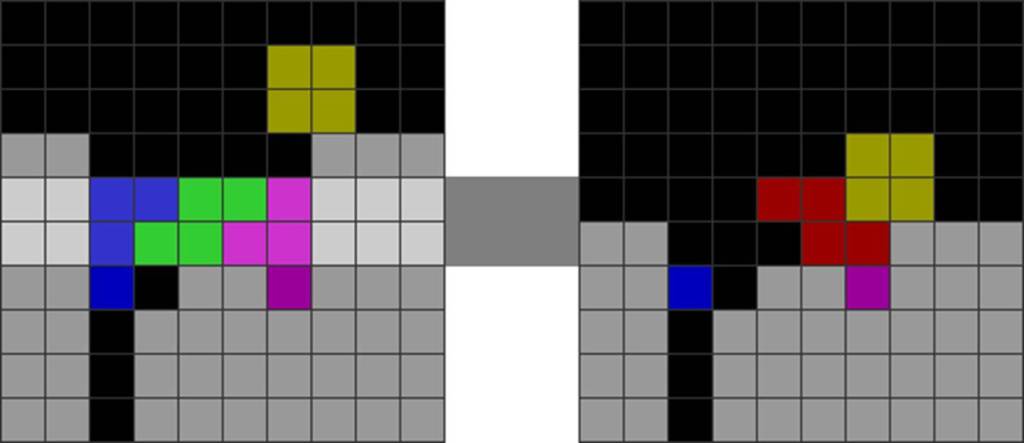
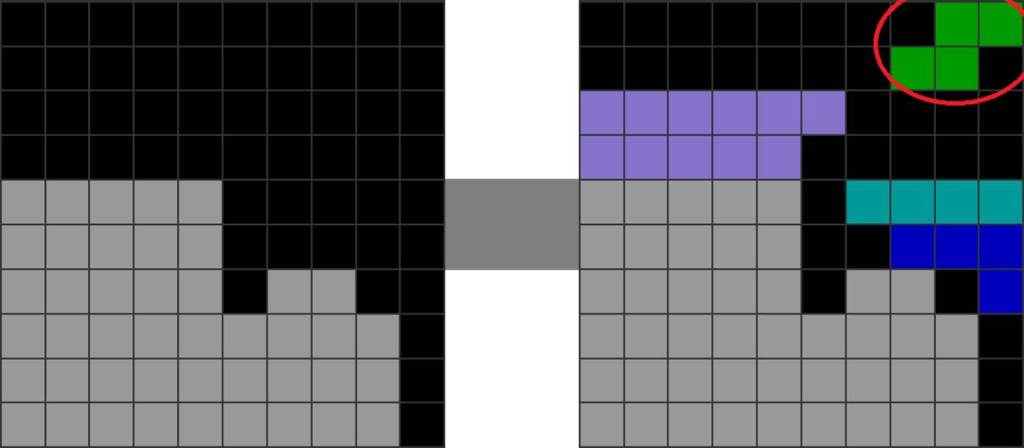
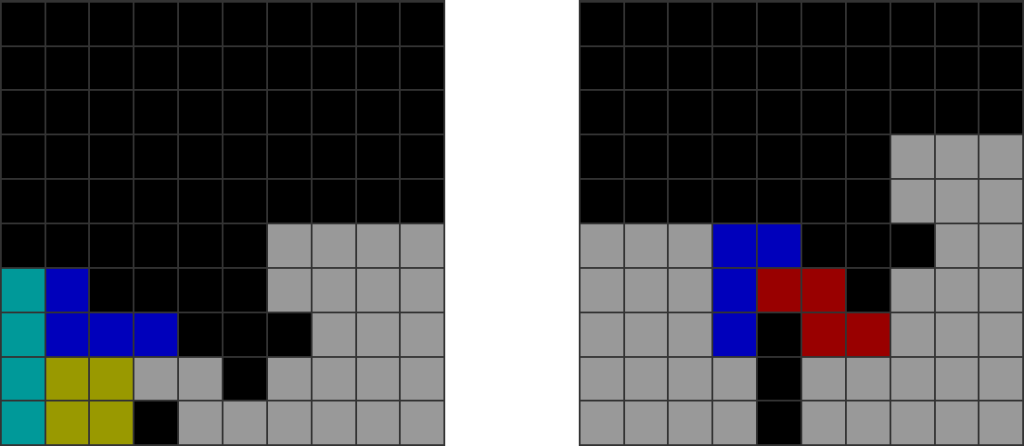
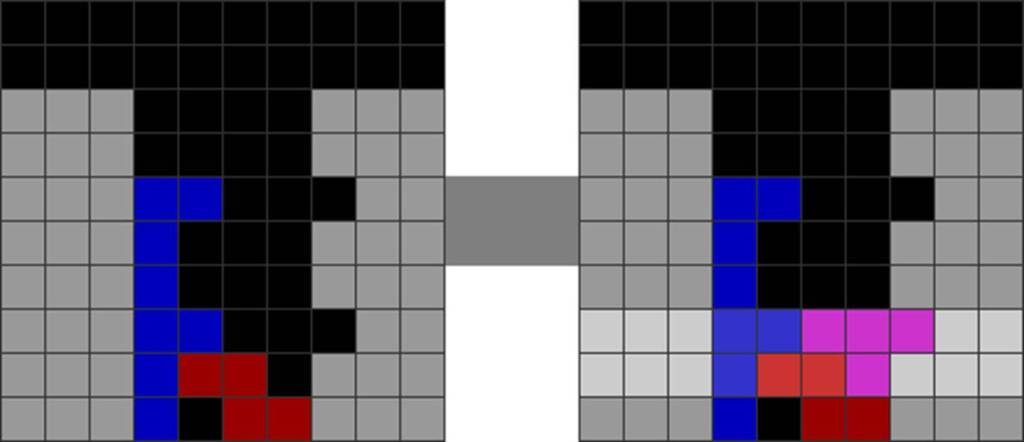
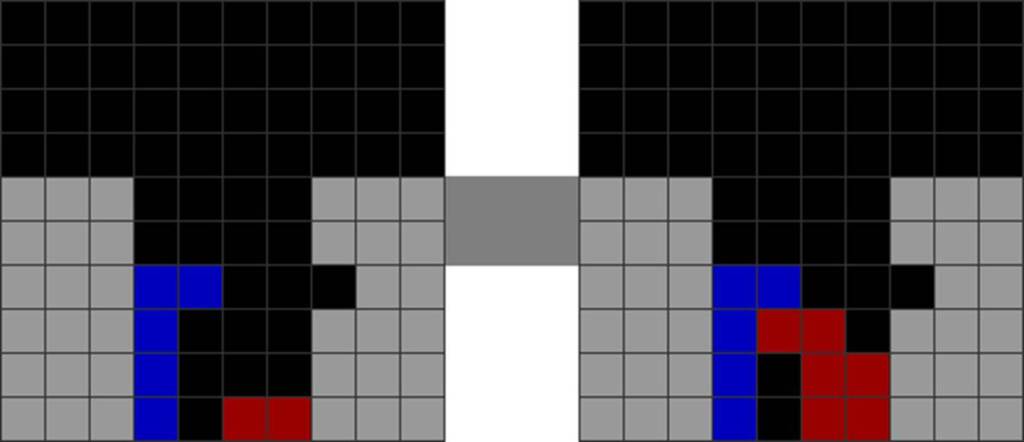
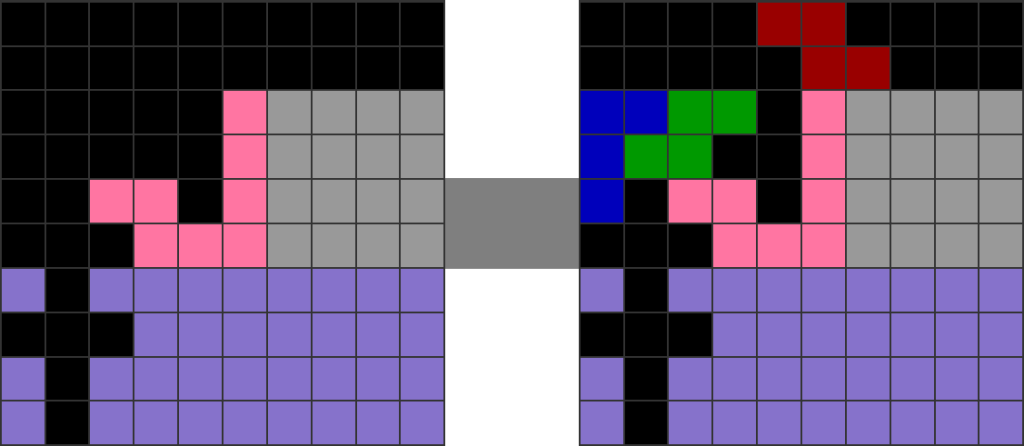
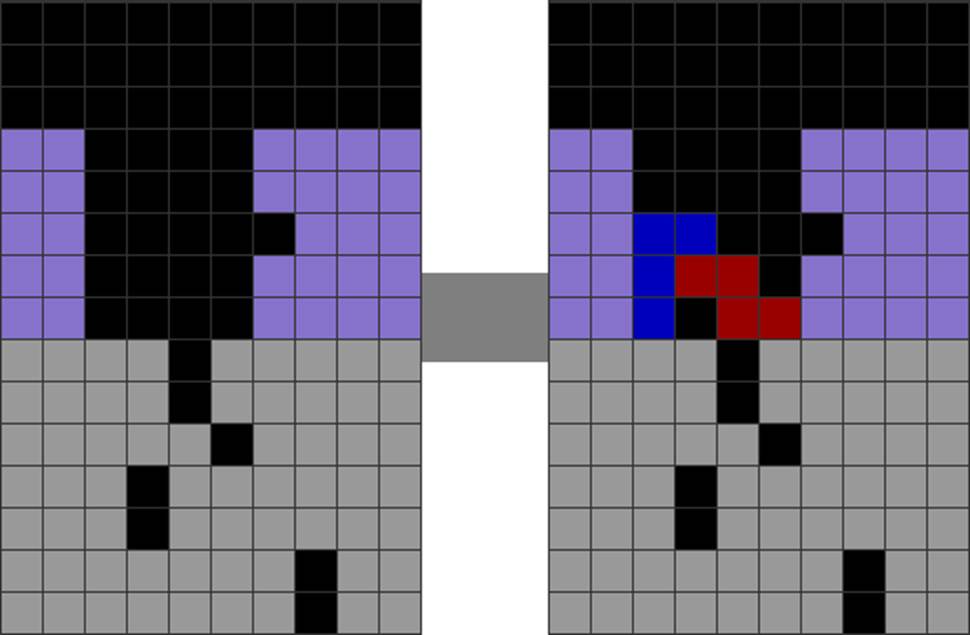
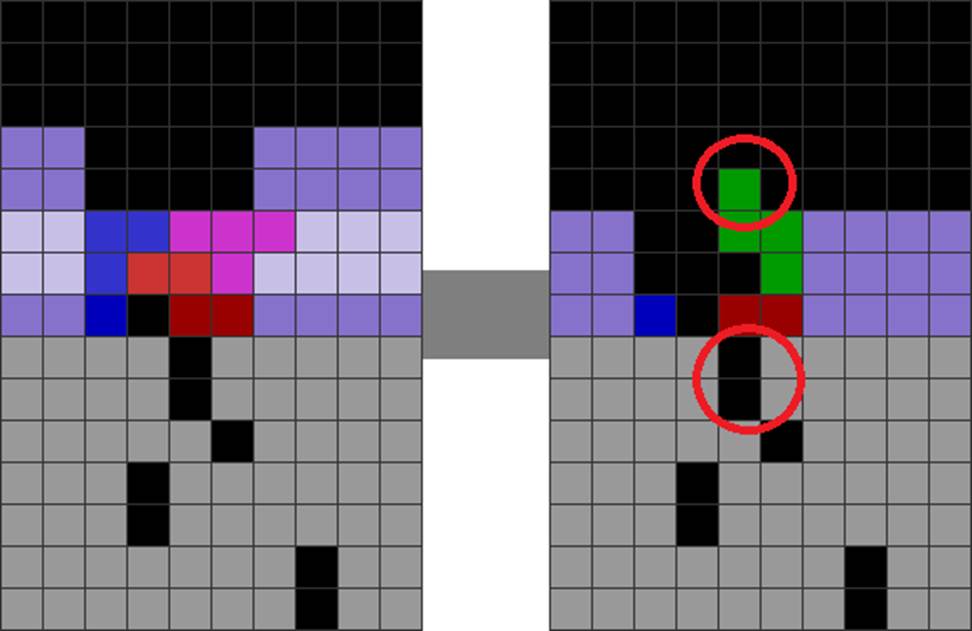
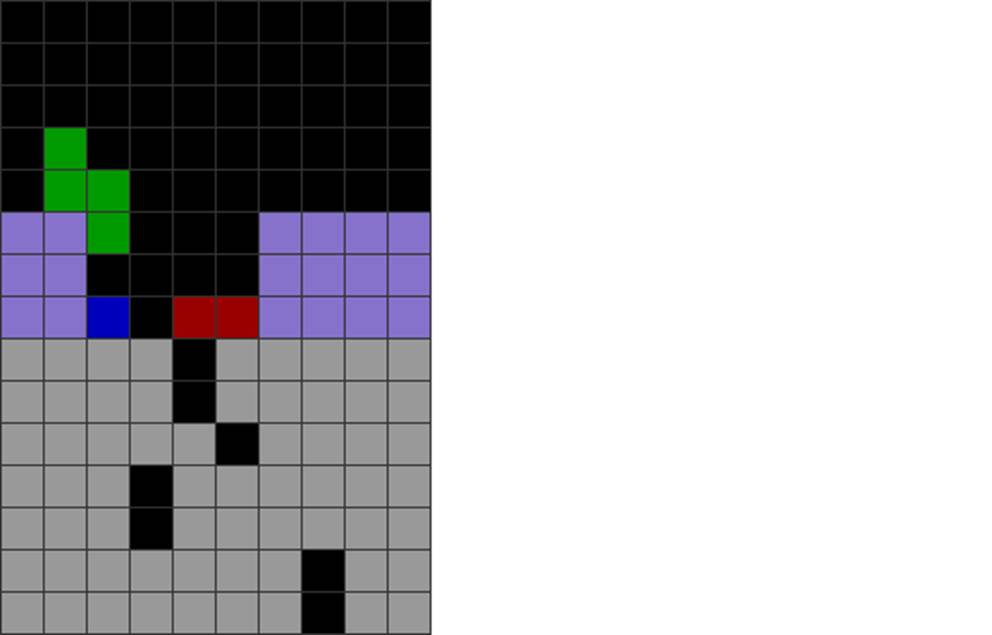
In step 4, he adds a Z overhang to make a second T-spin double.
It is helpful in the above situation compared to the bottom choice, which is an alternative to set 12-1’s step 2.
Diagram Set 12-2
Variations and Mid-Game Chances
Often, many Tetris guides cover only one core form of Shachiku Train. I cover at least 4.
1. Core Form
This is the most common form. It is best created during 9-0 stacking opportunities.
Diagram Set 12-3
1
2
Recognize this pattern during 9-0 stacking.
Put L and S and make an overhang. That’s it!
2. LJ Form
Shachiku Train has an alternate form that uses L and J as a ‘base,’ as shown here:
Diagram Set 12-4
1
2
A Shachiku Train with L and J as the base.
The first T-spin double concludes.
3
4
You get this pattern.
You top the area with a Z overhang to make the second T-spin double.
3. Vertical Form
The method below is my favorite method. It is the vertical T-spin triple variant of Shachiku Train. However, it comes with significant field conditions and piece dependencies, so it is usually given up in serious games.
Diagram Set 12-5
1
2
Recognize this pattern during 9-0 stacking.
Put LZ like this for the first T-spin double. Then, insert the S for the second T-spin.
3
4
Just like this.
Once you are used to making it during 9-0 stacking, transition to creating it in the mid-lanes:
Diagram Set 12-6
1
2
Recognize this mid-game opportunity.
The player puts S, J, and O to make a T-spin triple variant of Shachiku Train.
3
4
After step 3’s T-spin double, one tucks a Z piece into the leftover cavity in step 4 to make a second T-spin double.
You can also place I and J together (I and L, if mirrored) to create the same form:
Diagram Set 12-7
1
2
Vertical Shachiku Trains can be built using I and J props, too. It creates the same shape. Tuck S under the cavity later.
4. Freestyle Forms
Shachiku Trains can be freestyled. Be creative and experiment!
Diagram Set 12-8
A
B
You can freestyle Shachiku Trains to fit many situations.
Continuations and Follow-Ups
There are several ways to continue making more T-spins after the initial 2 T-spins from the original Shachiku Train.
1. Stacked Traditional Shachiku Trains
Shachiku Train can be stacked, as shown:
Diagram Set 12-9
1
2
Step 1: There is a Shachiku Train at the bottom. The player stacks a second J, creating a new overhang above the bottom one. The T-spin double ends in step 2.
3
4
You get this leftover pattern.
The player tucks in a Z to make a second Shachiku Train.
They are rare, but some players like Kazu have used them mid-game often. Shachiku Train is a highly practical and safe canonical method, and it is advisable to master it.
2. Stacked Vertical Shachiku Trains
The vertical version of the earlier sub-section’s method exists:
Diagram Set 12-10
1
2
Recognize the pink pattern. The lavender parts can be in many variable setups.
Stack S and J like this. This adds more T-spin doubles.
After step 2, soft drop a Z piece into the cavity. This is left as an exercise.
3. Cleanliness and Follow-ups
Shachiku Train sometimes cannot be spammed mechanically, as seen here:
Diagram Set 12-11
1
2
The player makes a Shachiku Train.
3
4
In step 4, the player follows up with the setup’s second T-spin double, but the S piece’s red-circled block will block the garbage hole in the red circle.
Alt. A
You can instead put the S overhang on the left side to make a clean T-spin single.
One should be flexible when using this method. As seen above, the S overhang in step 4 sometimes blocks the next garbage hole. Therefore, one should place it in a cleaner position in Alt. A.
In a Nutshell
Shachiku Train is strong, giving 2 back-to-back T-spin doubles, which can substantially improve your APM. It also stacks nicely and usually opens up a Tetris hole if you stack it right. However, it requires some planning to ensure you have the right pieces before creating them.
Pros and Cons
Pros
It is a beneficial double T-spin double method in many situations.
Can be stacked.
Has multiple variations, giving it impressive flexibility.
Cons
The donation may block the Tetris hole, making you vulnerable to spikes.