“The unexamined life is not worth living.”
—Socrates
Introduction
The cosmos is a circle, an eternal reflection of ourselves.
Every thought, belief, intention, and feeling manifests into action in the physical world. This, in turn, affects broader social, cultural, environmental, ecological, and cosmic aspects. Finally, their effects ripple across the cosmos after a duration and return to us.
The cycle then repeats eternally, completing the endless reflection between thought and reality.
This law is the culmination of many earlier laws, such as those of cause and effect, connectivity, manifestation, physicality, and perspective.
This can be encapsulated in the following diagram, which is from my The Eternal Reflection spiritual and philosophical dark fantasy novel series:
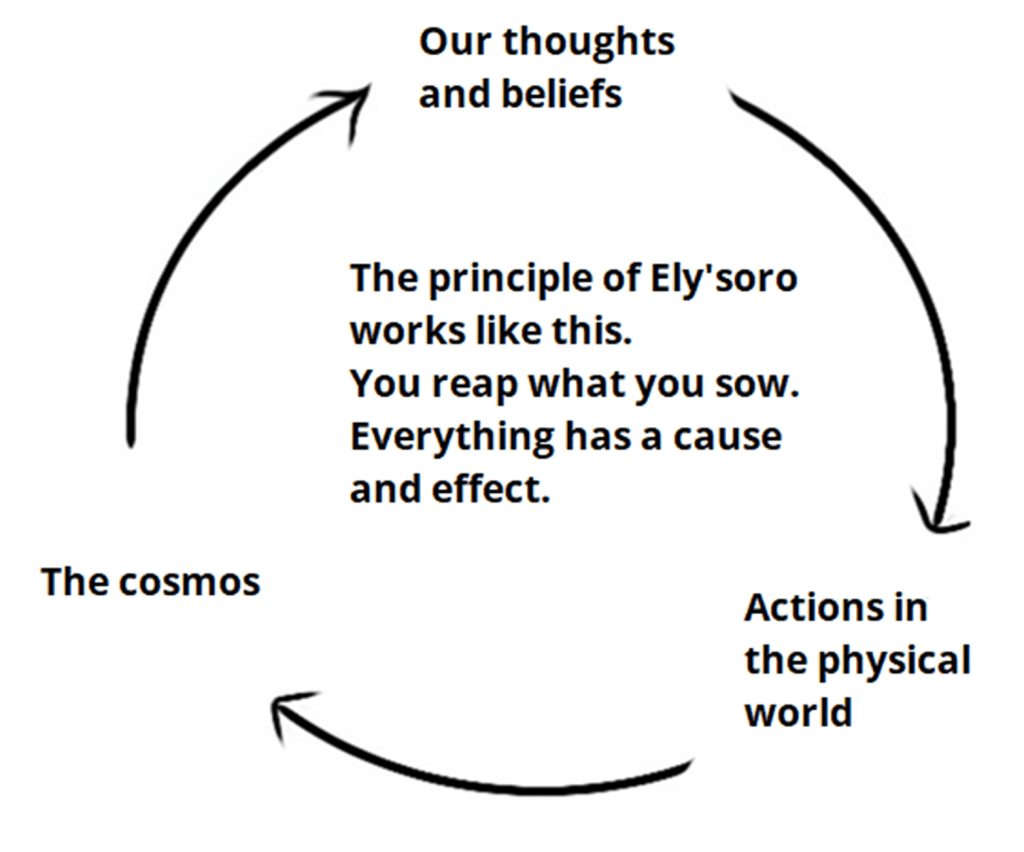
I refer to this law of eternal reflection as the law of Ely’soro in my novel series.
This concept has been paralleled in many mystical, religious, philosophical, and literary traditions.
Friedrich Nietzsche calls this the law of eternal recurrence. Gabriel García Márquez parallels this eternal cycle in his perennial novel A Hundred Years of Solitude.
The Islamic Sufis call this Wahdat al-Wujūd, in which the entire cosmos is a reflection of God and all reality is unitary.
Lao Tzu reflects this entire concept through the process of Yin and Yang, where they continuously interchange to become each other.
In physics, John Wheeler calls this concept the self-seeing eye. And in philosophy, Christopher Michael Langan’s Cognitive-Theoretic Model of the Universe (CTMU) theory explores this idea in the context of a self-defining, self-reflexive universe.
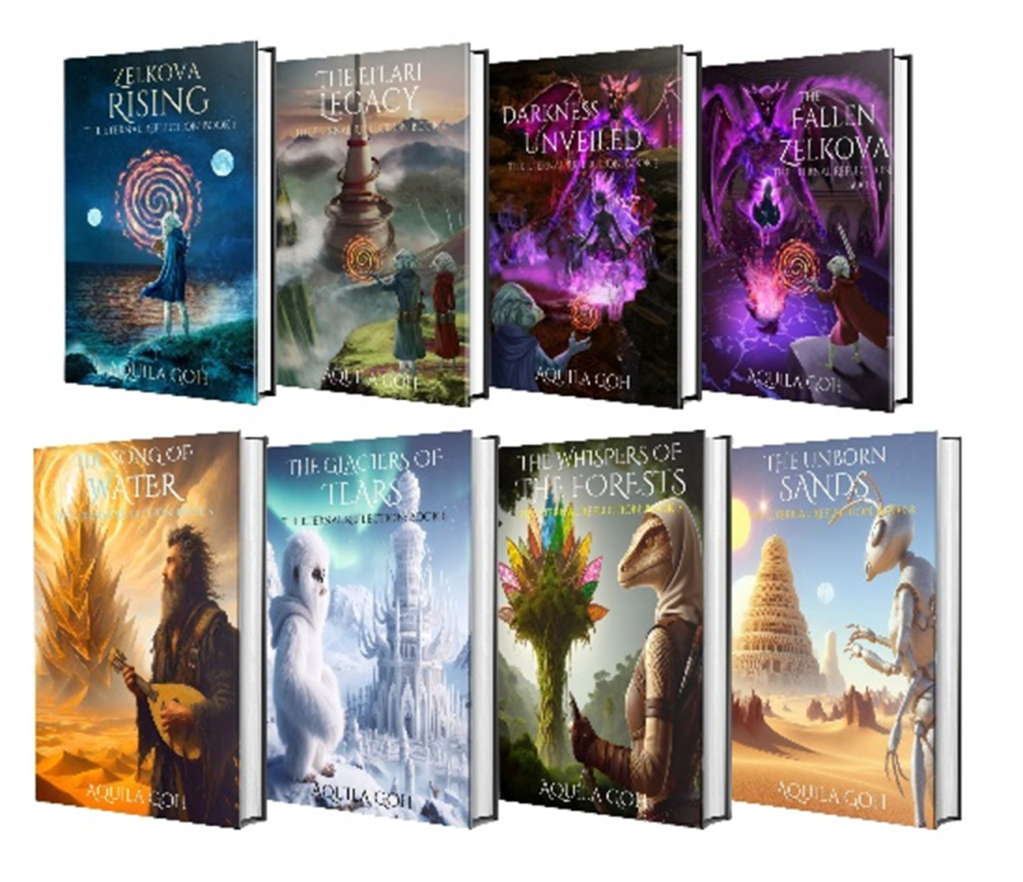
In my The Eternal Reflection series, as shown above, I simply refer to it as the eponymous namesake of my novel series, the eternal reflection.
This mechanism, in which sentient life breathes its essence, through action, into the cosmos, so that its manifestations or effects return to it, makes possible all free will.
Instead of a linear system where a chain of events traces back to an initial prime mover, reality is circular.
We, sentient beings, define and contribute to the cosmos through our acts of creation and destruction. Our effects ripple throughout the cosmos and return to us as karma. This then compels us to evolve or be entrapped in such.
Hence, the cosmos defines and determines itself. The cosmos is entirely free at the macrocosmic level.
Tetris as an Analogy
Tetris could not be a more fitting metaphor for this law.
In Tetris, all progress occurs in a series of cycles until one reaches the next stage.
All learning is reflecting on experience. Experiences without reflection are mere flows from one state to another. Reflection without experiences is mere untested fantasy.
In Tetris, this circularity is as follows:
- Inspiration: The player first learns a specific skill set in the game to boost their win-loss ratio.
- Externalization: The player then applies it to their mid-game. Often, this is difficult because integrating new methods into one’s playstyle is not the same as memorization. One must learn when to use and when not to use certain techniques, depending on specific situations. The player then checks whether the applied method leads to higher win rates.
- Internalization: They may join Discord servers to hire Tetris coaches for feedback on their gameplay. They continue testing their methods until they succeed. When completed, the player has successfully internalized the skill.
The entire process begins with intention and thoughts in the inspiration stage. It is then internalized as an ideal. Only when one has put it into tested actions can one externalize the methods.
Depending on the player, some players may internalize or externalize first.
All Tetris is hence a continuous reflection, a rich interplay between one’s internal ideals and their manifested actions. Only when ideals and actions are married can actual growth truly occur.
Perhaps, this circularity can best be illustrated using the following diagram:
| Diagram Set 12-1 |
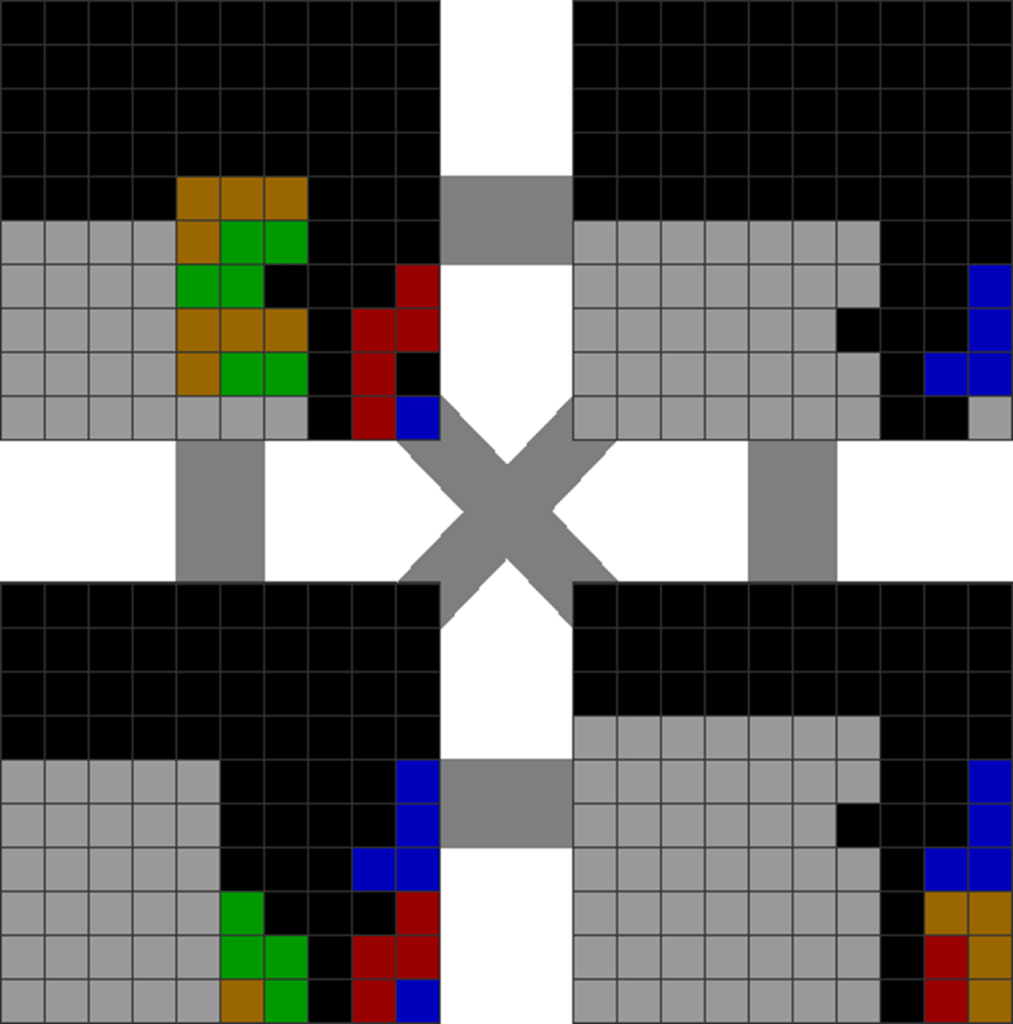
| You can transition between ST stacking, LT stacking, LST stacking, and freestyling. |
During 7-2 stacking (when the garbage hole is in columns 3 or 8), there is an easy trick to create as many compact T-spins as possible using a repeatable method.
It involves the above alternation between ST, LT, LST, and freestyle stacking. These methods are simply ways, covered in my Tetris guidebooks, of using the S, Z, L, and J pieces as the base to create T-spin doubles.
The whole cosmos repeats itself across many cycles, each similar in essence and fundamentals but different in circumstances, symbolizing the eternal reflection.
The shown Tetris example illustrates circularity, where the cosmos repeats itself through a continuous interchange of cause and effect.
Personal Applications
The law of eternal reflection implies that free will is the base nature of the cosmos.
The cosmic spirit only seeks to expand itself, realizing every possibility and duality.
Hence, the goal of any individual or society is to maximize freedom or free will. However, I do not speak of the kind of freedom in the USA’s First Amendment. I speak of something far more encompassing.
The philosopher Isaiah Berlin speaks of two kinds of freedom: positive and negative.
Negative freedom is freedom from constraints, such as the freedom to express one’s views without being imprisoned or condemned.
Positive freedom is the freedom to do something. Hence, for an artist, it may mean cultivating the skills to create any form of art one desires.
I go further: spiritual freedom is an extended form of positive freedom.
According to Theosophical findings, the soul is layered with many kinds of spiritual auras. Each is a form of conscious energy that grants us the power to do something.
Hence, a relatively undeveloped artistic soul may express itself in simple ways, perhaps through cave paintings.
An artist soul who has gathered far more essences can manifest in many more complex ways.
Imagine someone like Leonardo Da Vinci, who can partake in more kinds of creation than the former example. He can paint the Mona Lisa and The Last Supper, invent helicopters and tanks way before their time, and explore the golden ratio through architecture.
Between the two, Da Vinci obviously has more positive and spiritual freedom. Even if both are given the freest circumstances in terms of negative freedom by having no laws bind them, only Da Vinci could create The Last Supper.
Hence, the fundamental goal of the soul’s life is to gather more and more experiences. This amplifies one’s range of freedom to do what one desires.
Per my knowledge of esotericism, it seems that every soul individually develops into their own universe after an unimaginably huge period of time.
However, the fundamental essence that connects such a cosmic soul with a humble human soul is still freedom and free will.
Social and Global Applications
In a societal and global context, humanity may never escape the consequences of its actions.
Prior theories of economics have always assumed that a nation should maximize consumption, investment, governmental spending, and net exports.
However, such a system leads to ruin as many countries over-industrialize and fail to care for the environment.
That is why there are new ecological or Buddhist-based economic systems that factor in long-term environmental sustainability. This includes the works of Arne Naess and E. F. Schumacher.
In these new Earth economic systems, the environment matters as much as society.
Even more so are societies like Bhutan, which now prioritize “Gross National Happiness.” Hence, the individual becomes a focal point of many future economic and social systems.
Future economic and social systems must incorporate not merely ecological and social merits, but also the individual’s spiritual fulfillment.
Only when the micro-, meso-, and macro layers of the social system are balanced can it be stable.
If any node is lacking, such as a lack of care for the environment, or it suppresses human freedom, it would not be sustainable.
This is because of the law of eternal reflection. Let us consider two examples:
First, suppose an economic system does not care about the environment. In that case, we will suffer the effects of climate change as we do now.
Second, suppose a system does not care for human freedom. In that case, people will become increasingly alienated, leading to social revolutions seeking equality.
All karma, in the end, is collective. Everything originates from the self, affecting the whole, which then affects the individual.
 How to Tetris