“The unexamined life is not worth living.”
— Socrates
Introduction
The Eternal Reflection
The cosmos is a circle, an eternal reflection of ourselves.
Every thought, belief, intention, and feeling manifests into action in the physical world.
This, in turn, affects broader social, cultural, environmental, ecological, and cosmic aspects. Finally, their effects ripple across the cosmos for a duration and return to us.
The cycle then repeats eternally, completing the endless reflection between thought and reality.
This law culminates many earlier laws, such as cause and effect, connectivity, manifestation, physicality, and perspective.
This can be encapsulated in the following diagram, which is from my The Eternal Reflection spiritual and philosophical dark fantasy novel series:[1]
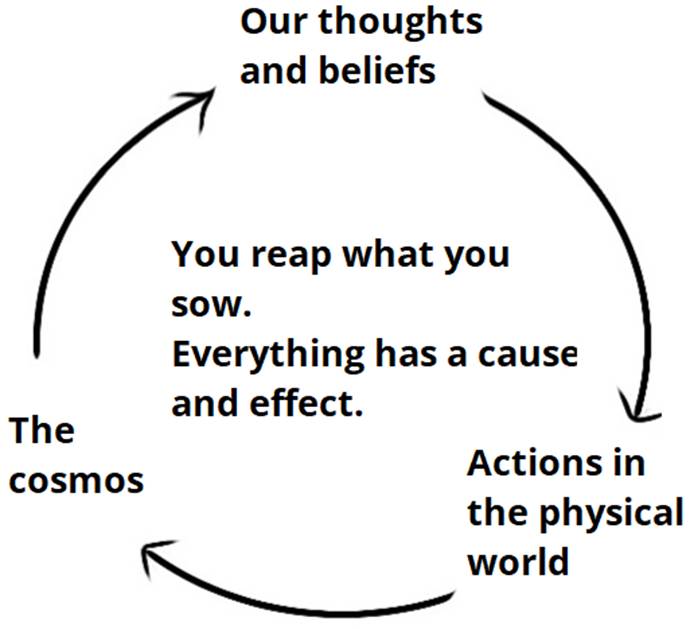
I refer to this law of eternal reflection as the law of Ely’soro in my novel series.
It shows the cyclical relationship between consciousness and the material world, which gives rise to free will.
Academic Coverage of This Law
This law appears in many mystical, religious, philosophical, and literary traditions.
Friedrich Nietzsche calls this the law of eternal recurrence. Gabriel García Márquez parallels this eternal cycle in his novel A Hundred Years of Solitude.
Islamic Sufis call this Wahdat al-Wujūd, in which the entire cosmos reflects God and all reality is unitary.
Lao Tzu reflects this entire concept through the yin and yang, which continuously interrelate to become each other.
In physics, John Wheeler calls this concept the self-seeing eye. In philosophy, Christopher Michael Langan’s Cognitive-Theoretic Model of the Universe (CTMU) explores this idea in the context of a self-defining, self-reflexive universe.[2]
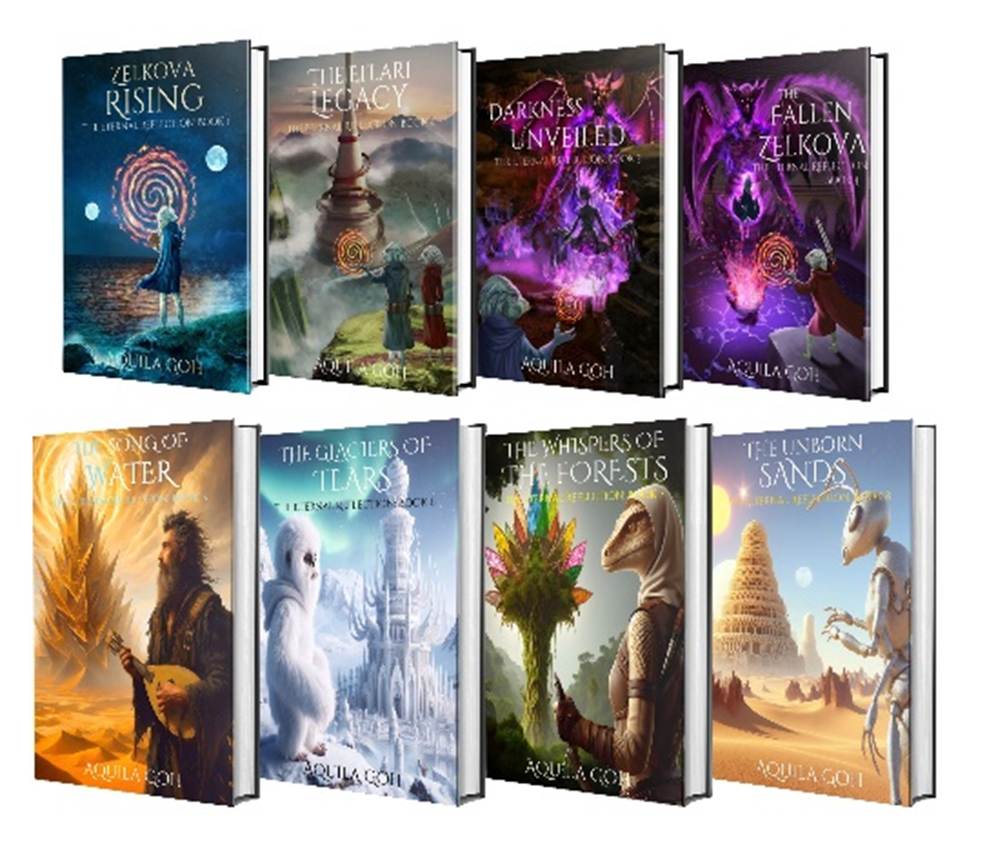
In my The Eternal Reflection series, as shown above, I refer to it simply as the eponymous title of my novel series.
How It Births Free Will
Chris Langan’s CTMU theory attempts to resolve the contradictions in many philosophical paradigms of free will.
Existing models often suggest that either (i) the physical world determines our choices as if the universe is a gigantic billiard table that can be predicted by a computer (no free will), (ii) we all have individual free will, or (iii) a reconciliation of the two.[3]
Langan resolves it by stating that the entire cosmos is self-contained. Hence, individual souls determine the cosmos, while their effects ripple back from the universe to the self.[4]
Hence, the broader all-that-there-is is self-determined.
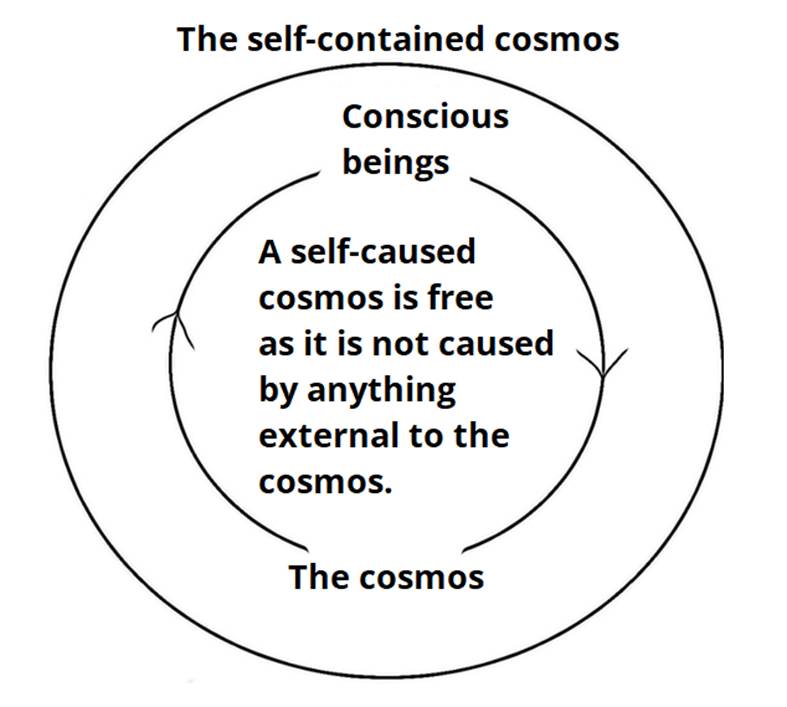
With this, we derive the law of eternal reflection, in which sentient life breathes its essence, through action, into the cosmos, so that its manifestations or effects return to it, making all free will possible.
Instead of a linear system where a chain of events traces back to an initial prime mover, reality is circular.
We, sentient beings, define and contribute to the cosmos through our acts of creation and destruction.
Our effects ripple throughout the cosmos and return to us as karma. This, in turn, compels us to evolve or be entrapped in it.
Hence, the cosmos defines and determines itself. The cosmos is entirely free at the macrocosmic level.[5]
That is how free and powerful we all are.
And so are the consequences of our actions.
Tetris as an Analogy
Tetris could not be a more fitting metaphor for this law.
In Tetris, progress occurs in a series of cycles until you reach the next stage.
All learning is reflecting on experience. Experiences without reflection are mere flows from one state to another. Reflection without experiences is mere untested fantasy.
In Tetris, this circularity is as follows:
- Inspiration: The player first learns a specific skill set in the game to boost their win-loss ratio.
- Externalization: The player then applies it to their mid-game. Often, this is difficult because integrating new methods into one’s playstyle is not the same as memorization. One must learn when to use certain techniques and when not to, depending on the situation. The player then checks whether the applied method leads to higher win rates.
- Internalization: They may join Discord servers to hire Tetris coaches for feedback on their gameplay. They continue testing their methods until they succeed. When completed, the player has successfully internalized the skill.
The entire process begins with intention and thoughts in the inspiration stage. It is idealized. Only after testing it in action can one externalize the methods. And only after much reflection can this skill be fully internalized.
Depending on the player, some players may internalize or externalize first.
All Tetris is hence a continuous reflection, a rich interplay between one’s internal ideals and their manifested actions. Only when ideals and actions are married can actual growth truly occur.
Perhaps this circularity can best be illustrated using the following diagram:
| Diagram Set 12-1 | |
| 1 | 2 |
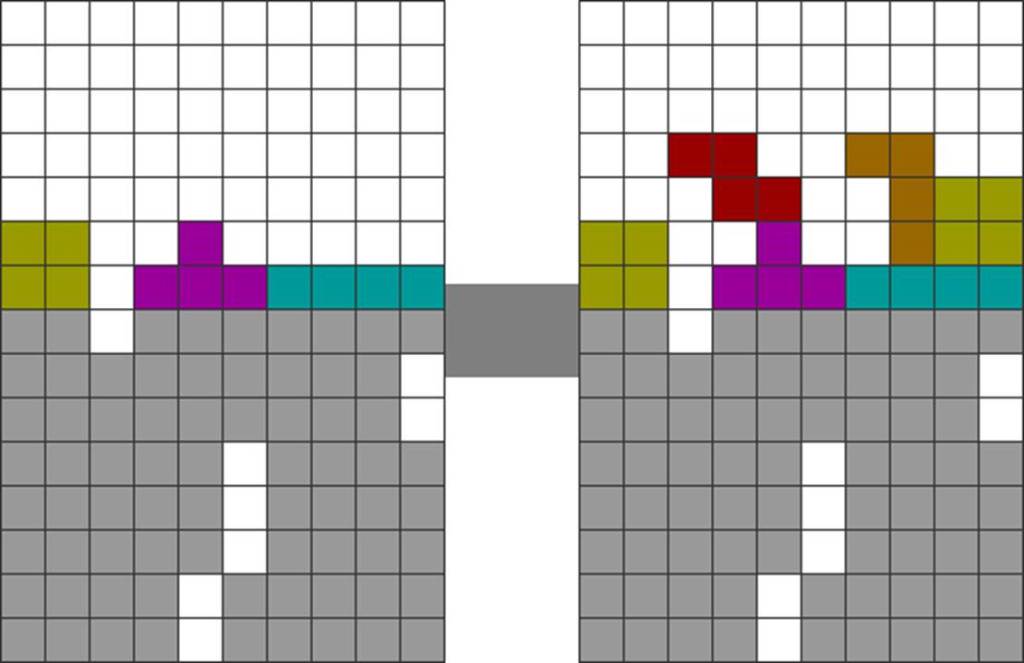
| Starting field. You panic. | Your panic makes your fingers tremble. You place many pieces wrong, and this messes up your field. |
Here, above, you panic and externalize that state into trembling fingers. You place many pieces wrong. This guts your long-term offense and defense and likely leads to a loss.
What if you had calmed down instead? Observe the following:
| Diagram Set 12-2 | |
| 1 | 2 |
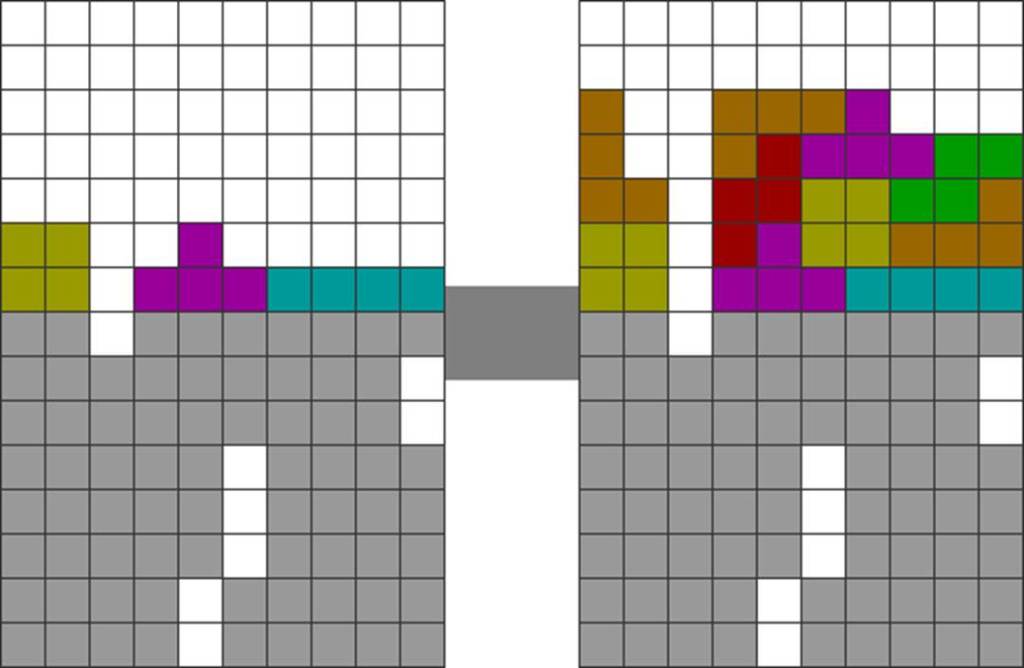
| Starting field. You remain calm. | You stack flatly and properly, resulting in high offense and defense. |
Here, you stay calm, stack well, and the rest of the game improves, leading to a victory.
Thus, in Tetris, your internal state manifests as an external state in your gameplay. It then returns to you as consequences, either as a win or a loss, causing you to feel joyous or upset.
This Tetris example illustrates circularity, in which the cosmos repeats itself through a continuous interchange of cause and effect.
Broadly applied, the whole cosmos repeats itself across many cycles, each similar in essence and fundamentals but different in circumstances, symbolizing the eternal reflection.
Personal Applications
Two Kinds of Freedom
The law of eternal reflection implies that free will is the base nature of the cosmos.
The cosmic spirit only seeks to expand itself, realizing every possibility and duality.
Hence, the goal of any individual or society is to maximize freedom or free will.
However, I do not speak of the kind of freedom in the USA’s First Amendment. I speak of something far more encompassing.
The philosopher Isaiah Berlin speaks of two kinds of freedom: positive and negative.[6]
Negative freedom is freedom from constraints, such as the freedom to express one’s views without imprisonment or condemnation.
Positive freedom is the freedom to do something. Hence, for an artist, it may mean cultivating the skills to create any form of art one desires.
I go further: spiritual freedom is an extended form of positive freedom.
According to Theosophical findings, the soul is layered with many kinds of spiritual auras. Each is a form of conscious energy that grants us the power to do something.[7] This is positive freedom.
Hence, a relatively inexperienced artistic soul may express itself in simple ways, perhaps through cave paintings.
An artist soul who has gathered far more essences can manifest in many more complex ways.
Imagine someone like Leonardo da Vinci, who can create in more ways than the former example. He can paint the Mona Lisa and The Last Supper, invent helicopters and tanks way before their time, and explore the golden ratio through architecture.
Between the cave person and da Vinci, the latter obviously has more positive and spiritual freedom.
Even if both are given the freest circumstances in terms of negative freedom by having no laws bind them, only da Vinci could create The Last Supper.
Hence, when we gather more experiences (not mere knowledge!), this broadens our spiritual freedom to do what we desire.
This is why many souls seek physical incarnations: every life is a pearl among a string of pearls.
Every life enriches us with experiences, talents, and skills, expanding our spiritual power. We can then perform more complex tasks and express ourselves in more ways.
Social and Global Applications
The Cyclicality of Collective Cause and Effect
In a societal and global context, humanity may never escape the consequences of its actions.
Prior economic theories have always assumed that a nation should maximize consumption, investment, government spending, and net exports.
However, this system leads to ruin, as many countries over-industrialize and fail to care for the environment.
That is why new ecological or Buddhist-based economic systems factor in long-term environmental sustainability.[8]
In these new Earth economic systems, the environment matters as much as society.
Societies like Bhutan go further. It now prioritizes “Gross National Happiness.” As a result, the individual’s self-fulfillment becomes a focal point of many future economic and social systems.
Future economic and social systems must incorporate not merely ecological and social merits but also individual spiritual fulfillment.
Only when the micro-, meso-, and macro layers of the social system are balanced can it be stable.
If any node is lacking, such as a lack of care for the environment, or if it suppresses human freedom, it would not be sustainable.
This is because of the law of eternal reflection. Let us consider two examples:
Example 1:
First, suppose an economic system does not care about the environment. In that case, we will suffer the effects of climate change as we do now.
Some economic metrics account for the negative effects of pollution and environmental damage. This is sometimes called Green GDP.
In the United States, many AI firms are actively constructing many AI data centers. Unfortunately, this is not sustainable.
These AI data centers have devices that are outdated as early as in 18 months. They would then have to be replaced as new, better AI models demand more hardware.
Even if it were not the case, the US power infrastructure relies heavily on fossil fuels and twentieth-century technology. The focus on renewable energy is much lower than in China.
Hence, to supply the AI data center, you have to build more power plants that use non-renewable coal or oil. This will then damage the environment and pollute the air and water.
It hence fails to incorporate the concept of Green GDP.
The current US infrastructure system is not sustainable unless the government implements socialist policies that think long-term rather than term-long (i.e., every election cycle).
This is because a purely free-market or capitalist system run by AI firm oligarchs will not spend a cent on public utilities, since they are not profitable.
Example 2:
Second, suppose a system does not care for human life satisfaction. In that case, people will become increasingly alienated, leading to social revolutions in pursuit of equality.
This is already happening in many modern societies, such as Japan, South Korea, and the United States.
Japanese workers are fed up with the salaryman system of working ten hours a day and having little leisure time.
South Korea has one of the highest suicide rates worldwide and one of the lowest fertility rates. This arises from a hyper-competitive system that ranks people based on inauthentic measures such as looks or grades.
In the United States, certain firms use AI monitoring to ensure workers are questioned every time they use a toilet or the phone. If they give a poor reason, they are penalized or fired.
The current system, which mainly rewards the oligarchs, is unsustainable and will only alienate future workers.
None of these are sustainable, as lower life satisfaction will translate into lower fertility, quality of life, and freedom. People will eventually revolt.
Implication
All karma, in the end, is collective. Everything originates in the self, affects the whole, and then affects the individual.
Until we break the cycle, the systems in the last two examples will continue.
Two Contrasting Examples
I present two hypothetical cases to illustrate the law of eternal reflection and show the cyclical relationship between the individual and the collective social structure.
They are the opposite of each other, as the second is a solution to the first’s problems.
Example 1:
- A wealthy billionaire, perhaps such as J.P. Morgan or Rockefeller during America’s Gilded Age in the late 1800s, decides to monopolize many business areas.
- He creates rail, road, and coal services that no one else can compete with. However, everyone requires such necessities and is willing to pay a high price for them.
- He then overcharges for them, impoverishing the working and middle classes.
- However, he pays lawmakers to abolish laws involving the protection of the rights of employees and the common person.
- He then uses his money to influence Congress to institute bills and policies that allow the wealthy elites to be spared from taxation.
- Using this power, he decreases the wages of his employees. However, the latter cannot dissent because trade unions were banned during his tenure.
- He then uses the money to splurge, creating extravagant palaces to live in, while owning a fleet of luxury cars that he never drives.
- Society becomes resentful over many years as living conditions become worse.
- They then plan revolts around the country, leading to violent clashes. The crime rate vastly increases.
- The clashes get out of hand, and the government is forced to institute policies that favor the equal distribution of wealth.
- The billionaire is then forced to break up his monopoly into many smaller, competing companies.
That was almost exactly what happened in the USA in the early 1900s! The US government broke up Rockefeller’s company, Standard Oil, for becoming too powerful.
This example shows the inherent consequences of broad, negative social or economic policies that affect the whole and then provoke a destructive reaction from its people, highlighting the cyclical cause-and-effect between individual and collective layers.
The opposite, however, can occur in a more positive manner.
Example 2:
- A billionaire, having accumulated vast riches from his empire, decides to focus on the welfare of his workers.
- He allows the workers to share in the company’s profits, letting them purchase its stocks and get yearly dividend payouts.
- He generously allows workers to join trade unions and implements corporate policies that heavily favor their rights (such as the means to appeal being fired or laid off).
- He creates elaborate infrastructure and services (free gym, health check-ups, etc.) for his employees as part of joining the company’s benefits.
- He then uses his wealth to influence candidates who mandate sustainable and green development, while ensuring more equitable distribution of wealth.
- The result is a society that is far more balanced, more humanistic, and more secure, allowing workers to work for fewer hours, yet feeling more fulfilled.
- This model is then emulated by other countries.
One country is already doing something like this. It is Norway![9]
Hence, what goes around truly comes around.
People in power can positively influence civilizational development towards universal love and harmony.
By breaking the negative karmic cycles and creating new, positive ones, people in power can shift civilization towards prosperity and equality.
[1] I hesitate to introduce my novels to people. I wrote them from a far less experienced perspective and writing skill level. If I do, I will have to create new editions of the entire series, with another serious round of editorial improvements. If you are interested, please be understanding towards the works.
[2] John Wheeler, At Home in the Universe (1994); Christopher Michael Langan, “The Cognitive-Theoretic Model of the Universe,” Progress in Complexity, Information, and Design (2002).
[3] For determinism see Pierre-Simon Laplace, A Philosophical Essay on Probabilities (1814); for libertarian free will see Robert Kane, The Significance of Free Will (1996); for compatibilism see Daniel Dennett, Freedom Evolves (2003).
[4] Christopher Michael Langan, “The Cognitive-Theoretic Model of the Universe,” Progress in Complexity, Information, and Design (2002).
[5] This applies to universes with linear time. From the perspective of some timeless afterlife dimensions, individual free will may be an illusion. The cosmos could be manifesting all states simultaneously. In that sense, the cosmos is free because it has manifested everything. We may be one-dimensional temporal beings embedded in infinite time dimensions, each with the illusion of free will, and we might be exploring parallel timelines simultaneously, as afterlife literature has written.
[6] Isaiah Berlin, “Two Concepts of Liberty,” in Four Essays on Liberty (1969).
[7] C. W. Leadbeater, Man Visible and Invisible (1902); Annie Besant and C. W. Leadbeater, Thought-Forms (1905).
[8] Arne Naess, Ecology, Community and Lifestyle (1989); E. F. Schumacher, Small Is Beautiful: Economics as if People Mattered (1973).
[9] See OECD Better Life Index (2024); Norway ranks among the top nations for worker rights, life satisfaction, and equitable wealth distribution. To be fair, Norway’s model emerged not from one billionaire’s generosity but from decades of strong labor movements, government policy, and collective will.

