Introduction
Master and prioritize stacking above all other skill sets.
With improper stacking, you can stack into the following mid-game situations:
| Diagram Set 12-1 | |
| 1 | 2 |
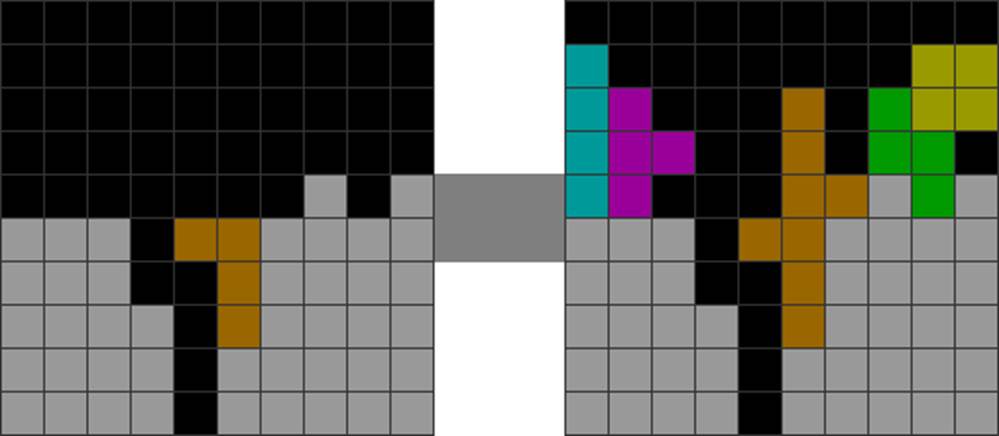
| The player sees a T-spin chance. | They go for it, but stack into a dead end, causing the O piece to sit dirtily over holes. |
Here, the player stacks dirtily over holes, creating a bumpy, jagged surface. This makes it hard to stack incoming pieces cleanly on top of them, which can disrupt your mid-game defenses and momentum.
| Diagram Set 12-2 | |
| A | B |
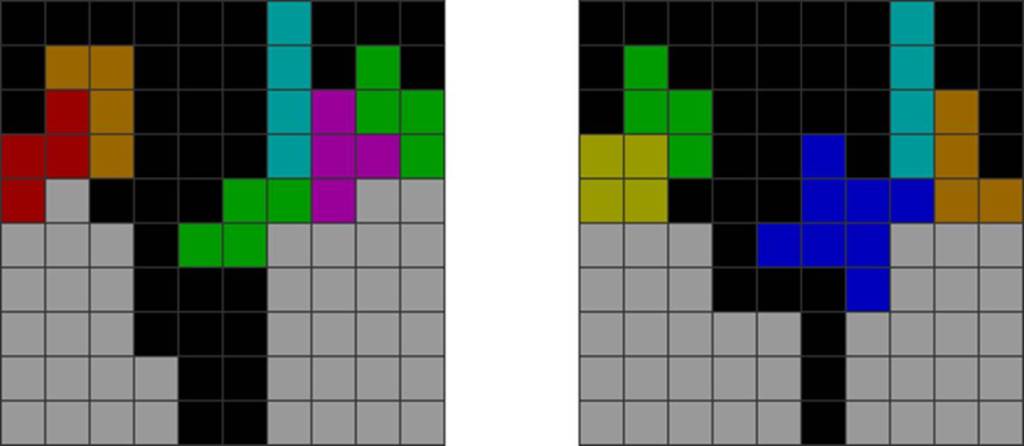
| An STMB Cave. However, the player stacks the left and right stacks poorly. | Another floating T-spin. Same, poor stacking outcome. |
In these other tragic scenarios, a player’s T-spin proficiency vastly surpasses their stacking skill. This results in very fancy, complex T-spins.
Unfortunately, the player fails to stack the sides of the T-spin setup cleanly. The setup is messy and overstacked, making it hard to defend and downstack afterward.
A Tetris setup’s success depends directly on how well you stack. If you master stacking, your setups become more consistent, and your success rates improve.
Training How to Stack
The simplest way to train stacking is to simply open up the Four-tris app or use any Tetris client (like Farter’s mod) that allows you to set the gravity to zero. This gives you infinite time to think.
In Four-tris, because you are playing solo against no one, you will have no incoming garbage to disrupt your decision-making.
You basically just stack in Four-tris as far as possible without using T-spins. Just spam Tetrises:
| Diagram Set 12-3 |
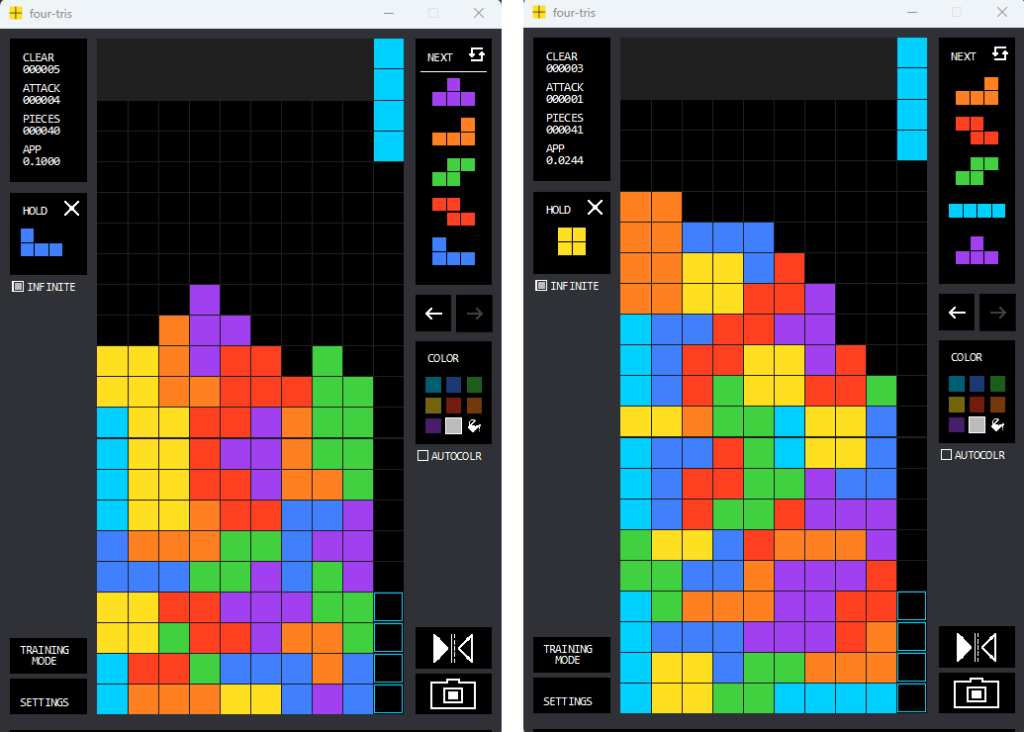
| The player uses Four-tris to train 9-0 stacking. 9-0 stacking can mostly only be freestyled. Fixed, deterministic setups eventually break, forcing one to freestyle. |
All Forms of Stacking Styles Needed
Less experienced players see stacking as simply using 9-0 stacking:
| Diagram Set 12-4 | |
| 1 | 2 |
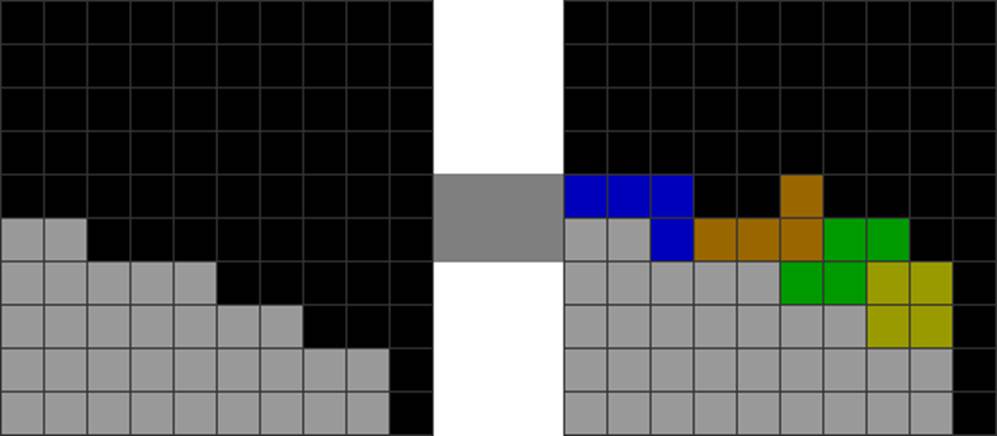
| Starting field using 9-0 stacking. | The player continues stacking. |
This means you leave an empty column in the farthest hole (column 10, to the far right), and stack the left side.
However, having the main hole in columns 1 to 10 changes the kind of stacking involved.
If you train only with the main Tetris hole in column 10, you will not know how to stack proficiently when the hole is in columns 1 to 9.
Here is a list of variations that you should train:
9-0 Stacking
9-0 stacking is the most straightforward stacking style most Tetris players learn first (thanks to Classic Tetris’ popular influence!).
The main hole is in column 10, on the far right.
I strongly recommend players spend as much time as possible training this stacking form.
This is because the entire left stack is joined. Hence, compared to the other upcoming stacking forms, you are forced to freestyle without using fixed patterns:
| Diagram Set 12-5 | |
| 1 | 2 |
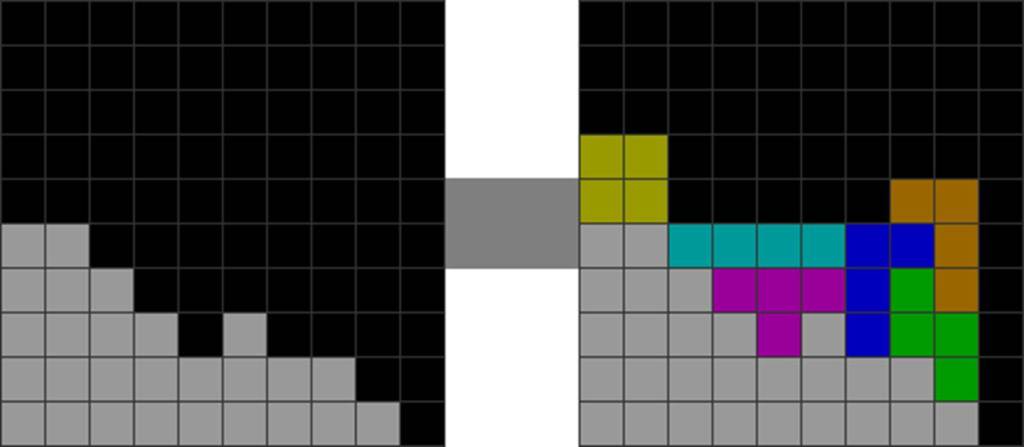
| Starting field using 9-0 stacking. | The player uses freestyle stacking to continue. |
8-1 Stacking
8-1 stacking is a bit awkward. The hole is in column 9.
Hence, when you stack, you typically have to place many I pieces on the far right like this:
| Diagram Set 12-6 | |
| 1 | 2 |
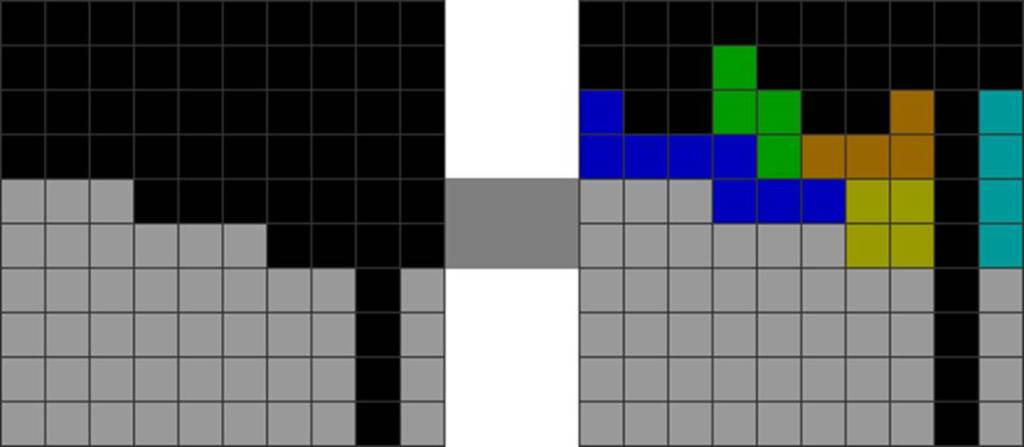
| A starting 8-1 stacking field. | The player stacks. Note how the right side (column 10) can only accommodate vertical I pieces. |
Many people dislike this stacking form. However, you will inevitably encounter it mid-game. If you train this, you will know how to stack fast when the situation calls for it.
One key point: the player should use skims if one cannot stack Is on the far right:
| Diagram Set 12-7 | |
| 1 | 2 |
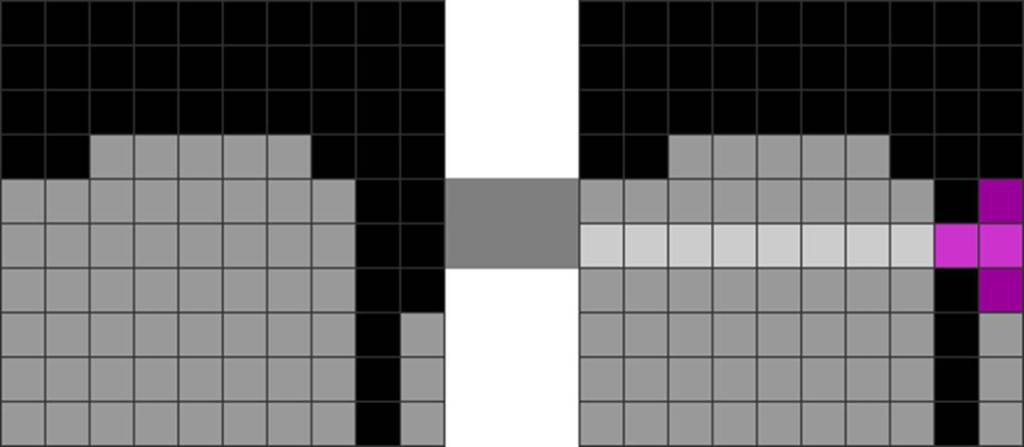
| A starting 8-1 stacking field. | An I piece does not arrive to be placed in column 10. The player skims with a T piece. This increases column 10’s height. |
Trust me, this practice will be of enormous benefit in many situations later: (i) the skimming provides one vital way to avoid excessive I dependencies on the far right, and (ii) learning to 8-1 stack will let you chain Parapets a lot (as covered in Book C’s Parapet chapter, free on my website).
7-2 Stacking
7-2 stacking, as you can probably guess, involves stacking when the main Tetris hole is in column 8:
| Diagram Set 12-8 | |
| 1 | 2 |
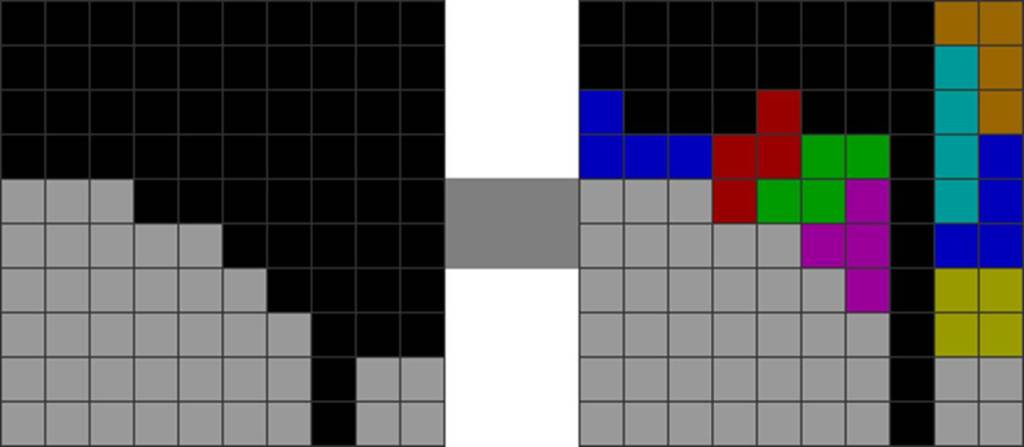
| A starting 7-2 stacking field. | The player continues stacking. Note how they stack the far right’s 2 columns. |
Note how you can stack the far right’s 2-block-thick tower through various piece combinations, such as combining L, J, O, and I into rectangles.
7-2 stacking is very important, as if you master it, you can employ 2 very efficient T-spin chaining forms: ST stacking and LST stacking:
| Diagram Set 12-9 | |
| A | B |
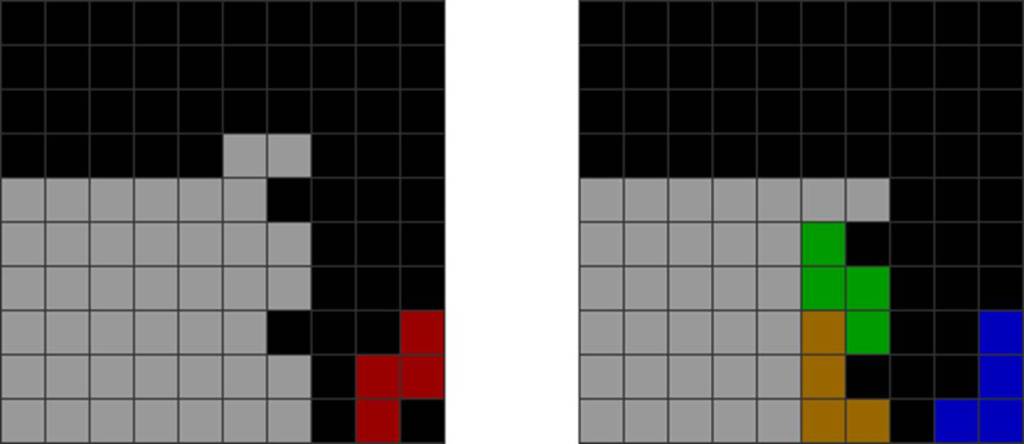
| ST stacking. | LST stacking. |
These 2 methods have among the highest T-spin efficiency in the game. They can produce endless strings of back-to-back T-spin doubles and Tetrises.
However, to use them well, you must first master 7-2 stacking.
6-3 Stacking
6-3 stacking involves the central Tetris hole being in column 7.
6-3 stacking is important for 2 reasons:
First, many players use it to achieve a slightly faster 40-line sprint time than 9-0 stacking. This is because of the following:
| Diagram Set 12-10 | |
| A | B |
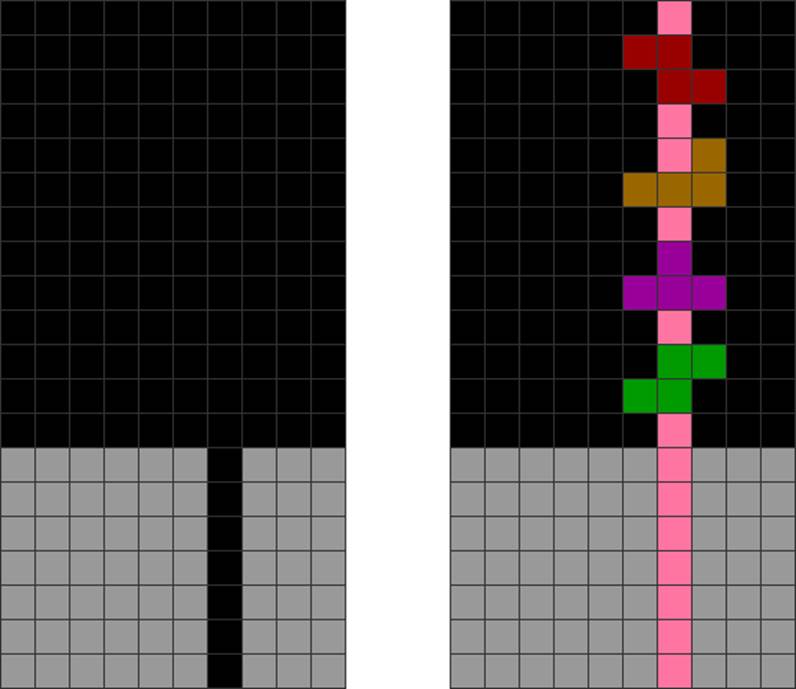
| A starting 6-3 stacking field. Note column 7. | A pink line runs through column 7. 6-3 stacking minimizes the above Z, L, T, and S placements, which require many double taps (pressing “move right” twice). |
This stacking form minimizes finesse placements that require double-tapping. This saves extra button presses that can slightly boost your 40-line sprint time, which matters for world records.
Second, it allows you to chain T-spins and Tetrises easily like this:
| Diagram Set 12-11 | |
| 1 | 2 |
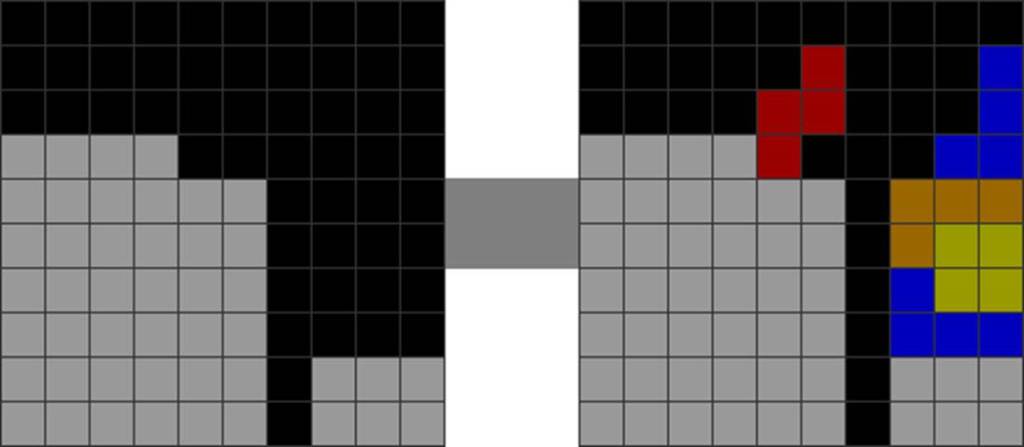
| A 6-3 stacking starting field. | With proper, balanced stacking on both sides, the player easily makes a T-spin double. |
| 3 | 4 |
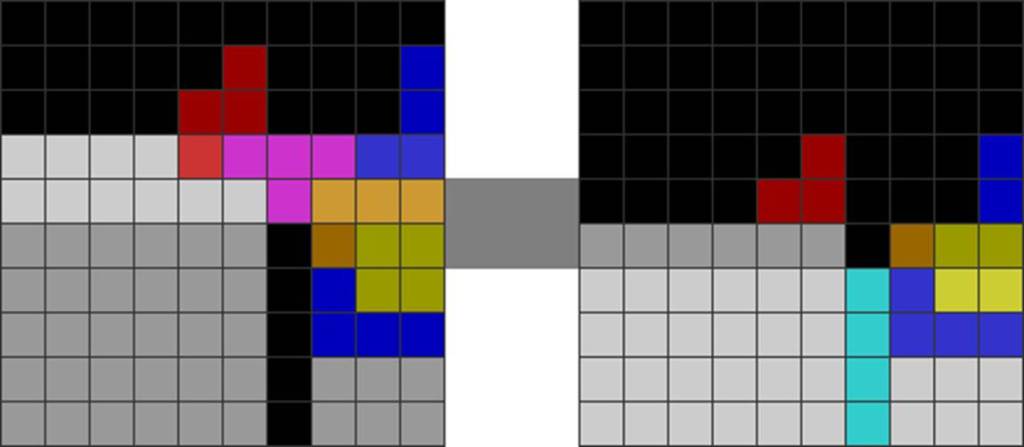
| They perform the T-spin double line clear. | And follow up with a Tetris line clear. |
Performing the above 2 clauses well involves stacking the right side’s 3-block-wide tower well with familiar piece combinations:
| Diagram Set 12-12 | |
| A | B |
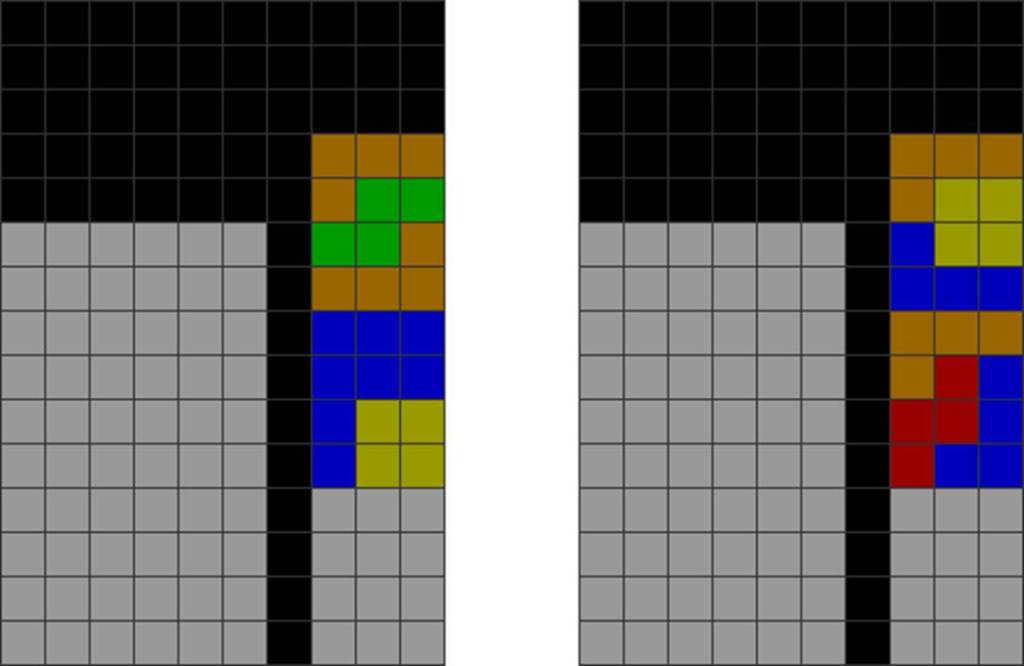
| Note the LSL and JJO shapes that make up 3×4 rectangles. | Note the LOJ and LZJ shapes that make up 3×4 rectangles. |
Note how some pieces combine to form 3-block-wide rectangles that help you build the right stack.
Memorizing the combinations is easy, since there are only a few.
5-4 Stacking
5-4 stacking involves stacking when the main Tetris hole is in column 6.
Beyond 9-0 stacking, I also strongly encourage players to train 5-4 stacking frequently.
This is because, like in the former’s case, there are too many ways to combine pieces to stack the left and right stacks properly. This, hence, forces a player to freestyle.
Some combinations exist, such as these:
| Diagram Set 12-13 | |
| 1 | 2 |
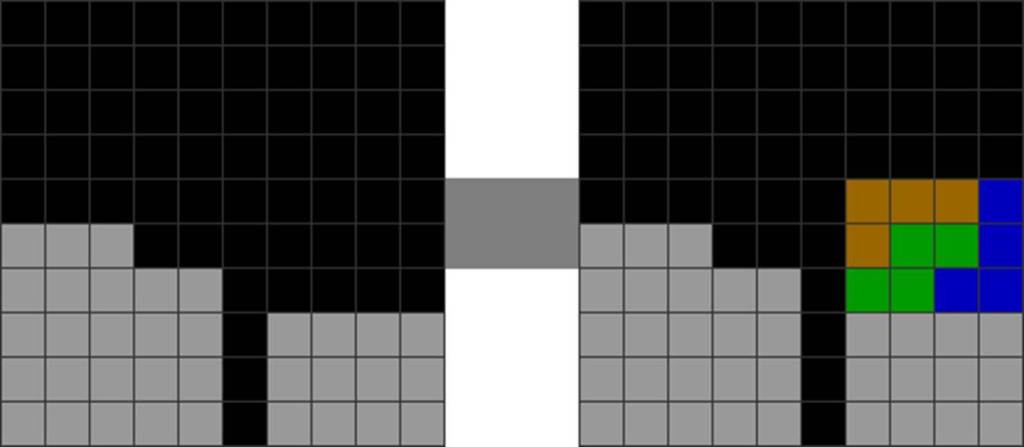
| A 5-4 stacking starting field. | L, S, and J combine into a 4×3 rectangle that can fill up the right stack smoothly and flatly. |
However, most of the time, a player must freestyle during 6-3 stacking.
And when you train freestyling, you are forced to cultivate fluidity and adaptability in your thinking.
The Mirrored Versions
Now, you might think that the mirrored versions of the above stacking forms are exactly the same.
Hence, 7-2 stacking is similar to 2-7 stacking:
| Diagram Set 12-14 | |
| A | B |
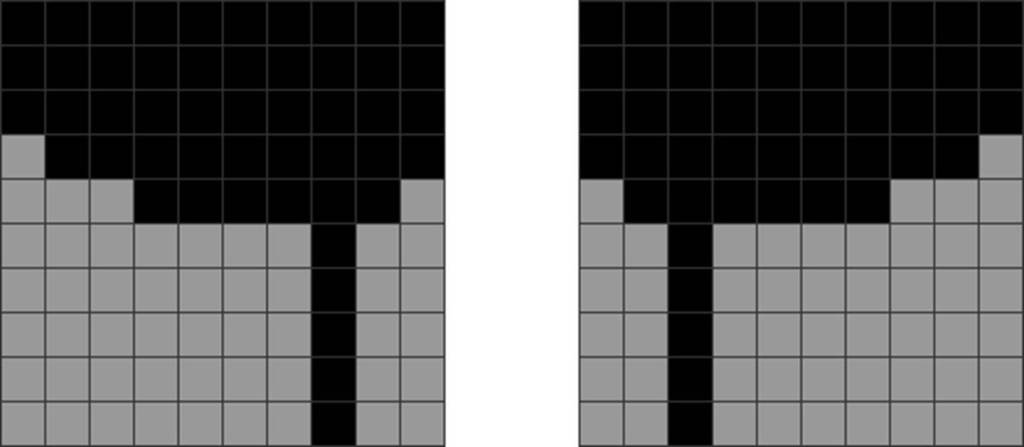
| 7-2 stacking. | 2-7 stacking. |
It sounds obvious, right? 7-2 stacking is the mirrored version of 2-7 stacking.
However, this is a massive misconception because of one reason: some pieces, like the L, J, T, S, and Z pieces, spawn slightly to the left:
| Diagram Set 12-15 | |
| A | B |
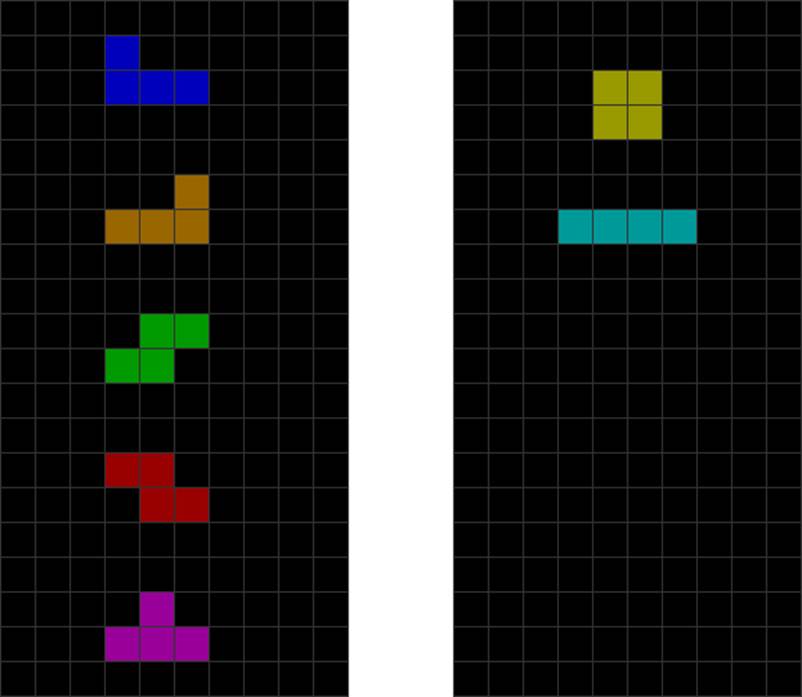
| The L, J, S, Z, and T pieces spawn in these asymmetric positions. | However, the O and I pieces spawn in these symmetric positions. |
Hence, the finesse schemes for each of them would not be mere reflections of their mirrored variants:
| Diagram Set 12-16 | |
| A | B |
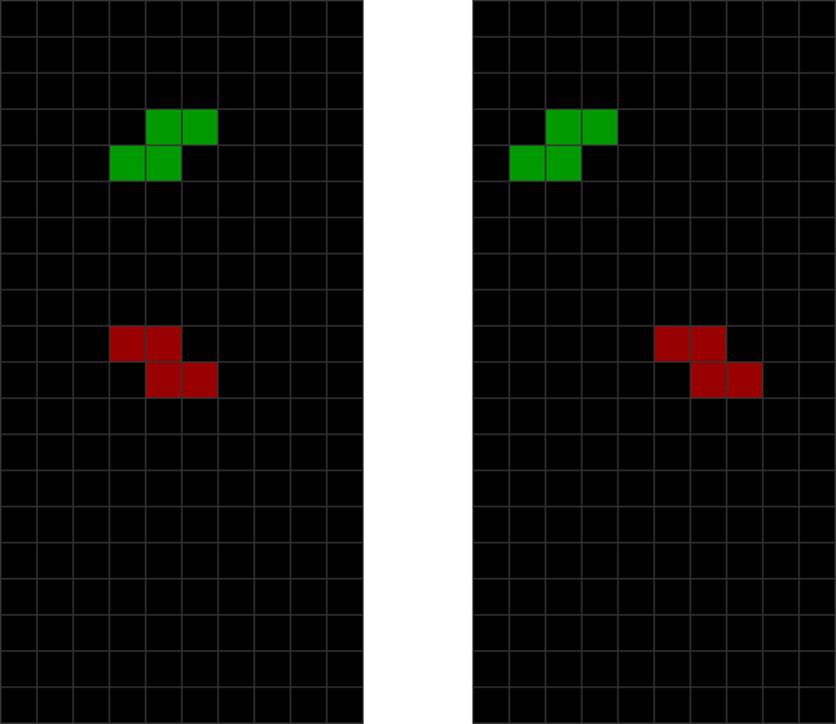
| The S and Z pieces spawn in these 2 orientations. | Their finesse schemes are not symmetric: when you press “move left” twice, the S piece gets to this position. When you press “move right” twice, the Z piece is 2 blocks away from the nearest wall instead of 1 block away. |
Observe the finesse scheme of the S and Z pieces, which mirror each other. Even though they are intended to be placed 1 block away from the edges, their finesse schemes differ.
This is why it is important to train stacking when the main Tetris hole is in columns 1 to 10.
Only by familiarizing yourself with all of them can you truly become a stacking master and handle each case with proficiency.
In a Nutshell
| Key Points |
| Stacking mastery comes from familiarizing yourself with all kinds of stacking forms: 9-0, 8-1, 7-2, 6-3, etc. Every stacking form has its unique finesse schemes. Mirrored stacking forms (6-3 and 3-6, etc.) are not necessarily symmetrical in terms of finesse requirements. |

