“In all chaos there is a cosmos, in all disorder a secret order.”
— Carl Jung
Introduction
The Cosmic Plan
The One that is not the many is imperfect. Those who see not the One in all things are ignorant.
The One that experiences the all-that-there-is, such that there is no more mystery or limitation, has no more room to grow.[1]
This is why the One created the many: to come and realize itself by incarnating in many physical universes.
If reality were seamless and homogeneous, there would be no room for growth. The omniscient One would find no challenge.
Infinity is an undecipherable state. The ancient Greeks suggested that matter has a velocity limit. Without it, everything would manifest everything at once, and we would not make sense of it.[2]
Some physicists suggest that infinity is unstable. If everything traveled at infinite speed, it would destabilize immediately, turning into concrete forms with limited speed.[3]
This provides concreteness and specificity, creating the illusion of time because the speed of light is bounded.[4]
Hence, the purpose of all existence is for the One to experience all facets of reality.
The One needs opposed experiences, such as sadness and joy, good and evil, and pleasure and pain, to have a balanced perspective and complete itself.
And because we are all sparks of an infinite cosmic spirit, our role is to experience the all-that-there-is and contribute to the cosmos’ endless diversity.
Only then can the One complete itself and become whole.
Why Evil and Suffering Exist
One may wonder why the One created and allowed darkness and evil to exist alongside light and good.
Because, just like the space within a window, if the space does not exist, the window may not. No boundaries outlining the end of its glass edges may exist. The window would just be a formless abstraction.
Likewise, if life had been so perfect as to experience only pure bliss, the value of such would be fleeting and unearned. The best dishes are best savored only after one has performed a hard day’s labor.
When one is immersed in the default peace and absolute love of the afterlife after physical life, one would have no challenges. One would not have experienced the pangs of being hated and ostracized and grown out of such.
It would be pure, undifferentiated oneness. When an infinite unity collapses into components, it differentiates, making the experience of polarities possible.
The same can be said for evil and darkness in the long-lasting problem of theodicy.
An entirely good cosmos would not know itself. It would be a good thing freely given, not earned.
Is it better to be born good than to have been born evil, and gone through centuries of deep meditation and repentance to earn the exalted crown of goodness?
Just as some players would not play a video game that is too easy, many souls have volunteered to incarnate on the difficult Earth realm to be tested.
Without trials, the ideals of love, oneness, and truth in the spiritual realm would be untested.
Hence, when a human faces difficult or vile relationships, it is an invitation for the soul not to flee. Instead, it invites the soul to face the darkness and choose radiance amid it.
The brightest candles shine the most, not because they are in the presence of other luminous candles.
Instead, those that shine the most are radiant candles amid everlasting darkness.
Tetris as an Analogy
The whole cannot exist without its parts. The parts cannot be complete without the whole.
This is perfectly illustrated through the example of perfect clears. It is when a player must use line clears to clear the entire field and leave an empty field:
| Diagram Set 14-1 | |
| 1 | 2 |
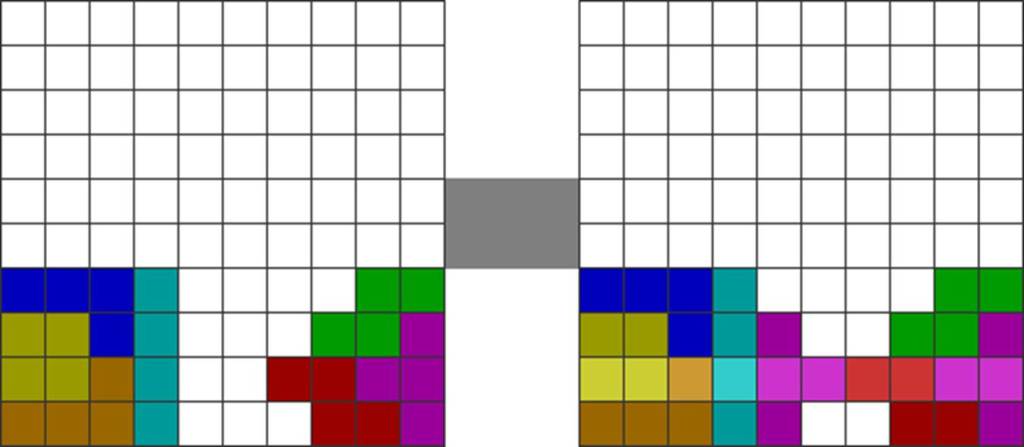
| The player places the 7 distinct minoes in the above configuration. This is a Perfect Clear Opener (PCO). | The player skims with a T piece. This clears 1 row. |
| 3 | 4 |
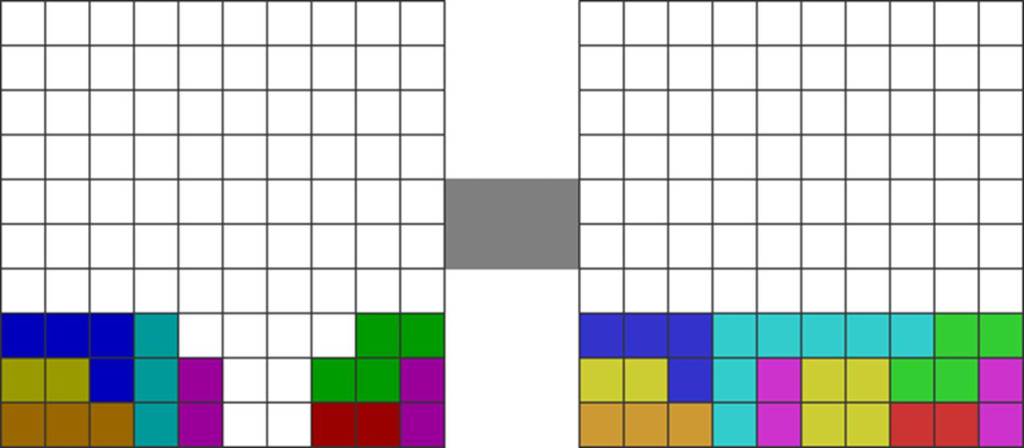
| You are left with this shape. | The player inserts the I and O pieces into the central cavity. It clears the entire field. |
| 5 |

| After the lines have been cleared, you get an empty field. |
The above illustrates a perfect clear. The player sets up the perfect clear opener in step 1. Over steps 2 to 4, the player places some tetrominoes to clear lines and leave an empty field.
Noticed anything? The entire sequence requires all seven unique tetrominoes. Without just one, a perfect clear may not be possible.
This is the same with life. The cosmos needs you, just as you must rely on the cosmos.
Let us consider another case study, based on my personal history in Tetris:
In the Tetris community, you will meet all kinds of individuals. Some are considerate, sensitive, and helpful. Others can be challenging to work with.
Early in my Tetris experience, I faced criticism and exclusion in some community spaces. Discord groups and online forums openly questioned my abilities on platforms like Twitch and Twitter.
The turning point came when the founder of a well-known Tetris group banned me from their community. They accused me of misconduct I never committed.
Being removed based on false accusations was deeply frustrating and felt unjust.
However, this challenging experience ultimately led to significant positive change. It motivated me to step away from that group entirely and stop contributing to their Tetris Wiki site.
I also removed and blocked them, including the group’s founder, permanently from my social media and streaming accounts, creating clear boundaries.
Instead of dwelling on the injustice, I channeled my energy into building something of my own.
I founded my own Tetris guide websites — Galactoid Tetris WordPress and Howtotetris — where I could share my knowledge independently and establish my presence in the Tetris community.
These challenges also allowed me to evaluate my relationships more carefully.
I began distancing myself from interactions that felt toxic or unsupportive, including personal relationships like my ex, which were no longer aligned with my spiritual growth and values.
Looking back, being unjustly banned became a catalyst for growth. The adversity forced me to develop resilience, independence, and clarity about my path forward.
Because of those difficult experiences, I have created extensive Tetris resources that might never have existed otherwise.
This book, alongside my eight Tetris guidebooks, represents work that emerged from choosing to build rather than remain in spaces where I was not valued.
The experience taught me that sometimes being pushed out — even unfairly — can lead to better opportunities than we could have imagined.
I grew from darkness into the light, and I became more complete.
Personal Applications
Negative Experiences Serve a Purpose
Nothing in the cosmos happens without a reason.
According to afterlife and near-death experience studies, many souls arrange their lives voluntarily to experience extreme hardships.
I once read a near-death experience account of a woman who was sexually exploited many times in her life. She likewise attempted suicide many times.
During her near-death experience, her spirit guide lovingly told her that she had arranged to be raped in her life. The soul who volunteered to rape her was one of her best spiritual companions in between many lives.
The goal was to provide her with psychological problems to work through and develop spiritually.
These similar arrangements have also been confirmed through Edgar Cayce (known as the sleeping prophet) readings, in which he read his clients’ karmic and akashic records.
Many came to him with problems. One, in particular, had a difficult divorce. Cayce informed her that the breakup was an opportunity to learn forgiveness. She then embraced it and advanced her consciousness by several levels within a single life.[5]
Nothing in the cosmos is purposeless. Even the mundane act of sloughing through one’s corporate job in a relentless rat race may serve as an experience to reflect upon.
Perhaps, in a few centuries, after a brutal life, the soul may realize in the spirit realm that the experience inspired one to battle corporate greed or exploitation.
The same can be said for many challenging situations that we experience in life.
They are an invitation, arranged by our souls, to act with grace and grow through pain.
It is only from the darkness that the light can burn more radiantly.
Only when we experience the light and dark can we see things more objectively and be whole and complete.
We may never know the whole cosmic plan and purpose of our experiences until they reach fruition far in the future.
But that does not mean giving up the present because life is too hard.
Zen and the Art of Life
Many individuals believe that enlightenment is a state of completion to aspire to.
They think that, once we reach enlightenment, we can give up on physicality and no longer need to reincarnate.
Simply put, they believe the journey has an end state.
I recently read The Cat Who Taught Zen by James Norbury, and the author completely reframes this misconception.
The story is about a cat who seeks a magical tree said to hold the answers to life’s biggest questions.
Along the way, he meets many animals, such as a monkey, a tortoise, a tiger, and another cat, and teaches them many Zen lessons.
Once at the end, the protagonist reaches the mythical tree and meditates on it.
He then realizes that life is an end in itself. That when we become enlightened, it does not mean that we journey to some nirvanic paradise.
Instead, we return to life, embracing life in all its prosperity and challenges, for the obstacle is the path.
That is, Earth provides many lessons for us to learn and master. We are here not because we need to go home, but because we are already home.
The law of completeness simply means completion is not an end state, but an eternal, ongoing journey of expression and manifestation, where we embrace the now.
Social and Global Applications
The Necessity of Turmoil on Earth
Earth is now undergoing a seismic and turbulent shift into the new Earth. During this time, many souls have chosen to incarnate to accelerate their learning.[6]
This is because it may be the last chance, within the current timeline, for souls to work out their problems and learn from darkness before the new Earth dawns.
If they fail, they may have to incarnate in other parallel realities as a different sentient being, not as punishment, but to voluntarily catch up on unlearned lessons.[7]
The world now is indeed fraught with many hardships.
Many countries are over-militarizing. Many corporations are exploiting less developed countries and individuals. Life feels alienating and difficult amid the inflation and financial volatility we are all going through.
However, they also give us ample opportunities to exercise free will.
Many souls now have the opportunity to become visionaries and leaders in transforming the old Earth into a new one.
The time is now. Have you had your fill of such?
Earth as an Experiment
Winston Churchill famously said that “democracy is the worst form of government except for all those other forms that have been tried from time to time.”
Many schools of thought have championed democracy and the free market above all other systems.[8]
As such, many Western countries use this to justify their system of governance.
However, in my view, this is political and economic chauvinism.
By itself, there is no harm in Western countries holding on to this view. The only problem comes when some of them use military interventionism to socially engineer other countries (like Iraq and Afghanistan) to implement it.
Most of these attempts failed.
This is because every country has its unique history and culture. They must find the most appropriate path to growth based on their own context.
For instance, many economists advocate that India should follow China’s developmental model.
However, this is not appropriate because India differs in many aspects. It is ethnically non-homogeneous, has an election-based democracy, focuses more on services than manufacturing, and missed the period of globalized trade from the 1990s to the early 2000s.
India would then have to find its own means to attain prosperity.
The same goes for other non-Western forms of government.
Who is to say that non-free-market systems are inefficient?
China’s state-led developmental model helped lift 800 million people out of poverty, implemented the world’s longest high-speed rail system, and built the world’s largest manufacturing base.[9]
They did it, to a large extent, without adhering to the West’s insistence on Western-style democracy or the free market system.
Europe is also known to have a form of socialist system. Countries such as Australia and Canada have variants of such systems.
Purists in the United States may find such systems inappropriate. However, the Scandinavian countries have among the highest literacy rates, happiness, and life expectancy while using this socialist system.
They also have some forms of robust social safety nets and welfare systems, health coverage, and security.
The point is that, per the law of completeness, every nation is part of the whole, exploring and experimenting with different social systems.
Instead of insisting that one system is always right, we should recognize that each system may have benefits over others in some respects.[10]
China applied this well by combining the best of capitalism and socialism, which helped it rise to superpower status.
If it had not been for the social experiments of other countries, it would not have known this effective combination.
Likewise, if the entire world had simply adhered to a single economic, social, and political system, we would not have known of their alternatives.
Social reality is like a massive computer simulation. Its many parts explore questions and find solutions. Without the parts, the whole would not be complete.
The same is true of spiritual reality. The all-that-there-is is constantly experimenting with new forms of consciousness and physical bodies. Life is a cosmic experiment.
And we are fortunate enough to participate in its unending evolution.
Live and let live, and to each their own, for diversity is the spice of life.
[1] US Army Lieutenant Colonel Wayne M. McDonnell, Analysis and Assessment of the Gateway Process (1983), declassified by the CIA in 2003. The report concludes that upon returning to the Absolute, consciousness loses its differentiated free will and individual expansion.
[2] Aristotle, Physics (c. 350 BCE). Aristotle argued that infinite velocity was impossible — motion needs time, making instantaneous travel a contradiction.
[3] John Barrow and Frank Tipler, The Anthropic Cosmological Principle (1986). Documents how bounded physical constants, like the speed of light, make a stable, structured universe possible.
[4] Brian Greene, The Fabric of the Cosmos (2004). Greene explores how the bounded speed of light creates the ordered, finite experience of reality.
[5] Edgar Cayce readings, compiled in Noel Langley, Edgar Cayce on Reincarnation (1967); see also Kevin Williams, Near-Death Experiences and the Afterlife, http://www.near-death.com, for Cayce case studies on karmic lessons and soul advancement.
[6] Lee Carroll, Kryon channeling; see http://www.kryon.com. The Kryon material describes the current planetary transition and souls choosing to incarnate during this critical window.
[7] Dolores Cannon, The Convoluted Universe, Book 3 (2008). Cannon’s QHHT regression sessions described souls who fail to evolve during Earth’s current ascension window as remaining in lower vibrational realms or reincarnating in other dimensions and timelines to continue their lessons.
[8] Francis Fukuyama, The End of History and the Last Man (1992). Fukuyama argued that Western liberal democracy represented the final form of human government. Subsequent history has challenged this.
[9] Jin Keyu, The New China Playbook (2023). Jin documents how China’s state-led developmental model combined elements of capitalism and socialism to lift 800 million people out of poverty, showing that non-Western developmental paths can achieve outcomes Western models could not.
[10] Ha-Joon Chang, Bad Samaritans: The Myth of Free Trade and the Secret History of Capitalism (2007). Chang shows that no single universal economic model fits all nations.

