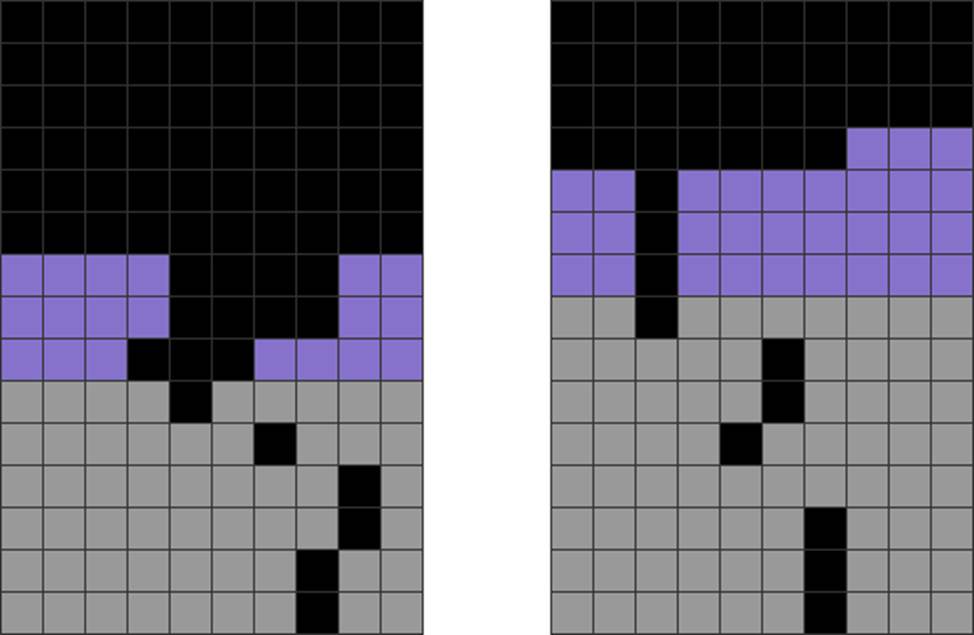
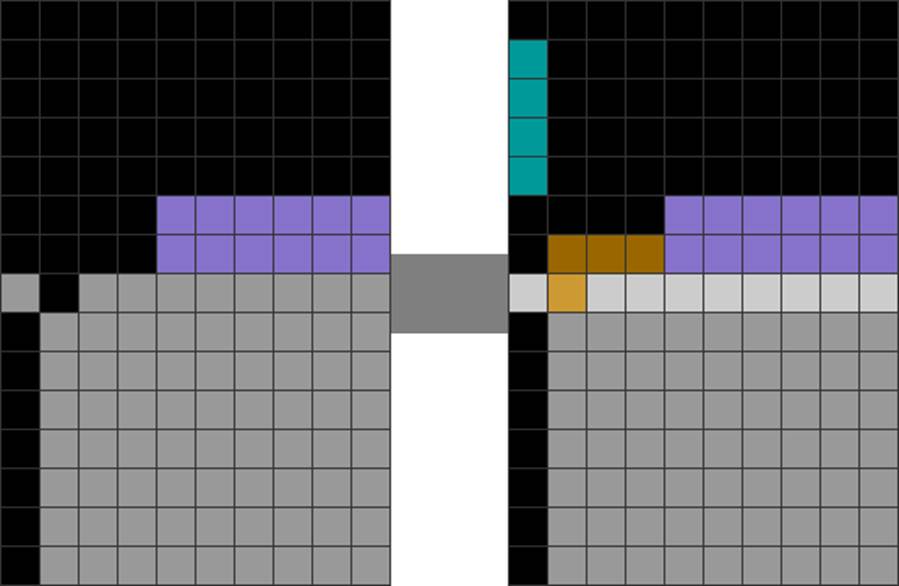
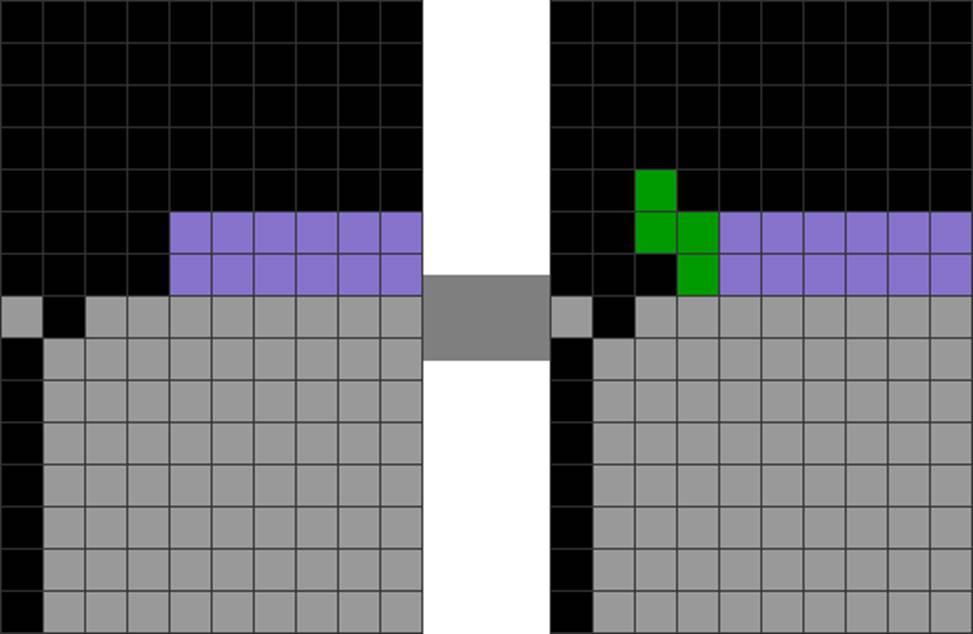
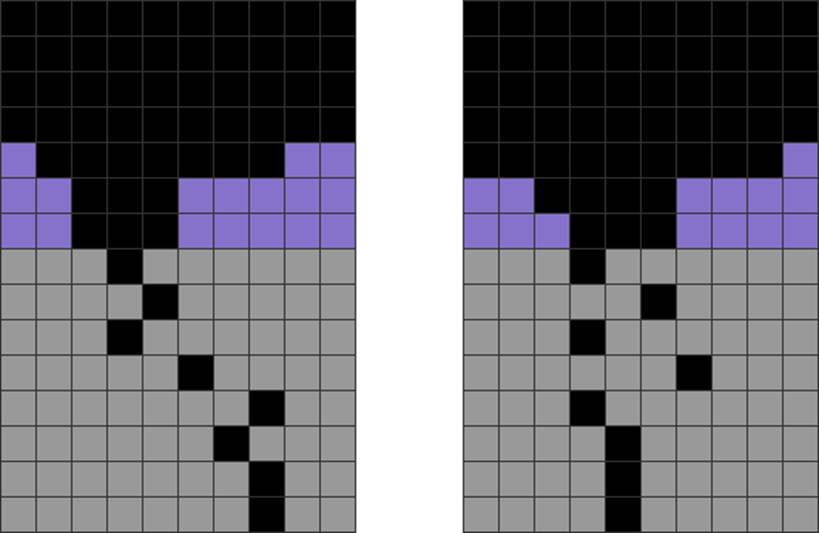
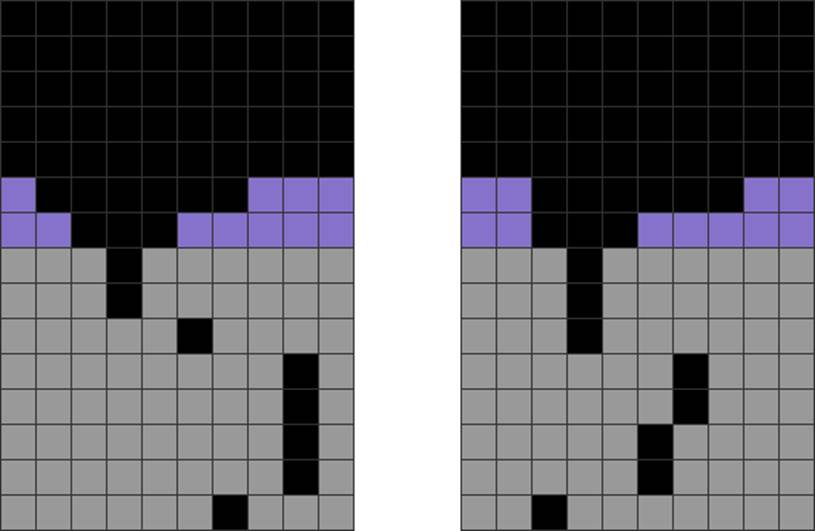
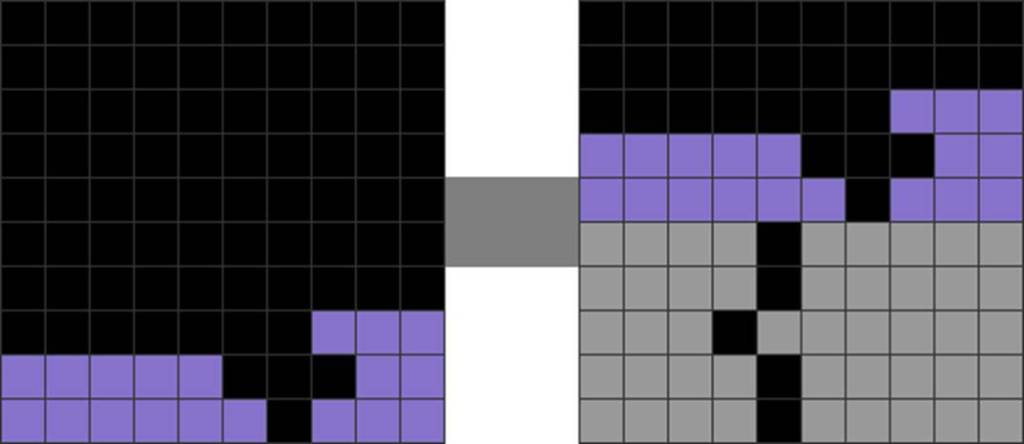
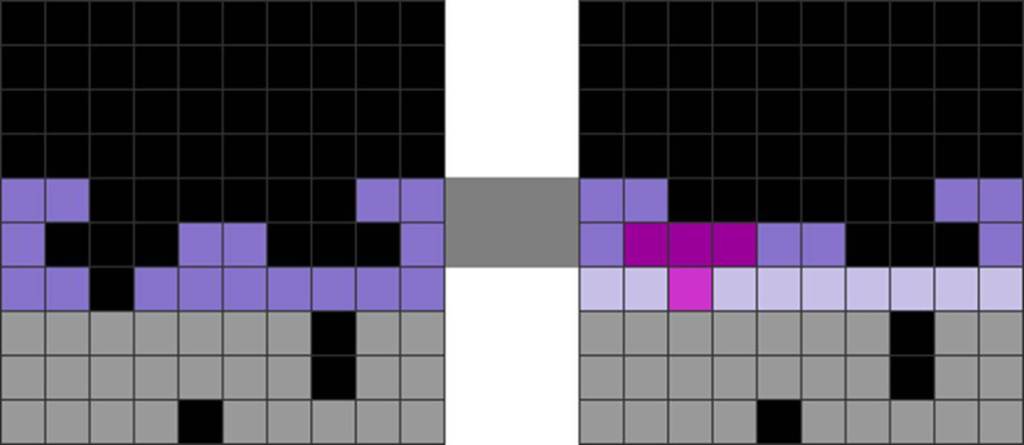
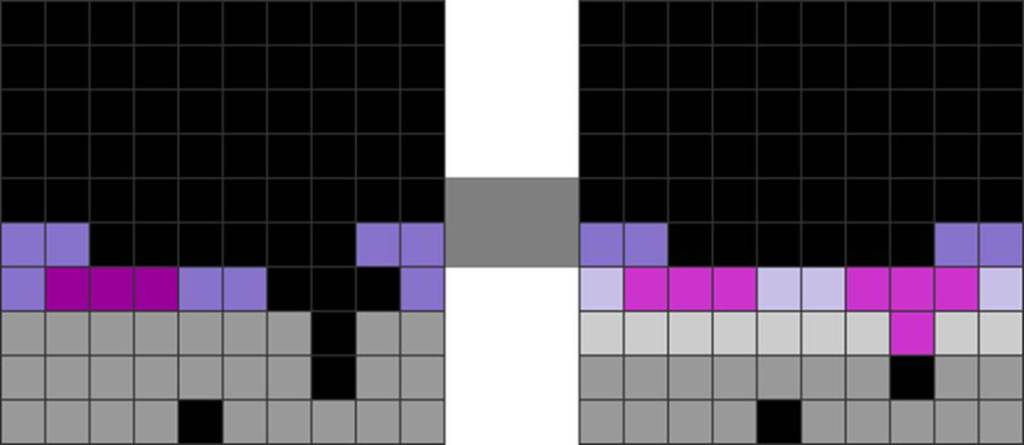
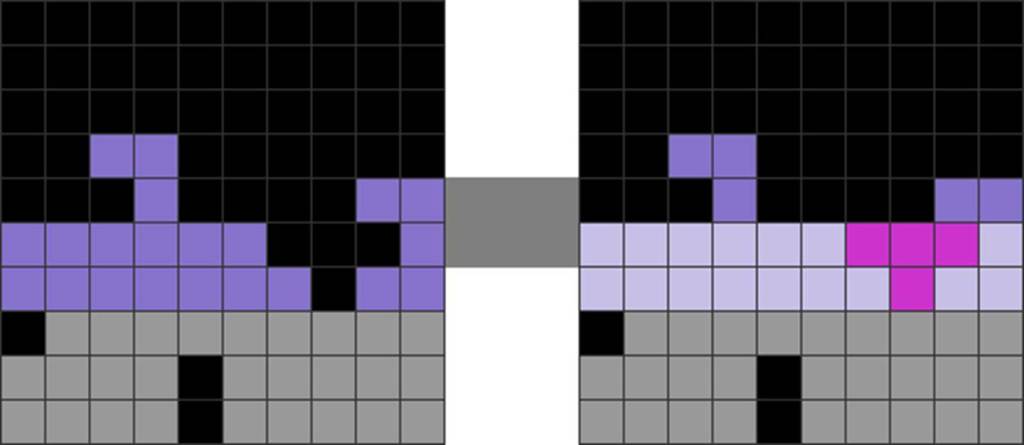
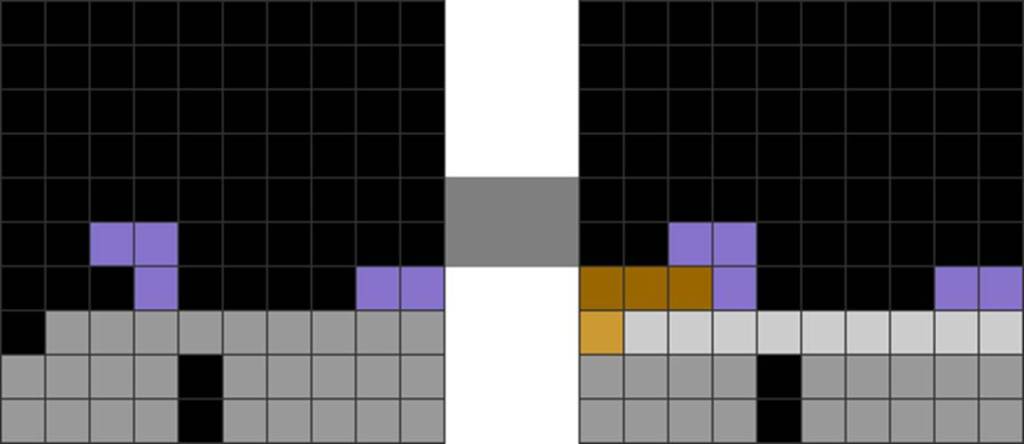
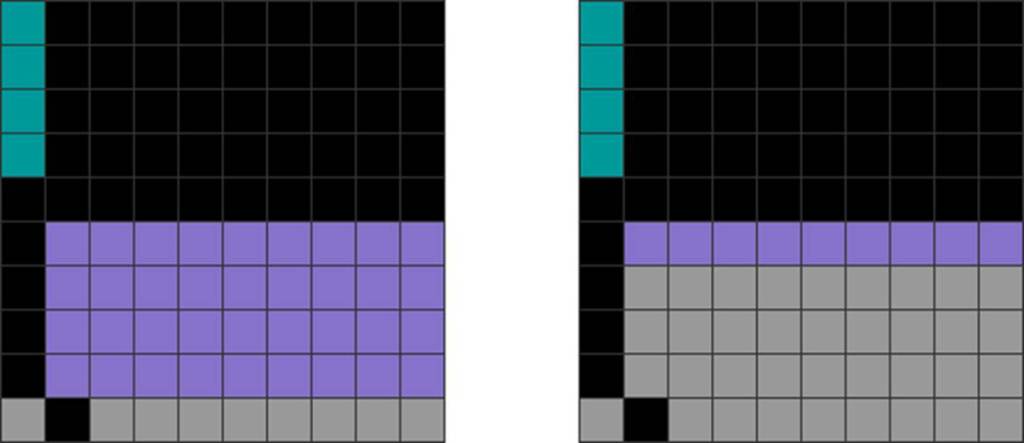
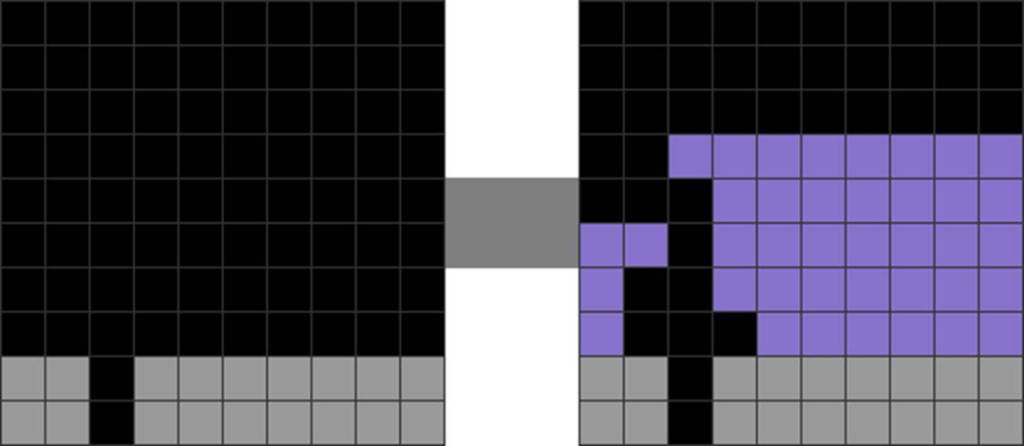
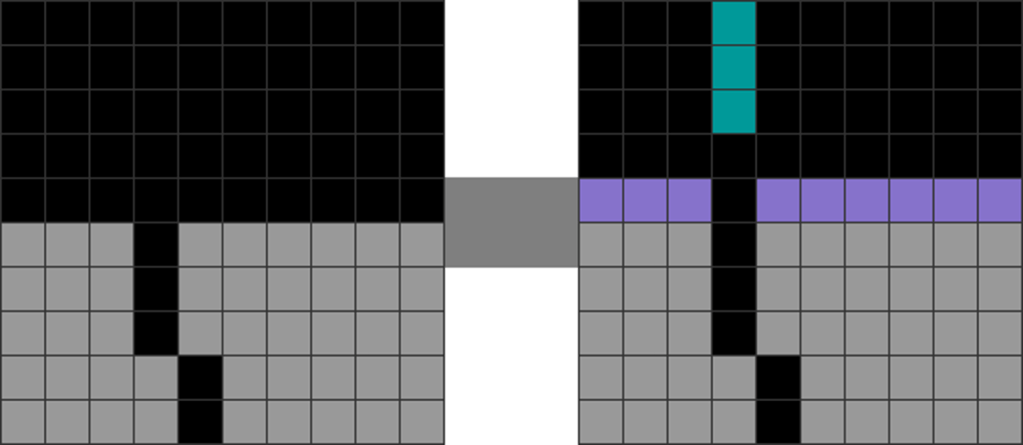
Mastery of Tetris comes largely from the mid-game, where you must harmonize the upstacked, colored blocks with the garbage patterns beneath them:
Diagram Set 16-1
A
B
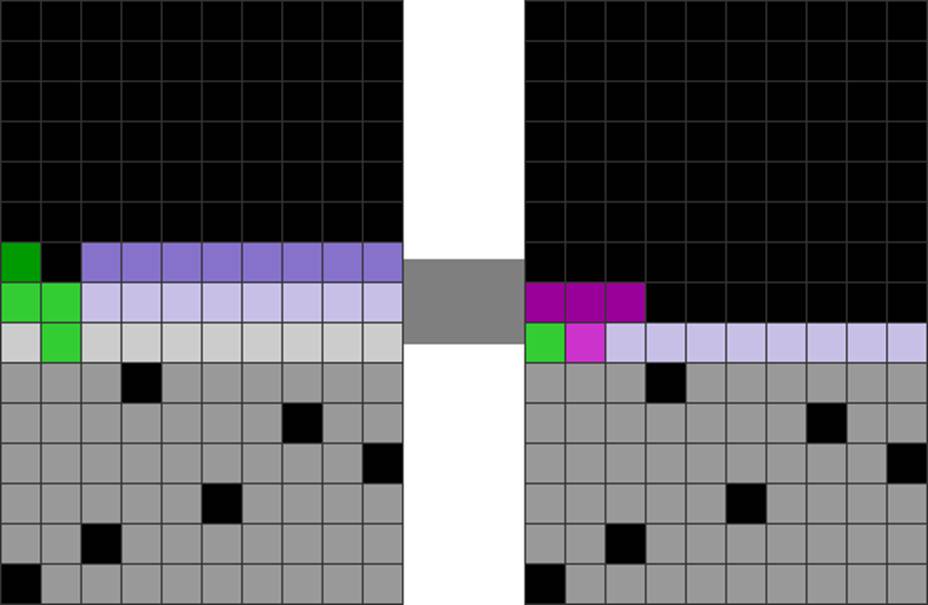
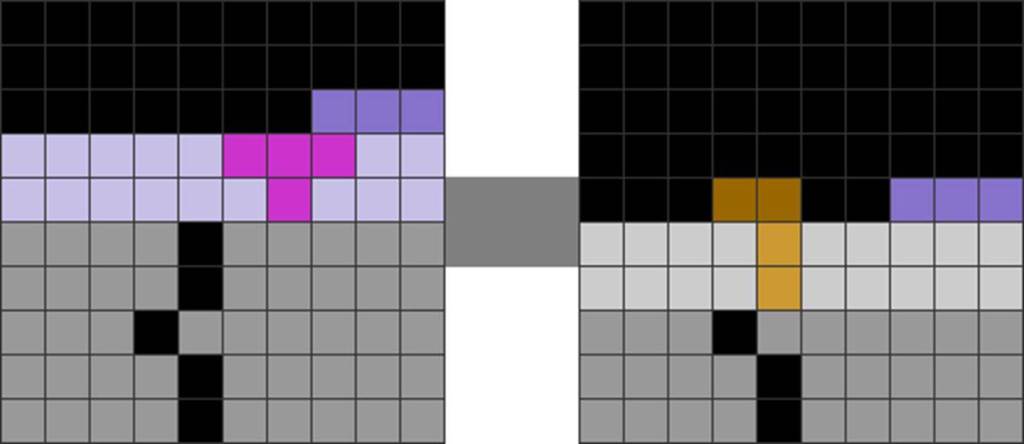
The player harmonizes the lavender, upstacked blocks with the gray, garbage blocks to make a T-spin double.
Same, but they make a Tetris instead.
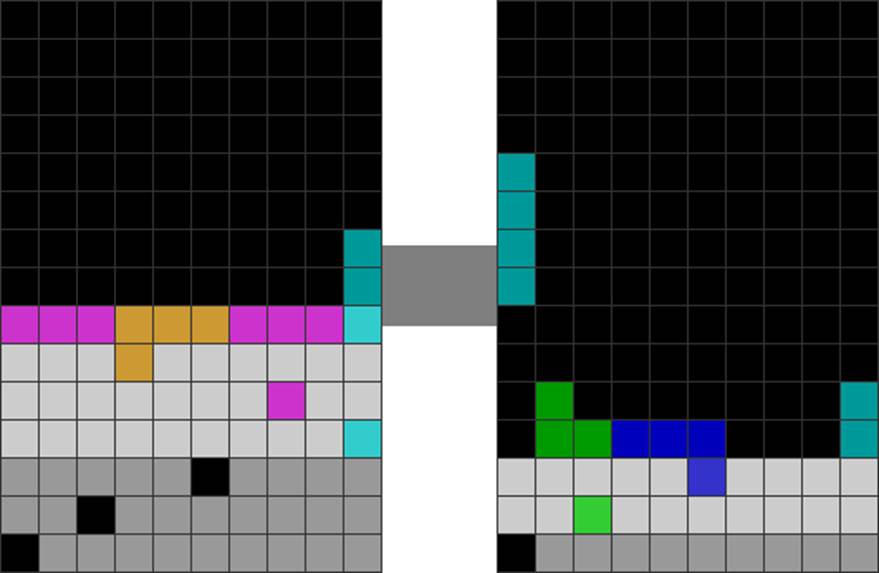
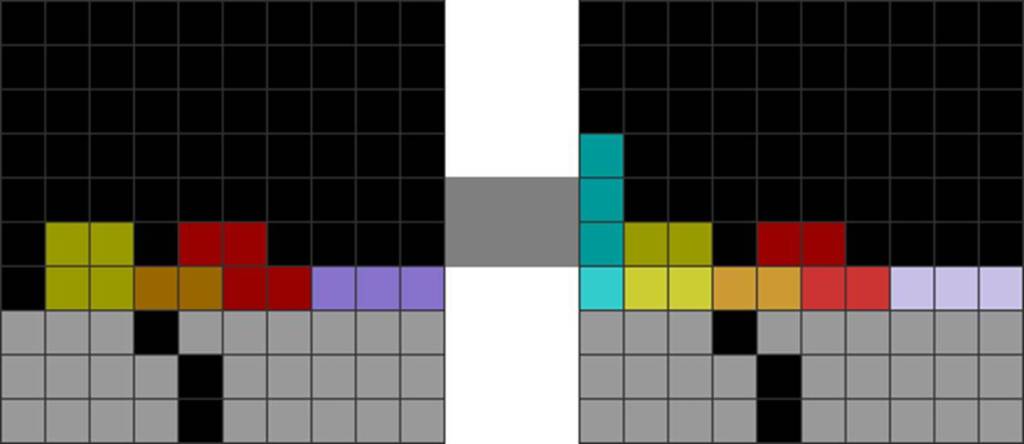
Here, an experienced player arranges the top, colored, upstacked blocks to adapt to the garbage patterns.
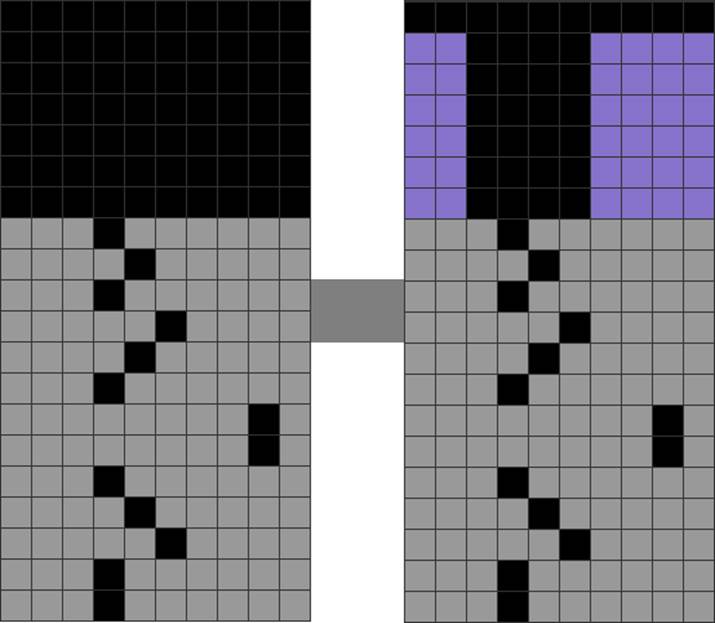
After A’s initial T-spin, the former’s overhang connects with the garbage, forming a secondary T-spin.
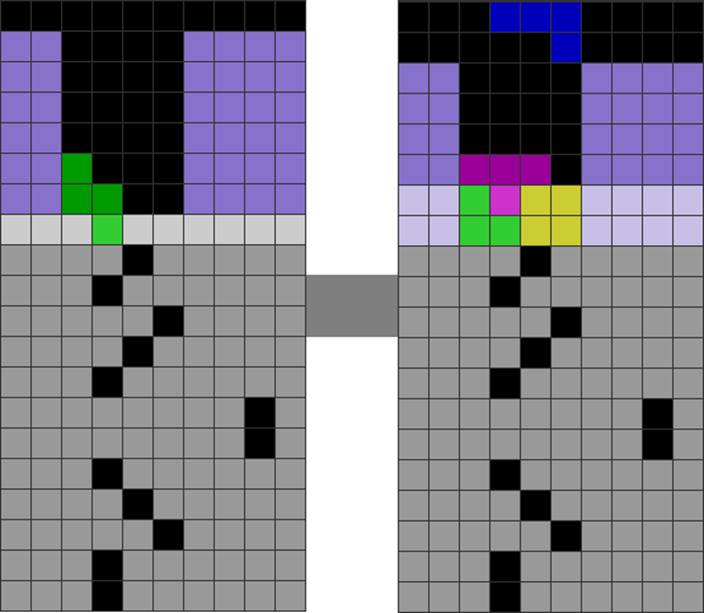
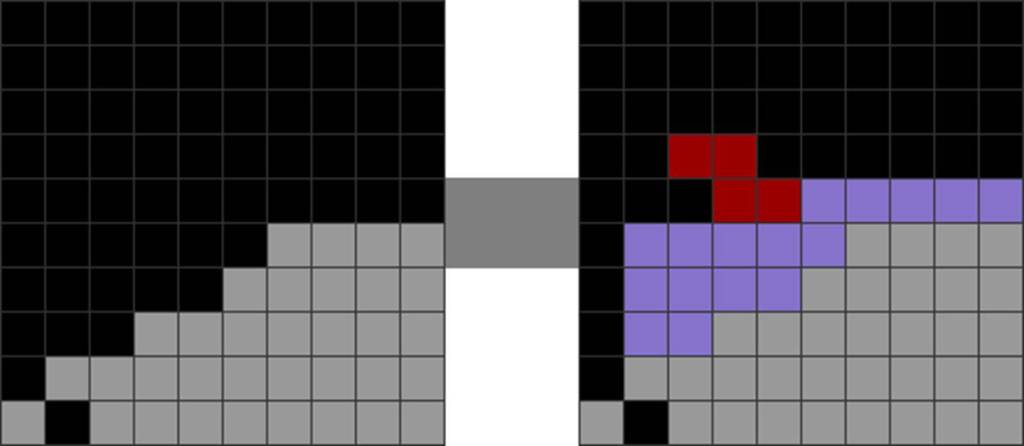
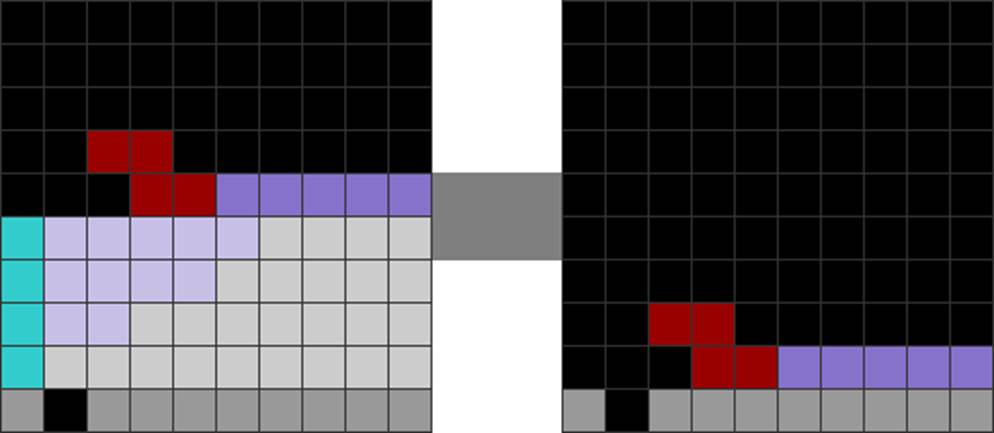
Outstanding Tetris players also plan ahead, harmonizing the 2 block types to optimize their downstacking.
What to Train for the Mid-Game
Many players assume the “mid-game” is a black box where anything goes, and that they should just freestyle it.
However, the mid-game has very specific things to note and train. Here are the core ones:
Downstacking According to Garbage Hole Patterns
It is very important to observe the kind of garbage hole you are receiving, and respond accordingly to them:
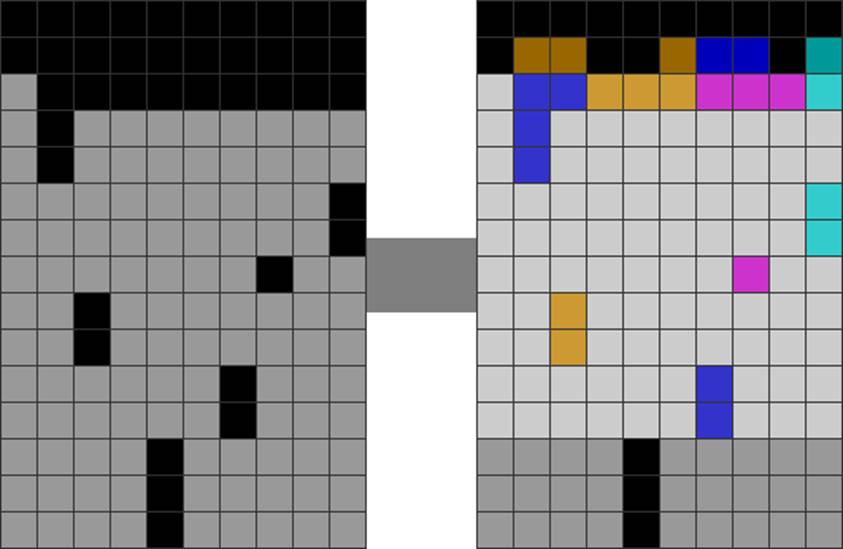
Diagram Set 16-2
1
2
A T-spin double chance. Can you spot it?
The player gives up the T-spin double chance. They skim and go for a Tetris line clear instead.
Here, the garbage is very clean. You only have to skim off several colored, upstacked rows to get down to them. This lets you insert an I piece into the hole to counter-spike and defend.
Some riskier players, however, may wish to upstack to sustain back-to-backs like this:
Diagram Set 16-3
1
2
The same starting field as the last diagram set.
Now, the player goes for the T-spin double chance.
Which one is “correct” depends on your playstyle. A more balanced, defensive player may prioritize getting down, even if it means breaking back-to-back bonuses. Riskier, more aggressive players may upstack to sustain back-to-backs.
In other situations, garbage may be extremely dirty, such as these situations:
Spread-out dirty garbage typically allows one to get a lot of mid-game freestyle downstack opportunities, such as:
Diagram Set 16-5
1
2
The player downstacks with S and T, using the lavender blocks as combo fuel.
3
4
They continue the downstack by not covering future garbage holes. This extends the combo.
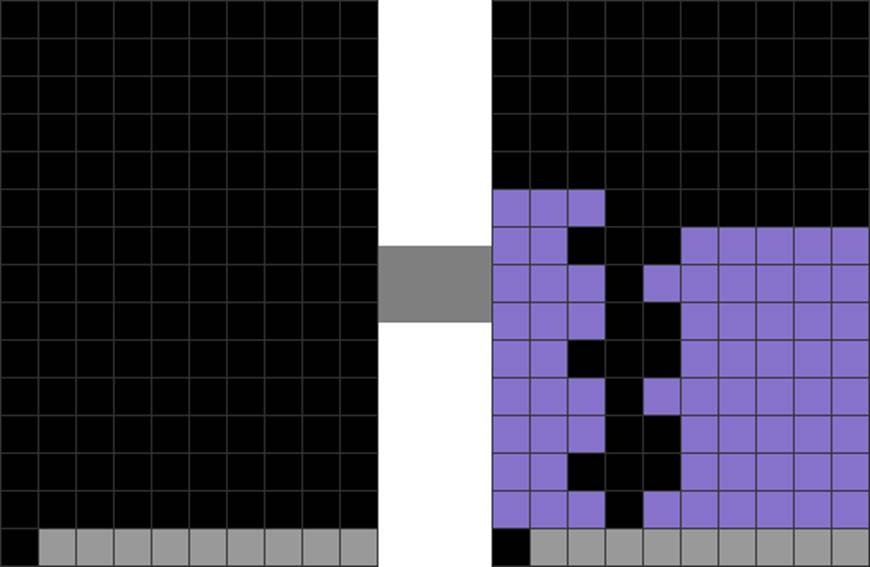
Clustered, overlapping garbage patterns typically require one to upstack around the concentrated garbage holes before beginning a downstack combo sequence:
Diagram Set 16-6
1
2
Dirty overlapping garbage situation.
Upstack 2 towers on the left and right for a mid-game 4-wide.
3
4
Start the downstack combo.
Extend it for as long as possible.
In other cases, garbage is most likely a mixture of clean and dirty patterns:
Diagram Set 16-7
A
B
Semi-clean garbage patterns.
Same. Another variation.
In such cases, the player has to freestyle and find a proper balance between sustaining back-to-backs or giving these up to go for downstack combos:
Diagram Set 16-8
1
2
The garbage is semi-clean.
There is significant downstack combo continuation.
Regardless, the reason why I spend so much time explaining the types of garbage patterns is that many players believe they are “experts” because they can sustain back-to-back T-spins in situations like these:
Diagram Set 16-9
1
2
The player only receives 1 row of garbage.
So they upstack the lavender parts to make many T-spin doubles.
In these situations, the player gets little garbage. They only use colored, upstacked blocks to make T-spins. However, when they receive garbage, they make inefficient or dirty choices like these:
Diagram Set 16-10
1
2
The player upstacks the lavender parts to make a T-spin double.
They receive 5 new garbage lines.
3
4
The player makes the T-spin double line clear.
They lose momentum by making a double line clear.
5
6
The aftermath field is dirty! The double’s orange block (left by the L piece) blocks the next garbage hole.
The player must then spend valuable line clear delay time to skim off the orange, obstructing block.
This causes them to lose pressure.
Hence, a true Tetris master adapts to the garbage instead of ignoring it. True mid-game mastery comes from maximizing back-to-backs and combos while downstacking.
Forecasted Setups from Garbage Patterns
Continuing from the last subsection, you can only make some important setups if you receive garbage.
These are called forecasted or prophecy garbage setups. Many players neglect these and believe they are already “experts.”
Diagram Set 16-11
1
2
The player upstacks the lavender part and puts the Z this way.
3
4
After the Tetris quad, the Z piece connects with the bottom garbage hole, creating a T-spin double.
Here, the player glances at the field and quickly calculates. They stack in a way that harmonizes the top, colored, upstacked layers with the garbage hole. After the Tetris line clear, the overhang connects and forms an immediate T-spin!
This can happen in other setups:
Diagram Set 16-12
1
2
Starting field with 2 T-spins. Do you see the second one?
The first T-spin single line clear concludes.
3
4
The lavender overhangs join the gray garbage pattern, creating a T-spin double follow-up.
The player concludes the second T-spin double line clear.
Here, the player forecasts an overhang by stacking the colored, upstacked blocks properly. After the first T-spin, the overhang connects with the garbage, creating another immediate T-spin!
This can also happen for forecasted all-spin setups:
Diagram Set 16-13
1
2
The player makes a T-spin double to a forecasted L-spin single. Do you see the latter?
The first T-spin double line clear concludes.
3
4
The aftermath field. The lavender overhang joins the gray garbage blocks, making an L-spin single.
The player makes the L-spin single line clear.
Here, the player sets up a T-spin. However, they pre-stacked the overhang, which connects to the garbage hole after the line clears. This creates an L-spin, which sustains back-to-backs in some Tetris games like TETR.IO.
Overall, a strategic, experienced Tetris player harmonizes the colored, upstacked blocks with the garbage-block patterns beneath.
An inexperienced player focuses only on the upstacked, colored blocks and their setups, while ignoring the garbage patterns.
Efficiency and Garbage
Another vital point is to stack flat and minimize upstacked, colored-block rows relative to garbage rows.
Sometimes this is not possible, and you must upstack aggressively.
However, in Book 4, I explain why you should prioritize the former.
The exact reason is hard to explain fully here. However, keeping your upstacked, colored rows-to-garbage rows ratio low increases your efficiency:
Diagram Set 16-14
A
B
A Tetris made from upstacking 4 lines. This takes a lot of time and is inefficient.
A Tetris upgraded from 3 lines of garbage by stacking only 1 lavender row. This takes far less time to create and is very efficient.
In A, the player needs to upstack 4 rows to make a complete Tetris. That is typically around 10 manually placed pieces. In B, 3 rows are garbage rows. The player only needs to place a few pieces to complete a top layer to make a perfect Tetris.
Therefore, B is obviously more efficient and quicker to construct than A.
Fundamentally, every garbage line you receive is a “free” set of 10 blocks (or 2.5 pieces) that you do not have to create from nothing.
Diagram Set 16-15
1
2
2 lines of free garbage.
The player creates a DT Cannon. 5 lines are upstacked instead of the usual 7, making it more efficient.
Above, the player needs to upstack 5 rows to make a complete DT Cannon. The other 2 rows are “free” garbage lines that the player has already received. This is compared to upstacking an entire DT Cannon from nothing, which takes 7 rows.
So, this takes less time and is more time-efficient.
During the mid-game, upgrading free garbage lines to clean Tetrises is among one of the most efficient attacks in Tetris:
Diagram Set 16-16
1
2
Starting field with 3 lines of clean garbage in the top 3 rows.
Upgrade it with 1 line of upstack (lavender blocks) for a clean Tetris.
Hence, a Tetris player should note this efficiency metric when training for mid-game tactical decision-making.
In a Nutshell
Key Points
Tetris mid-game mastery comes not from simply making setups using the upstacked, colored blocks.
Instead, it comes from harmonizing the upstacked, colored blocks with the gray garbage blocks beneath.
A player should harmonize the two to make forecasted all-spin, T-spin, combo, Tetris, and downstacking setups.
A player should upstack over free garbage lines to upgrade them, using them as fuel for more efficient attacks.