“Nothing is permanent in this world, not even our troubles.”
—Charlie Chaplin
Introduction
The Buddha was right: everything exists in accordance with the law of change. Nothing is ever permanent.
Physical, material things, such as wealth, status, health, appearances, or reputation, will all fade away with the passage of time.
Only spiritual, intellectual, creative, artistic, psychological, or emotional traits and abilities that we learn throughout or in between lives are carried over to the other side.
Matter is temporary. Spirit is eternal.
Because there is no time or space on the other side of the veil, once something has been learned, it becomes forever internalized in spirit, which is pure, timeless existence.
A pain endured and overcome in one lifetime is a gain for all eternity.
Tetris as an Analogy
Nothing is permanent, not even terrible situations. I illustrate this below:
| Diagram Set 17-1 | |
| 1 | 2 |

| Starting shape with an OT prop. This seems like a dead-end. | The player does not panic. An S-spin double concludes. |
| 3 | 4 |
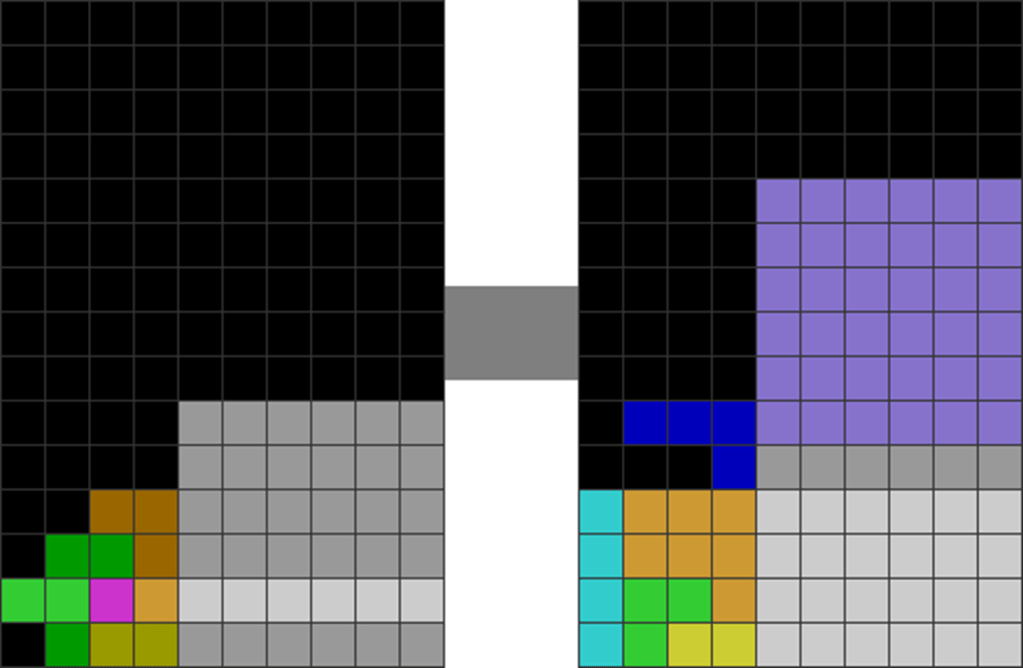
| Put L as an overhang and make an S-spin single. | Upstack the remaining shape with an L to make a Tetris. Then, top it with a J piece. You can make a J-spin double after this. |
Here, the player wanted to set up a 4-wide combo in step 1. This is a potent setup that leads to a massive downstack combo attack. However, he misdrops the T piece over the O piece. This seems to be curtains for him.
However, in games like TETR.IO that reward all-spins (such as an S-spin) with bonus attacks, this is wonderful.
In step 2, the player performs an S-spin double, triggering a back-to-back bonus. In step 3, he makes another S-spin single, sending even more bonus damage through the surge meter, which compounds with each sustained and unbroken back-to-back attack.
Finally, in step 4, the player upstacks to a back-to-back Tetris. He then places a J piece over it, which creates a 4-wide combo opportunity.
In non-Tetris layperson terms, the whole sequence means the player initially messed up. However, the problem is only temporary. He does not give up; instead, he improvises and gets out of it. He eventually rebounds and is in better shape than in the first step.
If one had given up earlier, one would not have seen the whole totality of such a marvelous sequence.
In Tetris, I often marvel at how many players take the game so seriously that they exalt their external accomplishments above all else.
Many players have grown frustrated, depressed, angered, and exhausted over the incessant need to maintain their rank or rating in some Tetris games.
These players continuously ‘grind’ to achieve a specific 40-line score, fearing that others will judge them as slow if they do not get a decent score.
Others get explosive with anger when they are defeated. I have seen many such cases on Twitch involving Tetris streamers.
Then, there were dramas in many Tetris communities because some players were so determined to be number one in certain areas that they engaged in questionable activities. I will not name these examples to protect their identities.
However, the reality is that such external accomplishments that mandate social validation are both empty and impermanent.
Most top Tetris players are between 14 and 20 because processing speed and reflexes peak around this age.
As one ages, one loses more and more of one’s reflexes. This naturally results in lower 40-line sprint scores or ultra scores. Eventually, the younger will always replace the old.
External achievements will hence fade in importance over time. The only thing that remains is experience.
As one gains more experience with Tetris, there is more to reflect on. In my case, after advancing to a sufficient level (per my standards) in Tetris, I began integrating my lessons to write my Tetris guidebook series and author this book. I have found many spiritual and philosophical lessons in the game.
Even though my reflexes have slowed (I am in my late thirties as I write this), the experiences I have gained are a gain for all eternity, with many applications in real life.
I have almost no attachments to Tetris left. It has served its role and completed it to my satisfaction.
Personal Applications
To apply the law of impermanence, introspect and see how many things are impermanent.
Here is a list of the common ones:
- Outcomes are a form of attachment: when we force an outcome, we want it to meet our expectations. However, when it does not get achieved, we get disappointed. Instead, see life not as a linear movement from A to B, but as a star radiating lines in all directions. If a desired outcome does not occur, determine where each alternate radial path leads. In there, you may find something more important and relevant.
- Status and prestige: Many people have over-identified with bodily and material consciousness. They judge potential love partners solely by salary, looks, external achievements, job title, and mating potential.
- Money and wealth: Many people identify with the number of houses, the size of their stock portfolio, luxury cars, and the black caviar they have on their tables.
- Physical appearance and youth: These are impermanent. However, many teenage girls often compare themselves to others on Instagram and other social media platforms. Many have committed suicide because they failed to reach their ideal image.
- Academic grades and intelligence: A person is not defined by a number. However, many high-IQ societies exist in which people brag about their intelligence to boost their egos.
- Credentials: These are likewise illusory. They may not equate to actual experience, skills, or knowledge.
Once you have identified a list, you can more easily detach from it. You can then focus on the more eternal spiritual aspects, such as:
- Creative and artistic endeavors: This can be any form of art, be it poetry, stories, novels, architecture, painting, music, dance, and more.
- Intellectual pursuits: This can include reading, scientific research, inventing, solving technological problems, or philosophizing and debating.
- Personality traits: One can work on one’s negative karma and replace it with positive ones to evolve spiritually.
- Humanity: One can cultivate the love of oneself and others and generously help and guide others.
- Joy: Engage in any activity that makes one happy, but is harmonized with a bigger purpose.
- Social bonding: It can be any bonding with a partner, a friend, family, or a larger social group.
- Social activism: This can be any pursuit that improves the lot of humanity and combats social injustices.
- Healing gifts: One can use their gifts to help others with psychological or physical problems.
Social and Global Applications
People often become highly attached to specific groups, organizations, countries, or broader entities.
As an ardent observer of modern geopolitics, I have witnessed how politics can negatively intervene in one’s life.
In the United States, I see people so over-identified with specific parties that they can sometimes be unable to accept people of different views.
In many others, I see people overly identified with their religions, to the point that they can sometimes impose their beliefs on others.
We have now entered a period of “wokeness,” where many socially aware people have become overly identified with their groups. They ironically fragmented themselves into specific groups.
Likewise, many people over-identify themselves as American, Japanese, Chinese, European, Indian, Arabian, and so forth. They mindlessly heed their leaders’ words and become aggressive towards specific countries.
This sometimes leads to tribalism, where the entire world fragments into groups rather than cohering.
However, many of these broader organizations are only temporary. Even the longest-lasting civilizations will be gone within a few thousand years.
Many of these broader identifications are mere objectifications. We identify with a country because our history books and education system socialize us to do so.
But deep down, we are all fragments of an undivided Oneness.
So why overly identify with some impermanent group and use it to justify divisions and exclusion within humanity and the cosmos?
 How to Tetris