“Nothing is permanent in this wicked world — not even our troubles.”
— Charlie Chaplin
Introduction
The Impermanence of Matter and the Permanence of Spirit
In Buddhist philosophy, everything is subject to the law of change. Nothing is permanent.
Physical, material things such as wealth, status, health, appearance, and reputation will all fade with time.
Only spiritual, intellectual, creative, artistic, psychological, or emotional traits and abilities that we learn throughout or in between lives are carried over to the other side.
Matter is temporary. Spirit is eternal.
Hence, many spiritually awake people focus more on their inner development.
But if so, what is the purpose of the material world?
Afterlife studies suggest that once something is learned in a lifetime, it becomes permanently internalized in spirit, which is pure, timeless existence.[1]
Pain endured and overcome in one lifetime becomes a gain for all eternity.
Hence, the temporary material world and forms are vessels we can use to master spiritual lessons.
Without the material world, we would have no means to translate spiritual ideals into action.
Living physically forever may not be ideal either. People may simply feel no urgency to act.
Some people may fear death. However, our life’s impermanence can provide the urgency to carry out important tasks.[2]
The physicist Stephen Hawking was diagnosed with motor neuron disease at age twenty-one and was told he had two years to live.
This gave him intense purpose and the diligence to make the most of the time he had left.
Tetris as an Analogy
Why is the physical and material world needed, despite its temporary nature, for spiritual growth?
I ask you: is it possible to master Tetris with only textbooks, without playing any temporary matches (analogously, each temporary match is like a human incarnation)?
When I was a Tetris novice, I spent my first year largely memorizing hundreds of openers and theorizing about Tetris.
However, I did not play the game much.
So when I finally did, I believed I was a Tetris expert because of my knowledge, and I battled many strong Tetris players, such as Cosin, Popte, Onizuka, RJ, Davdav, and Captivate on Puyo Puyo Tetris.
I had a perfect record: I lost to all of them.
So I started taking Tetris seriously, moving beyond theory and playing real matches.
Each Tetris match gave me an opportunity to unify theory with practice. I then played Tetris 99 for many years, fighting strong opponents such as Amemiya, Tomo, Supernooba, Feli, and Doremy.[3]
Each one hardened me until I fully internalized the essential tactical and strategic Tetris guidelines.
The same is true of life. Every life broadens our perspective, offering experiences to reflect on and grow from.[4]
Without them, we would be mere untested spirit beings.
The law of permanence also teaches us to cope with difficult situations.
Nothing is permanent, not even terrible situations. I illustrate this below:
| Diagram Set 17-1 | |
| 1 | 2 |
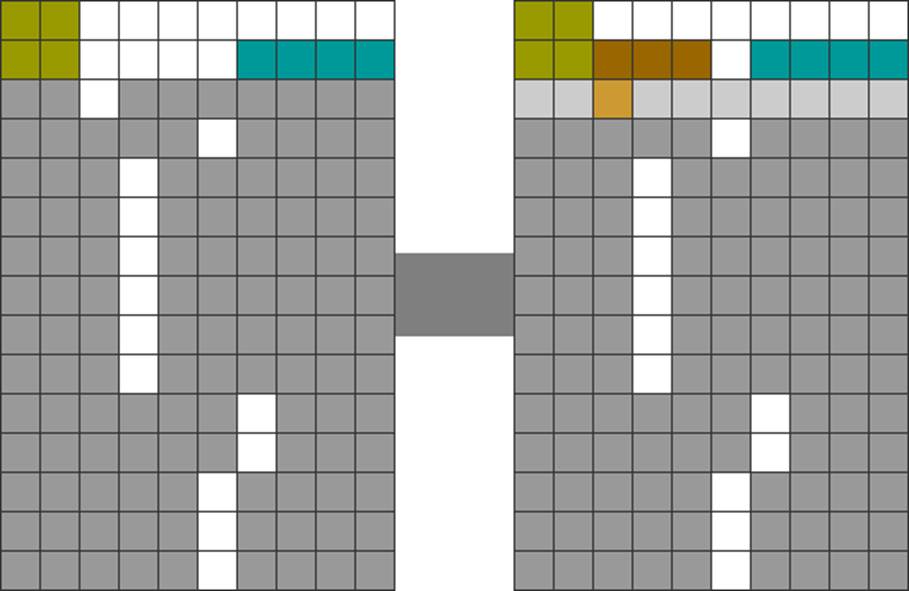
| The player is very close to the field’s top. If he receives just a few more garbage lines, he will lose. | The player does not panic. He digs down, starting with an L piece. |
| 3 | 4 |
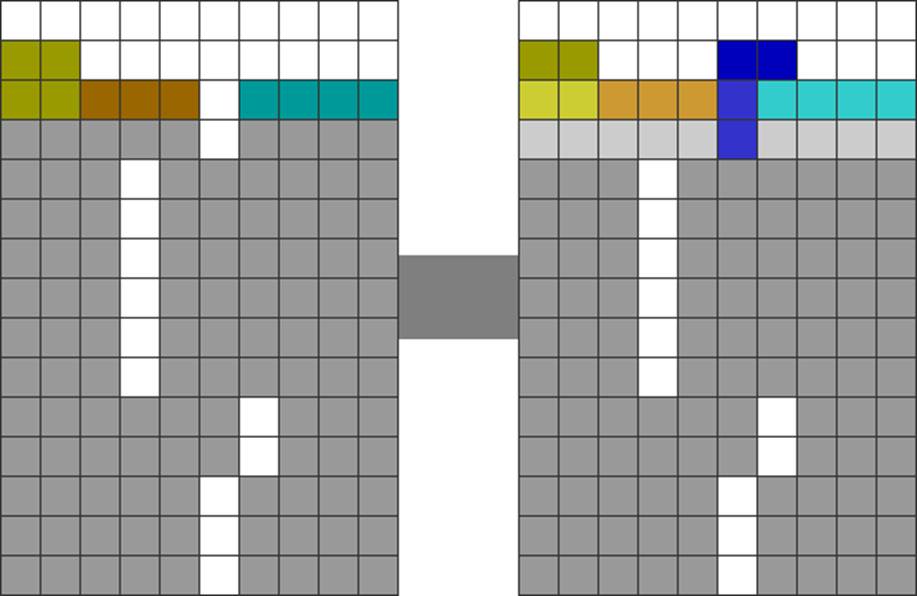
| The field becomes like this. | He digs down further using a J piece to clear 2 lines. |
| 5 | 6 |
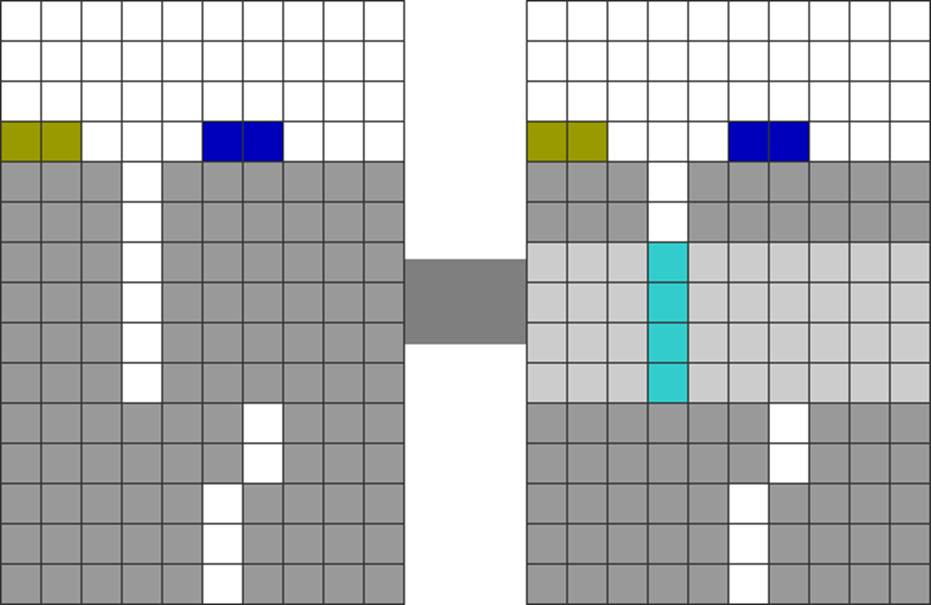
| The main hole is exposed, leading to a clean, vertical column in column 4. | The player inserts an I piece into the column, scoring a Tetris. |
Here, the player was almost topped out (defeated) in step 1. However, he does not panic. Instead, he uses two pieces (the L and J pieces) to dig down to the clean garbage line.
He then inserts an I piece into it to score a Tetris, lowering the field to survive better.
In non-Tetris layperson terms, the entire sequence means the player was initially in a terrible, near-death situation.
However, the problem is only temporary. He does not give up; instead, he improvises and gets out of it. He eventually rebounds and is in better shape than at the start.
If one had given up earlier, one would not have seen the whole totality of such a marvelous sequence.
In Tetris, I often marvel at how many players take the game so seriously that they exalt their external accomplishments above all else.
Many players have grown frustrated, depressed, angry, and exhausted by the endless pressure to maintain their rank or rating in some Tetris games.
These players continuously ‘grind’ (play repetitively and frustratingly) to reach a specific 40-line score, fearing others will judge them as slow if they do not get a decent score.
Others explode with anger when they lose. I have seen many such cases on Twitch involving Tetris streamers.
Then, dramas arose in many Tetris communities because some players were so determined to be number one in certain areas that they engaged in questionable activities. I will not name these examples to protect their identities.
However, such external accomplishments that mandate social validation are both empty and impermanent.
Most top Tetris players are between 14 and 20 because processing speed and reflexes peak around one’s teens and early twenties.
As one ages, one loses more and more of one’s reflexes. This naturally results in lower 40-line sprint scores or ultra scores. Eventually, the younger will always replace the old.
External achievements will hence fade in importance over time. Only experience remains.
As you gain more experience with Tetris, you have more to reflect on.
In my case, after advancing to a sufficient level (by my standards) in Tetris, I began integrating my lessons into my Tetris guidebook series and into this book. I have found many spiritual and philosophical lessons in the game.
Even though my reflexes have slowed with age, the experiences I have gained are a lasting benefit with many real-life applications.
I have almost no attachments to Tetris left. It has served its role, and I have completed it to my satisfaction.
Personal Applications
Consciousness: The Only Permanent Asset
If the Buddha said that everything is impermanent, then what is the point of pursuing anything at all?
If the entire physical cosmos is meant to die out, then perhaps there really is no point in being in the universe.
The same can be said of physical life: if it only exists for a fleeting eighty to a hundred years, then nothing matters.
However, consciousness persists after death. While mutable because it evolves, it is immortal and cannot truly be fully vanquished.
Think about it: if the cosmos were purely material, you would not even have a mind to contemplate whether life has meaning! But you do.
If the reader has made it this far, it is no secret that I truly believe in the existence of the afterlife and an immortal spiritual consciousness, as I have shown in many sources.
However, modern physics exists on a materialistic framework. Mostly, it holds that only material things objectively exist.
This limited framework is ill-prepared to study consciousness in its fullest depth.
Science advances in two ways: quantitatively and qualitatively.[5]
The former entails collecting and synthesizing more data. The latter involves a leap forward, expansion, or upheaval of existing scientific frameworks.
Hence, people once believed that the Earth was at the center of the solar system, with its planets and Sun orbiting it.
Nicolaus Copernicus challenged this belief by proposing that the Sun was at the center of the solar system and that the Earth revolved around it.
Scientists once believed that time was absolute and uniform everywhere, until Einstein showed in his theory of relativity that time can slow down with speed and be affected by gravity from other stellar objects.[6]
Likewise, scientific materialism has done plenty for humanity by explaining many phenomena, such as the Big Bang theory’s account of the universe’s creation and the phenomenon of galactic redshift.
However, it cannot explain away the hard problem of consciousness: why do we have inner sensations and thoughts (qualia)? And it fails to explain away near-death experiences or mediumship that can obtain external, verifiable information.[7]
If consciousness were truly purely physical, then two people mating would be just the copulation of two physical objects, with no inner sensations.
Therefore, a quantum leap in scientific revolution is needed to accommodate these new phenomena in consciousness.
The fact that Mount Everest had not been discovered in 5000 B.C. did not mean that it did not exist. The absence of evidence is not the evidence of absence.
Likewise, the lack of a consolidated scientific model to explain our inner consciousness does not invalidate the existence of an immortal afterlife consciousness.
As a skeptic, I often ask: is the consciousness that we assume after death the same as the one we have in physical form?
After much thought, my answer is no.
That sounds surprising, until you realize that you are not the same person as you were five seconds, ten minutes, a day, or twenty years ago.
You perceive only the moment in physical form, yet you maintain a sense of clarity about your continuation and identity across time.[8]
A Thought Experiment
The following line of reasoning is highly intellectual. The casual reader may skip this section and jump straight to the conclusion at the end of this section.
For those bold enough to remain, I ask the reader to ponder the following thought experiment, as seen in this picture:
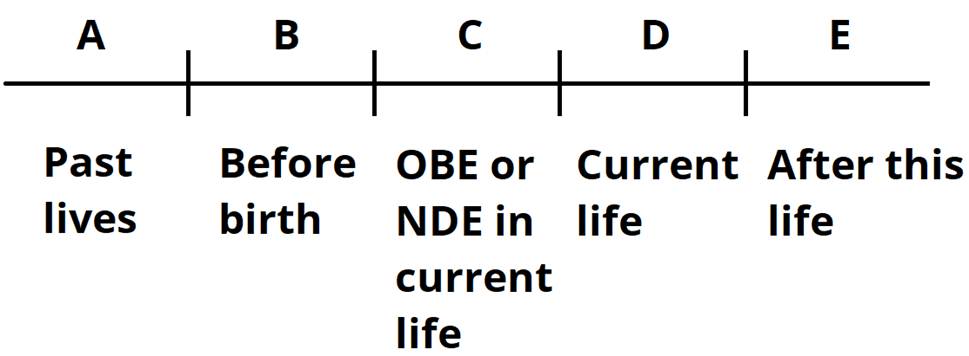
Is A, your past lives’ consciousness, the same as B, the consciousness that you harbor before this birth in spirit form, C, that which you experience in out-of-body (OBEs) or near-death experiences (NDEs) in this life, D, that of your current physical life’s mind, or E, that which you harbor after this physical life’s death?
I am not a philosopher of consciousness. However, my logical and layperson analysis is as follows:
- I maintain that all A, B, C, D, and E are different, because you persist in one frame of time and space (for most parts, it is complicated if you factor in spiritual dimensions with different structures of time). You are no longer the same person you were a second ago.
- However, C and D share the same causal linkage and identity. This is because people in NDEs and OBEs can remember their physical and spiritual experiences, vice versa, in either form.
- A, B, and D are likely to share the same identity. Why would a soul seek a new physical incarnation if it decimates their identity?
- A and D have the same causal linkage because past-life hypnotic regressions have had people remember past-life memories with stunning, specific, verifiable events and details.
- D to E is the hardest to prove, but it can be considered by flipping the question around: if A and D are linked, and people average many past lives, it means they are causally linked in identity. Reversing the time flow, there is likely a symmetric form of causality, in which D and E are likewise linked in the future.
- Hence, all A, B, C, D, and E are linked by a causal relationship and spiritual identity.
In simple terms, the consciousness that you are in physical life will be the true “you” when you cross over.
You eventually “die” in the physical realm, then upload your memory to a spiritual being with a continuous identity: “you.”
Hence, by this derivation, the soul is likely to be immortal.
Of course, I am reasoning using limited, linear human logic. No amount of reason may ever approach or substitute for physical reality. Perhaps the only way to find out is to experience the “afterlife” through OBEs or NDEs (the latter is not recommended!).
Some theories also suggest that the brain is like a receiver, while the soul is the signal. This means that if the brain dies, consciousness (the signal) continues to exist. This makes it compatible with neuroscience’s physicalist theories.[9]
As such, consciousness, being permanent, is well worth investing in more than impermanent physical assets, such as prestige or fame.
Does it Mean Physical Pursuits are Worthless?
Despite the permanence of a spiritual and immortal consciousness, physical pursuits are not necessarily worthless.
I illustrate this with Tetris.
I make no secret of Tetris’ current state. Despite my passion for and research on the game, I feel Tetris is dying. Soon, it will exist only as a relic in human cultural consciousness, and very few people will play it.
However, perhaps this book could partly revive its interest.
Anyway, we can draw an analogy: Tetris represents our physical universe. Each Tetris match is our individual physical lives.
The lessons that Tetris provides are many, which need not be repeated if you have read up to this part.
Even if Tetris is dying, I, having played it for seven years, created an entire Tetris guidebook series and, most importantly, this book, to justify having played it.
My Tetris guidebooks and this book represent the immortal part of our consciousness, the integrated life lessons we gain across hundreds of lives on Earth.
Even if the Earth or the cosmos are temporary physical existences, that does not mean their physical forms are useless.
Rather, they serve as the concrete and finite vessels or means of expression and challenges that the soul goes through to evolve and bring forth their accumulated wisdom in the cosmos.
This is where I stop. Nobody truly knows what our accumulated wisdom leads to.
My many earlier-cited sources and studies have already alluded to a timeless, transcendental realm where all life eventually unites into a divine consciousness.
I suspect that, after we have made our choices in the lower realms, we reunite with a unitary consciousness that exists not in space, but in a timeless present. Then, life becomes experiential, where we behold the cosmos’ eternity in the “now” as a “completed project.”
However, Theosophy’s various explorations of the many higher spiritual realms beyond the physical plane, such as the causal, mental, or logoic planes, have reached a dead end.
They maintain that understanding those “higher” realms is impossible from a human perspective. It is like a 2D creature trying to play 4D chess.[10]
One of my OBEs involved seeing reality in its 3D form, instead of a 2D image formed on my retinas. In spirit form, I saw the things around me at a microscopic scale, where I discerned particles.
This shows how constrained our human reality is compared to the spiritual.
Regardless, not knowing the eventuality does not matter.
What matters is using our fleeting physical experiences for permanent spiritual evolution.
Applying the Law of Impermanence
To apply the law of impermanence, introspect and see how many things are impermanent.
Here is a list of the common ones:
- Outcomes are a form of attachment: when we force an outcome, we want it to meet our expectations. However, when it is not achieved, we get disappointed. Instead, see life not as a linear movement from A to B, but as a star radiating lines in all directions. If a desired outcome does not occur, determine where each alternate radial path leads. There, you may find something more important and relevant.
- Status and prestige: Many people have over-identified with bodily and material consciousness. They judge potential love partners solely by salary, looks, external achievements, job title, and mating potential. This is Maya, and we can transcend these shackles without over-identifying with them.
- Money and wealth: Many people identify with the number of houses, the size of their stock portfolio, luxury cars, and the black caviar they have on their tables. This is also Maya.
- Physical appearance and youth: These are impermanent. There is nothing wrong with wanting to look beautiful or handsome. However, many teenage girls often compare themselves to others on Instagram and other social media platforms. Many have committed suicide because they failed to reach their ideal image. Again, this is Maya.
- Academic grades and intelligence: A person is not defined by a number. However, many intellectual societies exist in which people brag about their intelligence to boost their egos.[11]
- Credentials: These are likewise illusory. They may not always equate to actual experience, skills, or knowledge.
Once you have identified a list, you can detach more easily from some impermanent aspects.
You can then focus on the more eternal spiritual aspects, such as:
- Creative and artistic endeavors: This can be any form of art, be it poetry, stories, novels, architecture, painting, music, dance, and more.
- Intellectual pursuits: This can include reading, scientific research, inventing, solving technological problems, or philosophizing and debating.
- Personality traits: One can work on one’s negative karma and replace it with positive ones to evolve spiritually.
- Humanity: One can cultivate the love of oneself and others and generously help and guide others.
- Joy: Engage in any activity that makes one happy, but is harmonized with a bigger purpose.
- Social bonding: It can be any bonding with a partner, a friend, family, or a larger social group.
- Social activism: This can be any pursuit that improves the lot of humanity and combats social injustices.
- Healing or counseling gifts: One can use their gifts to help others with psychological or physical problems.
Social and Global Applications
The Perils of Extreme Materialism
Singapore, my home country, as a spiritually young-soul country, has allowed me to experience and observe the perils of materialism firsthand.
More than a decade ago, I spoke with an old man in his sixties. He is one of my neighbors, and he is still alive and well as of writing this book.
We had a long conversation about what matters in life. This brought up the fact that he spent half a million dollars to send his son to medical school.
He advised me to follow what his son was doing: engaging in long post-work socializing, drinking, and smoking with his bosses.
I then refuted him, saying that this was extremely inauthentic and led to an imbalanced and unhealthy life.
He rebutted that if a person does not do this, they will lose the vital social and business network that might lead to a promotion or career opportunity.
Another person in a prestigious law firm in my country once advised his students to “work like no tomorrow” when they were young to compete against the rest.
The result is a deeply unhealthy stream of competition, in which many Singaporeans focus on the transient wave of materialism that fuels burnout and hustler culture.
Hence, what can one do about this?
The great irony of excessive materialism is that it can become a powerful force for spiritual growth.
This often happens after extreme loss. When a younger soul has gained many successes, only to lose it all in some bankruptcy, it can force them to rethink their lives.
I once had a relative who likely fit into this category, having had assets valued at SGD 7,000,000.
However, he was stricken with a neuromotor degenerative disorder that led him to lose his ability to move.
In his final days, he wrote an important autobiography and became a successful artist, rebuilding his relationship with the community.
He has passed away, but his life shows that sometimes a moment of significant loss can be the right push to inspire spiritual growth and a focus on more enduring assets, such as creativity and community.
The New Global Tribalism
People often become highly attached to specific groups, organizations, countries, or broader entities.
As an observer of modern geopolitics, I have seen how politics can negatively affect one’s life.
In the United States, I see people so over-identified with specific political parties that they sometimes struggle to accept people with different views.
In many others, I see people overly identified with their religions, to where they can sometimes impose their beliefs on others.
We have now entered a period of “wokeness,” where many socially aware people have become overly identified with their groups. I have observed some groups using their social identities to seek privileges or advantages.
One particularly striking example is some university professors who harbor an extreme form of feminism that can be hostile towards or exclusionary of men.
Likewise, many people over-identify themselves as American, Japanese, Chinese, European, Indian, Arab, and so forth. They can strongly identify with their leaders’ positions and can sometimes become hostile towards specific countries.
This can lead to tribalism, where the world fragments into groups rather than unifying.
However, many of these broader organizations are only temporary. Even the longest-lasting civilizations will be gone within a few thousand years.
Many of these broader identities are temporary constructs.
We identify with a country because our history books and education system socialize us to do so. We also embrace an idea because our social circles socialize us into doing so. We identify with some religions since we were brought up to visit their religious places.
There is nothing wrong with identification when we love a specific culture or group. The problem arises when we use it to justify a hostile “us” versus “others” attitude.
But deep down, we are all fragments of an undivided Oneness.
Some temporary, exclusionary identities can therefore be unlearned.
So why identify so strongly with an impermanent group and use it to justify division and exclusion within humanity and the cosmos?
When we free ourselves from these temporary and material identities, society can become more inclusive.
[1] Michael Newton, Destiny of Souls (2000); Robert Monroe, Ultimate Journey (1994).
[2] Martin Heidegger, Being and Time (1927). Heidegger’s concept of “Being-toward-death” argues that confronting mortality gives life urgency and meaning.
[3] I bumped into them in Tetris 99. I have the screenshots and even the recorded videos for most of them. My battle with Amemiya lasted fourteen minutes.
[4] Michael Newton, Journey of Souls (1994); Destiny of Souls (2000). Newton’s regression case studies show souls reviewing each incarnation between lives, integrating its lessons before choosing lessons for the next life.
[5] Thomas Kuhn, The Structure of Scientific Revolutions (1962).
[6] I was deeply impressed when I studied how Einstein derived his special and general relativity equations when I was 13.
[7] David Chalmers, “Facing Up to the Problem of Consciousness,” Journal of Consciousness Studies (1995). Chalmers coined the term “hard problem of consciousness” to distinguish the explanatory gap between physical brain processes and subjective experience; for NDE verification studies, see Pim van Lommel, Consciousness Beyond Life (2010).
[8] Derek Parfit, Reasons and Persons (1984), Part III. Parfit’s influential work on personal identity argues that the self is not a fixed entity but a continuum of psychological connections.
[9] Bernardo Kastrup, Why Materialism Is Baloney (2014) — argues that consciousness is fundamental, and the brain is a “transceiver” rather than the generator of mind.
[10] Helena Blavatsky, The Secret Doctrine (1888); Annie Besant, The Ancient Wisdom (1897). Both works explore the higher planes while acknowledging the limits of human comprehension in grasping the highest logoic dimensions.
[11] This is based on my observation of their forums.

