Having Fun While Training
Many players take Tetris so seriously that they stop having fun while training.
This is counterproductive, as a talented or gifted player who burns out too quickly and quits can never fully realize their potential.
Balance training with fun and enough rest, and avoid becoming overly attached to outcomes.
Enjoy playing Tetris as it is, and do not put too much weight on achievements.
A Philosophical and Spiritual Conclusion
Ultimately, you must experience Tetris rather than study it.
This short book has hopefully given you a clear, broad picture of how to apply my other books’ Tetris methods to a personal training program and become a Tetris master.
Like many things in life, players can get too attached to Tetris or over-identify with it. This attachment is unhealthy and leads people to focus on external proxies and in-game achievements.
Players try to maximize their score and become “number one,” but this ultimately guts their health and passion for Tetris.
The ideal Tetris player sees Tetris as a game, not something to take too seriously. Winning or losing does not matter. Only the journey and the experience’s end state matter.
Playing Tetris is not about becoming perfect; no one can. Instead, it is about completion.
It is about gaining enough breadth of experience from the game to apply it to whatever endeavors or ventures you pursue.
For some people, Tetris is merely a social game, a way to have fun with others. Some people use Tetris as a socialization tool to build bonds, laugh, and joke.
Others see it more seriously, aspiring to surpass other top Tetris players.
Others see Tetris as creative experimentation, building fancy setups.
Others, like myself, see Tetris as a form of spiritual philosophy. I have written 2 Tetris spirituality books that have had a positive impact on my life: The Tao of Tetris: The Laws of Spiritual Reality and The Tao of Tetris 2: 30 Spiritual Laws Expanded:
| Diagram Set 18-1 |
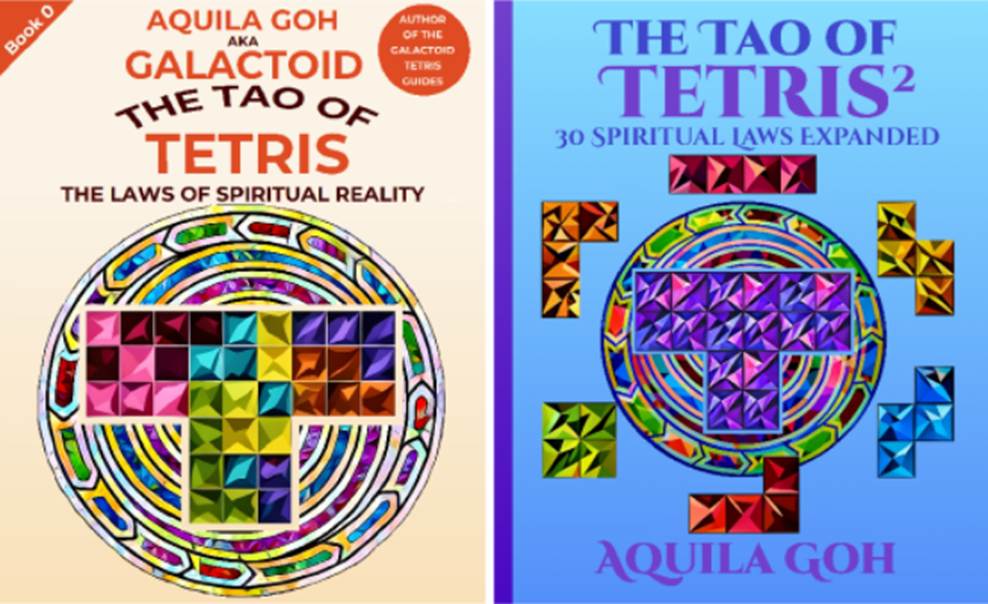
| My 2 Tetris spirituality books. I strongly recommend The Tao of Tetris 2: 30 Spiritual Laws Expanded (right picture). It is the second, vastly improved edition of the first book (left picture). |
Regardless of the outcome, Tetris is ultimately an experience you must flow with, never pausing to look at it.
One plays Tetris for its own sake, not for external proxies (like getting too attached to outcomes, such as a world record in 40-line sprints).
The more you detach from Tetris, the more you can flow and become Tetris. This lets you experience the Tao of Tetris, not because you wish to become anything. Instead, it is because you already are.
It does not matter if one cannot become a top Tetris player. Instead, focus on the timeless, eternal now and follow the path of your highest excitement. This allows us to co-create and co-participate in the endless omni-creativity of Tetris. When we celebrate and honor our unique Tetris experiences, we glorify the whole of existence.
And that is the Tao of Tetris.
In a Nutshell
| Key Points |
| Experience is the nature of reality. Enjoy playing Tetris for its own sake. Attachments to Tetris outcomes and achievements are the easiest way to burn out from Tetris and quit prematurely and permanently. Tetris, a deceptively simple puzzle game, is complex enough for Galactoid to write out 2 Tetris spirituality and philosophy books! |

