“Be yourself; everyone else is already taken.”
— Oscar Wilde
Introduction
Every person has two selves: the true self and the false self.
A person who manifests the false self lives in accordance with societal and cultural conditioning. He lives the life that others or his culture expect of him.
Such a person is clad in the veil of Maya, unable to see past or transcend the dualities of life. They may firmly believe that their material and worldly forms, arising from prestige, status, title, or wealth, are all that there is.
A person who manifests the true self overcomes conditioning and lives in accordance with the laws of spirit. He lives and expresses authentically, becoming a flame amidst other flames that set ablaze the cosmos.
This person can see past Maya, realizing that the true reality is consciousness, experience, and spirit. One needs no permission from others to live the life that one truly desires. And when one does this, one is fulfilled and self-actualized, contributing to the cosmos as a co-creator and co-participant.
Hence, one is not radiant because one lives off other light sources and merely consumes. Instead, one is radiant because one simply is.
Tetris as an Analogy
In Tetris, to be inauthentic is to play the game according to what social convention has decided on what is best.
A player may join many Tetris Discord servers and be influenced by the company of many. They may assert that the best way to play Tetris is simply to win and get a decent score in ultra, marathon, or sprint mode.
Then, they play in accordance with this conditioning, exploring no further the alternatives to playing Tetris.
If they fail to reach certain societal expectations, they may be dismayed or ridiculed by their peers.
Hence, they play by the established playbook, using the simplest setups like this:
| Diagram Set 18-1 | |
| 1 | 2 |
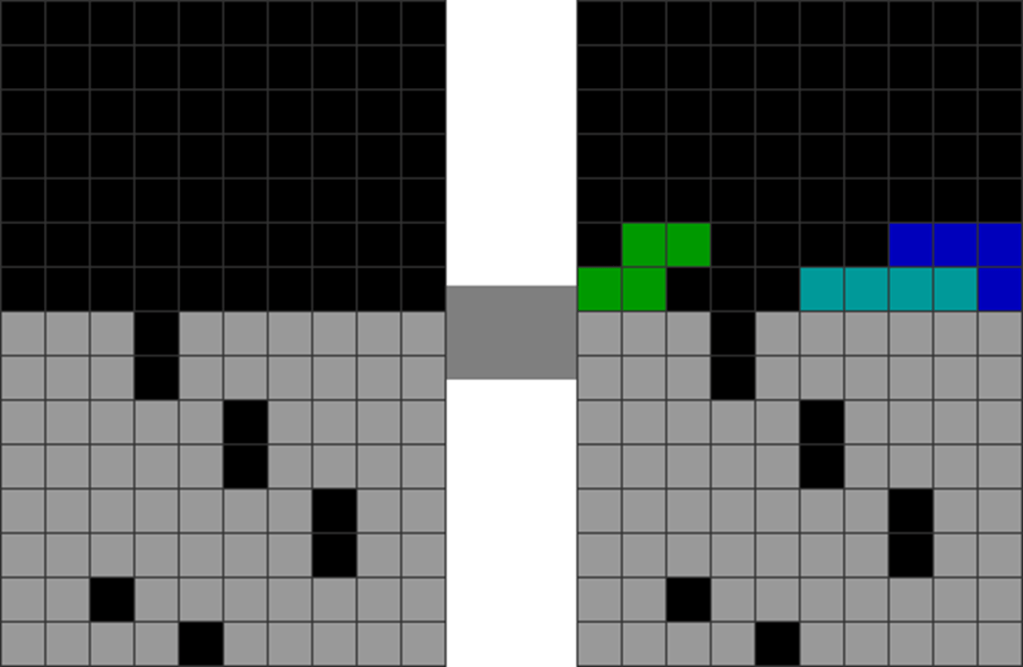
| The starting field. | The player simply goes for the most obvious and straightforward T-spin double. |
Here, a player simply goes for the safest and most guaranteed setup. This is not wrong.
However, when a player does something exorbitant, such as the following, he may be mocked by his peers:
| Diagram Set 18-2 | |
| 1 | 2 |
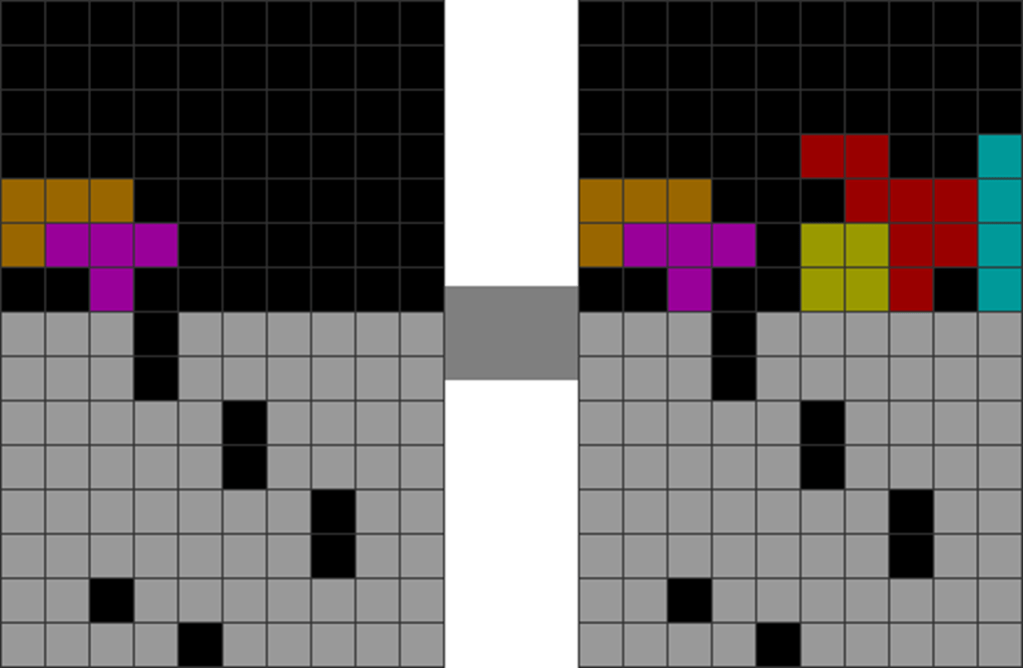
| The player recklessly makes an LT prop when a simpler T-spin is apparent. | He completes the T-spin double suspension prop. |
This takes the place of the last diagram set’s starting field. The player makes an outrageously fancy and dangerous setup.
While this is dangerous, the reality is that the intermediate Tetris player should sometimes experiment with such setups. This allows them to experience and understand the pros, cons, and risks of each method. They can then understand when to and when not to use some techniques.
Even wackier are the following setups:
| Diagram Set 18-3 | |
| A | B |
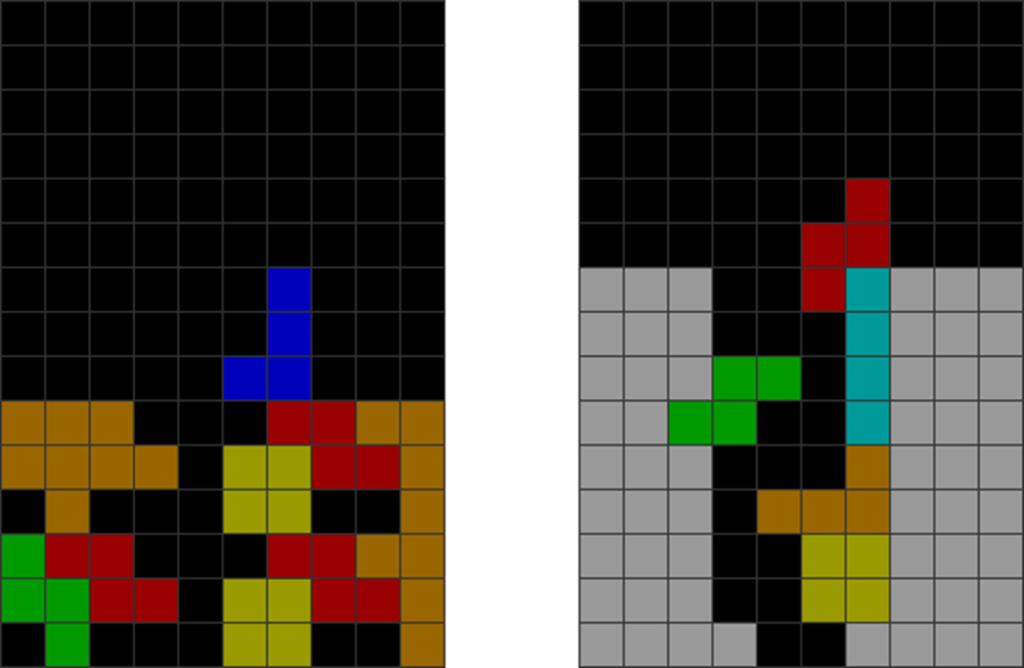
| A double-stacking T-spin double prop. | A four T-spin double spliced setup. |
| C | D |
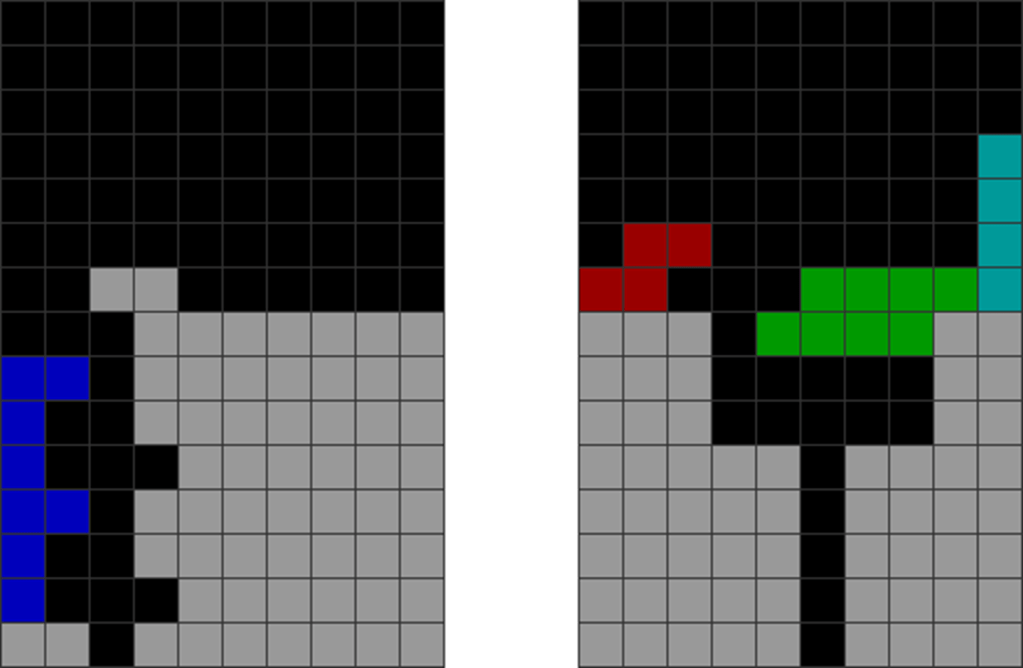
| A spliced Trinity with four T-spin doubles. | A floating 5-wide STMB Cave T-spin double. |
The above setups are extraordinarily complex and advanced, used only by top players like Yakine.
People who use them are sometimes ridiculed for being over-the-top and risky. However, many players like myself sometimes go for them.
Why? It is not to brag. Instead, it is purely done out of fun. I make such setups simply because I express myself uniquely without following social or cultural conventions.
I do not bother about what other players think, as I follow only my own path—one of the highest inner excitement and fulfillment.
Personal Applications
In real life, the law of authenticity simply means several things:
- Cultivating the self-awareness to discern what is real (spirit) or false (external) to life’s fulfillment. This involves identifying what Maya is.
- Choosing what is authentic to enrich the soul, while slowly abandoning those that do not serve the soul’s fulfillment or joy.
- One then chooses a life that intermarries practicality with pursuits that let one live by one’s greatest excitement, joy, and freedom.
Once one has identified the unreal and unnecessary aspects of one’s existence, one can then manifest spirit and one’s true personality.
This means living in accordance with the positive manifestations of one’s soul type.
For instance, a creative artist who lives by the false personality may turn their brooding nature into frustration. They may vent by turning towards self-harm or other destructive habits and fail to produce anything creative.
They may also write scattered novels without a coherent narrative. Everything becomes a rambling mess.
However, an artist living in accordance with the positive poles can produce vast troves of work in art, music, architecture, or literature. Most importantly, they will find fulfillment while balancing the practical need to earn enough money to take care of themselves.
A natural leader living in accordance with the positive poles can mobilize entire countries to combat poverty and injustices. Manifest in the negative pole, and you have Pol Pot or Hitler!
A server living in the positive pole will be like Mother Teresa. One in the negative pole may be withdrawn and self-centered.
Social and Global Applications
Society is the collective manifestation of individual selves. However, its institutionalized practices and norms directly enable or restrict people’s capacity to be authentic.
Currently, many modern societies face the problem of participants being alienated from themselves, others, society, and nature.
Many social philosophers and scientists, such as Karl Marx and Herbert Marcuse, have covered this sociological problem.
The problem is two-fold: first, many individuals have become so accustomed to living by conditioned beliefs that, when they rise to positions of power, they perpetuate the system. Second, many institutions exist to continue the system, which oppresses people.
The way to break this cycle is two-fold:
- People should gain greater self-awareness and lobby for corporate and governmental practices that create more work-life balance and fulfillment.
- People in the upper echelons of power who have seen through the veil of Maya should alter the system to allow people to lead more self-actualized lives.
When enough people do this, large-scale social revolutions can occur to the benefit of humanity.
Ultimately, you can only live your life, not the life others want you to live.
 How to Tetris