“Be yourself; everyone else is already taken.”
— Attributed to Oscar Wilde
Introduction
The False and True Selves
Every person has two selves: the true self and the false self.
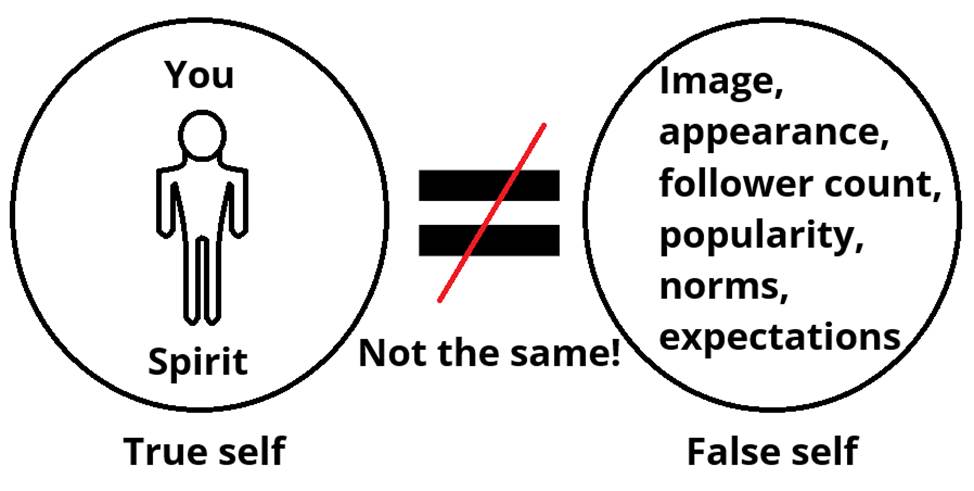
A person who lives by the false self follows societal and cultural conditioning. He lives the life that others or his culture expect of him.[1]
Such a person is clad in the veil of Maya and might not see past or transcend life’s dualities.
They may firmly believe that their material and worldly forms, arising from prestige, status, title, or wealth, are all that there is.
A person who manifests the true self overcomes conditioning and lives in accordance with the laws of spirit.
He lives and expresses authentically, becoming a bright flame amid other dimmer flames.
This person sees past Maya, realizing that true reality is consciousness, experience, and spirit.
One needs no permission from others to live the life that one truly desires. And when one does this, one is more easily fulfilled and self-actualized, contributing to the cosmos as a co-creator and co-participant.
Hence, one is not radiant because one lives off other light sources and merely consumes. Instead, one is radiant because one simply is.
This is the law of authenticity.
A Scenario
Let us consider a scenario on why being authentic is important:
Imagine living on a planet where everyone does the same thing, wears the same clothes, follows the same trends, and so forth.
The result will be a homogeneous culture with zero diversity. It will be a boring place to live.
We would not know what kinds of alternative lifestyles, social systems, or economic systems work.
Now expand this scenario to a cosmological level, where every living being is your spiritual clone, being exactly just like you. Imagine infinite copies of yourself.
Exact spiritual clones are of little value to the all-that-there-is. The cosmos can have infinite numbers of them, but they will not contribute to the Tao’s diversity and exploration of different forms.
By definition, having a “personality” means being unique. Hence, having infinite similar duplicates of yourself is functionally similar to having just one.
Instead, it is more lucrative for the cosmos to have infinite distinct variations: every different lifeform broadens the cosmos’ diversity.
With infinite variation, the cosmos becomes a vast simulation that explores every possible problem and tests every possible answer.
In doing so, the cosmos becomes whole, manifesting every choice.
And it all begins with you being your unique self.
Tetris as an Analogy
In Tetris, to be inauthentic is to play the game according to what social convention has decided is best.
A player may join many Tetris Discord servers and be influenced by the company of many.
They may assert that the best way to play Tetris is simply to win and get a decent score in ultra, marathon, or sprint mode.
Then, they play according to this conditioning, exploring no further alternatives to playing Tetris.
If they fail to reach certain societal expectations, they may be dismayed or ridiculed by their peers.
Hence, they play by the established playbook, using the simplest setups like this:
| Diagram Set 18-1 | |
| 1 | 2 |
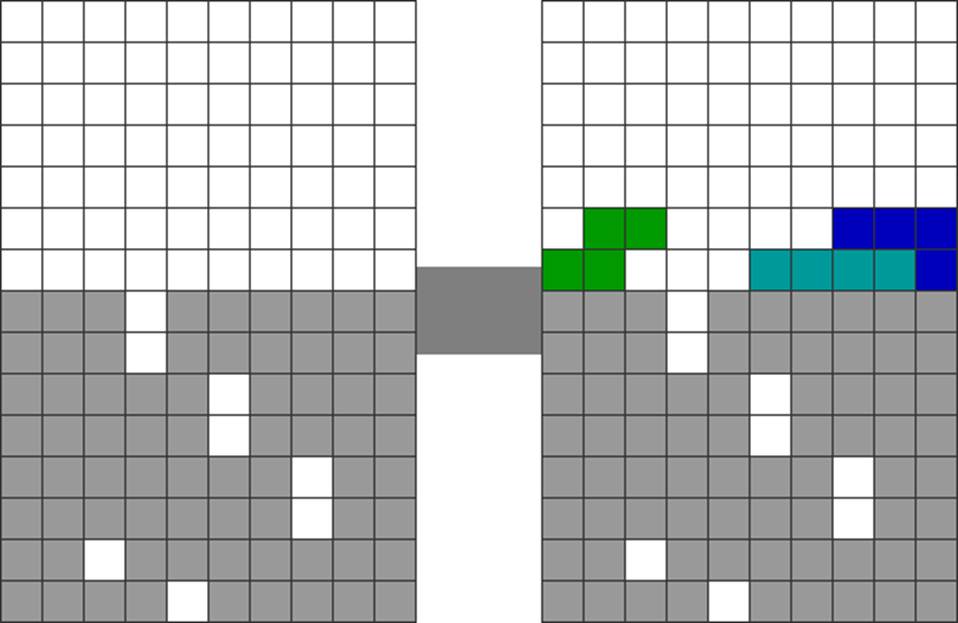
| The starting field. | The player goes for the most obvious, straightforward T-spin setup. |
| 3 | 4 |
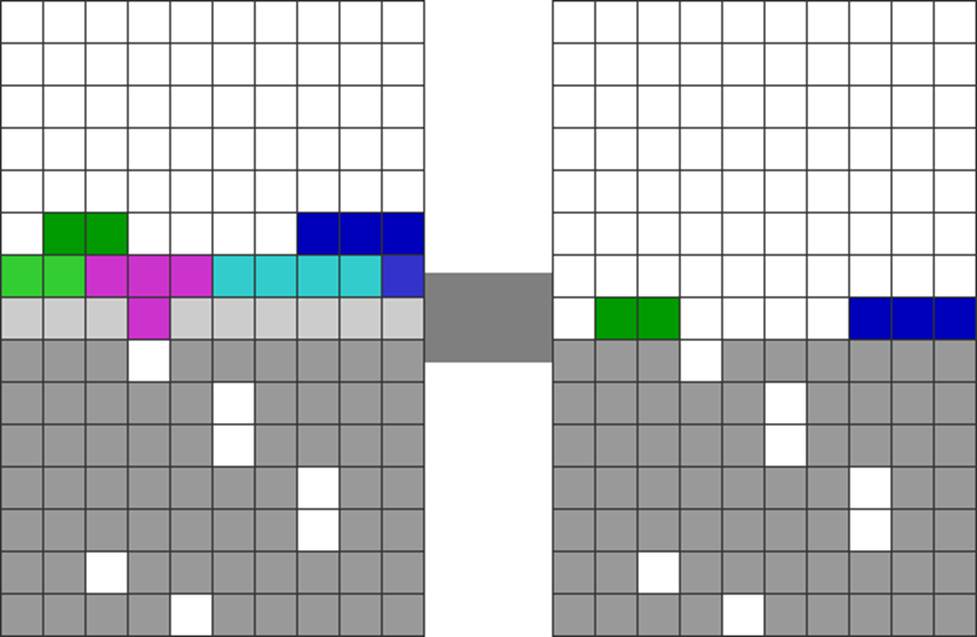
| The player inserts a T piece into the T-shaped cavity, completing a T-spin that clears 2 rows. | The next garbage hole in column 4 is cleanly exposed. |
Here, a player simply goes for the safest and most guaranteed setup. This is not wrong.
However, when a player does something extravagant, such as the following, his peers may mock him.
To non-Tetris players, it just looks like an over-the-top, fancy method:
| Diagram Set 18-2 | |
| 1 | 2 |
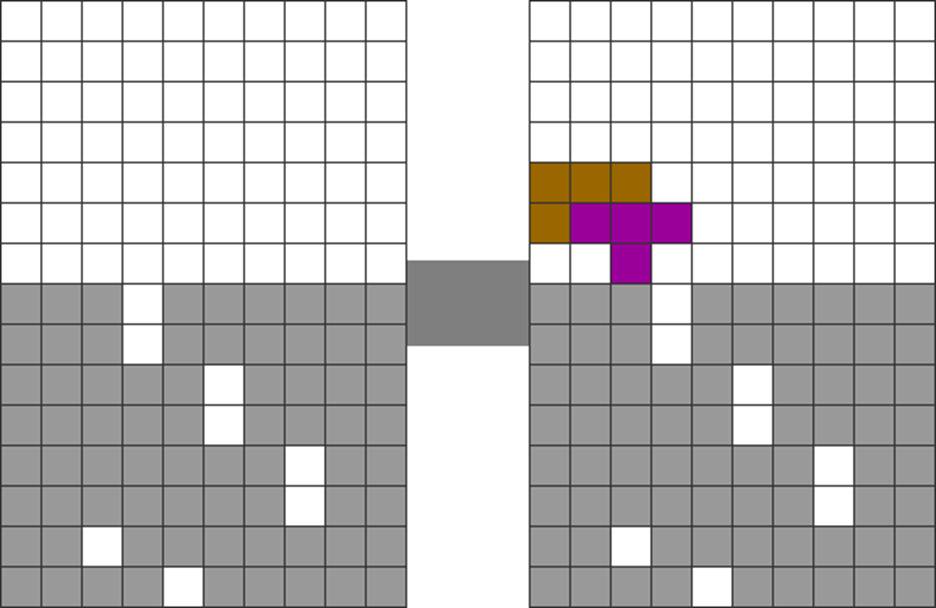
| The same starting field as the last diagram set. | The player combines L and T into a strange prop. |
| 3 | 4 |
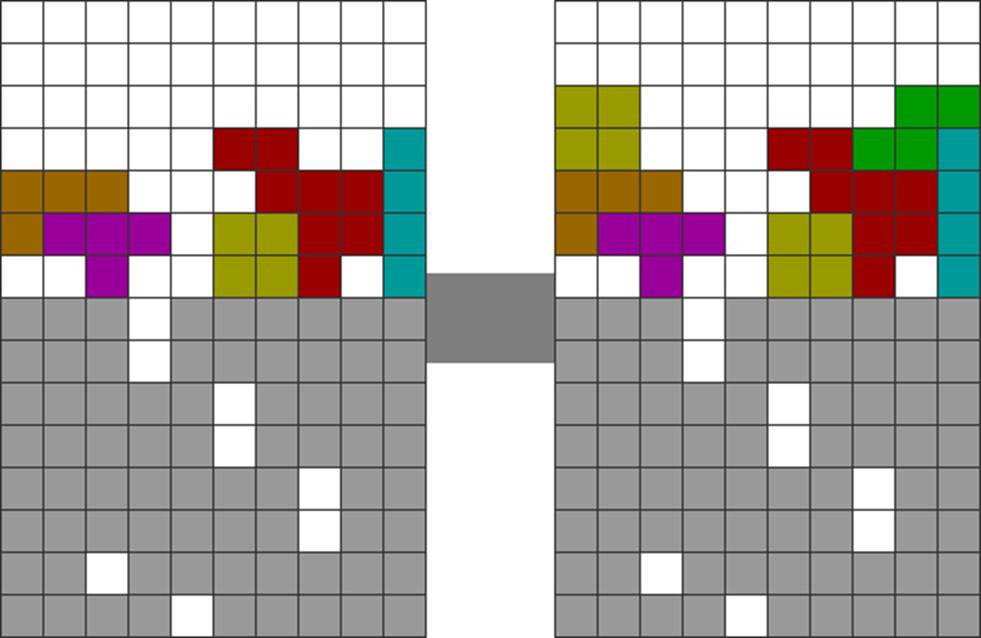
| He builds up the right side. This creates a high-level suspended T-spin setup! | However, the required T piece to complete the T-spin does not arrive. He places the O and S pieces in awkward manners. |
| 5 | 6 |
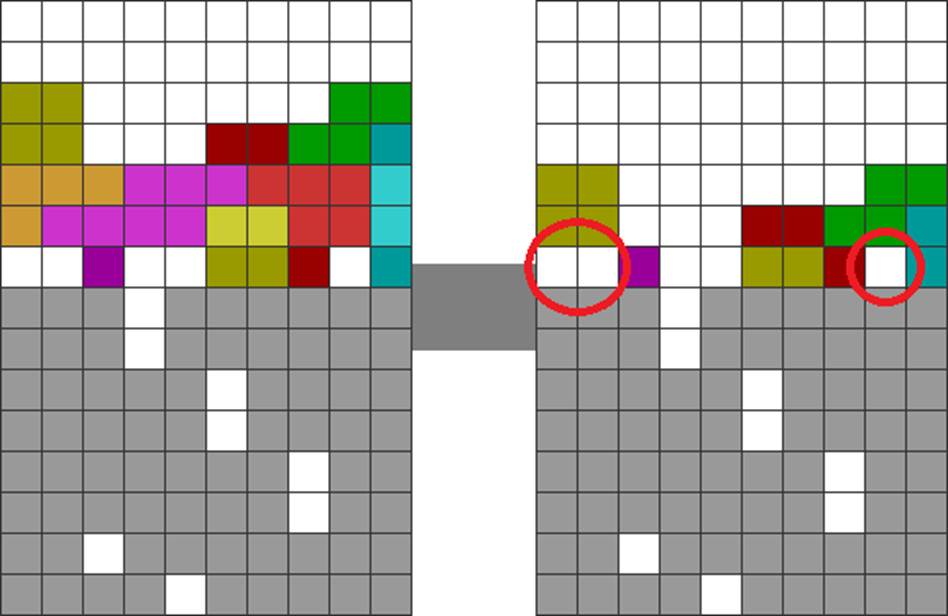
| Aha! The T piece finally arrives, and he completes the T-spin, clearing 2 lines. | Because of the prior O and S placements, the resultant fields’ O and S pieces stack over the red-circled holes. This makes the field dirty. |
Here, the player makes an outrageously fancy and dangerous setup.
While this is dangerous, the intermediate Tetris player should sometimes experiment with such setups.
This allows them to experience and understand the pros, cons, and risks of each method. They can then understand when to use certain techniques and when not to.
People who use them are sometimes ridiculed for being over-the-top and risky. However, many players like me still go for them sometimes.
Why? It is not to brag. It is purely for fun. I make these setups because they let me express myself uniquely, without following social or cultural conventions.
I do not worry about what other players think, because I follow only my path. This lets me experience one of the highest levels of inner excitement and fulfillment.
Without players like me to explore the unknowns, Tetris would be boring.
And this book would not exist.
Personal Applications
When You Are Authentic, You Need Not Try to Be
When I was a Tetris novice, I fell into the Dunning-Kruger effect. It is the idea that people of lower competence overestimate their abilities.
They often do this because of insecurities or ego defensiveness. After all, who wants to feel bad or stupid about themselves?
So, in my early days, I used technical Tetris vocabulary to sound smart to others. After all, Tetris is a very competitive environment, where people compete for attention.
During my Tetris streams, I would use all kinds of fancy Tetris setups just to wow my audience, even if they were impractical.
However, as I immersed myself more deeply in Tetris over many years, I no longer felt the need to be all fancy.
Instead, I focused on pure strategic placement and efficiency by using simple methods.
When I became an expert, I realized that doing this repetitively makes Tetris boring. So I returned to creativity and played in a more elaborate way.
When I play fancily, I do it only for fun, even though some Tetris pros misinterpreted my methods as overly dangerous techniques.
When I play and stream Tetris these days, I have no desire for glamor. Quite the irony: I choose my audience instead of the other way around, no longer playing just to impress.
I play Tetris only in the way I wish to play.
This seems to parallel the case of many other experts in their own fields.
Bruce Lee, in a famous interview, once remarked that when a martial artist first starts out, one deliberately tries to be all fancy and cool. However, when one reaches the pinnacle, only sheer efficiency and brutality matter.[2]
I go further by saying the next stage of evolution is to return to the beginning and simply play for fun in one’s own way.
What is the psychology behind this?
From a Tetris perspective, it is because when you start out, you are literally nothing. So you need external validation and achievements to prop up your image.
However, when you have true substance and finesse, you already embody the skill. You have progressed past the Dunning-Kruger hypothesis’ peak; you know precisely what masterful Tetris gameplay is.
You become an authority of your own, no longer needing anyone or a group to tell you if you are playing well. You simply are.
And you express authentically without needing to impress others.
A female friend once told me that the true spiritual masters are the quiet types. They are unassuming in life and never brag much about their spiritual knowledge or wisdom.
Perhaps there is a grain of truth in that saying.
After all, if you have become spiritually evolved, humility becomes your default. You no longer need others to tell you that you are spiritual.
Applying the Law of Authenticity
In real life, the law of authenticity simply means several things:
- Cultivating the self-awareness to discern what is real (spirit) or false (Maya) to life’s fulfillment.
- Choosing what is authentic to enrich the soul, while slowly abandoning those that do not serve the soul’s fulfillment or joy.
- One then chooses a life that intermarries practicality with pursuits that let one live by one’s greatest excitement, joy, and freedom.
Once one has identified the unreal and unnecessary aspects of one’s existence, one can then manifest spirit and one’s true personality.
This means living in accordance with the positive manifestations of one’s soul type.[3]
For instance, an artist who lives by the false personality may turn their brooding nature into frustration. They may vent by turning towards destructive habits and fail to produce anything creative.
They may also write scattered novels without a coherent narrative. Everything becomes a rambling mess.
However, an artist living in accordance with the positive poles can produce vast troves of work in art, music, architecture, or literature.
Most importantly, they will find fulfillment while balancing the practical need to earn enough money to take care of themselves.
A natural leader living in the positive pole can mobilize entire countries to combat poverty and injustice.
Manifest in the negative pole, and you have Pol Pot or Hitler!
A soul that likes serving others and lives in the positive pole can be like Mother Teresa.
One in the negative pole may be withdrawn and self-centered.
And it begins with self-awareness.
Not Being Like the Masses
We live in a world where our minds are being conditioned endlessly to be like others.
The philosopher René Girard suggests that we desire what people we consider models desire.[4]
Hence, we may follow certain influencers on social media and copy their lifestyles. This may involve embodying their values and following another’s hedonistic lifestyle.
However, this can be dangerous in an age where many social media platforms use algorithms to prioritize sensationalism, clickbait, and pure charisma over substance.
In my Tetris community, without naming names, I noticed that many of the most popular Tetris players are the loudest and have the flashiest personalities.
However, sometimes when I peel back their surfaces, I see Tetris gameplay devoid of higher-level strategic reasoning. They also lead lifestyles that do not go beyond sensationalism.
Yet, they get the most followers and subscribers.
YouTube has completely changed its algorithms to compete with TikTok. Both platforms heavily reward sensationalism and a lack of critical thinking skills.
Channels with a simple, authoritative worldview (like “this country is always right or wrong”), rather than more nuanced ones, get more attention and views.
This relates to René Girard, since it creates widespread social conformity toward simplicity, a lack of critical thinking skills, a lack of self-awareness, and a lack of individuation.
As a result, society becomes increasingly homogenized, prioritizing sensational, shallow books and movies over deeper ones.
When Fifty Shades of Grey sells better than The Glass Bead Game, you get a society that rewards shallowness over depth.
To manifest authentically, minimize social media’s influence.
The only ones that I recommend watching are long-form videos and channels that go deeply into many subjects, such as Religion for Breakfast or Patrick Boyle’s channels.
Social and Global Applications
Creating an Authentic Society
Society is the collective manifestation of individual selves. However, its institutionalized practices and norms directly enable or restrict people’s capacity for authenticity.
Many modern societies currently face the problem of participants being alienated from themselves, others, society, and nature.
Many social philosophers and scientists, such as Karl Marx and Herbert Marcuse, have covered this sociological problem.
The problem is two-fold: first, many individuals have become so accustomed to living by conditioned beliefs that, when they rise to positions of power, they perpetuate the system. Second, many institutions exist to continue the system, which oppresses people.
The way to break this cycle is two-fold:
- People could gain greater self-awareness and lobby for corporate and governmental practices that create more work-life balance and fulfillment.
- People in the upper echelons of power who have seen through the veil of Maya could alter the system to allow people to lead more self-actualized lives.
When enough people do this, large-scale social revolutions can occur for humanity’s benefit, letting us be more authentic.
Ultimately, you can only live your life, not the life others want you to live.
The Over-Conditioned Society
In George Bernard Shaw’s play Pygmalion, the protagonist is oversocialized to speak, act, and pass as a high-society lady.
She ultimately asserts her independence and chooses to marry Freddy, a man she prefers.
According to Shaw’s epilogue, she and Freddy go on to run a flower shop together — work that aligns with her origins and genuine interests.
This allegory parallels society, as many of us are brought up with notions of who we should be.
In the United States, social media teaches people to be like the Joneses, living a materialistic lifestyle even if it means getting into severe, unsustainable debt.
In Japan, Singapore, and South Korea, people are raised to be obedient, earn good grades, and never be the first to leave the workplace, even if their job is done for the day.
My stance: unlearn all of these conditionings and be yourself.
The great Indian philosopher, Jiddu Krishnamurti, suggests that we should free ourselves from all these conditionings that stand at odds with our true, spiritual, and authentic nature.[5]
When we can free ourselves from what society has imposed on us, we can then embody these in our lives.
Imagine if enough people in Japan or South Korea, such as Gen Zers, were to start lying flat and rebel against the overwork culture.
This would force the establishment to dismantle the conditioning structures that sustain and create the Mayavic veil.
Perhaps this is the solution to their countries’ fertility problem: by restructuring old societal habits and fostering a more authentic society, people can be more self-realized and fulfilled, encouraging childbirth.
Their societies can then be more diverse and interesting.
[1] José Stevens and Simon Warwick-Smith, The Michael Handbook (1990); Shepherd Hoodwin, Journey of Your Soul (1995). Both works distinguish between “true personality” — the authentic expression of the soul — and “false personality,” the conditioned mask shaped by societal expectations.
[2] Bruce Lee, interview, date unspecified. See also Bruce Lee, Tao of Jeet Kune Do (1975), in which Lee strips away the ornamental in favor of pure efficiency and directness.
[3] José Stevens and Simon Warwick-Smith, The Michael Handbook (1990): Soul Roles. The Michael Teachings describe seven soul roles — Server, Artisan, Warrior, Scholar, Sage, Priest, and King — each with positive and negative poles of expression.
[4] René Girard, Deceit, Desire, and the Novel (1961). Girard’s mimetic desire theory holds that humans imitate the desires of those they admire.
[5] Jiddu Krishnamurti, Freedom from the Known (1969).

