“Flow is the natural, effortless rhythm of the mind when fully engaged.”
—Mihaly Csikszentmihalyi
Introduction
Miserable is the person who stubbornly attaches to and forces an outcome when the circumstances do not allow it.
Lazy is the one who fails to plan for the future and becomes entirely passive, waiting for life to occur and for fortune to arrive.
Noble is the soul who acknowledges that all things happen at the right time, place, and circumstances, in line with the principle of synchronicity.
Such a person still plans for the future and actively works towards their plan. However, when calamity strikes, they are as resilient as a mighty zelkova tree.
When desires are not fulfilled, such as wanting a romantic partner, they acknowledge that the time is not ripe. One does not begrudge one’s circumstances but simply accepts them for what they are.
After all, existence is eternal. The soul is immortal. You will live forever. If one cannot realize something in this life, they may be able to in a future life or on the other side.
The cosmos finds the right time and place for miracles to occur.
This is like the principle of Wu Wei in Taoist philosophy. One does not attach to forced outcomes; instead, one flows like water, taking the path of least resistance without looking back.
In psychology, Csikszentmihalyi’s research has shown that people perform most productively when they are exposed to sufficient challenge and have the required skills in equal measure. This lets them enter a prolonged state of flow.
After all, life can only be lived forward and analyzed backwards. The essence of reality is existence. By stopping to examine its flow, you cease the natural progression of reality.
Only by flowing with reality can you sink into the rhythm of experience to become reality.
Tetris as an Analogy
The beginner and intermediate Tetris players would almost always make the most fatal mistake in the game. It is to force a setup when the incoming previews and field do not allow.
As shown below, the player can sometimes make a Tetris easily:
| Diagram Set 19-1 | |
| 1 | 2 |
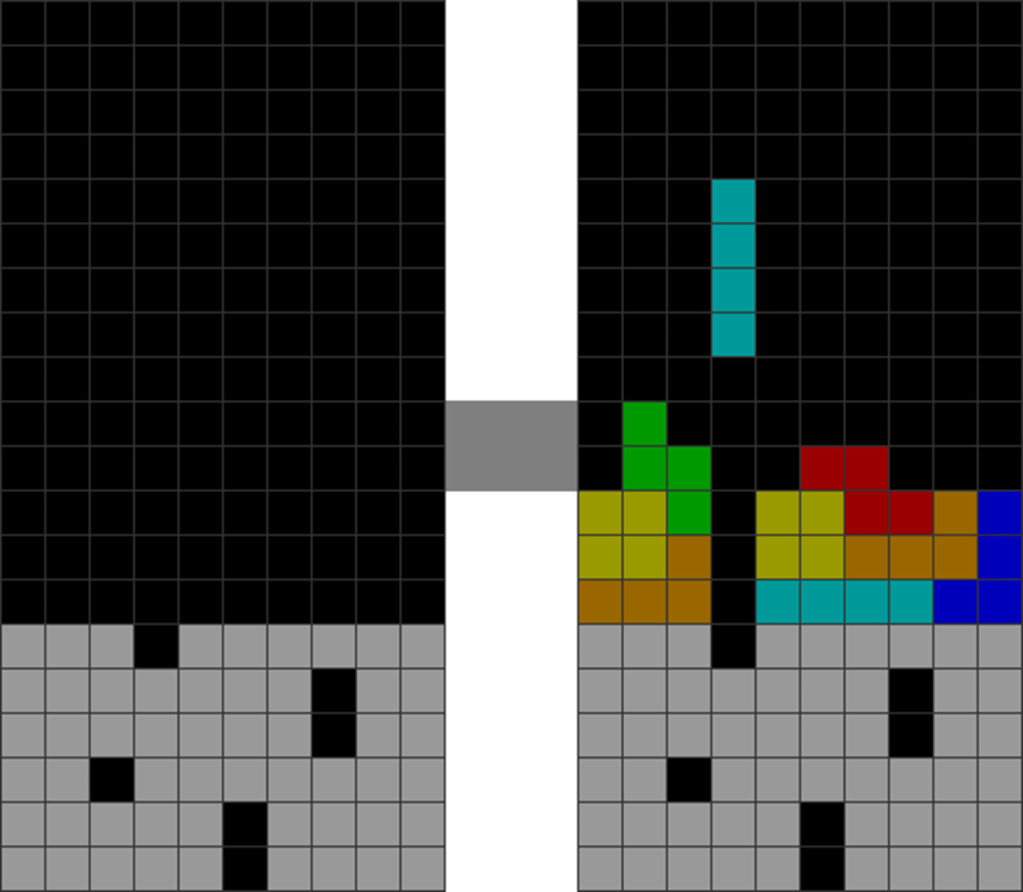
| The player upstacks to make a perfect Tetris in step 2. |
Here, the player has the right pieces to upstack correctly and safely into a Tetris. He can then use the I piece to make a Tetris quad line clear.
However, things are not as fortunate in the following situation:
| Diagram Set 19-2 | |
| 1 | 2 |
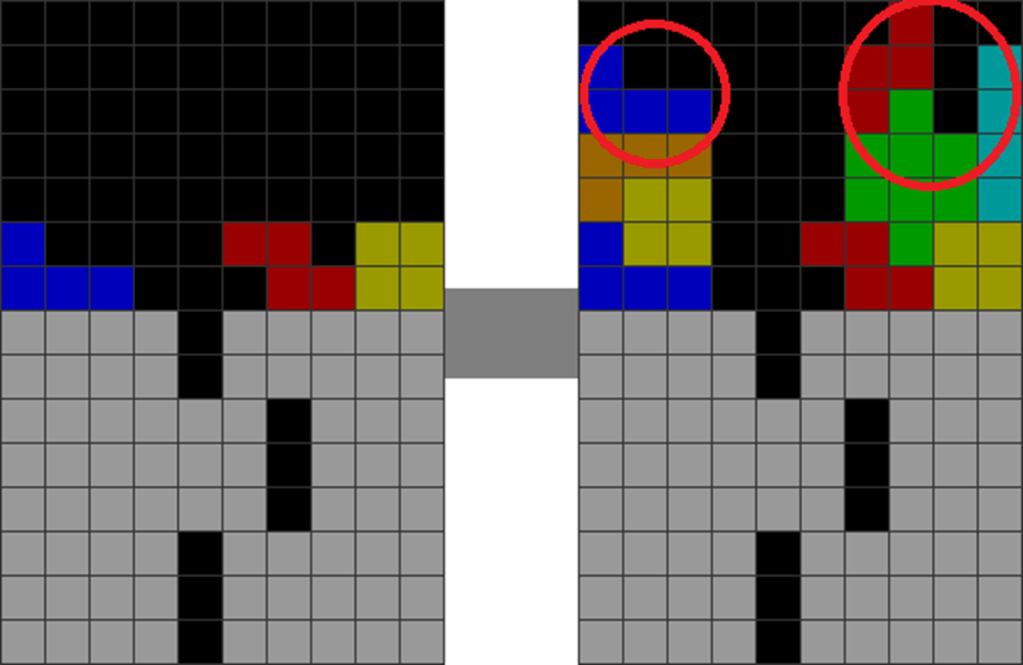
| A player tries to force a T-spin with J, Z, and O, using Z as an overhang. | The Ts are not in the previews. While waiting for Ts to arrive, he puts all incoming pieces on the left and right sides (red circles). |
Here, the player forces a T-spin setup in step 1. However, the T piece does not arrive to complete the T-spin line clear. Hence, in step 2, the player is forced to place all pieces to the left and right of the stack. This makes one overstack.
Instead, one can do this below, where sometimes, even the following downstacking options are the most efficient:
| Diagram Set 19-3 | |
| 1 | 2 |
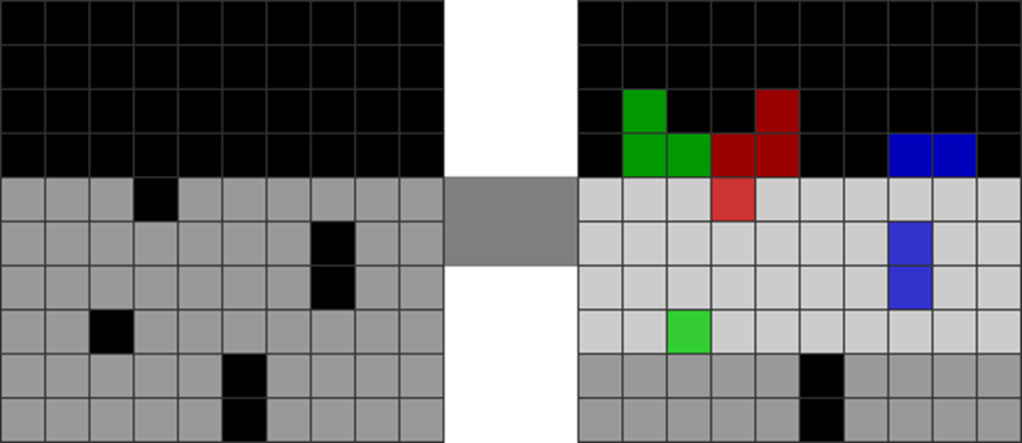
| The player chooses the most immediate pieces available, such as S, Z, and J, to downstack. |
Here, the player does not force any setup. Given the incoming pieces and the field’s shape, they simply sacrifice some efficiency by skimming and downstacking. This exposes the garbage hole in column six, allowing one to play safely.
Forcing a setup would most likely lead to risky stacking and losing the game.
Personal Applications
In real life, living in accordance with the law of flow is simply accepting life as it is, embracing its vicissitudes, and following where it leads.
Everything in the cosmos happens for a reason at the right time and right place.
When things are not ripe, forcing such an outcome will only lead to despair and disappointment.
Many of you reading this book, per my demographic data, are around 30 to 40 years old.
You all may wonder why life has not turned out the way it has. You all may not yet have achieved financial independence or found a romantic partner.
If you are reading this, perhaps this book has somehow, by some vibratory resonance, found you at the right time.
You are not a failure. Instead, your life has yet to begin. Carl Jung famously once said that true life begins at 40.
You are just merely being prepared, carefully gathering experiences, knowledge, skills, wisdom, and maturity for the next stage of your life.
Most lives are planned before birth. You and wise counsellors have arranged for many milestones in life that must be passed before you progress.
Nothing is wasted.
It is not to say that everything is predestined. Instead, the major milestones are destined, but the paths in between and the ways you deal with each are entirely free.
If you were to rush ahead, you would force untimely outcomes to occur and disrupt the plan.
Instead, flow with the rhythm of life and see where it leads you. Do not worry.
Social and Global Applications
The society of the new Earth will not be run by rigid laws, rules, and regulations to dictate people’s interests or economic needs.
Instead, it will be based on the law of synchronicity, where people will meet and interact whenever they need or want to at the right place and time.
Just like in the Tao Te Ching, the government that rules least allows for the natural laws of spirit to take precedence.
The ultimate purpose of governance is to maximize individual freedom for spiritual growth, creative expression, intellectual pursuits, emotional satisfaction, social interaction, and spiritual attunement.
A government that overrules and dictates too much will limit personal freedom.
A government should exist only to the extent of providing cooperation between people for large-scale public projects that benefit the whole. This includes scientific, social, ecological, cultural, and technological development, as well as security and public goods.
When a government oversteps its role, clashes occur between the government and the people.
No longer will either be in a perfect state of flow.
But when harmony between the two is restored, the world flows in accordance with the balanced expressions of its participants’ natural traits.
 How to Tetris