“Flow is the natural, effortless rhythm of the mind when fully engaged.”
— Inspired by Mihaly Csikszentmihalyi, Flow (1990)
Introduction
Flowing With Reality
According to Taoism, the more you resist the world’s natural rhythm, the more resistance you will face.[1]
A person who stubbornly attaches to and forces an outcome when the circumstances do not allow it becomes miserable.
One who fails to plan for the future and becomes entirely passive, waiting for life to occur and for fortune to arrive, is lazy.
Some things happen at the right time, in the right place, and under the right circumstances.
A person who accepts this can find life far easier to cope with.
Such a person still plans for the future and actively works towards their plan. However, when calamity strikes, they are as resilient as a mighty zelkova tree. When their goals do not arrive, they are not hasty or impatient.
When desires are not fulfilled, such as wanting a romantic partner, they acknowledge that the time is not ripe. One does not begrudge one’s circumstances but accepts them as they are.
Spiritual and Empirical Perspectives
Afterlife studies have found that, before birth, our spiritual counselors and we arrange major milestones so we can face and outgrow them.[2]
Even some family members, relatives, friends, business partners, or spouses were arranged as part of a pre-life agreement.[3]
Conversely, some souls choose to live independently and have far fewer pre-life arrangements. They may choose no spouses.
The cosmos then finds the right time and place for these events and people to appear in our lives to fulfill our life purpose.
If they do not appear, it means that the right circumstance has not yet arrived.
When a soul resists or rushes the natural flow, they get depressed and upset.
Hence, why not go with the flow?
This is not to encourage passive fatalism. One’s life’s major milestones might be arranged before birth. However, the in-betweens may not be.
You still have plenty of freedom to actively work toward other goals in these in-between states.
This is like the principle of Wu Wei in Taoist philosophy. One does not attach to forced outcomes; instead, one flows like water, taking the path of least resistance without looking back.
Modern psychology describes flow as a phenomenon in which people perform most productively when challenge and skill are matched.[4]
After all, life can only be lived forward and analyzed backward. The essence of reality is existence.
By stopping to examine its flow, you disrupt reality’s natural progression.
Only by flowing with reality can you sink into the rhythm of experience to become reality.
Tetris as an Analogy
The beginner and intermediate Tetris players would almost always make the most fatal mistake in the game.
They force a setup when the incoming previews and field do not allow it.
As shown below, the player can sometimes make a Tetris easily:
| Diagram Set 19-1 | |
| 1 | 2 |
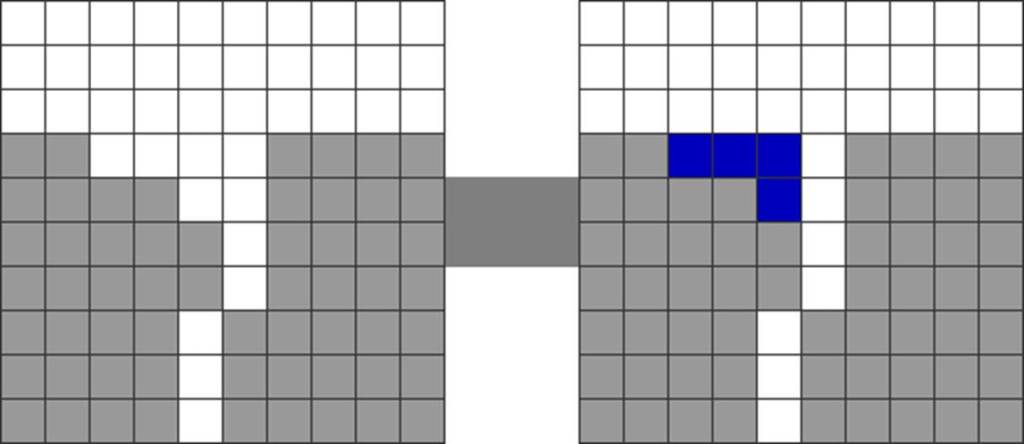
| The starting field. | The player only needs to place 1 piece: the J piece to create a 4-block-high rectangle. |
| 3 | 4 |
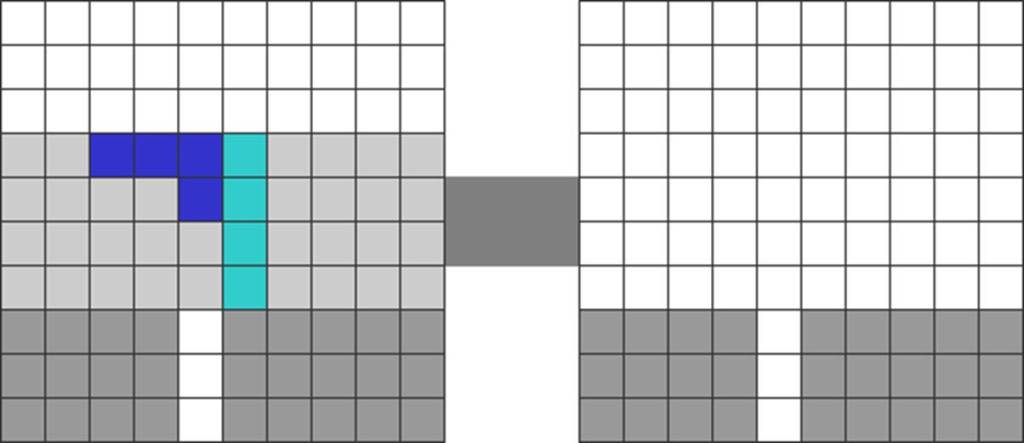
| The 4-block-high rectangle is line-cleared by inserting an I piece into it to score a Tetris. | After the line clear, the stack is perfectly clean. |
Here, the player has the right pieces to stack correctly and safely into a Tetris. He can then use the I piece to make a Tetris line clear.
It went with the flow. It was thus smooth.
However, things are not as fortunate in the following situation:
| Diagram Set 19-2 | |
| 1 | 2 |
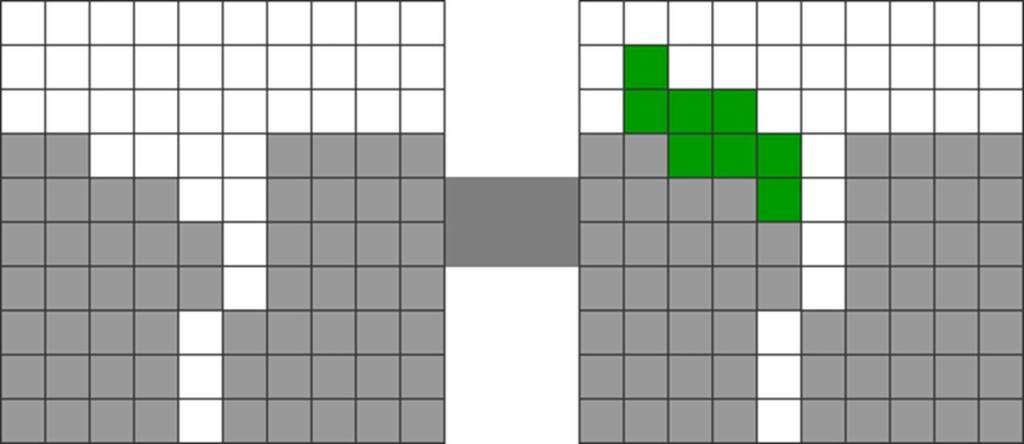
| The same starting field as the last diagram set. | The player prepares to make a T-spin. He places some pieces. |
| 3 | 4 |
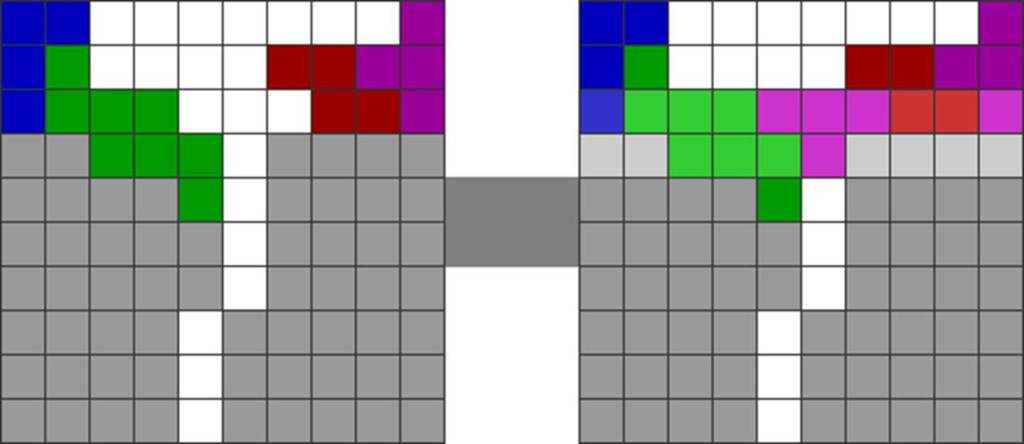
| The T-spin is ready after placing 5 pieces. | He completes the T-spin. |
Here, the player forces a T-spin setup in step 3 instead of a quick Tetris in the last diagram set.
He ends up needing six pieces to complete the chosen setup, while in the previous Tetris example he needed only two.
Hence, this went against optimal flow by forcing a less efficient setup.
Forcing a setup would most likely lead to risky stacking and losing the game.
Personal Applications
Flowing With Life
In real life, living in accordance with the law of flow is simply accepting life as it is, embracing its unpredictable challenges and events, and following where it leads.
Everything in the cosmos happens for a reason at the right time and right place.
When things are not ripe, forcing such an outcome will only lead to despair and disappointment.
According to my demographic data, many of you reading this book are between 30 and 40 years old.
You all may wonder why life has not turned out the way it has. You all may not yet have achieved financial independence or found a romantic partner.
If you are reading this, perhaps this book has somehow, by some vibratory resonance, found you at the right time.
You are not a failure. Instead, your life has yet to begin. Carl Jung famously once said that true life begins at 40.[5]
You are merely being prepared, carefully gathering experiences, knowledge, skills, wisdom, and maturity for the next stage of your life.
Most lives are planned before birth. You and your wise counselors have arranged many milestones you likely must reach before you can progress.[6]
Nothing is wasted.
If you rush ahead, you force untimely outcomes and disrupt the plan.
Instead, flow with life’s rhythm and see where it leads you. Do not worry.
Flow States
When novices play Tetris, they often need intense concentration and a lot of deliberate thought. They have to think through every move consciously, like when you first ride a bike.
After a while, a novice might quit Tetris because it simply takes too much energy to improve.
Then, people sometimes ask me: how much thinking do I actually do in Tetris?
Surprisingly, the answer is “not very much.”
This is because I have internalized nearly every decision, so I do not need to consciously learn or figure much out.
I have explored nearly every conceivable option in Tetris, knowing when to use them and when not to.
Nearly everything requires pure muscle memory and pattern recognition. I do not think much except for rarer, unfamiliar setups.
This is why I can play Tetris for up to five hours in my streams without getting tired.
And this state, where one’s ability matches Tetris’ ongoing challenges, is called a flow state, as described by the Hungarian-American psychologist Mihaly Csikszentmihalyi.
This is why many virtuosos across many fields can consistently pursue their projects without burning out.
When one is so passionate about their projects or area of expertise, they need not work a single day in their lives.
This is because they no longer see their hobbies as typical “work” or a normal “job.”
Two decades ago, a taxi driver in his sixties had retired from his former job as an engineer. He complained to me that he needed a real hobby where he could fully immerse himself and forget everything.
However, every few years, when I met him again, he said the same thing. The greatest tragedy was that he did not even start learning a new skill to master.
Unfortunately, this seems to be a common theme in many of my fellow Singaporeans whom I have met.
They are so engrossed in their corporate jobs and the nine-to-five rat race that, upon retirement, they realize they have nothing beyond them.
People sometimes ponder why I can write thousands of pages of deep spiritual and philosophical fiction and non-fiction without getting tired.
The fact is that I still get tired. However, once I have mastered a skill’s sub-domains, such as plot structure and the handling of tone, atmosphere, theme, and prose in novels, my brain does not need much conscious deliberation to act in these areas.
This is my secret to achieving flow states: in my experience, you cannot gain it straight away.
Instead, one has to spend many years mastering a skill until it becomes embedded in automated muscle memory.
Only then can one enter this flow state and not work a single day in one’s life.
However, most people fear their inadequacies and fail to begin.
As a result, my advice for you is simply an adaptation of the one that the Irish writer, Julian Gough, told me:
Do not wait or overthink a hobby. Start now and just do it.
Then, turn it into an ikigai:
Ikigai: The Four Quadrants
The Westernized interpretation of the Japanese concept of Ikigai is the idea that a fulfilling vocation should harmonize four elements: (i) what we are good at, (ii) what the world needs, (iii) what we can be paid for, and (iv) what we love.[7]
When what you are good at is combined with what you can be paid for, you have a profession.
When what you love is combined with what you are good at, you have a passion.
When what the world needs is combined with what you can be paid for, you have a vocation.
What you love and what the world needs is a mission.
When you bring all four together, you reach ikigai.
For me, Tetris is one of my several ikigais.
It really began when I started playing Puyo Puyo Tetris around seven years ago. It started as a passion, and I did not know where it would lead.
I faced many hurdles and wanted to quit because of the challenges, friction with some groups, and the pain of improving.
I honestly do not know how Tetris led to the creation of this book and my other guidebooks and tutorial videos; I just kept pushing into the unknown.
I suppose that it required a kind of unconventional courage to be authentic and unique.
All I know is that if I had given up out of fear and a lack of perseverance, my Tetris achievements would not have been possible.
My other ikigai is creative writing, which took me about ten years to master its many sub-skills.
Without writing a long story, I had to face a lot of fear and uncertainty. Somehow, I pushed through it with the same grit I used for Tetris.
Yet, there is still much to learn, and I dream of returning to make the next editions of my The Eternal Reflection novels by refining the prose further.[8]
Other people may have developed their ikigais differently.
However, to summarize, I developed mine through a combination of perseverance, courage, and a need for originality and uniqueness.
Social and Global Applications
The New Earth
The society of the new Earth will not be run by rigid laws, rules, and regulations to dictate people’s interests or economic needs at their life satisfaction’s expense.
Instead, it will be based on the law of flow, finding the proper balance between governance and freedom for maximal life satisfaction and efficiency.
The ultimate purpose of governance is to maximize individual freedom for spiritual growth, creative expression, intellectual pursuits, emotional satisfaction, social interaction, and spiritual attunement.[9]
As in the Tao Te Ching, the government that rules least allows the natural laws of spirit to take precedence.[10]
A government that overrules and dictates too much will limit personal freedom.
When a government oversteps its role, clashes occur between the government and the people.
The former USSR is the best example of what happens when a government overreaches to the point of eventual societal collapse.
In 1932, Stalin forcibly collectivized Ukrainian farms, seizing harvests to meet state quotas. Farmers then lost the motivation to work. The result was a man-made famine killing millions.
Yet, if a country’s government under-regulates, the opposite happens.
In 2008, the US government had spent years failing to regulate its financial system and banks. People borrowed money excessively to buy property until the real estate market crashed. This led to the 2008 Subprime Mortgage Crisis.
Hence, some regulation is still needed: a government should facilitate cooperation among people on large-scale public projects that benefit and protect the whole.
This includes scientific, social, ecological, cultural, and technological development, as well as security, safety, and public goods.
When harmony between people and the government occurs, the world flows in accordance with the balanced expressions of its participants’ natural traits and abilities.
A proper balance between governmental regulation and deregulation is hence needed for society to flow properly.
An Ikigai-Oriented Earth
We currently live in a tumultuous world where most of us cannot truly self-actualize and embrace a flow state.
In the US, more than half of the populace live paycheck to paycheck. If an emergency strikes, fewer than half of Americans have sufficient funds to cover a $1,000 expense.
And to make matters worse, healthcare services can be extraordinarily expensive. A helicopter ambulance can cost around $25,000 to $30,000.
Mortgages and rentals are rising to astronomical levels because wealthy moguls have bought up all the property for speculation, leaving supply unable to meet demand.
And many people worry each day about being fired from jobs they often have no passion for.
In Marxist terms, human beings are alienated from themselves, others, their work, and their jobs.[11]
The division of labor, which increases human productivity, has broken down jobs into unfulfilling components that we cannot even see how they fit into the finished product.[12]
And the greatest contradiction? The Earth has enough resources for everyone to live rather comfortably.
However, most of its wealth is in the hands of just a few privileged millionaires and billionaires, or developed countries.
Much of the produce of the average man is extracted by wealthy capitalists who fill their coffers with enough money to buy an entire fleet of Ferraris.
A civilization that operates like this will have little security or a fundamental basis for the flourishing of human abilities.
However, this can change.
A new Earth can ensure a more even distribution of wealth, universal basic income, free healthcare, free education, and freedom from market volatility that could wipe out one’s savings, security, safety, employment, and other forms of hazard insurance.
Only when the basic safety net has been provided, where every Earthly citizen has enough income and wealth to no longer worry about the next paycheck, can we create a social system that allows people to self-actualize and achieve a true flow state.
[1] Lao Tzu, Tao Te Ching, Chapter 8 (c. 6th century BCE). Wu Wei — effortless non-action — holds that aligning with the natural flow of reality produces less resistance and greater harmony than forcing outcomes against it.
[2] Michael Newton, Destiny of Souls (2000). Newton’s subjects described pre-birth planning sessions where souls arrange key milestones, relationships, and lessons before incarnating.
[3] Edgar Cayce, compiled in Noel Langley, Edgar Cayce on Reincarnation (1967). Cayce confirmed pre-life soul agreements, including arranged relations and life events.
[4] Mihaly Csikszentmihalyi, Flow: The Psychology of Optimal Experience (1990).
[5] Carl Jung, “The Stages of Life” (1930), in The Structure and Dynamics of the Psyche, CW Vol. 8.
[6] Edgar Cayce readings, compiled in Noel Langley, Edgar Cayce on Reincarnation (1967); Michael Newton, Destiny of Souls (2000). Both sources describe pre-birth planning sessions with spiritual guides in which souls arrange key life milestones and lessons before incarnating.
[7] Ken Mogi, The Little Book of Ikigai (2017); see also Héctor García and Francesc Miralles, Ikigai: The Japanese Secret to a Long and Happy Life (2016). While traditional Japanese culture defines ikigai as finding joy in daily existence, popular international interpretations use this four-element framework.
[8] I probably manifested at the Michael Teaching’s earlier soul ages when I wrote the earlier novels. I likely began manifesting my true soul age during Books 5 to 7, in my Tetris guidebooks, and in this book. That is why Books 1 to 4 cover more emotional themes of loss and despair, while all my subsequent books cover detachment and intellectualized matters from a cosmic perspective. That is why I do not feel comfortable about returning to Books 1 to 4 to make a new, improved edition: I have outgrown them and feel lazy.
[9] Herbert Marcuse, One-Dimensional Man (1964); Abraham Maslow, Toward a Psychology of Being (1962). Both imply that the ultimate purpose of social organization is to free humans for creative, intellectual, and spiritual self-actualization.
[10] See Laozi, Tao Te Ching, ch. 57, which advocates governing with minimal interference (Wu Wei) and allowing things to follow their natural course.
[11] Karl Marx, Economic and Philosophic Manuscripts of 1844.
[12] Karl Marx, Economic and Philosophic Manuscripts of 1844; Adam Smith, The Wealth of Nations (1776); Émile Durkheim, The Division of Labor in Society (1893).

