“We are all connected; to each other, biologically. To the Earth, chemically. To the rest of the universe atomically.”
—Neil deGrasse Tyson
Introduction
There has never been any separation.
The separation that you perceive existing between objects, people, groups, countries, planets, or galaxies is nothing more than a figment of one’s imagination.
Before birth, one’s spirit exists in the absolute, knowing no distinctions between self and non-self, subject and object, me and others. It does not perceive or grasp the artificial plurality or multiplicity of the cosmos.
However, upon physical incarnation within a limited bodily form, this seamless perception of a unitary reality is broken.
Upon taking the corporeal form of an infant, it first develops a sense of physical and spatial separation from others.
As the child matures, it clothes itself in the illusion of the self versus other selves. This is when the ego is born.
Over many decades, the person adorns their ego with more artificial identities and forgets their original, divine oneness. It adorns the illusion of status, social class, intelligence, nationality, religion, political ideology, or other organizational traits.
When it does, the self forgets its unity and lives in accordance with this imagined sense of separation.
One then uses this veil of separation to justify many injustices in the world. When one perceives another as a non-self, one may use this as a pretext for racism, prejudice, bigotry, ostracism, or even genocide.
Many social and geopolitical issues in this world, be it wars or religious pogroms or massacres, arise because we mistake our perception of separation and forget our divine whole.
To break the cycle, one must remember their sacred origin that was forged in unity.
Tetris as an Analogy
Please allow me to help you remember and dispel this veil of separation using Tetris as a metaphor and vessel for spiritual and philosophical growth.
In Tetris, one of the first few essential offensive abilities is the mighty T-spin. It involves creating a T-shaped structure with a cavity. One then lowers (soft drops) a T piece into the cavity, spins it, and makes a line clear. This completes a T-spin that sends extra garbage lines to the opponent:
| Diagram Set 2-1 | |
| 1 | 2 |
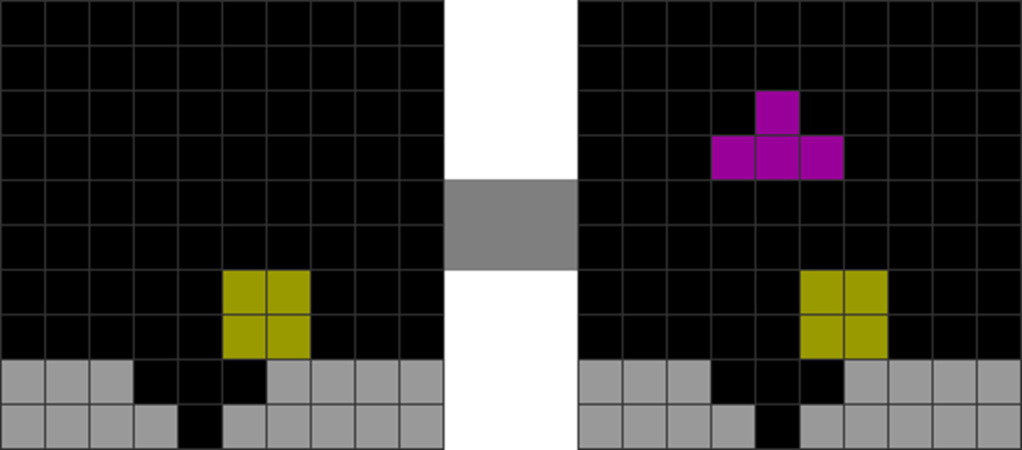
| Make an overhang with the O piece over the T-shaped cavity. | Move the T piece to the height above the T-spin cavity. |
| 3 | 4 |
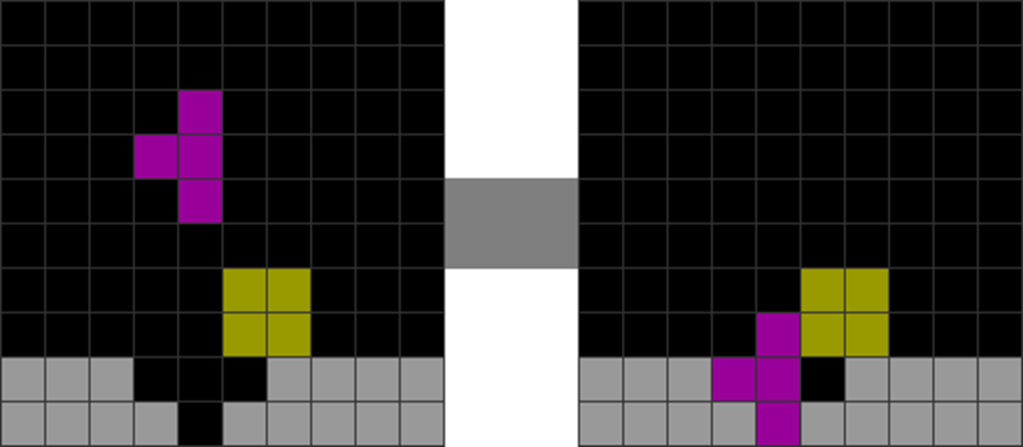
| Rotate it in the correct direction just above it to soft drop it down. | Soft drop it into the cavity below. Rotate it to make it fit into the cavity. |
| 5 |

| Once the T piece locks, it triggers a T-spin double, clearing two lines. |
Most casual players would simply terminate at this level of understanding. They can, at most, see only a single T-spin.
However, many intermediate players advance to the next stage by inserting T-spins in between T-spins to create composite setups. The following shows a Super T-Spin Double (STSD), which comprises two T-spin doubles:
| Diagram Set 2-2 | |
| 1 | 2 |

| The first T-spin double is spun vertically. This then leaves a second T-spin double. |
| 3 |

| You are left with this second T-spin double. |
In step 2, the player inserts the first T piece into the cavity to create the first T-spin double line clear. In step 3, the aftermath shape is a second T-spin double. Hence, the player can then insert a second T piece into the T-shaped cavity, creating a second T-spin double line clear.
Hence, an STSD is not a single, independent T-spin setup. Instead, it can be broken down into two conjoined T-spins.
There was never any separation between the two T-spins: they both make up part of a greater whole.
This can be generalized further in more advanced setups that comprise more than two embedded T-spins, such as the following:
| Diagram Set 2-3 | |
| 1 | 2 |

| A spliced STSD with two T-spin doubles inserted into it in the lavender area. |
| 3 | 4 |
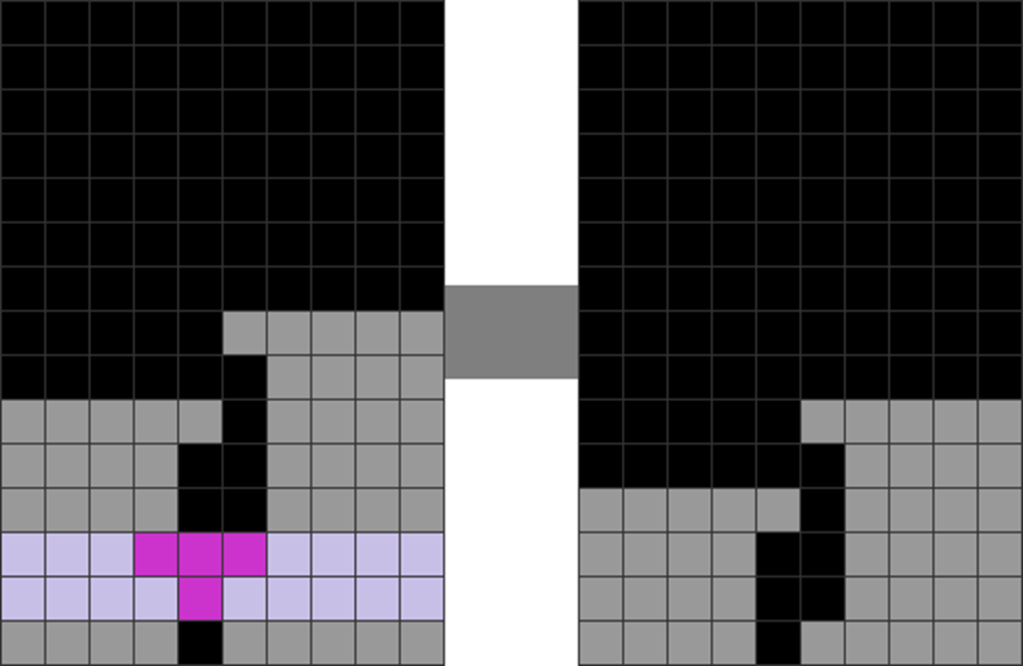
| After the second T-spin concludes, you are left with the STSD. |
The above setup is made of four T-spin doubles. It involves inserting two extra T-spin doubles into an STSD that already has two T-spins.
How does this apply to the spiritual law of oneness?
In Buddhist philosophy and spirituality, one of the most vital concepts is Sunyata, or emptiness. This means that the true nature of reality is emptiness.
This might sound confusing, suggesting that reality is inherently made of nothing. However, this is a widespread misconception involving the term. Nothingness more accurately means “spaciousness.”
To illustrate this, I invoke the analogy of a tree within a garden.
My question to you is: “Where is the tree?”
A person who operates from the perspective and illusion of separateness will point at the tree, and perhaps use paint to draw the boundaries whereby the tree’s outline ends. One perceives the tree as being separate from the soil, sunlight, and clouds that nourish it.
However, if one thinks deeper, the tree absorbs water and nutrients from the soil. The soil is also formed from the accumulation of organic matter from dead plants and creatures.
Likewise, the soil is not separate from the environment either. The clouds above provide water to the soil, eroding its granite and contributing to its formation. Sunlight then contributes to further weathering.
When the tree absorbs nutrients and water from the soil, it is essentially soaking up the gifts the environment provides.
When it transpires, it again delivers moisture that makes up the clouds high above, completing the hydrological cycle.
Furthermore, many bees may harvest nectar from the tree’s flowers, pollinating other trees to continue the tree’s life cycle.
Throughout the entire process, the tree is not separate from the soil, sky, bees, sunlight, or other animals.
The separation we perceive in the tree arises primarily from object consciousness, which separates the subject and object.
When we point at the tree and name it a Bodhi tree, we are using our mind’s limited intellectual frameworks to draw boundaries between objects. We do this to simplify nature for practical applications or understanding.
However, the name of the tree is not the tree itself.
Just as one can point at the moon and declare that it is the moon, the finger pointing at the moon is not the moon itself.
It is this dispelling of separation between all things, knowing that they are all connected in a web of eternal causation, that we can remember the unitary nature of the cosmos.
Personal Applications
Remembering our inherent unity confers many benefits and applications to our lives.
When one perceives others as non-separate, we essentially dispel the invisible and artificial veil between us.
We remember that every individual, soul, creature, or object is part of an immortal and divine reality and consciousness.
When we do, we see ourselves in others and others in ourselves. Each of us is both an other, and every other is essentially us.
Upon this realization, we will begin to love and nourish others as we do ourselves.
And with that, it is far easier to forgive and accept others, pardoning many transgressions and dislikes we once had for others.
Social and Global Applications
On a broader societal and global level, applying the principle of oneness can have many lasting, positive effects.
When entire countries no longer see each other as an ‘other,’ there will be no need for any intense geopolitical competitions and wars.
Imagine if China and the USA cast aside their rivalries and combined their massive technological and industrial supremacy to resolve climate change and revolutionize robotics?
Imagine if Israel and Palestine were to cast aside their sense of separation and cooperate? Imagine if Russia and Ukraine did the same.
We would all live in a world that is far more peaceful, tolerant, accommodating, and harmonious.
The whole world is one. There are no Americans, Chinese, Japanese, Koreans, Europeans, Africans, Indians, Australians, and so on.
There are also no plants, animals, humans, or extra-terrestrials.
We are all one.
 How to Tetris