“We are all connected to each other, biologically. To the Earth, chemically. To the rest of the universe atomically.”
— Neil deGrasse Tyson
Introduction
The Illusion of Separation
There has never been any separation.
The separation that you perceive existing between objects, people, groups, countries, planets, or galaxies is nothing more than a figment of one’s imagination.
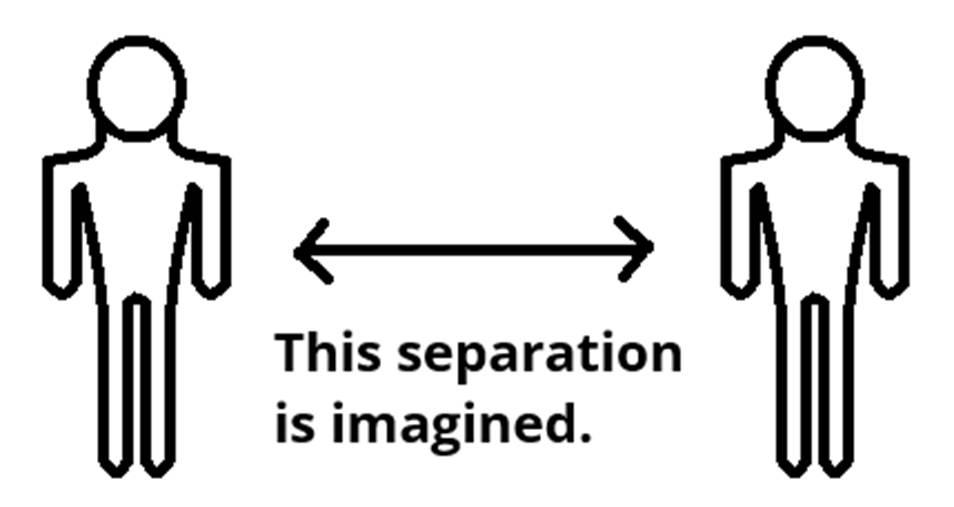
Before birth, one’s spirit exists in the absolute, knowing no distinctions between self and non-self, subject and object, me and others. It does not perceive or grasp the artificial multiplicity of the cosmos.[1]
However, upon physical incarnation in a limited bodily form, this seamless perception of a unitary reality breaks.
Upon taking the corporeal form of an infant, it first develops a sense of physical and spatial separation from others.
As the child matures, it clothes itself in the illusion of the self versus other selves. This is when the ego is born.
Over many decades, the person adorns their ego with more artificial identities and forgets their original, divine oneness.
It adorns the illusion of status, social class, intelligence, nationality, religion, political ideology, or other organizational traits.
When it does, the self forgets its unity and lives according to this imagined separation.
The Consequences
When one sees the world and others as separate, one uses this veil of separation to justify many injustices.
When one perceives another as a non-self, one may use this as a rationale for racism, prejudice, bigotry, exclusion, ostracism, or even genocide.
Many social and geopolitical issues in this world, be it wars, religious pogroms, or massacres, arise because we mistake our perception of separation and forget our divine whole.
To break the cycle, one must remember their sacred origin, which was forged in unity.
Tetris as an Analogy
Please allow me to help you remember and dispel this veil of separation using Tetris as a metaphor for spiritual and philosophical growth.
In Tetris, one of the first few essential offensive abilities is the mighty T-spin.
That is right! You have heard of the Tetris introduced in the last chapter. However, a step above it is the T-spin.
It involves creating a T-shaped cavity. Then you lower a T piece into the cavity, spin it, and clear a line. This completes a T-spin, sending extra garbage lines to the opponent. Here is how to create one:
| Diagram Set 2-1 | |
| 1 | 2 |
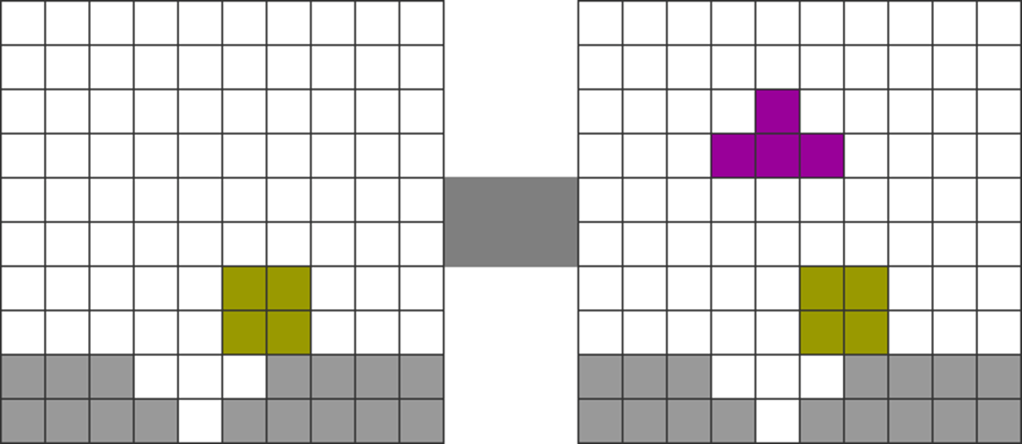
| Place the O piece over the T-shaped cavity to create an overhang (roof). | Move the T piece to the height above the T-shaped cavity. |
| 3 | 4 |
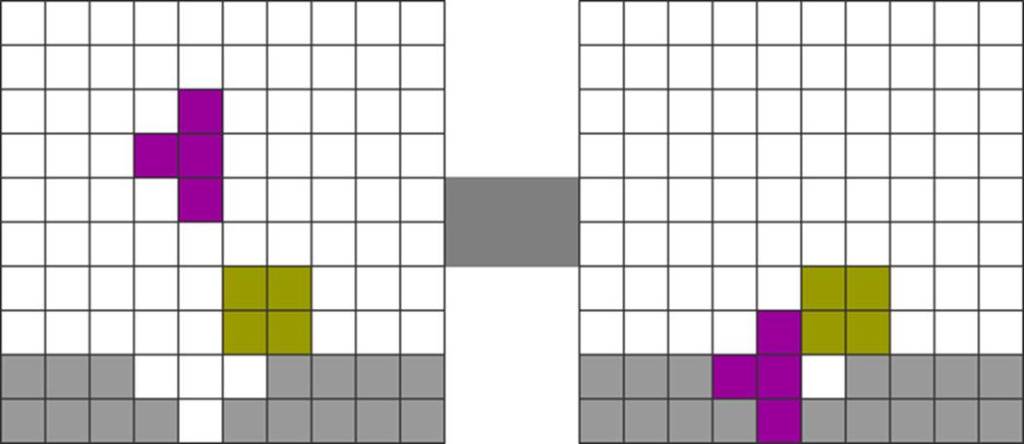
| Rotate it in the correct direction just above it to drop it down. | Insert it into the cavity below. Rotate it to make it fit into the cavity. |
| 5 | 6 |
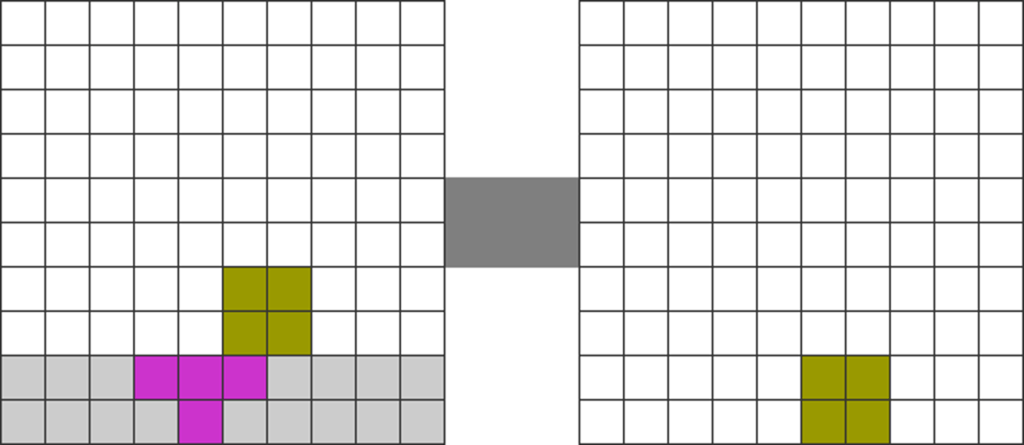
| Once the T piece locks, it triggers a T-spin, clearing 2 lines. | The resultant field. |
Most casual players stop at this level of understanding. They can, at most, see only a single T-spin.
However, many intermediate players advance to the next stage by inserting T-spins in between T-spins to create composite setups.
The following shows a Fractal setup:
| Diagram Set 2-2 | |
| A | B |
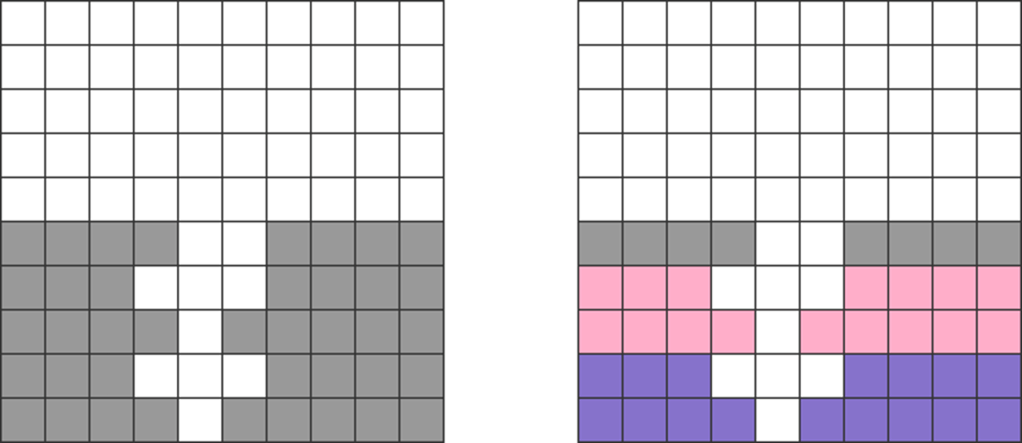
| This is a Fractal setup. | A Fractal is simply 2 stacked T-spins. The first is in pink, the other is in lavender. |
Please do not get spooked! A Fractal is just two stacked T-spins! Think of it as stacking two T-shaped cavities on each other!
The player can then finish the sequence this way:
| Diagram Set 2-3 | |
| 1 | 2 |
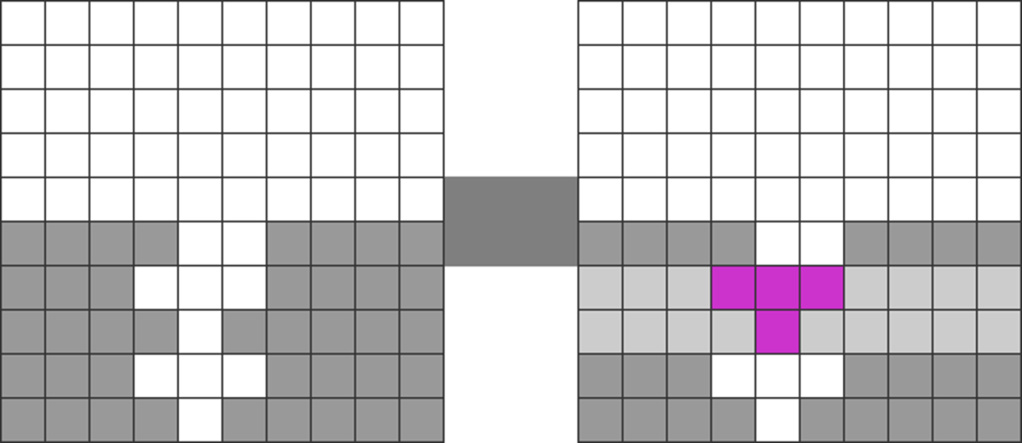
| A Fractal is ready. | Insert the first T piece into the top T-shaped cavity. This clears 2 lines. |
| 3 | 4 |
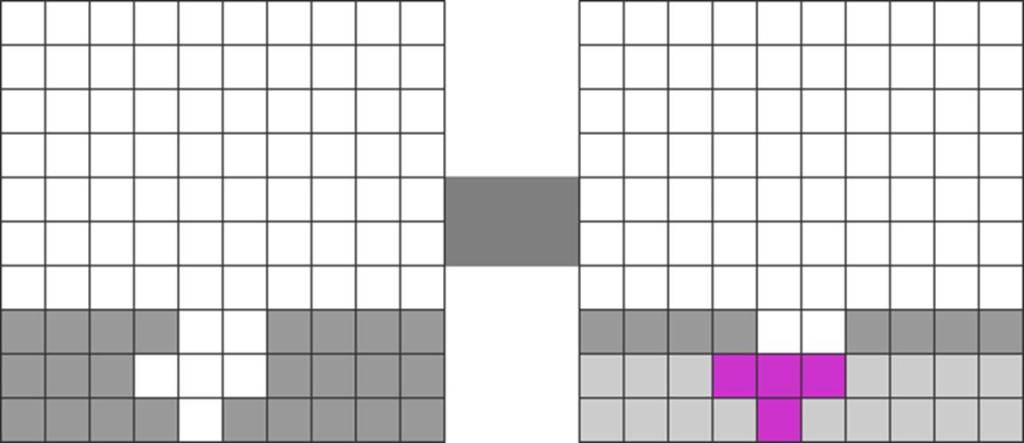
| You are left with the second T-shaped cavity. | You insert the second T piece into this T-shaped cavity, clearing 2 more lines. |
Not too difficult, is it?
Hence, a Fractal is not a single, independent T-spin. Instead, it can be broken down into two conjoined T-spins.
There was never any separation between the two T-spins: they both make up part of a greater whole.
How does this apply to the spiritual law of oneness?
In Buddhist philosophy and spirituality, one of the most vital concepts is Sunyata, or emptiness. This means that the true nature of reality is emptiness.
This might sound confusing, as if it suggests reality is inherently made of nothing. However, this is a widespread misconception involving the term. Nothingness more accurately means “spaciousness.”
To illustrate, I invoke the analogy of a tree in a garden.
My question to you is: “Where is the tree?”
A person who operates from the perspective and illusion of separateness will point at the tree, and perhaps use paint to draw the boundaries whereby the tree’s outline ends. One perceives the tree as being separate from the soil, sunlight, and clouds that nourish it.
However, if one thinks deeper, the tree absorbs water and nutrients from the soil. Soil also forms from the accumulation of organic matter from dead plants and creatures.
Likewise, soil is not separate from the environment. The clouds above provide water to the soil, which erodes the granite and contributes to its formation. Sunlight then contributes to further weathering.
When the tree absorbs nutrients and water from the soil, it is essentially soaking up the gifts the environment provides.
When it transpires, it again releases moisture that forms the clouds high above, completing the hydrological cycle.
Furthermore, many bees may harvest nectar from the tree’s flowers, pollinating other trees to continue the tree’s life cycle.
Throughout the entire process, the tree is not separate from the soil, sky, bees, sunlight, or other animals.
The separation we perceive in the tree arises primarily from object consciousness, which separates the subject and object.
When we point at the tree and call it a Bodhi tree, we use our mind’s limited intellectual frameworks to draw boundaries between objects. We do this to simplify nature for practical applications or understanding.
However, the name of the tree is not the tree itself.
Just as one can point at the moon and declare that it is the moon, the finger pointing at the moon is not the moon itself.
It is this dispelling of separation between all things, knowing that they are all connected in a web of eternal causation, that we can remember the unitary nature of the cosmos.
Personal Applications
The Effects of Remembering Our Oneness
When we perceive others as non-separate, we dispel the invisible, artificial veil between us.
We remember that every individual, soul, creature, and object is part of an immortal, divine reality and consciousness.
When we do, we see ourselves in others and others in ourselves. Each of us is both an other, and every other is essentially us.
You are simply the all-that-there-is taking on a mortal and limited form to explore multiplicity and manifest free will, contributing to the eternal dreamscape of creation, participating in the great game of life.
Upon this realization, we will begin to love and nourish others as we do to ourselves.
We can then dispel discrimination against some social groups (based on neurodivergence, religion, ethnicity, gender, nationality, etc.) easily.
This dismantles that us-versus-them mentality that is responsible for institutionalized racism, wars, suppression, or genocides against some people.
When we remember that all is one, it is far easier to forgive and accept others, pardoning many transgressions and dislikes we once held toward them.
This is because hurting them equates to hurting ourselves, since we are all one.
Dismantling the Veil of Separation
To remember our original oneness, one must first dismantle our illusion of separation.
The Zen master, Bankei Yōtaku, once wrote about the concept of the unborn self.[2]
It is the idea that, before birth, you are a unitary whole that has not yet learned the distinctions or imagined separations between people.
However, once you are born, you take on a physical form that is separate from others. This is when the “me” is born.
Over many years, you learn your native language, picking up words such as “me,” “others,” “you,” “they,” “us,” and so forth.
Many sociological and psychological theories support this. Through symbols, we differentiate ourselves from others.[3]
This is how you learn separation. It exists largely in the mind and is constructed biologically, psychologically, and sociologically.
Do you still remember your childhood school days, when some people strove to be the most popular?
And maybe, in your workplace, where people strove to be the best performer, seeking to have the biggest portfolio and influence?
That is when separation is the greatest.
And what surrounds you in your upbringing: church, social clubs, Tetris clubs, workplace, and other institutions can sometimes strengthen this sense of us versus them.
During the time of the Nazis, young boys were brought up to harbor the state-sanctioned racist Aryan ideology. The result? They saw other races, like Jews, as sub-humans, leading to the Holocaust.
Before the 1960s US Civil Rights movement, people of color were segregated in toilets, buses, and other public areas. This created a subconscious attitude among Whites, who saw Blacks and other races as those to be avoided.
In some countries, which I will not name because of cultural and political sensitivity, their children are brought to the residences of a people they consider to be “sub-human.” They then witness the bombing and blowing up of these residents, glorifying them.
The result? Once they became conscripts during their mandatory military service, they dehumanized these people, justifying their slaughter with a racist ideology.
The walls between people are only as real as the mental boundaries of mapmakers. Dismantle this.
Return to that unborn self, where you again remember the lack of separation in a connected cosmos, where every flicker of life matters.
When the entire world does this, no longer will there be a need for conflict, prejudice, discrimination, segregation, pogroms, wars, or genocides.
Social and Global Applications
When entire countries no longer see each other as an ‘other,’ there will be no need for intense geopolitical competition or war.
Below, I provide several examples of what happens when the law of Oneness is breached.
Many of these examples involve real-life geopolitical events.
I do not wish to take sides whenever possible since geopolitics is sensitive. However, I must cover them because of their importance and relevance to this law’s applications.
Whether you are from the political left or right, I respect your opinion. I will keep matters as factual as possible.
Hence, I will analyze them in terms of consequences and show how the same separation principle underlies each.
Middle Eastern Conflicts
As of 2026, Iran and its allies are interlocked in a long-term conflict with many Gulf nations, Israel, and the USA.
Before this, the region was engulfed by many wars involving the Iraqi-Iranian War, the USSR’s and the USA’s invasion of Afghanistan, Operation Iraqi Freedom, and the many wars between Israel and the nearby Arab states.
However, some scholars argue that many of these conflicts had precedents traced back to European colonialism. The British Empire broke up the region into many artificial states, such as the Gulf monarchies.[4]
Over many years, many nations within the Middle East have had their wars predicated on this false separation of artificial nationality, which is taught and ingrained within their children and their children’s children.
The result is an artificially imposed sense of ethnic nationalism, in which the boundaries between people are man-made.
This separation can be dispelled, so people of the Middle East can cooperate.
The Russo-Ukrainian Conflict
Russians and Ukrainians used to be one people, sharing the same civilization.
However, some political scientists, such as John Mearsheimer, argue that Russia saw NATO’s eastward expansion as an existential threat.[5]
Russia then engaged eastern Ukraine in a special military operation. As of 2026, the two countries are locked in a war of attrition that shows no sign of ending.
As for which country’s fault the war might have its actual roots in, I will remain neutral. Only future historians can be sure with the benefit of hindsight.
But, to me, this is a sign of constructed division, where geopolitical factors have separated a single people and led to long-term conflict.
Ukrainians and Russians have no reason to battle each other.
By dispelling the imagined lines between the two peoples, Europe need not be in this perpetual conflict.
The Sino-US Conflict
An intense second Cold War is being orchestrated between China and the USA.
This conflict, while still non-militaristic as of this book’s writing, is governed by intense geopolitical, economic, cultural, financial, and technological competition.
Under the Biden and Trump administrations, the US has imposed various technological controls on China, including the Chip Alliance. Under Trump, the US imposed massive rounds of trade tariffs on China.
China responded with its economic sanctions and a near-monopoly on rare earth metals.
However, this is saddening because, during the era of American unipolarity and globalization from the 1990s to the early 2000s, the US and China saw their relationship blossom. The US helped China to enter the World Trade Organization (WTO).
The result was a mutually beneficial relationship in which China was the world’s manufacturer and the US was the world’s consumer.
Yet now, both countries are retreating inwards, decoupling, and reacting militarily to each other.
China and the USA could enter a real military engagement, turning the Cold War hot.
Again, this happens when the law of Oneness is breached. China and the US see each other not just as rivals, but increasingly as adversaries.
The result is another artificial boundary crafted between the two superpowers, when they could stand a better chance of cooperating in harmony against the upcoming climate change crisis.
This imagined wall between China and the USA can likewise be dispelled.
Big Corporations
What do I think about the rich billionaire oligarchs that run the world?
There is no contest regarding their massive contributions, such as Bill Gates’ co-founding of Windows. However, without naming names, I feel many are exploitative.
Some geoeconomic analysts suggest that many big AI tech firms intentionally offer their stocks through Initial Public Offerings (IPOs).[6]
This means ordinary investors without technical investing knowledge, like you and me, can buy their stocks.
However, as of late 2026, the USA’s AI firms are undergoing the biggest stock bubble in history.[7]
Political economist Ben Norton suggests that wealthy elites do this to raise immediate funds and boost their portfolios at those people’s expense.
The goal was to get average, non-savvy investors to buy into these corporate stocks. When stocks climb, the wealthy sell their shares, essentially performing a reverse Robinhood.
This happens when big companies and CEOs have an “us-versus-them” mentality that justifies exploiting ordinary people for their profit.
I feel that a civilization based on the law of Oneness would not let this happen. If everyone is one, an economic system would distribute wealth equally.
As an author, my publishing platform takes a large share of my profits with every transaction. My How to Play Tetris: The Essential Guide costs $45. However, after all deductions, I essentially earn only around $6 to $7 per customer purchase.
The great German philosopher and economist, Karl Marx, called this the extraction of one’s surplus labor.[8]
It is the tool that capitalists use to earn a much larger-than-entitled share of other people’s produce, without producing it themselves.
That is the reason techno-feudalists, such as the CEOs of many Big Tech firms, could get so rich: by taking a larger-than-entitled share of other people’s produce.
If such a system were to continue, where wealthy executives see themselves as an entitled “them” versus the rest of humanity, we would only continue to suffer from this vast and unfair inequality.
However, the French philosopher Charles Fourier proposed a solution in the early 19th century.
He proposed that communities of 500 to 2,000 people live and work together in self-contained buildings called phalansteries.
Jobs were assigned based on personal passion rather than economic necessity. As a result, workers rotated tasks to stay engaged, and they shared profits collectively.
His vision showed that when work aligns with passion within a cooperative community, productivity and human wellbeing can rise together.
If such a system could be incorporated back then, it can likewise be implemented today.
However, doing so requires not just full government backing, but a global shift in our attitude.
Such a system would be disadvantaged compared with other capitalist corporations; it would quickly lose its competitive edge and become obsolete.
Only when the world adopts a true “we” mentality and applies it globally can this be possible.
A Return to Oneness
Imagine if China and the USA set aside their rivalries and combined their massive technological and industrial capabilities to address climate change and revolutionize robotics?
Imagine if Israel and Palestine were to cast aside their sense of separation and cooperate?
Imagine if Russia and Ukraine did the same.
We would all live in a world that is far more peaceful, tolerant, accommodating, and harmonious.
The entire world is one. There are no Americans, Chinese, Japanese, Koreans, Europeans, Africans, Indians, Australians, and so on.
We are all one.
[1] Bankei Yōtaku, The Unborn: The Life and Teachings of Zen Master Bankei (1984), trans. Norman Waddell.
[2] Bankei Yōtaku, The Unborn: The Life and Teachings of Zen Master Bankei (1984), translated by Norman Waddell.
[3] George Herbert Mead, Mind, Self, and Society (University of Chicago Press, 1934), pp. 135, 191–192; Charles Horton Cooley, Human Nature and the Social Order (Charles Scribner’s Sons, 1902), pp. 149–153.
[4] David Fromkin, A Peace to End All Peace: The Fall of the Ottoman Empire and the Creation of the Modern Middle East (1989).
[5] John J. Mearsheimer, “Why the Ukraine Crisis Is the West’s Fault,” Foreign Affairs (September/October 2014).
[6] Ben Norton, “Before the AI Bubble Pops, Billionaires Want to Take Your Retirement Funds,” Geopolitical Economy Report, June 4, 2026. The video argues that billionaires and corporate insiders could use IPOs to shift the risks of an overvalued AI market onto ordinary investors.
[7] Oliver Wyman, “What happens if the AI bubble bursts?”, January 2026. The report examines the risks posed by elevated AI valuations.
[8] Karl Marx, Das Kapital, Vol. 1 (1867), Chapter 7: “The Labour-Process and the Process of Producing Surplus-Value.”

