“Happiness is not a matter of intensity but of balance and order and rhythm and harmony.”
—Thomas Merton
Introduction
To be balanced is to be an integrated whole and complete.
To be imbalanced is to create a blind spot in other areas and become ignorant of them.
The One that seeks to be complete and whole must necessarily be balanced.
The person who wants to be spiritually actualized must balance the many aspects of one’s life to achieve harmony within and outside.
According to Ken Wilber’s psychographs, a person can be mature in one area, but undeveloped in others.
To progress through the spiritual stages and complete the human incarnational cycle, a soul typically chooses to experience all facets through hundreds of lives.
As I will uncover later in the application section, modern societies have lost this balance.
We have now focused so much on the material that we have forgotten our inner spiritual worlds.
Tetris as an Analogy
In Tetris, it is vital to have a balanced skill set that includes both offensive and defensive elements.
Beginner and intermediate Tetris players often prioritize one skill domain at the expense of others.
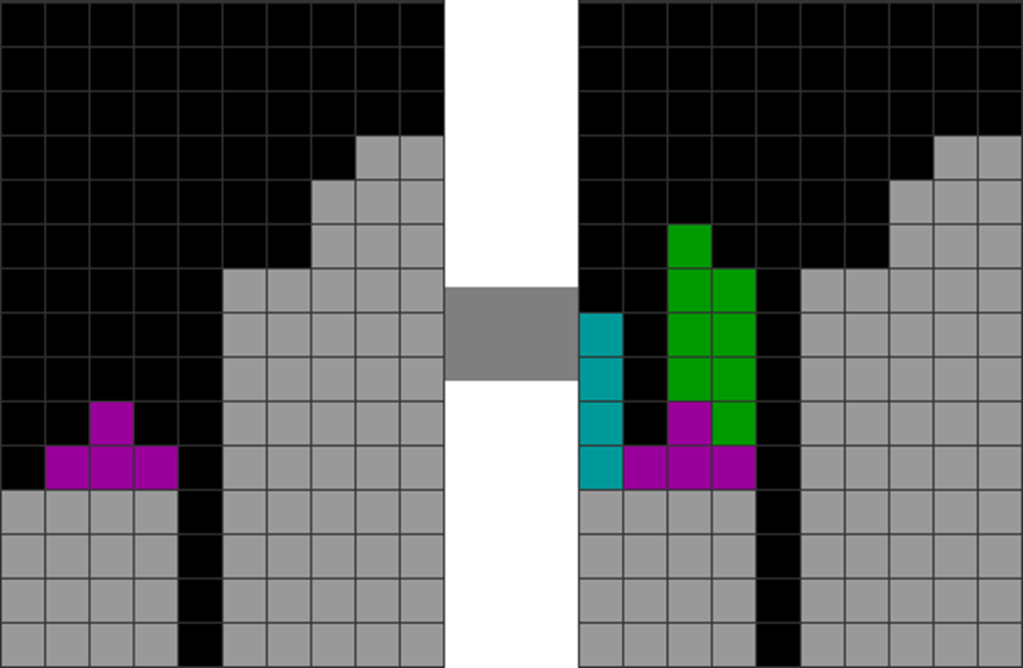
For instance, it is highly common for beginners to stack unevenly like this:
| Diagram Set 20-1 | |
| 1 | 2 |
| Step 1’s disharmonious T placement will cause vertical I and S placements, leading to tall overstacking. |
Here, the stack is imbalanced and too tall. This overstacking reduces stacking opportunities, forcing vertical I and S placements that further compound the problem.
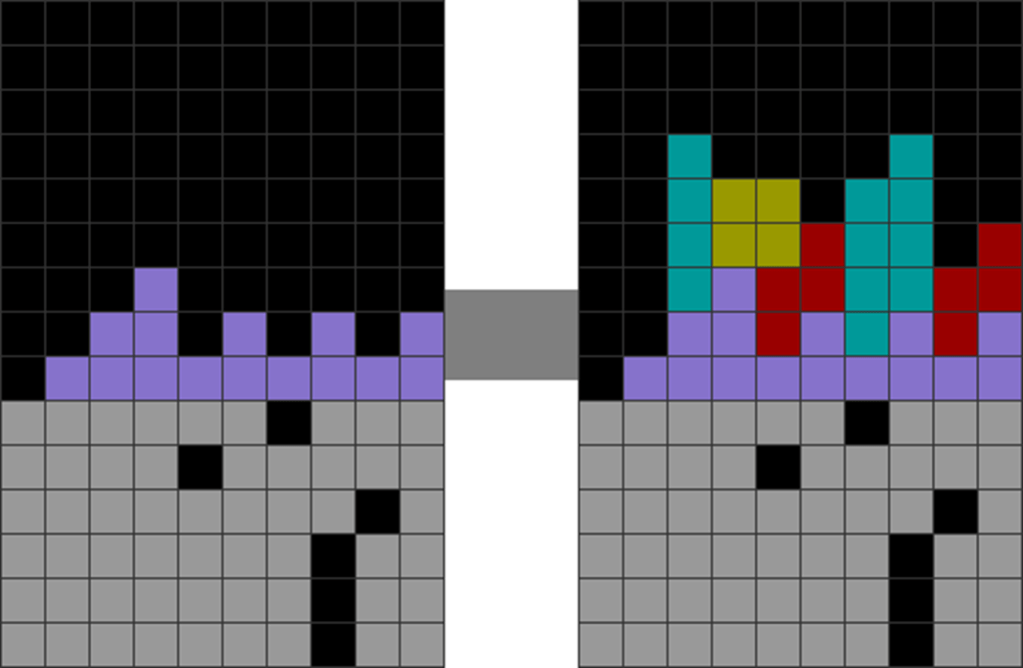
Another common beginner and intermediate flaw is not managing parity (the field’s jaggedness) properly:
| Diagram Set 20-2 | |
| 1 | 2 |
| Another field with severe local parity imbalances (jaggedness) and many unfilled cavities. | This forces vertical I and Z placements, further worsening local parity issues and overstacking. |
Here, the player stacks into extreme field jaggedness and division. Horizontal L, J, and O pieces cannot be placed. Hence, the player can only put vertical S, Z, and I pieces, resulting in more overstacking and field vision.
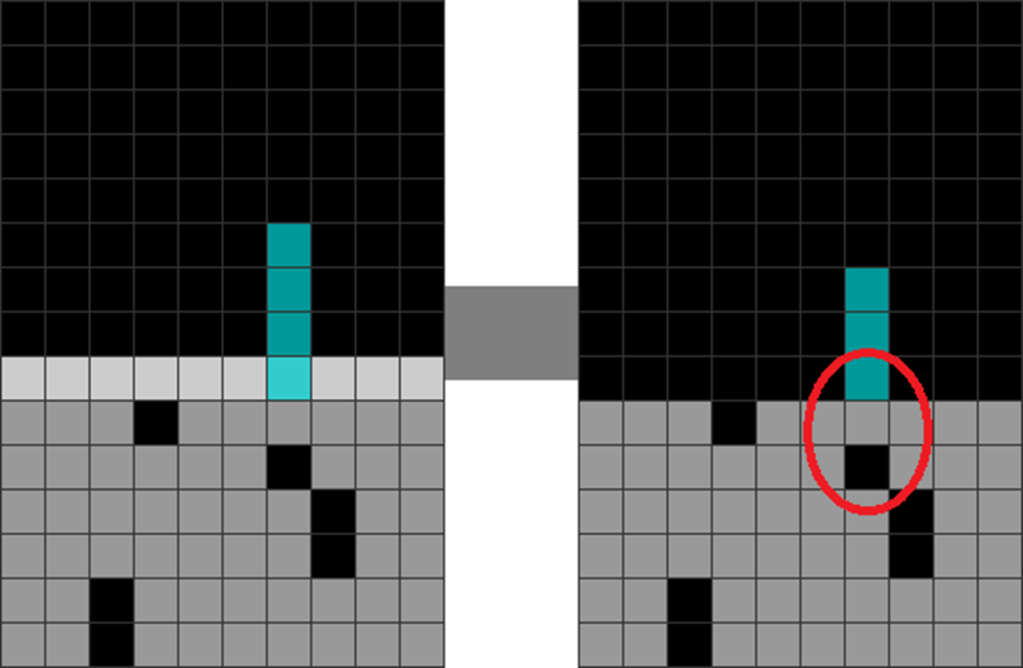
A beginner player also makes the following downstacking error:
| Diagram Set 20-3 | |
| 1 | 2 |
| An I piece downstack. | The remaining cyan blocks cover the future garbage hole. |
The player makes a vertical I placement to downstack. However, after the line clear, the cyan blocks overstack and obstruct the future garbage hole in column seven.
The last few examples illustrate a severe imbalance in failing to cultivate proper stacking, survival, and defensive abilities.
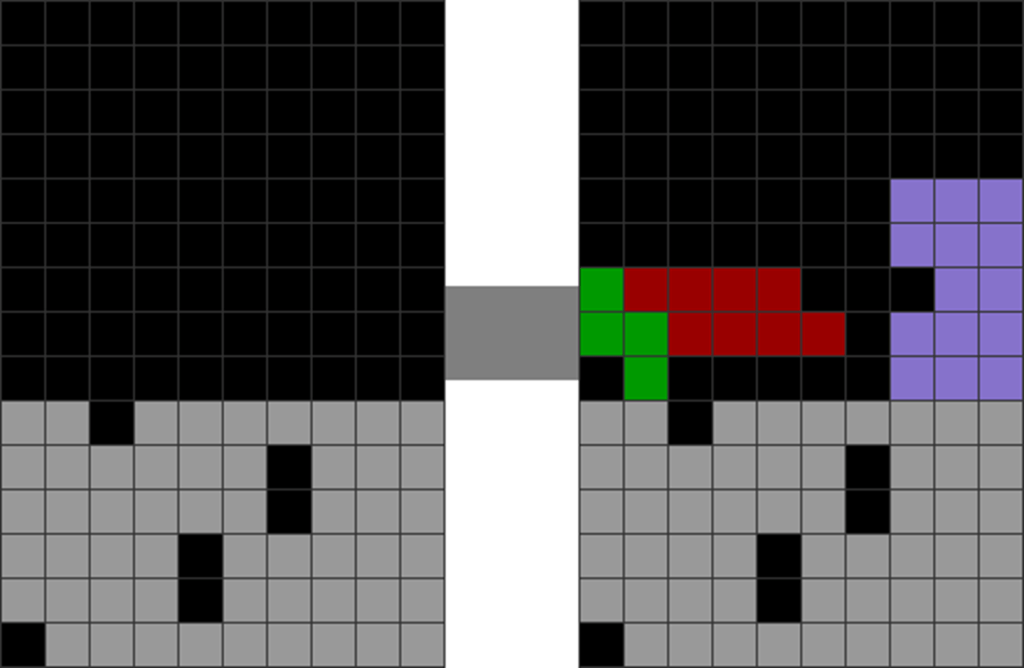
Some players do the opposite, over-focusing on offensive abilities like T-spins, as shown below. They force complex T-spins if the situation does not allow for such:
| Diagram Set 20-4 | |
| 1 | 2 |
| Starting field with an easy T-spin double opportunity using the hole in column three. | The player instead makes a fancy and dangerous T-spin. |
| 3 | 4 |

| The T does not arrive; he is forced to put all incoming pieces in a dirty pile. | The T still does not arrive. He is forced to abort the setup by putting O in the hole dirtily. |
The above forcing of a floating T-spin double setup when the field and incoming pieces do not allow it causes the problem to run into a dead-end.
The field is dirtily and riskily stacked, leaving one vulnerable to an opponent’s attacks.
Hence, to play Tetris properly, one should have a balanced suite of attacking, defending, survivability, stacking, speed, and recovery abilities.
If any one is absent, one would encounter vulnerabilities that one’s opponent can exploit.
In real life, this manifests as a completely imbalanced psyche.
Imagine the person who focuses entirely on intellectual pursuits, but has no social skills.
Imagine the person who spends their whole life hanging out at social parties but does not even read a single verse of philosophy or literature.
Imagine the person who spends so much time on their corporate career that they neglect their health.
Imagine the man or woman who focuses too much on feminine and masculine energies, respectively.
They would not have a balanced and androgynous personality, so crucial in Carl Jung’s psychology.
Personal Applications
Many modern societies face the problem that, as the Dalai Lama aptly puts it, man is a living paradox.
He works hard to earn a lot of money and build wealth. However, he becomes ill from overwork and must spend all that money to mend himself.
This is the problem faced by many modern societies, such as Japan, South Korea, Singapore, China, and the United States.
The obsession with achievement overwrites all other developments in the social, creative, artistic, intellectual, emotional, and spiritual spheres, leaving humans empty.
This marks the peak of what the Michael Teachings refer to as the young-soul cycle—souls at this mid-level of development desire to master the physical.
In doing so, they neglect their spiritual and emotional faculties. They reduce everything in the cosmos to mere monetary value.
The subject of consciousness is lost in the process. Everything becomes objectified. This is what Marxist philosophers refer to as reification and commodity fetishism.
One is simply measured by net worth, not inner value.
Oh, how far has humanity fallen to this state?
In even more competitive societies such as South Korea or Japan, this has taken on the form of overwork. Many Japanese salarymen have worked themselves to death in the phenomenon of karoshi.
Many people in the United States now work overtime just to cover their mortgage, rent, and utility payments.
Paradoxical indeed is the modern man, who has deviated far from spirit until he is nothing more than a lifeless husk.
To change this is to reconnect with spirit. And to reconnect with spirit is to see the difference between reality (experience or consciousness) and Maya (worldly things).
When we see past the veil of Maya, we no longer identify too much with external achievements.
We place greater priority on the spiritual and inner world. This is when we re-balance our lives by incorporating matters of the spirit into our daily rhythms.
And when we do, life becomes far more balanced and tolerable.
Social and Global Applications
This is a message to all members of the elite class of company owners, politicians, and other high-ranking officials.
If you are reading this message, please realize that the economy exists for the individual.
Human beings do not exist for the economy or society.
The whole purpose of a social, economic, and political system is to serve the needs of the individual.
It seeks not to enslave people as it is right now, by reducing them to wage slaves with no individuality.
Instead, it provides them with a universal basic income and free healthcare services. It ensures a proper work-life balance by reducing mandatory work hours.
The new Earth we will transition into will be one in which humanity awakens to its spiritual gifts.
They will then have a social and economic system that is far more equitable, taking care of people’s basic needs so that humans may god-actualize and god-realize.
 How to Tetris