“Happiness is not a matter of intensity but of balance and order and rhythm and harmony.”
— Thomas Merton
Introduction
Integrating the Parts to Become Whole
Balance is vital to becoming an integrated, whole, and complete being.[1]
The One seeks to be complete and whole. It does so by polarizing itself into many dualities to manifest all facets of existence.
We choose various lives to explore and manifest various combinations of this infinite polarization.
According to Ken Wilber’s psychographs, a person can be mature in one area, but undeveloped in others.[2]
To progress through the spiritual stages and complete the human incarnational cycle, a soul typically chooses to experience many facets through hundreds of lives.[3]
While not mandatory because of free will, many souls try out various opposing lifestyles. In some lives, one may be affluent. In others, they may be poor.
However, a soul that has seen both sides of each polarity can often have a more objective, broader, balanced, and fairer perspective.
That is why kings who have experienced poverty sometimes make the best rulers.
Within each life, balancing the mind, body, and soul is crucial for healthy psychological functioning.
Many modern societies have lost this balance.
We have now focused so much on the material that we have forgotten our inner spiritual worlds. We have also become clad in Maya.
When material and technological focus outstrips the means to manifest spiritually, life becomes void and cold.
We become mere cogs in a giant machine, living paycheck to paycheck, devoid of rich inner lives.
Tetris as an Analogy
In Tetris, a balanced skill set that includes both offensive and defensive elements is vital.
Beginner and intermediate Tetris players often prioritize one skill domain at the expense of others.
For instance, it is highly common for beginners to stack unevenly like this:
| Diagram Set 20-1 | |
| 1 | 2 |
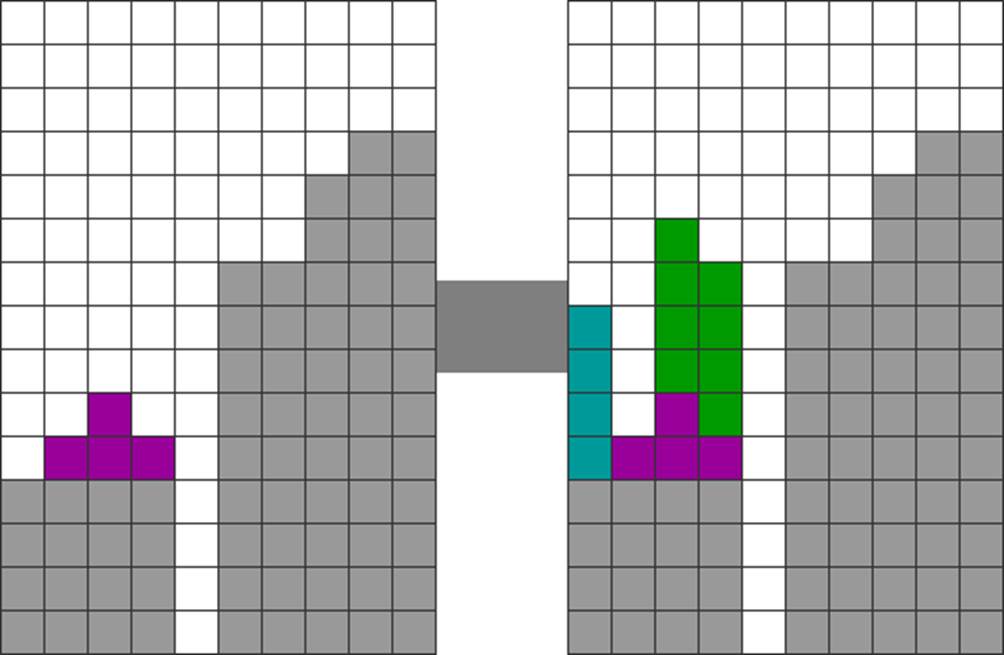
| This field is disharmonious (i.e., one cannot combine the field smoothly and flatly with many pieces). | It mostly allows vertical I and S placements, leading to tall, uneven overstacking. |
Here, the stack is imbalanced and too tall. This overstacking reduces stacking opportunities, forcing vertical I and S placements that further compound the problem.
Another common beginner and intermediate flaw is not managing parity (flattening the field’s jaggedness) properly:
| Diagram Set 20-2 | |
| 1 | 2 |
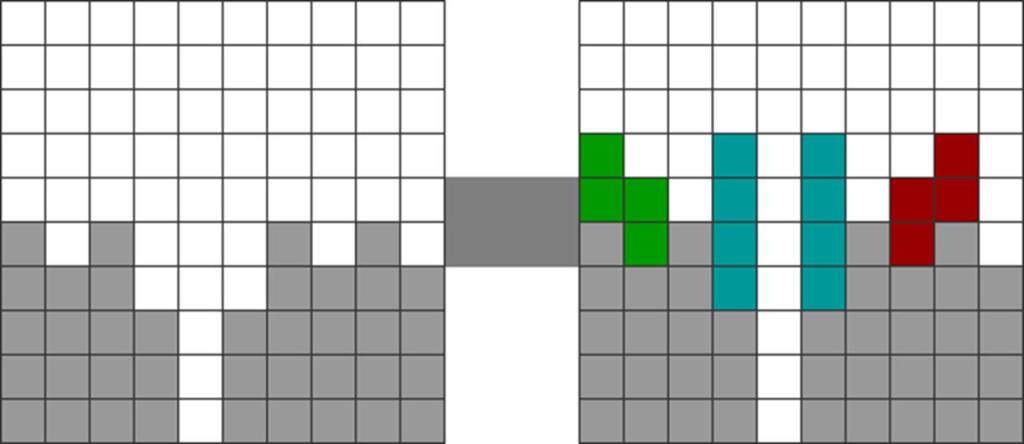
| The field is extremely jagged with many cavities. | This forces vertical I, S, and Z placements, further worsening the field’s jaggedness |
Here, the player stacks into extreme field jaggedness and division. The horizontal and flat orientations of L, J, and O pieces cannot be placed.
As a result, the player can only place vertical S, Z, and I pieces, leading to more overstacking and reduced field vision.
A beginner player also makes the following error. He tries to downstack (dig down and lower one’s stack) using a vertical I piece this way, which is a terrible error:
| Diagram Set 20-3 | |
| 1 | 2 |

| The starting field with a jagged garbage pattern. | A novice places an I piece vertically into the top row’s cavity. |
| 3 | 4 |
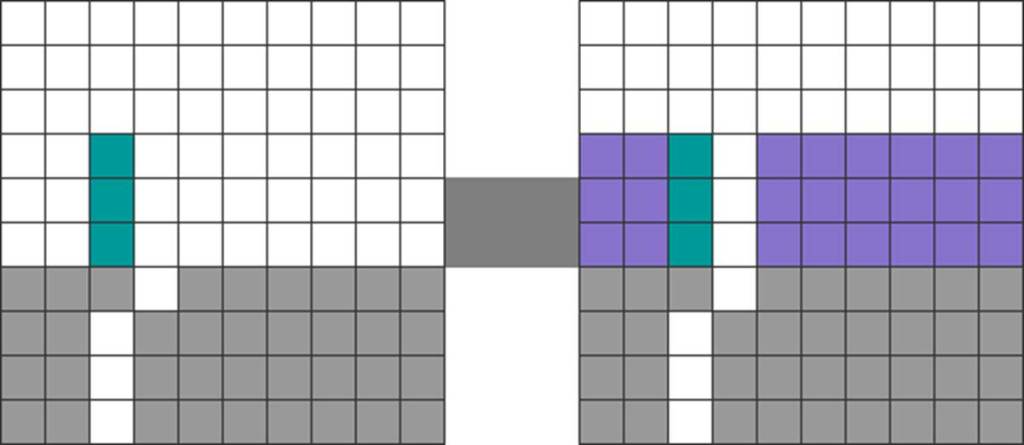
| After the line clear, the cyan blocks are left overlapping the garbage holes this way. | To clear the cyan blocks and reach the garbage, the player spends a lot of time stacking the lavender parts. |
| 5 | 6 |
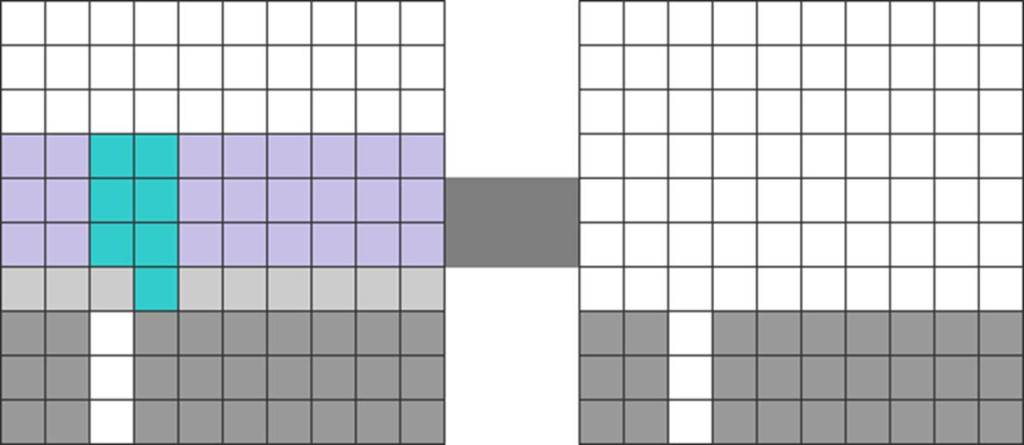
| The player skims the top layers off with an I piece, clearing 4 lines. | Finally, after much work, the garbage hole is exposed. |
The player makes a vertical I placement to downstack. However, after the line clear, the cyan blocks obstruct the upcoming tall garbage hole in column three.
The last few examples illustrate a severe imbalance between proper stacking, offense, and defensive abilities.
So, to play Tetris properly, you need a balanced suite of attacking, defending, survivability, stacking, speed, and recovery abilities.
If any one is absent, you will face vulnerabilities your opponent can exploit.
In real life, this manifests as a completely imbalanced psyche.
Imagine the person who focuses entirely on intellectual pursuits, but has no social skills.
Imagine the person who spends their whole life hanging out at social parties but never reads a single verse of philosophy or literature.
Imagine the person who spends so much time on their corporate career that they neglect their health.
Imagine a person who focuses too much on feminine or masculine energies. They would not have a balanced, androgynous personality, which is crucial in Carl Jung’s psychology.[4]
As a result, keeping a healthy balance across many areas may lead to better life functioning and happiness.
Personal Applications
A Lopsided Over-Work Culture
Many modern societies face the problem that, as the Dalai Lama aptly puts it, man is a living paradox.
He works hard to earn a lot of money and build wealth. However, he becomes ill from overwork and must spend all that money to mend himself.
This is a problem many modern societies face, including Japan, South Korea, Singapore, China, and the United States.
The obsession with achievement overwrites all other developments in the social, creative, artistic, intellectual, emotional, and spiritual spheres, leaving humans empty.
This marks the peak of what the Michael Teachings call the young-soul cycle — souls at this mid-level of development desire to master the physical.
In doing so, they neglect their spiritual and emotional faculties. They reduce everything in the cosmos to mere monetary value.
The subject of consciousness is lost in the process. Everything becomes objectified. This is what Marxist philosophers refer to as reification and commodity fetishism.[5]
People are measured by net worth, not inner value.
Oh, how far has humanity fallen to this state?
In even more competitive societies such as South Korea or Japan, this has taken on the form of overwork. Many Japanese salarymen have worked themselves to death in a phenomenon known as karoshi.
Many people in the United States now work overtime just to cover their mortgage, rent, and utility payments. Yet, they pursue the Horatio Alger myth, chasing mansions at the cost of inner development.
Paradoxical indeed is the modern man, who has deviated far from spirit until he is nothing more than a lifeless husk.
To change this is to reconnect with spirit. And to reconnect with spirit is to see the difference between reality (experience or consciousness) and Maya (worldly things).
Here are some concrete practices:
- Force yourself to have a “radio silence” by doing something that lets the mind literally blank out. For me, I go to the beach or fly around Azeroth in the video game World of Warcraft.
- Start with small things: just allocate a day per week to participate in a hobby without self-judgment. You can paint for its own sake without worrying about whether the painting is good.
- Force yourself to take one or two days off whenever you feel burned out.
When we see past the veil of Maya, we can choose not to identify so much with external achievements.
We can then prioritize the spiritual and inner world. This is when we rebalance our lives by incorporating spiritual matters into our daily rhythms.
And when we do, life becomes far more balanced and tolerable.
A Holy Trinity
A famous spirit guide, Silver Birch, once said in his channeling that most illnesses arise from an imbalance in the trinity of mind, body, and soul.[6]
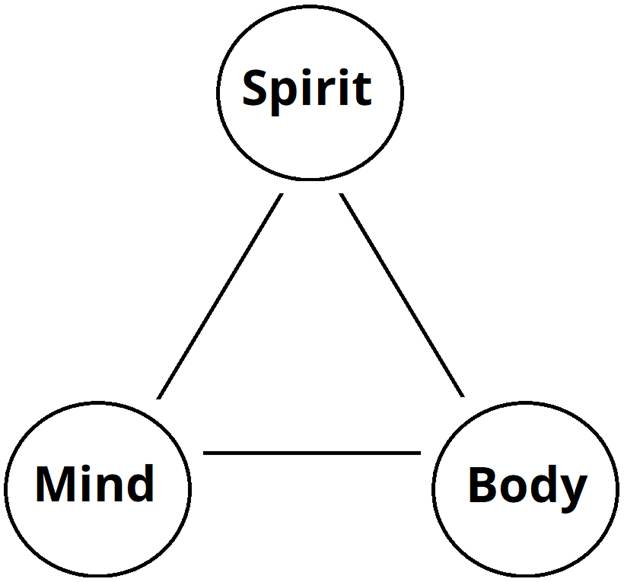
An imbalance in any of the three parts requires a different form of treatment, and multiple parts may be out of balance at once:
- Body: If the body suffers a physical illness, such as COVID or a broken bone, one can resort to traditional medical science.
- Mind: However, illnesses that stem from an imbalance arising from an injured mind are far more difficult to heal, requiring seeing a psychologist.
- Spirit: Silver Birch notes that past spiritual karmic patterns can upset the entire trinity.
Let us focus on the third part, spirit:
In the Life Between Lives case studies associated with Dr. Michael Newton’s work, Ken, a client, was brought into a past-life regression during hypnosis.[7]
Ken had suffered from many bouts of depression throughout his current life and sought a remedy.
In his regression, he remembered being Arthur in medieval Europe, where Vikings attacked his village.
Arthur did not give an early warning to his village, which resulted in the mass slaughter of many of his villagers. He carries that guilt into his current life.
After helping him to see this from a broader spiritual perspective, his depression abated.
A more relatable example is a friend whom I once knew, who continuously cut her wrists and binge-ate, becoming obese, whenever she had a depression episode.
Knowing her, her issues arose because of extreme neglect and abuse during her childhood, which led her to develop borderline personality disorder.
Unfortunately, she could not break this karmic cycle on her own, or through my assistance or professional help, resulting in the ongoing depression.
Hence, unless one breaks out of one’s past karmic cycles, it is likely that they will manifest in one’s psyche, resulting in maladaptive and destructive behaviors.
Beyond balancing mind, body, and spirit, it is also vital to support that balance with lifestyle changes.
In many alternative medicine systems, such as Traditional Chinese Medicine (TCM) and Ayurveda, health largely comes down to balance.[8]
In some TCM treatments, the focus is not just on healing the individual patient but on changing their lifestyle. This means identifying sources of stress and tension and alleviating them.
Even if you could heal a person using traditional means, if they return to their stressful and burnout-prone lifestyles, the result is a vicious and repeating cycle.
Jiddu Krishnamurti once said, “It is no measure of health to be well adjusted to a profoundly sick society.”
If one stays in social circles that exert overwhelming pressure on the individual toward negative practices, the result can be negativity.
Many South Koreans who I know told me about how toxic and competitive their homeland corporate environments were. This extends to their gaming culture, given the emphasis on being number one.
When they left South Korea for a country with less emphasis on material things, their mental and spiritual health improved significantly.
Ultimately, beyond mind, body, and soul, it helps to immerse us in the right social and cultural environment.
Social and Global Applications
Burnout Hustler Cultures
Many modern, post-industrial societies have progressed to a post-scarcity point.
Industrialization has enabled the mass production of affordable goods and services that the populace can readily access.
However, it also leads to another problem: the worship of money as an idol.
Perhaps it is not far-fetched to say that many modern societies, such as Japan, South Korea, China, Singapore, and America, fetishize it as an end goal above all else.[9]
Here in Singapore, where I live, I often arrange random meetups on Meetup.com, hoping to connect with spiritually aware people.
However, over many years, I have almost never met such people. When I engage with most millennials in their 20s, 30s, or 40s, they often resound with the same thing:
Conversations with them often involve careers, starting a business, investing, gaining influence or popularity, corporate life, buying gold, geopolitics, office politics, sports, fashion, or other worldly trends.
It is suffocating: after several of these meetings, I would delete my Meetup account (only to create it months later and find like-minded people).
In Singapore, many people are burned out by the materialistic rat race, overworking themselves to achieve the 5Cs (Cash, Car, Credit Card, Condominium, and Country Club).
Those who do not fit this mold are often seen as weird or as not fitting in.
I know friends in law firms who literally work up to ten hours a day just to meet their boss’ demands.
This phenomenon is not limited to Singapore. Many countries, such as Japan, the USA, and South Korea, also suffer from it.
Japan has an “Ichiban” (number one) culture. In South Korea, there is immense pressure for people to undergo plastic surgery to reach the “ideal look” to obtain a job in a prestigious corporation.
In the United States, there is an endless zeal to worship and keep up with billionaires such as Elon Musk and Warren Buffett.
Once the individual achieves wealth, they may develop a compulsion to shop, squandering their earnings on expensive LV merchandise.
They get sick and ultimately spend plenty to recuperate. They may, ironically, bankrupt themselves through overspending. Many Japanese end up renting a cubicle in an internet café for years.
Often, this arises because people idolize the dollar to the point where it morphs from a means to an end into an end in itself.
This occurs when we confuse the Maya of money, material possessions, and external achievements with reality.
However, something beautiful happens when one sees through this Mayavic veil: one can unshackle oneself from the material chain and free one’s energy for more important matters.
They can look inwards, realizing that consciousness is the central reality, and that material development cannot substitute for inner growth and spiritual depth.
This is the beginning of spiritual awakening.
The Economy Should Be Subordinated to the Individual
The economy exists for the individual.
Human beings do not exist for the economy or society.
The entire purpose of a social, economic, and political system is to serve the needs of the individual.[10]
It should not enslave people, as it is doing so right now by reducing them to wage slaves with no individuality.
Instead, it should provide them with a universal basic income and free healthcare services. It should ensure a proper work-life balance by reducing mandatory work hours.
Currently, humanity’s technological development has outstripped its spiritual advancement.
This imbalance causes many governments to over-focus on Mayavic matters like ensuring their country’s military dominance instead of taking care of their people.
The new Earth we will transition into will be one in which humanity awakens to its spiritual gifts. People will then have a social and economic system that is far more equitable, taking care of people’s basic needs so humans can live more balanced lives and god-actualize and god-realize.
[1] See Carl Jung, The Archetypes and the Collective Unconscious (1959), on psychological integration and wholeness through individuation.
[2] Ken Wilber, Integral Psychology (2000). Wilber’s psychograph model maps multiple developmental lines — cognitive, emotional, moral, spiritual — showing that growth in one does not guarantee equivalent growth in the others.
[3] Michael Newton, Journey of Souls: Case Studies of Life Between Lives (1994), which describes souls undergoing many human incarnations to develop spiritually.
[4] Carl Jung, The Archetypes and the Collective Unconscious (1959), CW Vol. 9, Part 1. Jung’s concepts of the anima and animus describe the feminine and masculine halves in every psyche. Psychological wholeness requires integrating both.
[5] Karl Marx, Capital, Vol. 1 (1867); György Lukács, History and Class Consciousness (1923), which expanded Marx’s concept of commodity fetishism into the theory of reification.
[6] Silver Birch, channeled through Maurice Barbanell, Teachings of Silver Birch, ed. A.W. Austen; available through the Spiritual Truth Foundation, http://www.spiritualtruthfoundation.org.
[7] Michael Newton, Destiny of Souls (2000). Newton’s Life Between Lives methodology involved hypnotic regression to access memories between incarnations, revealing the broader spiritual and cosmic plan.
[8] World Health Organization, Traditional Medicine (2019): Traditional Chinese medicine describes health as maintaining a balance between yin and yang, while Ayurveda describes health as maintaining balance among vata, pitta, and kapha.
[9] Karl Marx, Capital: Volume I (1867), on commodity fetishism and the elevation of commodities in capitalist societies.
[10] Kazimierz Dąbrowski, Multilevelness of Emotional and Instinctive Functions (1996), on technocratic society and the subordination of human development to social and economic systems.

