“Do not dwell in the past, do not dream of the future, concentrate the mind on the present moment.”
—Buddha
Introduction
The present affects all tomorrows but never all yesterdays.
Our consciousness of time is always in the present. The past is memory, and the future is one’s aspirations and speculations.
One who is not mindful of the present is merely letting time fleet past. This person does not engage with the experience of the now. One does not embrace life.
One who dwells in the past is depressed. One who dwells in the future is anxious. One who dwells in the present is living, not existing.
Perhaps that is why great religious figures like Jesus Christ and Lao Tzu advocate living in the present. After all, no amount of worries can take back one’s days or years.
And perhaps that is why great spiritual teachers like Eckhart Tolle and Thich Nhat Hanh championed the idea of living in the now and cultivating mindfulness of the present moment.
Of all the great illusions, such as that of separation and Maya, time is perhaps the greatest of all.
Time does not exist.
In the philosophy of time, there are two concepts of time. Eternalism holds that the past, present, and future are equally real and coexist as a static “block universe.” In contrast, presentism maintains that only the present moment is real.
We are one-dimensional temporal beings that experience only infinitesimal slices of an infinite reality.
However, the cosmos is multi-temporal. Per quantum physics, every moment we make a choice, reality branches into a parallel universe. Each one experiences a new linear order of time.
Hence, the cosmos is a fusion of infinite parallel timelines and is multi-temporal.
All timelines are being manifested as part of the all-that-there-is’s exploration and desire to become complete.
However, what matters the most is your current timeline.
Cherish all your nows, do not fret over the past, and do not worry excessively over the future.
Tetris as an Analogy
Whenever one misdrops (places a tetromino wrongly), they can choose to begrudge the present or move on. I illustrate with the following example:
| Diagram Set 21-1 | |
| 1 | 2 |
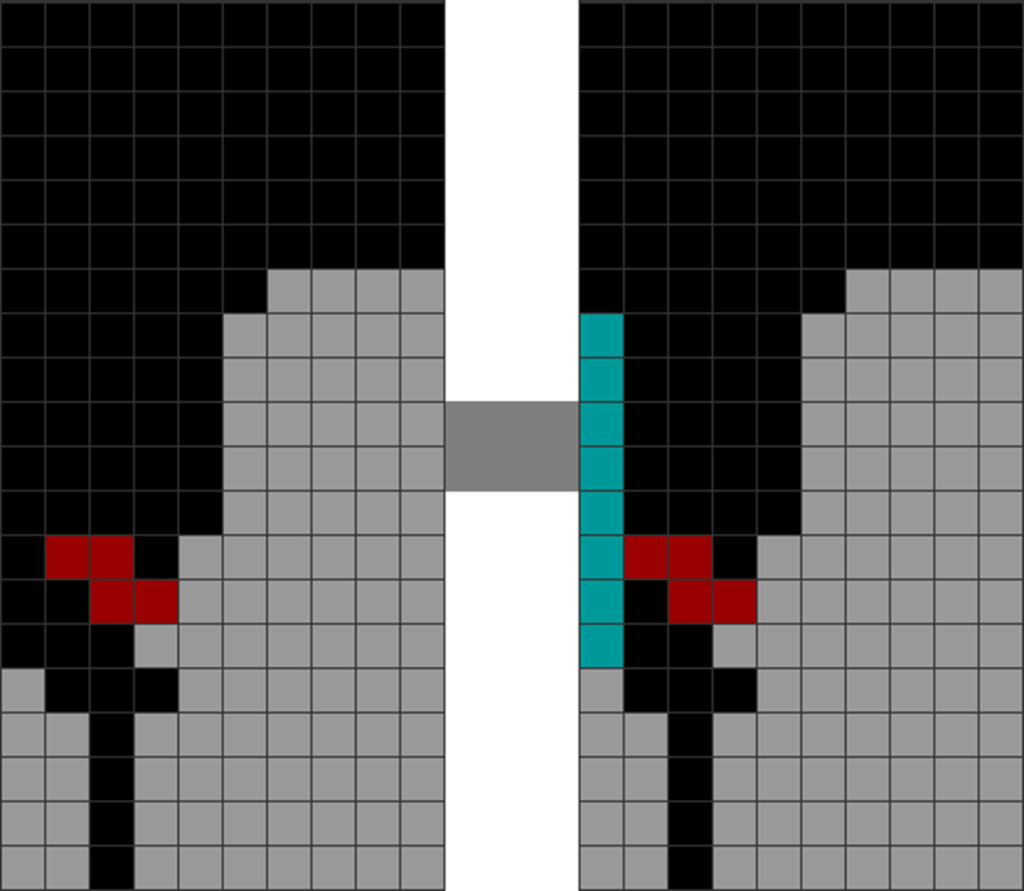
| The player makes an unfortunate misdrop with the Z piece. This seems like a dead-end. However, he does not get angry over it or become anxious over the future. | He upstacks the left-most column with two I pieces. This creates left and right towers. The Z piece is placed in the middle 4-wide well to make a 4-wide combo opportunity. |
For laypeople, a 4-wide combo setup is just an extremely overpowered attack. It blasts any opponent into pure oblivion and squeezes the living Jesus out of them.
| 3 | 4 |

| He starts the 4-wide combo with Z and O pieces. | This continues, leading to a lethal downstack combo for offense and defense. |
Here, the player misdrops in step 1 with a Z piece, which blocks the T-spin double chance below.
If a player had become frustrated by this and thrown their controller away, the game would have ended there.
However, instead of clinging to the past, one can only control the present. Therefore, in steps 2 to 4, the player does something splendid.
The player turns the mishap into a mid-game 4-wide situation. He begins a massive downstack combo that sends a barrage of garbage lines to the opponent.
In a more esoteric and metaphysical vein, Tetris is a finite game with two spatial dimensions played in one linear time dimension.
Time flows from the past to the future, and you cannot reverse it.
One may think that this is highly constraining, but perhaps it is the way the cosmos arranges for us to have meaningful choices in Tetris.
Imagine this thought experiment: you can now play Tetris from a multi-temporal point of view.
I illustrated this concept that I have explored in the fifth novel of my core novel series:
| Diagram Set 21-2 |

| A being with one time dimension can experience only one linear path, such as from A to A1 to B1 to C2. A being with two time dimensions can experience all linear paths simultaneously. A being with three can go even further by seeing more meta-possibilities. Therefore, a being with many time dimensions cannot choose: it must experience all dimensions, and life is without challenge. |
Imagine that in a Tetris game, you can miraculously perceive two dimensions of time, like in above diagram.
You can see the current timeline branching into future possibilities. However, you can also experience and manifest them.
Hence, in a Tetris game, you can already see and realize all possibilities, including wins and losses.
Since you have manifested all choices, you ironically do not have free will. Free will can only be experienced by having the illusion of limitation.
Now, let us take this thought experiment a step further. Imagine what it would be like if you could predict and choose your future:
| Diagram Set 21-3 |
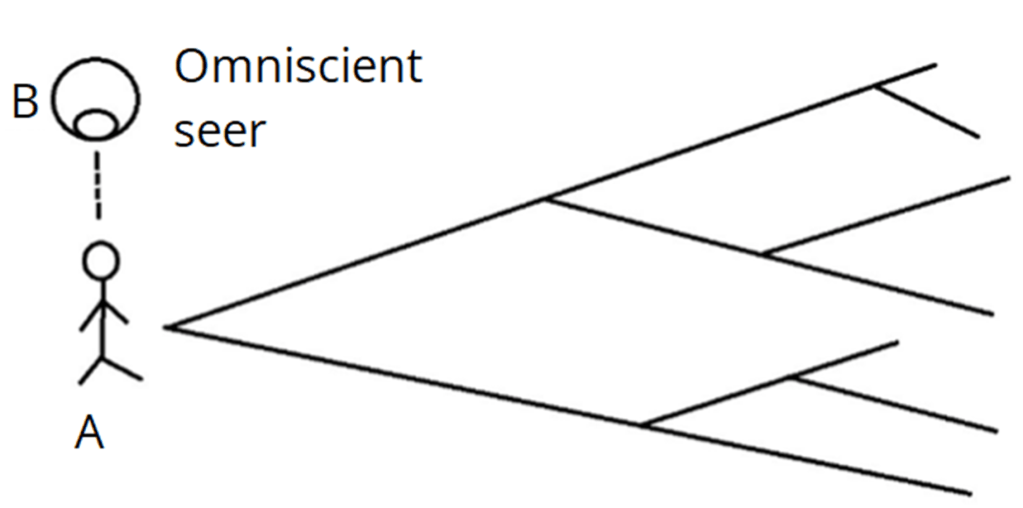
| Suppose A wishes to predict his future accurately. In that case, it must assume the perspective of an omniscient seer, B, to calculate all possible paths. He must exclude himself from his reality, or the seer will interfere and disrupt the future. |
This is a contradiction. He wishes to be free, but ironically cannot, as freedom can only come from ignorance. Omniscience from B’s panoramic perspective gives him the ability to choose each path, which “spoils” the mystery of life.
Without B’s intervention, A is free, as he can choose his original, destined path from his perspective. B, from a detached perspective with no causal influence over A, however, realizes that A will be led to disaster. Hence, for B to choose the best outcome for A, B cannot remain detached. B must intervene.
However, with B’s intervention, the sum of A’s and B’s choices disrupts A’s original choice and B’s calculations. This is because B intervening in A may lead to B’s original, perfect, and pristine prediction of the future being altered. Let us now extend the thought experiment further:
| Diagram Set 21-4 |
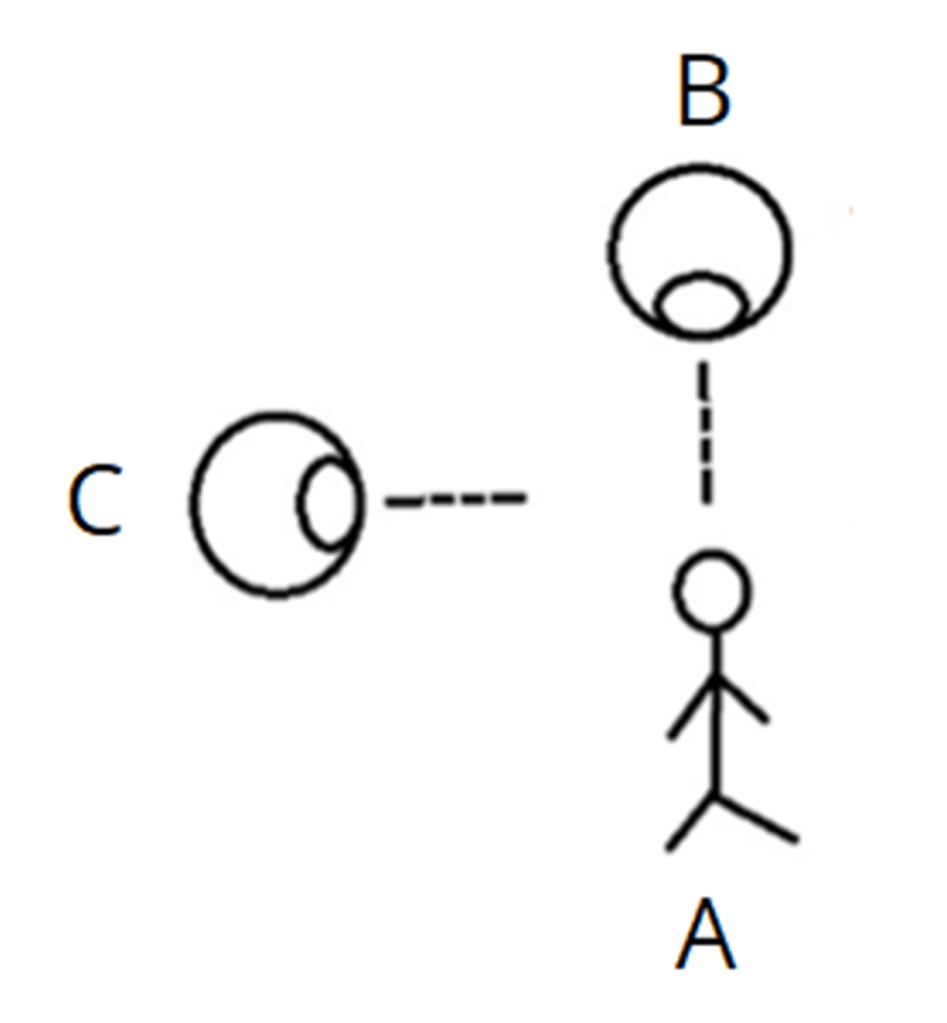
| Therefore, to predict his movements correctly, another omniscient seer, C, must calculate the sum of A’s and B’s choices. However, this leads to the same contradiction. If A knows what B and C predict, he can choose a non-predestined path. |
However, this leads to the same contradiction. C tells A and B what is best for them. If A knows what B and C predict, he can choose a non-predestined path that breaks the original plan if B and C had not intervened.
Confused? Imagine if you are already about to succeed in some project. However, you consult a prophet to see into your future. This person gives you advice on such matters. This intervening result may cause you to grow paranoid and decide a course of action that prevents that success.
Hence, the thought experiment continues:
| Diagram Set 21-5 |

| D then interferes. If this continues ad infinitum, it means no person can accurately predict their future. There is always free will. |
Here, imagine that you are in a Tetris game, but you wish to predict the future of whether you will win or lose.
In the above diagram sets, you are A, the player. To predict your future, you must assume the perspective of an omniscient seer, B, who sees you and the future timeline of the Tetris game.
This omniscient seer cannot involve itself in your reality, as doing so would disturb the flow of the future through intervention. This will then make its predictions inaccurate.
However, if you wish to win, the only way to do so is for the omniscient seer to intervene and help you choose the paths that lead to wins.
But when it does, it intervenes, potentially leading to inaccuracies in the intended outcome. Hence, you must have another omniscient seer, C, who predicts your future when B is intervening for this “prediction” to be accurate.
However, for C to do so accurately, it cannot intervene. But since it wants you to win, it must intervene to choose the options it predicts will help you win.
Yet when C intervenes, it disrupts the flow of the future, creating timelines that could deviate from its predictions and, hence, lead you to lose.
Thus, it needs another omniscient overseer, D, to again predict your future with A, B, and C in it, but not intervene.
This continues ad infinitum. The reality is that no being can ever see its own future, interfere with it, or assume that the future will unfold as planned.
Thus, what is time?
Time is simply a veil of Maya that the One creates in many lower dimensions of spirit and matter. It provides a mode to experience consciousness through this limit and lets us choose.
The absolute reality is timeless, and all things are experienced simultaneously when one merges with the One. There is no past and no future—only an ever-expansive I am realized in the Now.
Hence, in a game of Tetris that moves forward in a single, linear timeline, one cannot accurately predict the future.
This means the future is at least partly unknown, and we are free to choose, making our choices meaningful.
After all, what is the meaning of choice if we have already seen the outcome? Choices are only meaningful if there are dangers and unknowns.
Choices are meaningful only if we are finite beings with imperfect knowledge, experiencing a single timeline.
And it is only now that we can choose and enjoy the flow of experience.
Personal, Social, and Global Applications
Because now is the only time that makes sense and where we have power over, the implications could not be more obvious.
Many people in modern society have lost track of the linear flow of time.
They immerse themselves in addictive behaviors like social media, watching YouTube or TikTok shorts, being on their phones nonstop on the train, and always wanting more stimulation from Netflix.
And during or after work, they worry continuously about the unfinished work they must continue tomorrow or the difficult client they must deal with next week.
However, in doing so, their minds are either too focused on the past or the future. They do not experience the present.
Hence, only ten weeks can pass in ten years, whereas a mindful person can experience ten years in ten weeks.
What these people need is to merely silence all distractions, literally. They need to buy a special phone locker to lock their phones on a timer.
They need to set their WhatsApp to silent mode. They need to use the Freedom app to block all distracting social media apps, including YouTube, Instagram, Facebook, TikTok, Kik, Snapchat, and more.
Then, they should practice what the Italians sometimes do, in the art of doing nothing (dolce far niente). They can loiter at a café or park all day and literally embrace doing nothing.
This can involve any other similar activity, such as walking meditation or enjoying a hike in a nature reserve or forest. It can also involve a tea ceremony or just practicing mindful eating.
Then, something incredible happens. Without an excessive focus on the past and future, the mind is forced to turn to the present.
The person can no longer just savor life with their five senses. One can taste not with one’s tongue, but with one’s mind. One can see not with one’s eyes, but with one’s mind. One can listen to music not with one’s ears, but with one’s mind.
The now becomes a timeless now where one attunes to the divine vibrations of the cosmos. Then, one’s inner, spiritual voice would arise loud and clear, free from the terrible clutter and distractions of daily living.
This was how I honed my currently awakening psychic gifts, including sometimes accurately peering into the future, having out-of-body experiences in my dreams, reading people’s emotions, and communicating with nature, spirit guides, or the deceased.
It was also how I honed my creativity and intellectual and spiritual insights. By literally silencing my surroundings, I could hear the voice of the divine echoing in my head, giving me clear guidance.
And this was how I wrote this book: simply channelling the voice of the divine through me, without effort, completing the whole book in four days.
When one finally lives in the present, life becomes fuller and much more tolerable. Every scent now becomes bursting with more vibrancy and energy.
Life becomes whole, a testament to the sacred gift of free will, where today affects all tomorrows. One can finally live life in the present time, rather than merely exist or flow through time.
 How to Tetris