“The mind is its own place, and in itself can make a heaven of hell, a hell of heaven.”
— John Milton, Paradise Lost (1667)
Introduction
The Limits of Reasoning and Theories
All thoughts and concepts are subjective illusions and imperfect representations of an absolute reality.
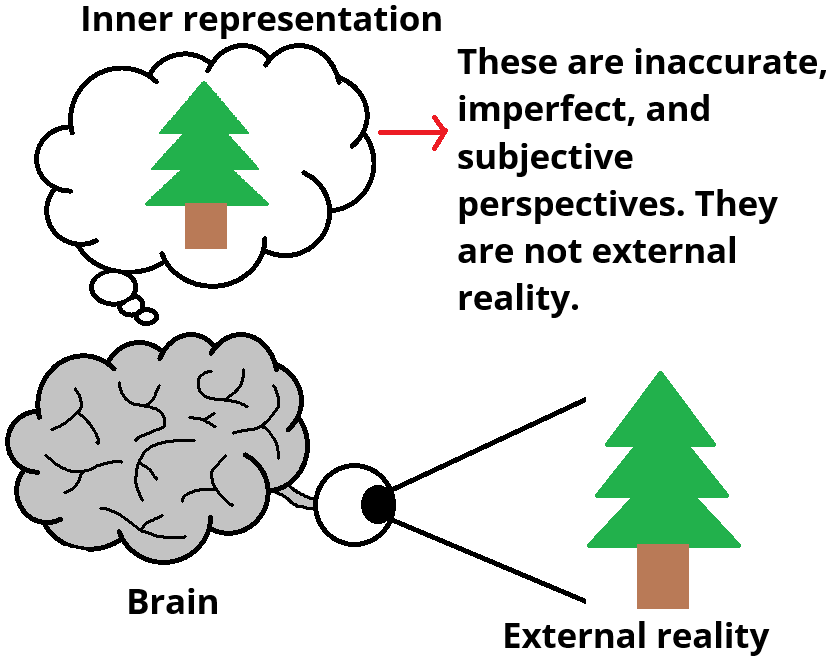
You may harbor hatred, jealousy, or some misunderstandings about someone. However, they are merely your brain’s way of creating an imperfect representation of reality.
No amount of equations, theories, or descriptions can ever fully describe or explain physical reality.[1]
Even our esteemed theories of general relativity and quantum mechanics are not perfect.[2]
While they can make many fancy predictions about black hole singularities and gravitational time dilation, they still do not know what precisely is in a black hole.
General relativity proposes a singularity, but that is merely a mathematical prediction, not necessarily an actual reality.
One who simply analyzes and compiles one theory after another is merely armchair philosophizing.
Absolute reality can never be approached. It can only be approximated.
You can, at most, use a theory to analyze a small part of reality by temporarily isolating a small phenomenon from the cosmos to understand it. However, the theory is not reality.[3]
The finger pointing at the moon (theory) is not the moon (actual reality).
When we realize this, intellectual constructs, while mere creations of the mind, become tools that serve us, rather than enslave us within their perspectives.[4]
The World is What We Perceive
Our inner thoughts, impressions, and preconceptions of others are subjective.
We perceive reality through the veil of Maya, which does not see the full spectrum of colors or hear the full range of sounds. Our personality type, whether trusting or suspicious, often clouds this judgment.
Our model of someone else’s personality or of our own lives is often an imperfect framework of reality. We can never fully comprehend reality.
Thus, our inner models are sometimes lies crafted by the brain.[5]
Hence, we can dismantle and detach ourselves from biological instincts that make us seek revenge or violence against others.
We can also dispel our paranoia, prejudice, or distrust towards some people.
This dispels the psychological basis and motives that institutionalize hate and bigotry on a wide, societal scale.
Even more profound is the fact that we can use this phenomenon to our advantage:
You can craft a white lie to make your life even easier.
By that, I mean deliberately changing your perspective to improve your life.[6]
A person who sees the world in purely negative terms, in shades of black and white, will become suspicious and distrustful. They may become hermits and withdraw from the world.
However, this framework or perspective exists only in one’s mind.
If the person shifts their worldview toward positivity and trust, others will likely be drawn to them, improving their life chances.
This is the law of parallax: our behavior reflects the perspectives we adopt.
Tetris as an Analogy
We find the law of parallax reflected throughout Tetris.
When most people encounter the following dead-end patterns, they often feel nervous and may give up:
| Diagram Set 23-1 | |
| A | B |

| An extremely imbalanced stack. | A terrible situation with many jagged areas, preventing the flat orientations of pieces like L, J, or O from being placed. |
This is because the dead-end patterns above end smooth offensive attacks with quick, simple T-spins. As a result, the player may panic and slow down.
However, all we need to do to escape these issues is to adopt an optimistic, opportunity-oriented perspective by doing the following:
| Diagram Set 23-2 | |
| 1 | 2 |

| Diagram set 23-1’s A. | The player places I, I, L, Z, and S and makes a T-spin. |
| Diagram Set 23-3 | |
| 1 | 2 |

| Diagram set 23-1’s B. | The player places J and Z to create a T-spin. |
Here, the opportunistic player turns all prior dead-end situations into mid-game chances to create more T-spin opportunities.
In both cases, the player created a T-spin out of a terrible, initial situation.
If the player had given up because of negativity, they might not have made such practical follow-ups, which could have won the game.
Personal Applications
Giving Yourself the “Permission Slip”
To apply this law, one only needs to deliberately change one’s perspective, even if it is unrealistic.
After all, what is real is not the perspective in our minds, but the actual effects or manifestations of it.
How can one do this? By using permission slips.
A permission slip, in the Bashar channeling’s terminology, is any tool, technique, ritual, or object that you believe will help create a specific change in your experience.[7]
This can be an excuse, belief, or placebo you create and follow to trick your mind into adopting a perspective.
Hence, you can trick your mind into feeling that you are healing by wearing an amethyst amulet (associated with mending in Reiki) even if you know that it scientifically does not work. Yet, you believe in its placebo effect.
You can also trick yourself into furnishing your room with a dream catcher if you have nightmares. Even if it does not have a true paranormal effect, the placebo effect alone could help you sleep better and reduce nightmares.
Of course, this is not to say that wearing a specific Native American charm can literally block bullets!
Reframing by Others
Another trick involves careful reframing with the assistance of someone who can help us look beyond our blind spots.
Consider the cynic and pessimist, who distrusts everyone and believes nothing good can ever happen to him.
As a result, this person may withdraw from broader reality and avoid interacting with the world, believing it is always negative.
Although he may be correct from this perspective, the past need not define the self or the future.
However, his tendency to bury himself in a burrow to avoid humanity can sometimes limit him. This effect is therefore real in the physical world.
A helper needs only to show him evidence to the contrary to challenge his views. Then he may replace that negative lens with a more inclusive, positive one.
By doing so, he can manifest positively by trusting humanity again and integrating himself into the world.
All it takes is a perspectival change, even if it is not founded in reality, because the effects of one’s perspective are real.
It is almost like the placebo effect.
Social and Global Applications
The Dangers of Misinterpreting Perspectives
According to post-revisionist understandings of the Cold War, it is now widely accepted that the USA and the USSR mutually fed each other’s suspicions through their actions.[8]
The USSR’s act of occupying East Germany or invading Afghanistan, despite it being for security, was seen by the USA as a desire to expand communism.
The USA’s expansion of NATO and the planting of nuclear missiles in Western Europe were seen as an offensive threat to the USSR’s security instead of being merely defensive.
This common distrust and misinterpretation of each other’s actions led to a Cold War that nearly went nuclear.
Today, we see the same thing repeated between the USA and China in Cold War II.
China sees American bases in Japan and East Asia, alongside the USA’s constant involvement in Taiwan, as a threat to China’s security and sovereignty.
America sees China’s expansion of the Belt and Road Initiative, the BRICS alliance, and its control over rare earth metals as a means to challenge the US dollar’s dominance.
Some political scientists frame either country’s actions not as aggression but as a survival necessity in an anarchic world.[9]
The result? The two juggernauts are retaliating ever more. America is opening up more military bases in the Philippines, and China has increased its nuclear missile stockpile to nearly 700 in 2026.
If the two countries ever destroy each other in a nuclear war, future historians will frown at this.
It turned out that China simply wanted to defend its borders because of the trauma of the hundred years of humiliation between 1839 and 1949.
America was significantly influenced by hawks who wanted to maintain US dominance, not by the typical American citizen’s desire for peace and a better life.
Hence, the entire US-China Cold War rests significantly on mutual suspicion and distrust.
To change this, we need to move from the old Earth to a new Earth, where political leaders are more responsible.
Countries must adopt a more enlightened perspective on peace, love, harmony, acceptance, and inclusion.
When they do, countries like the USA and China will no longer desire mutual conflict or tense security competition.
Instead, they will embrace one another, cooperate, and share their fruits with the rest of the world.
This is the view of the American geopolitical analyst, Cyrus Janssen, who supports full cooperation between the USA and China, and it is my view as well. He is both a patriot of the USA and China.[10]
Now extend this to all kinds of conflicts, such as the Russo-Ukrainian or Israeli-Iranian conflicts. This extends to disputes between organizations, religions, corporations, or other social identities.
Instead of cementing themselves in a cycle of revenge, hate, or distrust, they can replace it with love and harmony.
Then, the new Earth will no longer be filled with endless wars and conflicts.
The Dangers of Excessive Theorizing
Theories are mere linear frameworks that attempt to simplify an absurdly infinite reality into simple terms.
It does so through assumptions, approximations, symbols, language, or equations.
However, the theory, no matter how refined, is just a lens to interpret an unlimited reality. The lens may be miscolored, dirty, or sometimes filter out some wavelengths of light.
The greatest danger occurs when theories are created to justify state or institutional ideologies, or to discriminate against some groups, such as the following examples:[11]
Discrimination Against Homosexuals
Homosexuality was once labeled as a mental illness in the earlier versions of the Diagnostic and Statistical Manual of Mental Disorders (DSM).
Homosexuals were coerced into brutal psychiatric treatments against their will back then, in the 1950s to 1960s.[12]
The state ideology framed homosexuality as morally wrong and discriminated against homosexuals.
However, today, it is seen as human diversity and requires no medical or psychiatric treatment.
Electroconvulsive Therapy (ECT)
Electroconvulsive Therapy (ECT) is perhaps one of the most controversial treatments.
It was constructed and marketed as a cure-all for many psychological or psychiatric disorders, such as depression or suicidal ideation.
When ECT was popular, it was introduced in many mental institutions as a means of sedation and social control. In some prisons, it was introduced to control and suppress prisoners.[13]
Modern studies have found it controversial, sometimes causing permanent neurological, cognitive, and memory damage. The result is a less-than-functional individual who is kept relatively passive.[14]
Modern Monetary Theory (MMT)
In the broader economic and sociological sense, some scholars believed Modern Monetary Theory (MMT) justified the US central bank’s endless money printing.[15]
MMT states that in a sufficiently large economy, a country can print its own money indefinitely and need not worry about repaying its debt. All it needs is to control inflation.
However, while proponents may disagree, I see this as an institutionalized ideology used to justify the idea that the US can indefinitely increase its debt without paying it.
I have strong reasons to believe it also justifies the ruling elites’ position. Inflation caused by money printing indirectly transfers wealth from the poor to the rich.
Additionally, I feel that creating more debt that other countries can buy and finance keeps the US dollar afloat, maintaining dollar hegemony as a tool of unfair global economic privilege.[16]
If a country can just print money to solve its economic issues, it will not be motivated to build up its material economy, such as local industries.
To me, this creates a hyper-financialized US economic system that fails to address its root problems, such as the need to re-industrialize, build infrastructure, improve people’s education, and redistribute wealth fairly.
Conclusion
Ultimately, theories can be used to justify unjust ideologies, just as the Nazis did in the promotion of their controversial Aryan superiority theory.
However, while theories can control and undermine, one’s perspective can sometimes liberate.
Despite being a free thinker, I have never doubted any religion’s therapeutic and uplifting capacity.
Let us assume that xenoglossy (the ability to speak in languages one has never learned) is not real. However, I have attended some churches where their participants literally show this phenomenon during moments of blissful rapture.
When I asked them how it has impacted them, they said xenoglossy provided an elevating role that soothed their anxieties.
Sometimes it may not matter whether a belief is materially real.
What matters is their practical effects on one’s mind and society.
[1] Alfred Korzybski, Science and Sanity (1933). Korzybski’s foundational insight — “the map is not the territory” — captures the idea that no model or theory fully represents reality.
[2] Roger Penrose, The Road to Reality (2004). Penrose discusses the incompatibility between general relativity and quantum mechanics and their limits.
[3] See Ludwig von Bertalanffy, General System Theory: Foundations, Development, Applications (1968) on the limits of reducing complex systems to isolated components to understand their mechanisms.
[4] See Susanne R. Cook-Greuter, Postautonomous Ego Development (1999), on the Construct-Aware stage and awareness of the limitations of conceptual frameworks.
[5] Anil Seth, Being You (2021). Seth’s neuroscience research describes conscious experience as a “controlled hallucination” — the brain’s best guess at reality rather than reality itself.
[6] Martin Seligman, Learned Optimism (1991). Seligman’s research shows that adopting optimism improves life outcomes.
[7] Darryl Anka, Bashar channeling, YouTube lecture; see http://www.bashar.org for the full body of Bashar-channeled material.
[8] Melvyn P. Leffler, A Preponderance of Power (1992). Leffler argues that both superpowers shared responsibility for the conflict’s escalation.
[9] John J. Mearsheimer, The Tragedy of Great Power Politics (2001). Mearsheimer’s offensive realism argues that great powers compete for security in an anarchic world.
[10] Cyrus Janssen, YouTube channel: http://www.youtube.com/@CyrusJanssen. Janssen is an American-Chinese analyst and commentator advocating US-China cooperation and mutual understanding.
[11] Karl Mannheim, Ideology and Utopia (1929). He argues that knowledge and theories are never purely objective — they are shaped by the power interests of those who produce them. Anthony Giddens, The Constitution of Society (1984). Giddens’ structuration theory shows how institutions and theories mutually reinforce each other, reproducing and reinforcing power structures.
[12] Jack Drescher, “Out of DSM: Depathologizing Homosexuality,” Behavioral Sciences (2015).
[13] Peter Breggin, Toxic Psychiatry (1991). Breggin documented ECT as an instrument of social control.
[14] John Read and Richard Bentall, “The Effectiveness of Electroconvulsive Therapy,” Epidemiologia e Psichiatria Sociale (2010). The study concluded that ECT’s risks include permanent memory loss and cognitive impairment.
[15] Stephanie Kelton, The Deficit Myth (2020); for critique see Warren Coats, “Modern Monetary Theory: A Critique,” Cato Journal (2019).
[16] Michael Hudson, Super Imperialism (1972, updated 2021).

