“That which is below is like that which is above, and that which is above is like that which is below.”
—From the Emerald Tablet (Hermes Trismegistus tradition)
Introduction
Everything that happens in the microcosm affects the mesocosm and macrocosm.
Everything that occurs in the mesocosm affects the micro- and macrocosms.
Everything that transpires in the macrocosm affects the lower layers of reality.
This aligns with the spiritual law of oneness and connectivity.
This is the law of correspondence, where the parts affect the whole, and the whole affects the parts.
It is very similar to the idea of holons in Ken Wilber’s Integral Spirituality.
Whatever an individual harbors in their mind or perspective manifests as actions that permeate social reality and affect others.
This then affects society at the institutional level, returning once more as humanistic or negative policies that affect the self.
Hence, just like in the law of connectivity, every action sends ripples not just outwards, but throughout the entire ecosystem and cosmos and back to us again.
Tetris as an Analogy
The law of correspondence applies to Tetris. The part affects the whole, and the whole affects the part.
Here is an illustration below of how poor downstacking choices lead to jagged shapes, which compound further inefficiencies in downstacking:
| Diagram Set 25-1 | |
| 1 | 2 |
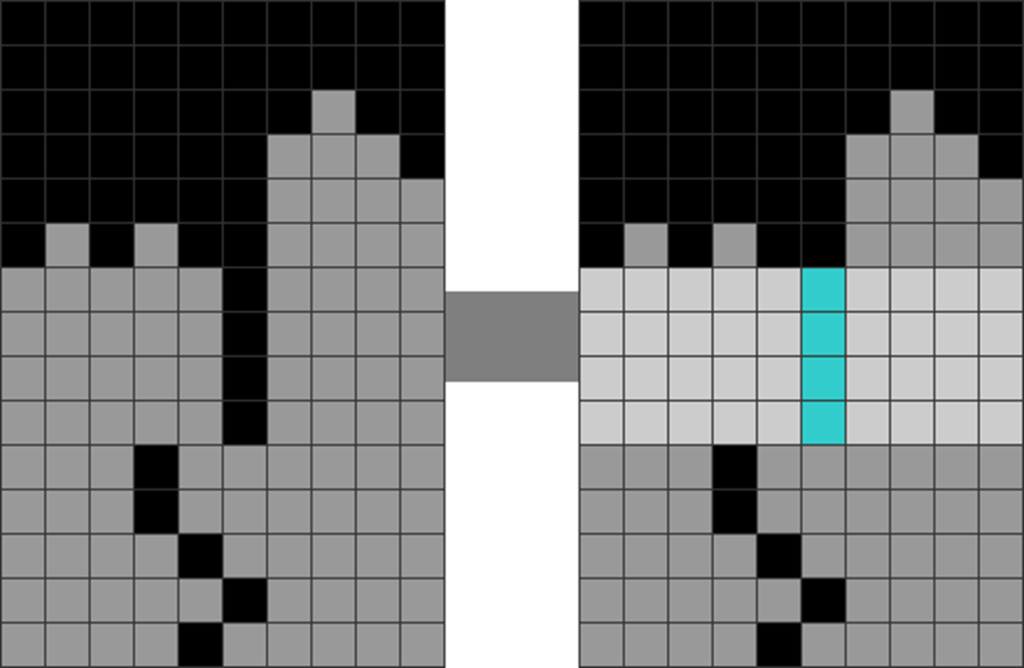
| The player downstacks with an I piece. |
| 3 | 4 |
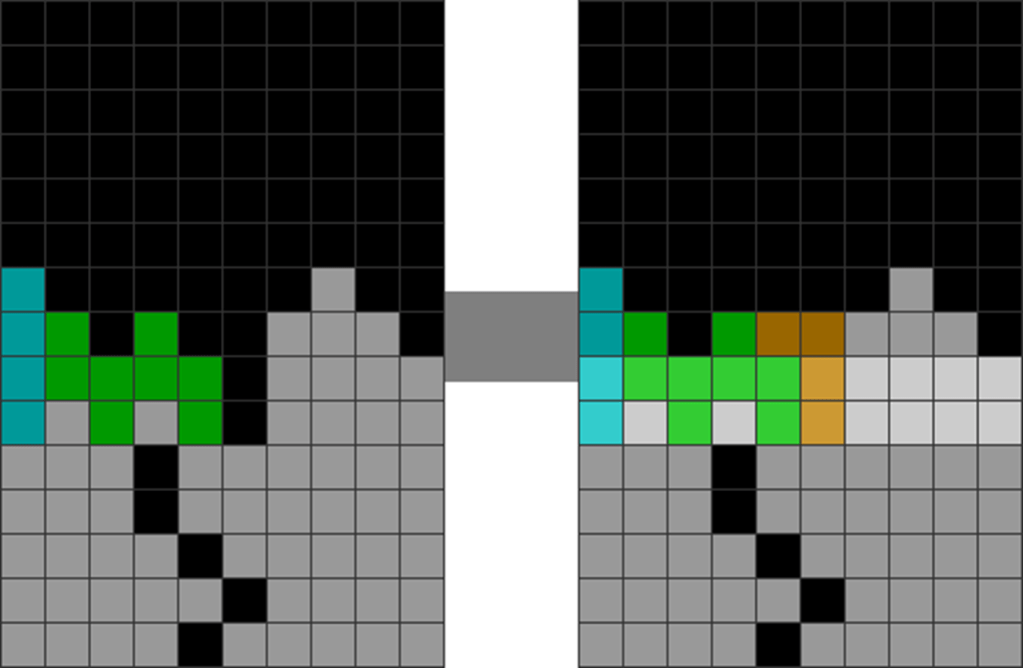
| The jagged field forces one to compound jaggedness with vertical S and I placements. | There is no room to put L flatly. He is forced to skim with the L. |
| 5 | 6 |

| There is no room to place the second L cleanly. He is forced to downstack with it, leaving a dirty aftermath. | He upstacks again with I, O, and J, skimming off the unclean layer with an inefficient single that sends no garbage. |
Here, the player chooses inefficient skims with vertical and sharp piece placements. The result is that the field’s jaggedness continues with each skim.
This does not alleviate anything. Instead, each consecutive act worsens the stack, making it even more jagged.
The result is that one ends up using many inefficient skims, which cause hefty line clear delays. This then buys the opponent time to build up to attack the player.
Hence, poor micro-decisions in stacking lead to severe over-arching structural shapes at the larger scale. This then returns in a spiral, worsening one’s win rate.
Instead, one can do this:
| Diagram Set 25-2 | |
| 1 | 2 |

| The player puts two Ts to flatten the field. | He Tetrises. |
| 3 | 4 |
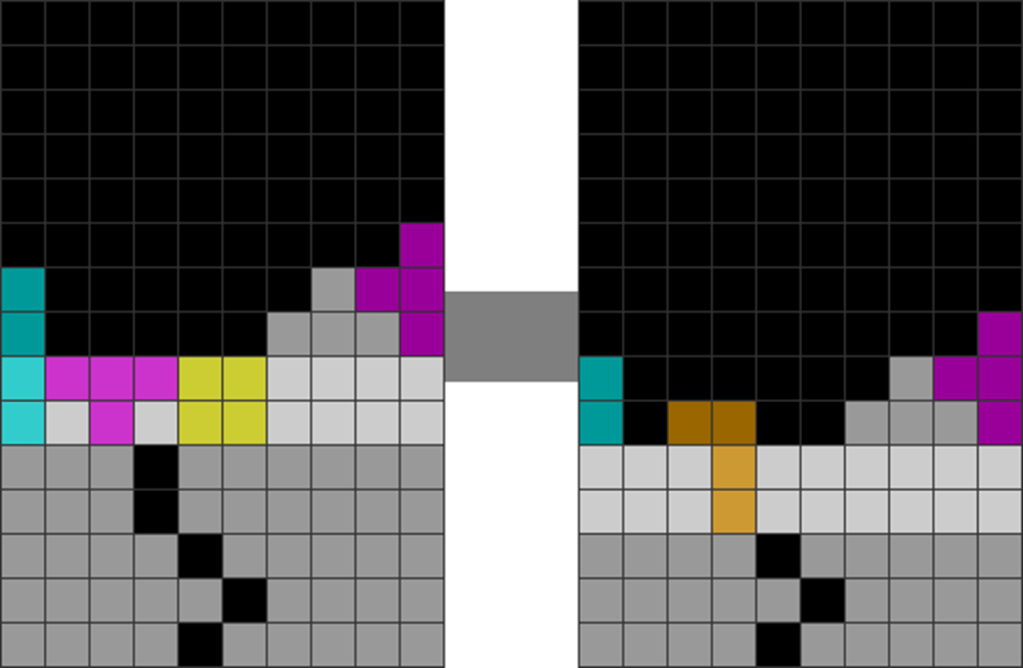
| He uses an O to do a double. | He continues with an L without breaking combos. |
| 5 | 6 |
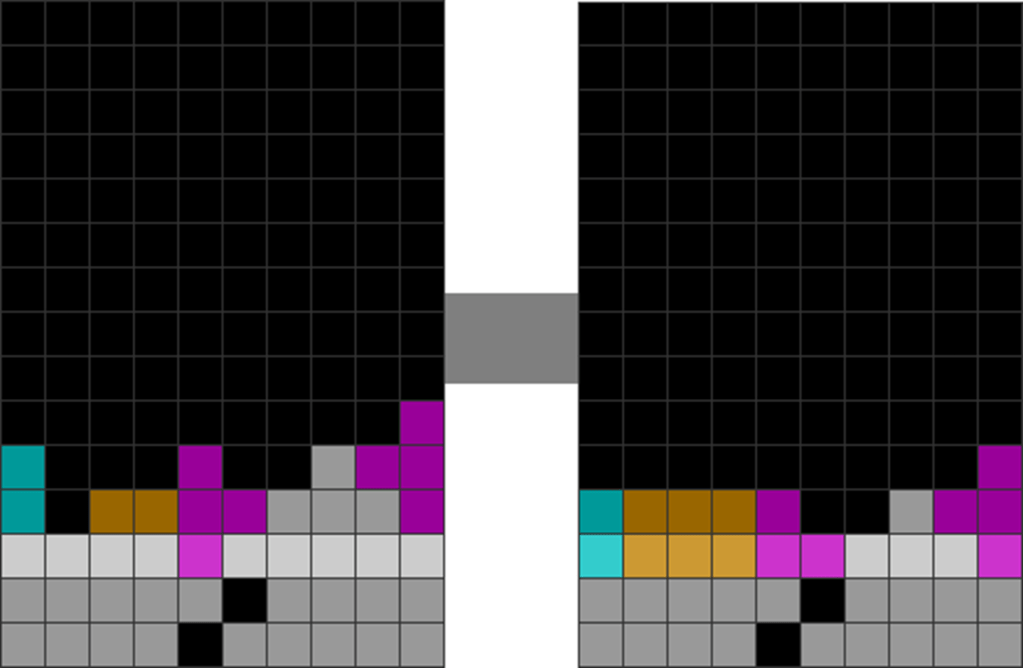
| He continues the combo with a T single line clear. | A final L line clear continues the combo. |
Here, the player manages jaggedness in the stack by putting T pieces to flatten the field.
By a mathematical law I derived in my other Tetris guidebooks, this usually leads to increased downstacking and smoother stacking.
This then reduces line clear delays and enables one to recover and downstack to safety quickly, then attack again.
Hence, the micro-level choice to manage jaggedness properly leads to macro-level effects of a smoother stack. This then makes it easier for one to stack flatly and win.
The cycle is completed. The parts affect the whole, and the whole affects the parts.
Personal Applications
In more applicable personal terms, every individual’s health is a balance between body, mind, and spirit.
Imbalances in this triune may lead to adverse health symptoms. When we identify which of the three the disease arises from, we can treat the root causes instead of the symptoms.
Afflictions of the body can only be cured through medical or external interventions. One cannot cure cancer simply through meditation, just as one cannot stop a bullet using the mind alone.
Ailments of the mind, such as obsessive-compulsive disorder or depression, can be treated with psychiatric means or therapy. Some brains are born with specific problems, and this is not the fault of the spirit.
However, diseases of the spirit cannot be fully cured through the methods of the former two nodes.
They are often karmic in nature, arising from one’s past life problems that have yet to be resolved.
In the studies of Michael Newton and Walter Semkiw, the researchers found that current life traumas can reflect past-life terrors.
For instance, Michael Newton, despite being a calm and intellectual person, found something interesting during his in-between-lives session.
During the birth of one of his children, he behaved extremely frantically and manically, almost like a different person.
It turned out that it was because a hundred years ago, his child had died in a miscarriage in a past life. He had been waiting a hundred years to resolve this trauma.
If you wish to resolve your karmic problems, you only need to look at your current life. Your current life is a reflection and continuation of your past life’s habits and tendencies, positive or negative.
While talents can arise from past life deeds, so can negative traumas.
In my past lives (verified by three spiritual mediums), I have taken on the roles of a philosopher, writer, scientist, and artist. This explains my current life’s intellectual and creative output.
I was also incarnated in ancient Tibet once and studied Buddhism there. This explains my current life’s focus on spiritual growth and Eastern philosophy. Likewise, many of my past lives were in Asia.
I also had many past lives as other non-human beings, which explains my obsessive zeal to learn about extraterrestrials or non-human existences. I had many dreams about my past lives on different worlds and dimensions.
However, I also suffered specific traumas in recent lives, which made me less confident and socially reclusive and anxious in this life.
Hence, one’s past lives can affect the present.
Once we identify our current traumas, we can ponder: what could have caused this in previous lives, without undergoing a past-life regression therapy session.
For instance, if one has a persistent fear of people in this life, it could be karmic in nature.
Hence, the solution is simple: we acknowledge the honesty of the situation and that we cannot hide from or run from them.
Instead, we tackle the problem head-on by taking actionable steps that can counteract and reverse it.
If one is constantly depressed and suicidal in this life, one can counteract that by stopping activities that worsen that. This can be endless doomscrolling on social media. We can hence block that.
Once that is done, we can reverse the depression by actively doing something meaningful. This is called behavior activation, in which we engage in positive activities that make us happy. This joy then overwrites our depressive feelings and breaks the cycle.
In Tibetan Buddhism, there is often the famous wheel of reincarnation. It states that many souls go through the six realms of desire until we break this cycle and achieve enlightenment, freeing ourselves from it.
The same is true with overcoming our past negative tendencies. Many involve repeated cycles that constantly repeat themselves until we transcend them.
Hence, in accordance with the law of karma, which states that thought affects reality, we only need to change our perspectives. When we do, our actions will shift, and we will break the cycle.
Hence, in many cases, mindful practices and internal reflection can identify the root causes of one’s current life to be treated.
I invite the reader to use a large sheet of paper to map their mind and soul.
Trace each of your traumas to specific events and reflect upon them. Only then can you address the root causes and break your destructive, non-self-serving cycles.
Social and Global Applications
On the societal and global levels, the law of correspondence becomes even more acute.
Some schools of thought, such as Nichiren Buddhism or Soka Gakkai, maintain that the external world reflects our inner state.
They endorse the idea that if we change ourselves, we can affect the entire ecosystem and globe. This then rebounds back to us in the form of good karma.
We reap the fruits of the seeds that we have sown. This is paralleled in many eastern philosophical traditions and even in Abrahamic religions, as in Galatians 6:7.
In Ken Wilber’s philosophy, a holon is something that is both a whole and a part of larger wholes, meaning that the individual and society mutually shape one another.
His AQAL framework shows that personal growth (inner development, values, consciousness) influences collective systems like culture and institutions. At the same time, those same social structures shape how individuals think and grow.
Because every level of reality is made of holons nested within larger holons, change in the self inevitably affects the wider society, and changes in society feed back into the development of the self.
Therefore, when we change ourselves towards the positive, our actions will parallel that inner state.
And when that happens, it affects other human beings. Imagine seeing someone who is always angry in one’s workplace. That alone can diminish one’s mood and result in poor productivity.
However, if one sees one’s boss smiling each day and encouraging one, one’s work will no doubt be of higher quality.
Helping is contagious. When we confer positivity and love on others, it can change the fabric of society, leading to better, fairer governance.
This then returns to the self, proving once again that the law of eternal reflection is valid.
 How to Tetris