“That which is below is like that which is above, and that which is above is like that which is below.”
— From the Emerald Tablet (Hermes Trismegistus tradition)
Introduction
The Whole and Its Parts are Connected
Everything that happens in the microcosm affects the mesocosm and macrocosm.
Everything that occurs in the mesocosm affects the micro- and macrocosms.
Everything that transpires in the macrocosm affects the lower layers of reality.
This is the law of correspondence, where the parts affect the whole, and the whole affects the parts.
It is very similar to the idea of holons in Ken Wilber’s Integral Spirituality.
Whatever an individual harbors in their mind or perspective manifests as actions that permeate social reality and affect others.
This then affects society at the institutional level, returning once more as humanistic or negative policies or effects that affect the self.
Hence, just as in the law of connectivity, every action sends ripples not just outwards but throughout the entire ecosystem and cosmos, and back to us again.
Tetris as an Analogy
The law of correspondence applies to Tetris. The part affects the whole, and the whole affects the part.
Let us consider the following mid-game Tetris situation:
| Diagram Set 25-1 | |
| A | |

| This is the starting field for the next 2 diagram sets. |
Here, the player should dig down, reach, and clear the bottom three garbage lines. How can one do this?
The upcoming illustration shows how poor downstacking choices (a way to dig down and lower one’s stack) lead to jagged shapes that compound downstacking inefficiencies.
Here, below, the player hopes to dig down to the garbage lines in the bottom three rows and fails.
Please hang on with me for a while! I know it is a complicated sequence, but that is the whole point: to show how difficult it is!
The non-threatening layperson summary for the sequence below: it just takes many steps to dig down.
Yeah, that’s it! Breathe!
| Diagram Set 25-2 | |
| 1 | 2 |
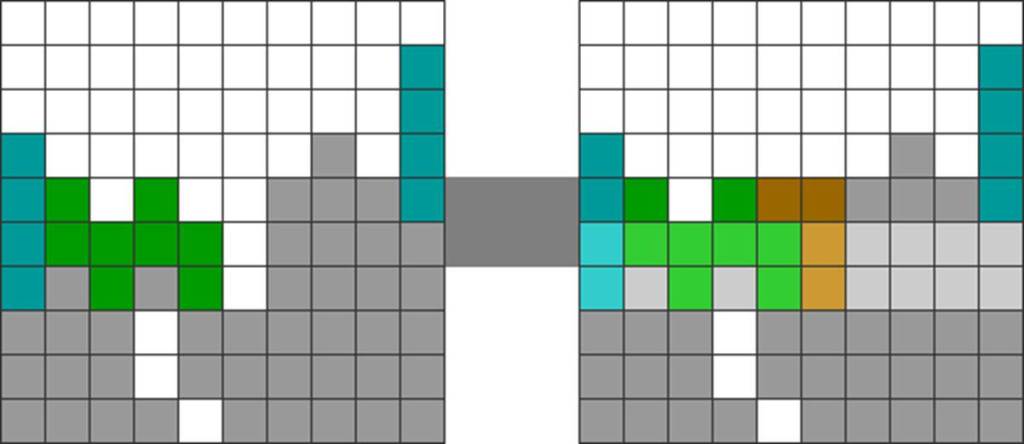
| The jagged field forces one to compound jaggedness with vertical S and I placements. | There is no room to put L flatly. He is forced to skim with the L piece. |
| 3 | 4 |
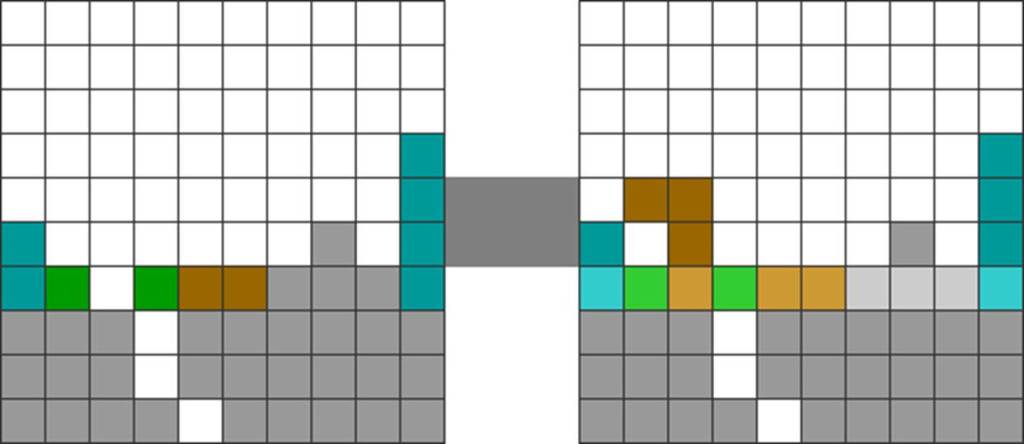
| The resultant field. | There is no room to put the L piece flatly. He is forced to skim with the L piece. |
| 5 | 6 |
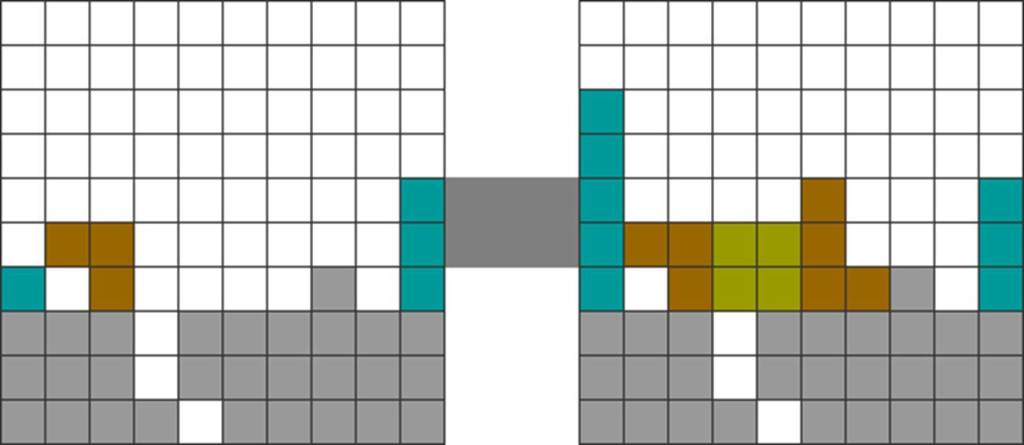
| The resultant field. | He upstacks again with I, O, and L pieces. |
| 7 | 8 |
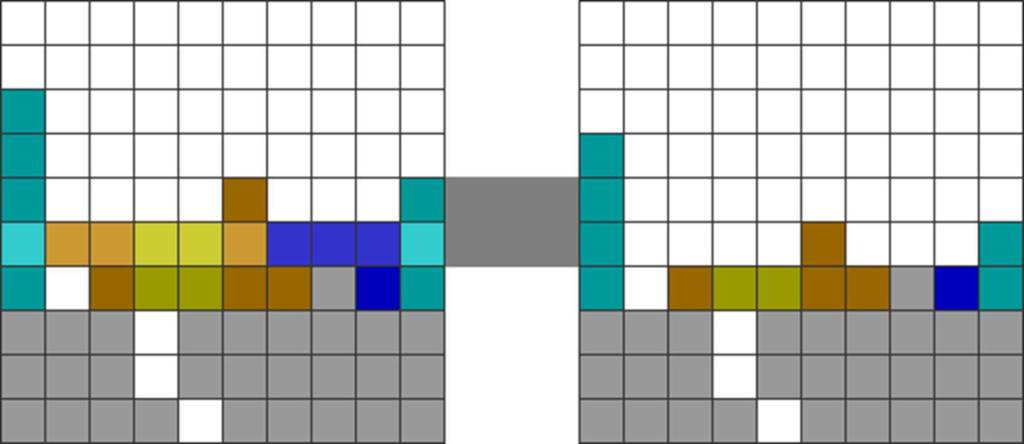
| He skims off the unclean layer with an inefficient line clear that sends no garbage to the opponent. | He still cannot dig down to reach the bottom garbage lines. |
Here, the player chooses inefficient skims (clearing lines) with vertical and sharp piece placements. As a result, the field’s jaggedness continues with each skim.
This eases nothing. Instead, each consecutive act worsens the stack, making it even more jagged.
As a result, one cannot dig down fast enough. This then buys the opponent time to build up to attack the player.
Hence, poor micro-decisions in stacking lead to severely uneven shapes at the larger scale. This then returns in a spiral, worsening one’s win rate.
Instead, one can do this:
| Diagram Set 25-3 | |
| 1 | 2 |
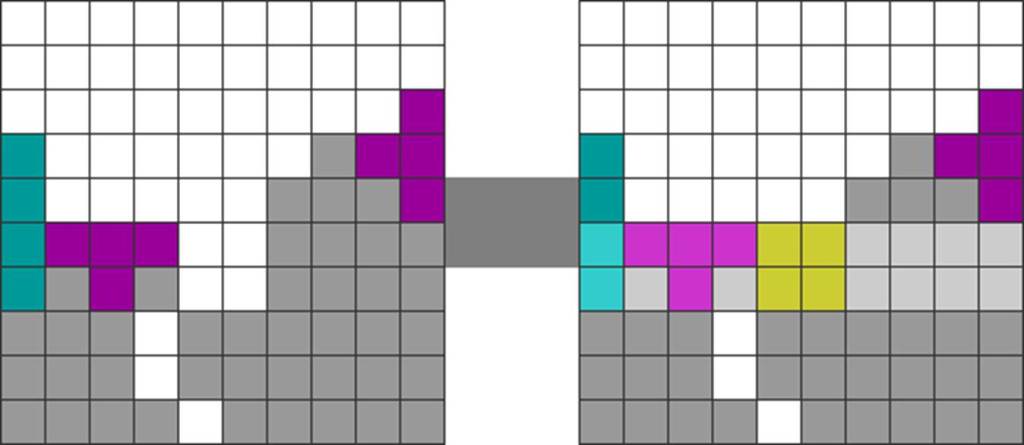
| The player puts 2 T pieces to flatten the field. | He inserts an O piece into the cavity, clearing 2 lines. |
| 3 | 4 |
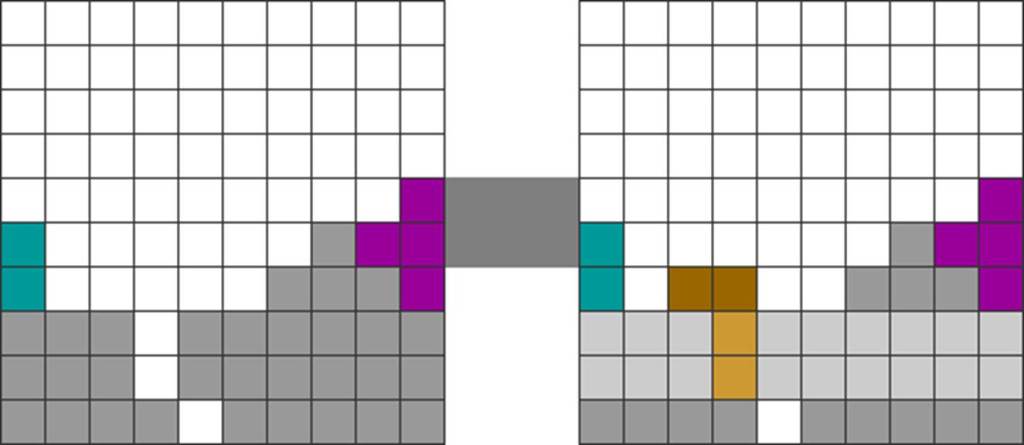
| The resultant field. | He continues with an L piece to skim 2 more lines. |
| 5 |

| The resultant field. The player successfully digs down to the final garbage row, exposing it cleanly. |
Notice how much faster and how fewer steps are needed to achieve the intended goal?
Here, the player manages jaggedness in the stack by putting T pieces to flatten the field.
By a mathematical law I derived in my other Tetris guidebooks, this usually leads to smoother digging down and stacking.
More importantly, during diagram set 25-3’s entire sequence, the entire attack is joined: the player does not clear lines, pause, stack up, and repeat.
This contributes to a mechanism called “comboing,” where joined attacks send more garbage lines to the opponent.
On the contrary, in the previous diagram, set 25-2’s sequence of attacks was not joined in some steps. There was almost no comboing.
Using combos, hence, maximizes offensive power and lets you recover quickly, dig down to safety, and attack again.
So, the micro-level choice to manage jaggedness properly leads to the macro-level effect of a smoother stack. This, in turn, makes it easier to stack flatly and win.
The cycle is completed. The parts affect the whole, and the whole affects the parts.
Personal Applications
Body, Mind, and Spirit
Every individual’s health is a balance among body, mind, and spirit.
Imbalances in this trinity may lead to adverse health symptoms. When we identify which of the three the disease arises from, we can treat the root causes instead of the symptoms.
Afflictions of the body can only be cured through medical or external interventions. One cannot cure cancer simply through meditation, just as one cannot stop a bullet using the mind alone.
Ailments of the mind, such as obsessive-compulsive disorder or depression, can be treated with psychiatric means or therapy. Some brains are born with specific problems, and this is not the fault of the spirit.
However, diseases of the spirit cannot be fully cured through the methods of the former two nodes.
They are often karmic, arising from one’s past life problems that have yet to be resolved.
In the studies of Michael Newton and Walter Semkiw, the researchers found that current life traumas can reflect past-life terrors.[1]
For instance, Dr. Michael Newton, despite being calm and intellectual, experienced something interesting.
He recounted the following in an interview:
During the birth of one of his children, he behaved extremely frantically and manically, almost like a different person.
He then uncovered the truth using unknown means. It might have been a past-life regression hypnosis session.
It turned out that, a hundred years ago, his child had died in a miscarriage in a past life. He had been waiting a hundred years to resolve this trauma, resulting in the maniacal outburst above.
If you wish to resolve your karmic problems, you only need to look at your current life. Your current life reflects and continues your past life’s habits and tendencies, positive or negative.
While talents can arise from past life deeds, so can negative traumas.
In my past lives (verified by three spiritual mediums), I have been a philosopher, writer, scientist, and artist. This explains my intellectual and creative output in this life.[2]
I was also incarnated in Tibet once and studied Buddhism there. This explains my current life’s focus on spiritual growth and Eastern philosophy. Likewise, many of my past lives were in Asia.
However, I also suffered specific traumas in recent lives, which made me less confident and socially reclusive and anxious in this life.
However, I can make sense of them and use them to my advantage. Writing books requires much solitude and introspection. Hence, this favored me well.
Hence, one’s past lives can affect the present.
Healing Past Psychic Wounds
In Tibetan Buddhism, there is the famous wheel of reincarnation. It states that many souls pass through the six realms of desire until they break this cycle and achieve enlightenment, freeing themselves from it.
The same is true with overcoming our past negative tendencies. Many involve destructive cycles and habits that repeat until we transcend them.
Mindful practices and internal reflection can help identify the root causes of one’s current life to address.
I invite the reader to use a large sheet of paper to map their mind and soul.
Trace each of your traumas to specific events and reflect upon them. Only then can you address the root causes and break your destructive, non-self-serving cycles.
Once we identify our current traumas, we can ponder what could have caused them in previous lives without undergoing a past-life regression therapy session.
For instance, if one has a persistent fear of people in this life, it could be karmic.
Hence, the solution is simple: we acknowledge the situation honestly and accept that we cannot hide from it or run from it.
Instead, we tackle the problem head-on by taking actionable steps that can counteract and reverse it. One can start by meeting people in small settings or streaming on Twitch without a webcam.
If one is constantly depressed and suicidal in this life, one can counteract that by stopping activities that worsen it. This can be endless doomscrolling on social media. We can hence block that.
Once we do that, we can reverse depression by actively doing something meaningful.
In psychology, this is called behavior activation, which involves engaging in positive activities that make us happy. This joy then overwrites our depressive feelings and breaks the cycle.
Cancer patients sometimes cope by doing constructive activities, such as climbing Mount Kilimanjaro. This gives them a sense of accomplishment, helping them manage their despair and break the cycle.[3]
Hence, we are entrapped in our karmic cycles until we break them.
It begins with self-awareness.
Social and Global Applications
Want to Change Society? Change Yourself First
Some schools of thought, such as Nichiren Buddhism or Soka Gakkai, maintain that the external world reflects our inner state.[4]
They endorse the idea that if we change ourselves, we can affect the entire ecosystem and the globe. This then rebounds back to us as good karma.
We reap the fruits of the seeds that we have sown. This is paralleled in many Eastern philosophical traditions and even in Abrahamic religions, as in Galatians 6:7.
In Ken Wilber’s philosophy, a holon is something that is both a whole and a part of larger wholes, meaning that the individual and society mutually shape one another.[5]
His AQAL framework shows that personal growth (inner development, values, consciousness) influences collective systems like culture and institutions. Those same social structures shape how individuals think and grow.
Because every level of reality is made of holons nested within larger holons, change in the self inevitably affects the wider society, and changes in society feed back into the development of the self.
Therefore, when we change ourselves in a positive way, our actions can reflect that inner state.
And when that happens, it affects other human beings.
Imagine seeing someone who is always angry at work. That alone can diminish one’s mood and reduce productivity.
However, if one sees one’s boss smiling and encouraging people each day, one’s work will be of higher quality.
Helping is contagious. When we confer positivity and love on others, it can change the fabric of society, leading to better, fairer governance.
This then returns to the self, completing the cycle.
The Backfiring of Greedy Corporations
The law of correspondence has parallels in many industries.
The gaming industry used to thrive on fully developed, high-quality games like Heroes of Might and Magic II and the Command & Conquer series.
In the past, gaming companies such as Blizzard were founded on passion. The game creators truly cared about making games that were fun and respected gamers.
Eventually, many companies turned to greed, raising AAA game (i.e., top-tier games that require extreme cost to create) prices to extravagant levels. Yet, they were filled with bugs when they were released.[6]
More importantly, they over-monetized their games, introducing downloadable content (DLC) priced at high rates. Gamers might have to spend hundreds of dollars before a game felt “complete.”[7]
Ultimately, newer Gen Zers could not afford $100 games. They started revolting and review-bombing AAA games built on greed.
Ubisoft, Activision, Blizzard, and EA Games all took this route and learned the hard way: that the main goal of games is to have fun, not to over-monetize them.[8]
Now, gamers increasingly spend money on indie games (i.e., smaller, independent companies’ games) with no predatory DLC policies that exploit them. Big gaming corporations are now losing market share.
This is the law of correspondence applied to the gaming industry.
In other industries, we can see the rise and fall of Microsoft and Apple, which follow similar trajectories.
It all began with innovation and consumer products priced appropriately for their functionality.
Now, Apple phones cost over $1000, yet offer only slight improvements over the last generation.
More people are turning to other phone companies, such as Samsung, Vivo, and Huawei, which produce cheaper and competitive alternatives.
This happens when corporations, at the macro level, betray consumers’ trust, at the micro level, in favor of greed over substance.
The latter rebel against the former until the cycle is broken.
[1] Michael Newton, Journey of Souls (1994); Walter Semkiw, Return of the Revolutionaries (2003).
[2] I cannot remember most of my non-human lives from my OBE that involved golden spirits showing my past lives on other worlds. The human brain cannot retain all that data. I wish I could, but the information was forgotten for a good reason.
[3] Shaunna Burke et al., “The Meaning of the Mountain,” Qualitative Research in Sport and Exercise (2010). Climbing Kilimanjaro helped cancer survivors build strength and regain personal control.
[4] Daisaku Ikeda, The Human Revolution (1965); see also Nichiren, The Writings of Nichiren Daishonin (1999).
[5] Ken Wilber, A Theory of Everything (2000); see also Integral Psychology (2000) for the AQAL model mapping individual and collective, interior and exterior dimensions of spiritual development.
[6] Cory Doctorow, The Internet Con (2023). Doctorow’s “enshittification” describes how corporations degrade products once they capture sufficient market share.
[7] I spent SGD 400 on The Sims 3 and World of Warcraft each, and I regret it.
[8] See Cory Doctorow, Enshittification: Why Everything Suddenly Got Worse and What to Do About It (2025), which outlines how corporations decay user value to extract short-term profits.

