“Perfection is not attainable, but if we chase perfection, we can catch excellence.”
— Vince Lombardi
Introduction
The Perfectibility of Souls
If you wake up one day in the West and say, “I’m God,” nobody will believe you and instead send you to an asylum.
But if you wake up in India or Thailand and declare, “I’m God,” your neighbors would all smile and say, “Congratulations, you have found yourself.”[1]
This is why people such as Jesus Christ, Meher Baba, Ramakrishna, and Sai Baba sometimes declare, “I am,” meaning they are literally God incarnate.
And we are all there to manifest that divine and Godly oneness in an infinite number of ways, be it to play the game of free will or to manifest creatively. Our goal is to co-create and co-participate alongside the One.
Simply put, you are an unawakened God in finite, human form, waiting to regain and remember your divinity and return to the One.[2]
The goal of your incarnations on many mental or physical dimensions, realms, planets, or universes is to serve mainly one purpose:
To perfect yourself and achieve divinity.
Tetris as an Analogy
Just as humanity’s pursuit of the mystical divine mirrors this process, Tetris mirrors it through the laborious training required to reach it.
Tetris is an exact parallel of the entire physical incarnational process on Earth. This could differ on other planets, realms, dimensions, or universes with different laws of physics or consciousness.
However, for Earth, the correspondence is almost exact.
Before you read the following sections, I invite you to a riddle that you can solve while you read the next part:
| Diagram Set 26-1 | |
| A | B |
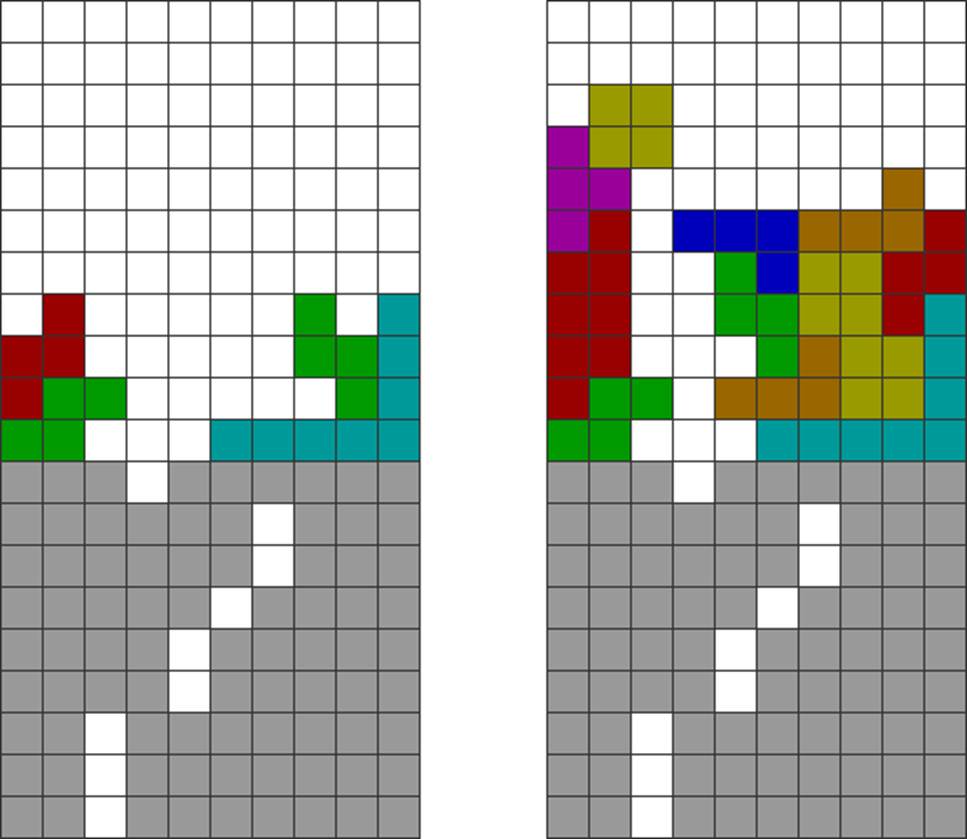
| Here are 2 T-spin setups. |
Which of the two T-spin setups belongs to a beginner or advanced player?
I will tell you at the end of the next section, along with its relevance to this chapter.
The following sub-sections compare Tetris and the incarnational process. The latter involves what happens in physical life, what we do in the spirit realm between lives, and our eventual union with the divine.
It is based on Michael Newton’s Journey of Souls. Over a lifetime, he documented hundreds of past-life regression sessions through hypnosis from his clients. Through them, he mapped out a roadmap of the entire reincarnation process from the first human life to the last and beyond.
Similar findings from compiled near-death experiences from Near-Death.com, the Monroe Institute’s conclusions, the Seth Speaks material, and the Michael Teachings also support this.
Observe the following Tetris metaphor:
The Initial Casting
We begin our incarnation in Tetris and have our first match.
Here, we choose the roles and personality types that we wish to manifest in the game.
I chose to be a scholar and an artisan.
The Lives on Tetris
When I first incarnated on Tetris, I forgot my daily self’s attributes. I forgot I was a novelist and academic.
I stubbornly clung to each match, desiring not to lose. I feared that upon topping out, it would be the end of all existence.
However, as I “died” in my first Tetris match, I realized that I was not dead. I was my bodily self in a three-dimensional space.
I could then “reincarnate” again and start a new Tetris “life.” I moved on to my second Tetris match and repeated the process.
Every “life” gave me more experiences to reflect on and apply my skills.
In between every “life,” I would take extended breaks to reflect on and review each match, much as in a near-death experience.
I would find myself with Tetris buddies and coaches (metaphorically, “spiritual elders”) who would review my “lives” in Tetris to guide my growth.
I would then apply those skills in each new match (“life”) until I learned every aspect of Tetris.
At first, I was young and survival-oriented.
As I grew, I became attached to achievements, wanting a high ultra or sprint score.
As I matured, I stopped caring about external achievements or social validation. I just wanted to be myself and play Tetris my way.
Once I became an “old soul” in Tetris, I realized that my goal is simply to teach and pass down my philosophy to others.
Between matches, I had become a well-respected figure who now passes on Tetris knowledge and methods to others.
Moving on from Tetris
And now, the role of my “physical incarnations” in Tetris is nearly over, and I may soon fully retire.
I may sometimes incarnate in Tetris to express the godly manifestation and culmination of my skills. But I am no longer attached to the outcome.
I now understand that there is an infinite number of ways to play and express Tetris. And now I embrace the whole.
I now return to the other side, reuniting with it, ready to begin a new “game” in a “new universe or planet,” such as Minecraft, Two-Point Museum, Sonic & Shadow Generations, or Lumines Arise.
Growth is eternal, and I look forward to it, for divinity is the final outcome.
By now, the reader should see the parallels between playing Tetris and the human reincarnational cycle.
Returning to the Earlier Puzzle
Now, we can return to the puzzle of diagram set 26-1 from earlier.
Most people would think that A is the beginner and B is the expert player.
Nope, it is the opposite: B is the beginner, and A is the expert player.
This comes from an insight in Bruce Lee’s interview: beginners are flashy and pretentious. Experts, however, go for simplicity and efficiency.
Here is what follows from A in the next few steps:
| Diagram Set 26-2 | |
| 1 | 2 |
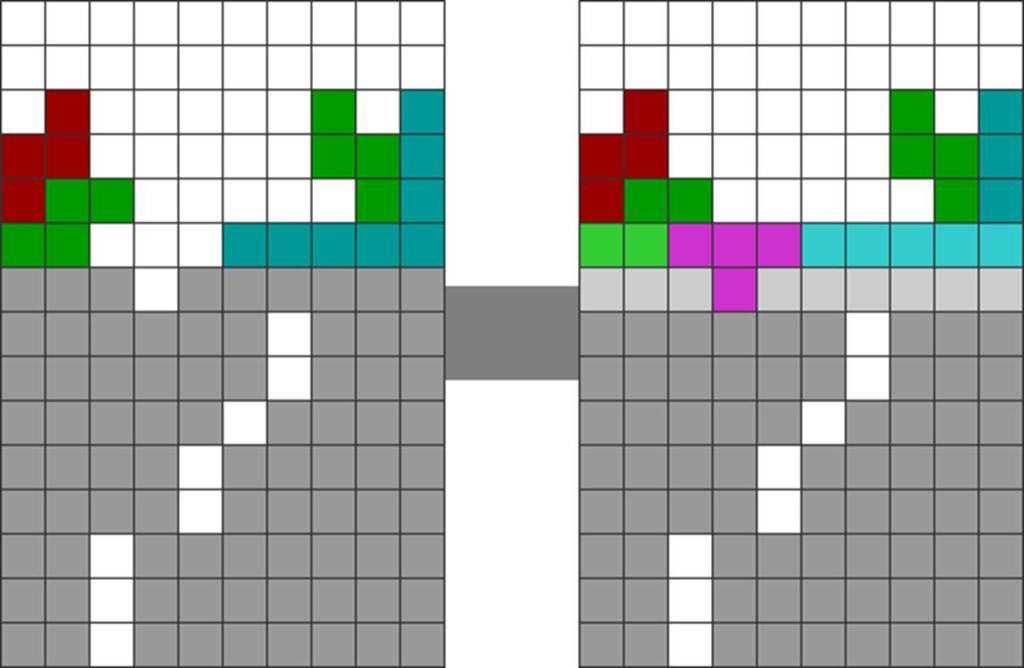
| A’s starting field. | The player goes for a T-spin, which clears 2 lines. |
| 3 | 4 |
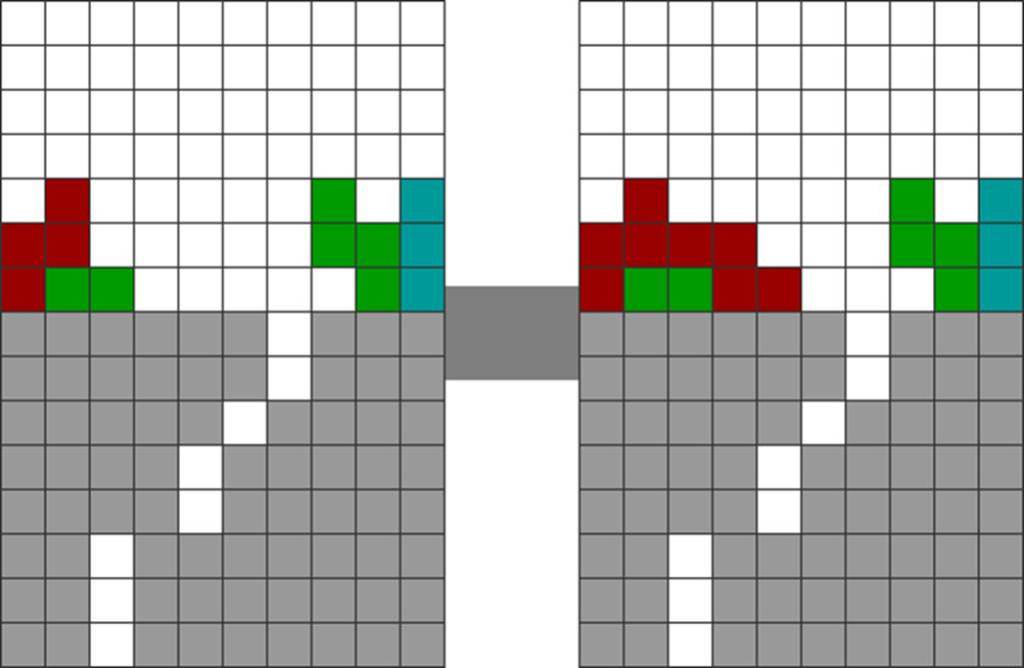
| The resultant field. | He places a Z piece, readying a second T-spin. |
Altogether, steps 1 to 4 required eight pieces (including the second T piece for the second T-spin).
B needed fourteen pieces, excluding the required T pieces to complete the T-spins!
I will not scare my non-Tetris-playing audiences with how to fully carry out B’s full sequence. I will leave it as an exercise for those who want to pick up Tetris!
Complex setups like B require many pieces, which can run counter to the flow of the field and situation — the right pieces may not be available.
Hence, expert players choose easier setups and go with the flow because they are more readily available for safe creation.
They can effortlessly create setups with high consistency as they know how to balance proper stacking with planning for complex setups.
Less experienced players rush for the setup, then plan later, only to fail.
Thus, perfection in Tetris comes from the seamless harmony between offense and defense, showing nuance in tactical choices. A key manifestation of perfection is elegance and simplicity, not over-complication.
Likewise, in real life, the philosophies of many younger souls are complex. However, as one matures, their teachings are almost always simple, cutting straight to the essence without the fluff.
This is why the teachings of Eckhart Tolle and Thich Nhat Hanh are so simple. Perfection comes with simplicity and clarity.[3]
Fear not the Tetris player who can perform 10,000 methods one time each, but the one who has practiced a method 10,000 times.
Some people spread their mental energy too thin across too many subjects and ultimately master nothing (like in my earlier years!). Sometimes, less is more.
Perfection comes when one can apply an experience or skill in many situations, rather than simply knowing a thousand experiences.
As you perfect yourself, you become more complex and layered. Your individual components integrate more seamlessly.
You broaden your perspective and become more inclusive and accepting of cosmic laws and realities. The way you teach others may also become simpler and more elegant, yet more profound and complex.[4]
Personal, Social, and Global Applications
Perfecting Ourselves by Embracing the Now and Ourselves
Do you now see how eerily similar Tetris is to the actual reincarnational cycle, the afterlife process, the reunion with the divine, and other things, such as the life review and soul group processes?
We all begin by being cast from the One.
We then incarnate across many lives on Earth to gain experience. We then reflect on them and put them into practice until our perspectives grow.
We then learn all we need from Earth and stop incarnating, rising through the spheres, such as the etheric, astral, causal, akashic, mental, messianic, buddhaic, and logoic realms.[5]
These terms refer to Theosophy’s delineation of the levels of existence beyond the physical.
We finally reunite with the One.
Then, we are free to begin life in another cycle as another sentient being or a different form of existence.
The cycle repeats, and we gain more complexity every time.
This is the nature and beauty of the cosmos: that we are given infinite chances and opportunities to grow into divinity.
It is not because we are reaching for divinity.
Instead, we are all already divine, and we are merely remembering it.
Since we are all aspects of the One, to manifest divinity in human form is the ultimate stage of physical evolution.
Think of souls such as Jesus, Buddha, Lao Tzu, Mahavira, Socrates, or Gandhi. They are God incarnate in physical, human form.
They project the loving and wise nature of all reality. They embody the One, manifesting their multiplicity and embracing the paradoxes of dualities.
But deep down, they do not differ from you and me.
After all, we are all fundamentally one.
It may seem like a long journey. However, the end is less important than the journey. Life is also not a race or arena.
What matters is living in the present and following the path of our highest excitement, celebrating our unique forms.
Perfecting Ourselves Through Human Civilization
When enough people manifest this godhood, society mirrors it.
The city of heaven is then brought down to Earth, curing all old wounds and ending social injustices.
Only then would humanity’s spiritual ascension be complete.
And you should rejoice, as you are among the many invited to participate in this grand project.
One might think that this is drudgery and boring “work.” But what challenge and meaning would life have if everything had been explored?
It is here, in a world full of unrealized opportunities, in this ongoing project called Earth, that we can manifest and evolve.
To my understanding of NDE accounts, entire long lines of souls queue up to reincarnate on Earth because of this. However, here on Earth, most of us forget our pre-life enthusiasm.
Apply this law by appreciating being in the flow of transformation. Embrace spiritual evolution by eagerly anticipating what lies ahead.
I once accidentally attended a seminar by a religious group whose name I will not reveal. It disguised itself as a spiritual meetup while intending to convert others. I did not know it was a religious cult at first.
There, the members tried to convert me, saying you need to go through an arbitrarily large number of incarnations to finally complete your mission on Earth. This was a few million.
They said that, through their religion’s practices, one can complete the cycle in one lifetime.
To me, such dogma, if true, would defeat the purpose of reincarnation. If we were here only for a single lifetime, we would not have enough experience to gain wisdom.
So I told them this: life’s purpose was not simply to reach some end goal. Instead, the purpose of life is life itself, being present in the now. There is no rush. I then left quietly.
Rushing through one’s spiritual incarnations would be like taking a ten-hour flight to Rome, stopping by the airport for an hour, and then flying home. Instead, one should embrace the moment and visit many parts of Italy.
We are all here to learn and should cherish the spiritual growth opportunities given to us to perfect ourselves.
Every planet, dimension, realm, or universe in which one physically incarnates has a different theme and a set of moral, physical, and spiritual lessons.[6]
On some planets, one could be part of a collective fungal lifeform with no sense of separation. Others may involve being a flying or oceanic race focused on emotions. Others may involve exploring other universes or being part of stars.[7]
Earth is a roiling, masculine-centered, action-focused planet with high levels of division and separation. Its core theme is limitation, in which we learn to build a civilization within our physical and mental limits through various coping methods.[8]
Incarnating in each world is a chance to regain and remember our divinity, not a punishment that we should grow tired of.
Just as being spiritual means manifesting our fullest potential as separate selves, spiritual growth is not about reaching a single end goal.
Instead, it is to manifest in the now mindfully, allowing every second to be a manifestation of the undivided timelessness beyond.
[1] Alan Watts, The Book: On the Taboo Against Knowing Who You Are (1966).
[2] Deepak Chopra, public lecture. See also The Seven Spiritual Laws of Success (1994) and God: A Story of Revelation (2012), in which Chopra develops the idea of humanity as divinity slowly awakening to itself.
[3] To my knowledge, according to their Michael Teachings charts, both are old souls. Eckhart Tolle had 17 previous cycles (five times the planetary average), and Thich Nhat Hanh was an intended vessel for the infinite soul.
[4] Being complex is not the same as being complicated.
[5] Helena Blavatsky, The Secret Doctrine (1888); C.W. Leadbeater, The Inner Life (1910); Michael Newton, Destiny of Souls (2000); Shepherd Hoodwin, Journey of Your Soul (1995).
[6] Shepherd Hoodwin, Journey of Your Soul (1995); Chelsea Quinn Yarbro, Messages from Michael (1979). The Michael Teachings describe many incarnational themes across different physical planes; see also Michael Newton, Destiny of Souls (2000) for regression accounts of souls describing previous incarnations in non-human forms on other worlds.
[7] The Michael Teachings describe “grand cycles” — entire sequences of incarnations across different planets, dimensions, or life forms. The average human’s previous grand cycle count averages three to four, the most being nineteen — Jesus Christ. I channeled many of my own using automatic writing and incorporated some into my spiritual novels. It gets eerie: when writing these non-human characters, I can easily map out their psychology deeply, almost like remembering.
[8] Darryl Anka, Bashar channeling, YouTube lecture; see http://www.bashar.org. Bashar describes humanity as “masters of limitation” — souls who chose Earth to explore the challenge of growing within extreme constraints.

