“We are all leaves of one tree. We are all waves of one sea.”
— Thich Nhat Hanh
Introduction
There is No Better or Worse
There is no “better” or “worse,” “higher” or “lower” in the cosmos.
Before birth, the self belonged to a greater whole that saw no separation.
However, all that changes when the soul incarnates in a limited physical body with a human intelligence that is just one out of an infinite number of ways to perceive the cosmos.
Linear concepts of “better” and “worse” arise when the human mind imposes linearity on the cosmos and analyzes the infinite, irreducible cosmos by reducing it into simplistic dichotomies.
These concepts exist only from the point of view of a “left-brained” analysis of the universe.[1]
We pick up these concepts through socialization and conditioning. We learn that we are either part of an elite, normal, or inferior group.
Then we internalize that sense of superiority, normalcy, or inferiority, leading us to distance ourselves from others, look down on people, or glorify certain groups.
This is when the ego is born: we put on the vestments of Maya and ascribe rank or hierarchy to different people.
Just as our intellectual concepts of “better” and “worse” are constructs, so is the ego.
The ego is a temporary construct that we adopt to experience the cosmos from the constraints of a limited, physical being.[2]
Without this, we would not have a personality or finite experiences. An “ego” is needed for spiritual evolution, but many attach to it too much.
When we shed our concepts and ego, we return to the pre-birth state of unity, where “better” or “worse” does not exist.
Every being at so-called different “stages” of spiritual or intellectual development is like the many flowers, plants, weeds, bacteria, or insects in a garden.
Only a human gardener judges some as “good” or “bad,” “better” or “worse,” “advanced” or “primitive.” He prunes away that which he judges as unfit, imposing a hierarchy of “better” or “worse” stages.
But when he leaves, nature goes in accordance with the cosmic law of equality again, where each entity plays its distinct role.
Together, they make the garden of heaven possible, not because they are “better” or “worse,” but simply because they are.
And you, dear reader, are no less than anyone.
No Absolute Standards
Zhuangzi, a Taoist sage, once said that there are no absolute standards.
I have read many spirituality and philosophy books that outright champion one way of life over others.
Many always say things like “love is the ultimate form of expression” and that we should always manifest it.
They sometimes also say we should always value things like beauty and truth.
This is not wrong, since these traits are amazing qualities to have in our world.
However, I offer a different perspective.
The physicist Max Tegmark once explored the idea of four levels of parallel universes.
Physicists often theorize that an infinite number of universes are being created every second through the process of eternal inflation.
That is, new Big Bangs create new universes with different laws of physics and maybe of spirituality and morality.
At the highest level of the four stages, universes may have different mathematical properties.
Hence, for ours, 1+1 is always 2. In other inconsistent universes, 1+1 might be 3.
If the all-that-there-is is constantly creating new universes, there is no reason why such alternate universes should not exist.
It is the same idea as with many video game creators who make games with unusual laws of physics. I even heard of a game in development that creates a world with four spatial dimensions.
So there could be universes where moral and spiritual systems are so different that love, beauty, and truth are not the top traits to pursue.
Now I leave you with a thought experiment: if someone is about to harm another person and you are the only one who can stop it, would you stop the first person?
Many people would judge the former’s act as morally unjust. They would then intervene.
However, from a broader perspective, who are we to judge what is positive or negative?
What is positive or negative is a largely human-centric concept that humans rationalize and understand.
Before humans evolved, most creatures never had the moral or cognitive faculties to solve this problem.
The same is true of hypothetical intelligent life forms on other planets, who may instead view this problem from a different moral perspective.
The reality is that, from a broader perspective, both paths may be equally valid (I am not suggesting that people should simply stand by when someone is in danger, though).
Why?
Because every path, every consequence, can lead to effects that we may not fully grasp until it really happens.
Zen stories sometimes tell of people who are injured and unable to do the things they want.
However, the injury sometimes, ironically, hardens their fortitude and leads them to positive events they would not have had if they had not been injured.
In the thought experiment, the victim who is harmed might, ironically, develop greater resilience to cope with life.
We may never know some pathways from a purely human perspective.
Perhaps every pathway, just like novels, is equal in the broader cosmic perspective.
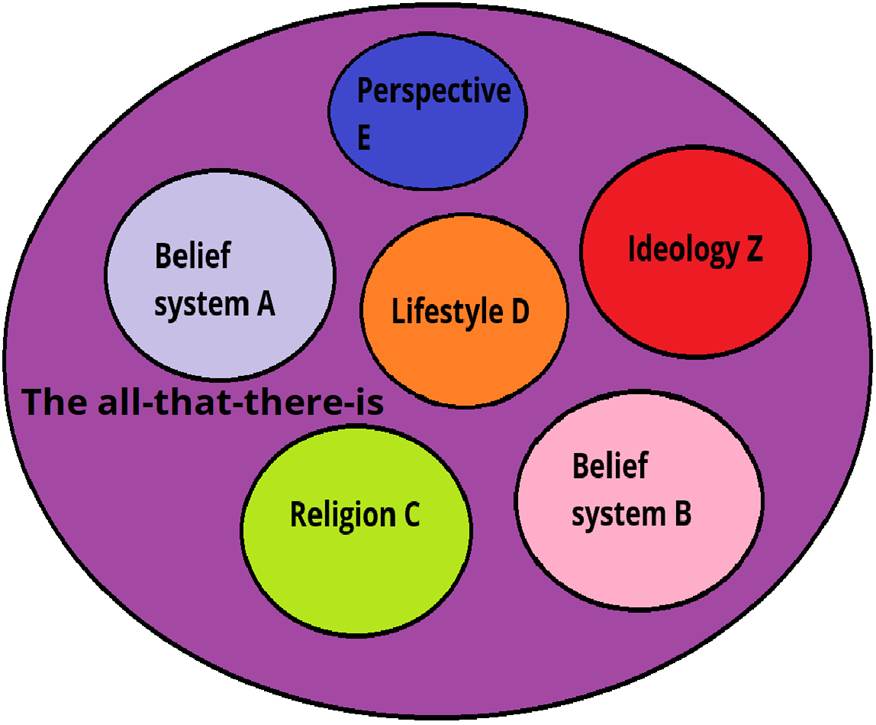
| Without these individual perspectives, the whole would not be complete. |
There are no absolute standards.[3]
Tetris as an Analogy
In Tetris, people often compartmentalize themselves as “elites” versus “non-elites.”
In my observations of many Tetris groups, elite groups often differentiate themselves by showcasing their godly skills.
However, many fall into the entrapments of the ego, believing that there are “better” or “worse” ways to play Tetris.
Players who play Tetris “ideally” by going for maximal efficiency and speed are praised as the “best.”
Players who deviate from this and merely play for fun without even learning how to input key commands properly in the most efficient manner are seen as “inferior.”
For instance:
| Diagram Set 27-1 | |
| 1 | 2 |
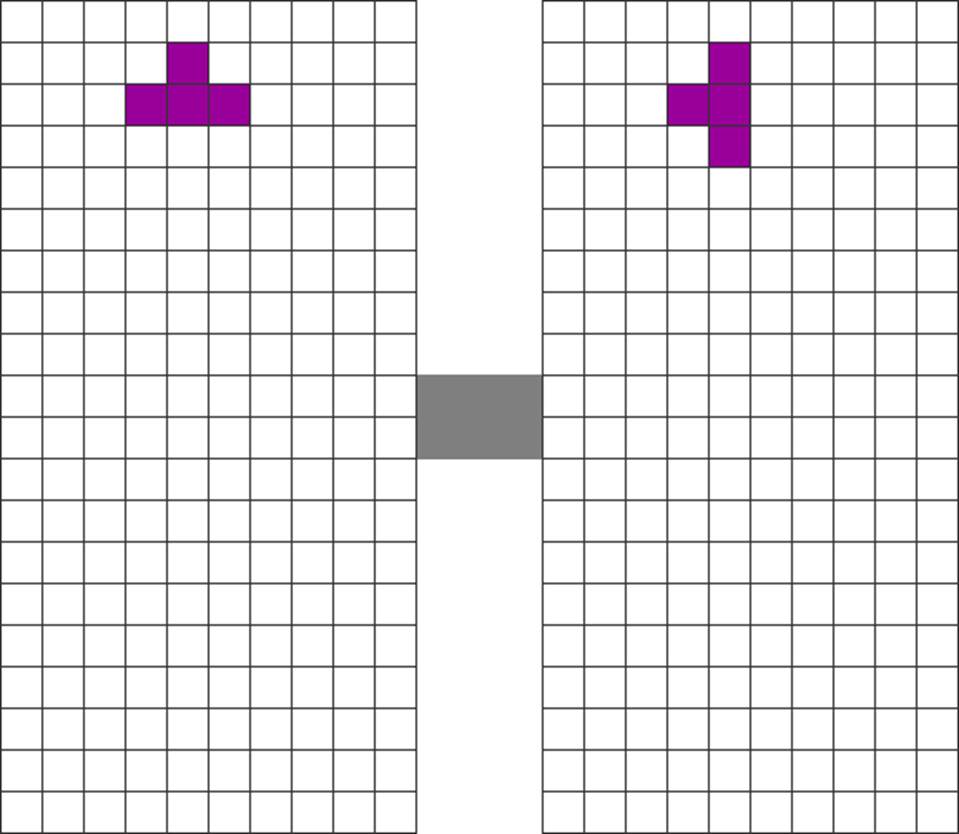
| The T piece appears. | Rotate counter-clockwise to reach this position. |
The above illustrates 2-Step Finesse, a scheme for placing all pieces optimally with minimal key presses. Here, the player makes no extra movements.
However, the following shows the opposite:
| Diagram Set 27-2 | |
| 1 | 2 |
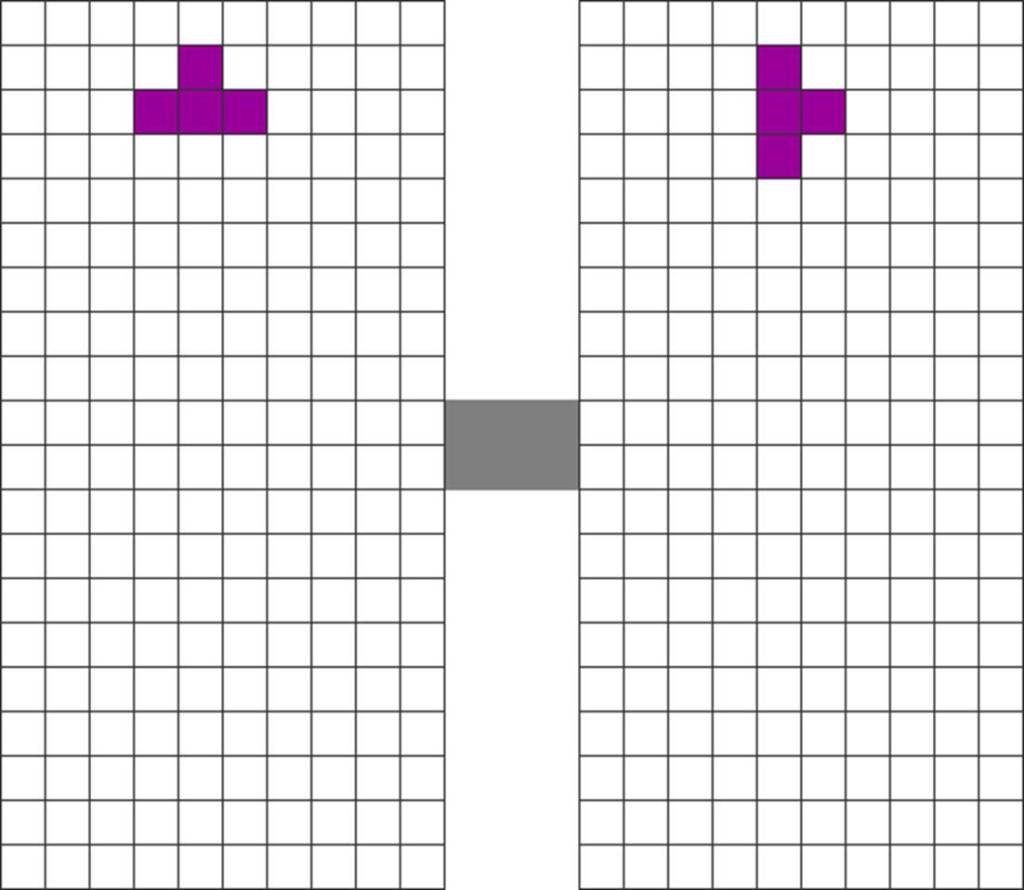
| The T piece appears. | The player rotates clockwise instead. |
| 3 | 4 |
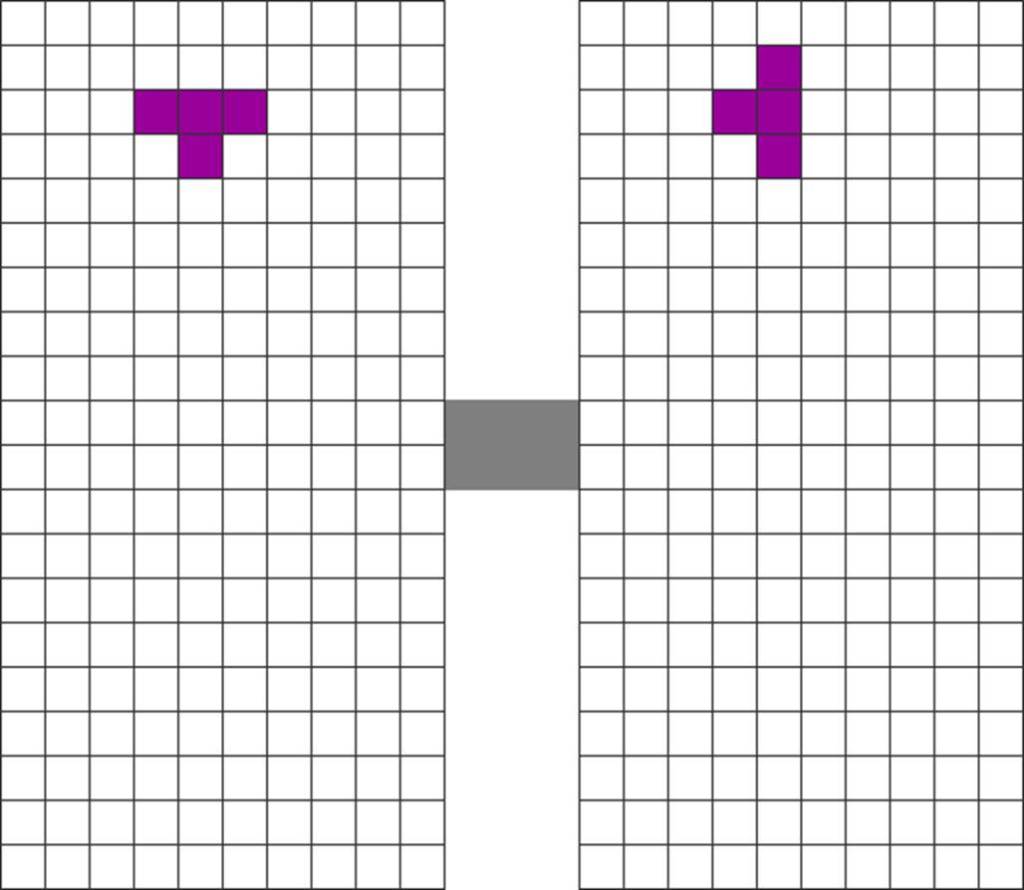
| And another time. | Then, a third time, just to reach the same position. |
Here, a player places the same piece in the same location as in the last diagram set. However, he rotates three times, when a single rotation in the opposite direction would do.
This is inefficient, and I have seen some Tetris Twitch streamers being made fun of by elites for doing so.
However, these players are not “inferior.” Instead, they play Tetris to a different tune. Some are just too lazy to learn to rotate in the opposing direction. Being lazy is not wrong.
More “elite” players engage in serious competition, where they can rage and form deep rivalries in tournaments.
However, “less elite” players sometimes use Tetris as a mere conduit for socialization. During Twitch Tetris streams, they chat about their lives and joke about other matters instead of trying to be “good.”
Yet, this is not wrong.
It is just another expression of the infinite cosmic consciousness manifesting differently.
Before the cosmic mind, all is equal, for without variation, the cosmos would be void, cold, and monotonous.
Personal, Social, and Global Applications
Resolve the Contradictions of Capitalism and the Free Market
According to the German philosophers G.W.F. Hegel and Karl Marx, society evolves by consolidating its opposites into a more inclusive whole.[4]
For instance, he suggests that a capitalist, free-market system is full of internal contradictions that people dislike.
It is unequal, exploitative, too stressful, not ecologically sustainable, too competitive, and not fulfilling for many individuals.
This creates many negative effects, such as people quitting work to “lie flat” (like in China or Japan), losing life satisfaction and authenticity, and suffering from brain fog, burnout, and other inflammatory issues.
It may also lead to mass demonstrations in some countries calling for the government to redistribute wealth.
According to Hegel and Marx, these negative contradictions can only be resolved if society evolves toward a broader mindset.
Our current post-industrial civilization has a zero-sum mentality, where some groups want to gain at others’ expense.
For instance, some people believe two superpowers cannot coexist, and that one must defeat the other and exploit its resources by winning the AI race.
However, this zero-sum mentality arises when we see others as unequal, by seeing them as “other lesser” people to be exploited.
When civilization matures, and this mindset evolves into a broader perspective, we can then identify the internal contradictions and failings of a capitalist free-market system.[5]
When people see others as themselves, we can then have a more equal perspective.
This more equal perspective then translates to more socialist and democratic systems with a more equitable distribution of wealth.
Governments can then implement large-scale reforms to achieve this.
This evolves society into a more inclusive whole that resolves the last stage’s contradictions, yet brings forth a new set of contradictions.
And it all begins by seeing others as equals.
Being the Best Version of Ourselves as Equal Spiritual Beings
Many societies measure a person’s worth through metrics such as wealth, income, or IQ.
In young-soul societies, these measures can become overemphasized and mistaken for a person’s true spiritual worth.
Societies can judge a person as being less valuable or less equal because they have a lower IQ or income.
This affects the person’s self-esteem and self-image, causing them to develop inferiority complexes that harm their lives.
For instance, a person may stop engaging in brainy activities if they feel unintelligent.
I am here to dispel this myth of unequal worth and show that everyone is equal.
You can easily say that 2 kg of steel is twice as heavy as 1 kg of feathers. This is because weight and mass are scalar magnitudes like length, width, or height.
You can easily say that a car is traveling 10 km/hr in the X and Y axes. Then a car traveling at 20 km/hr in both axes will be twice as fast. This is because velocity is a vector, like pushing something with a force in a certain direction.
However, some qualities, like intelligence, are not. A person with an IQ of 200 is not necessarily twice as intelligent as a person with an IQ of 100, because IQ is an interval scale, not a ratio scale — it has no true zero point.[6]
The same is true of spiritual worth. Spiritual worth comprises experiences in many different qualitative dimensions that cannot be reduced to mere measurable quantities.
For the case of intelligence, having a high IQ may not be as important as having 10,000 hours of Chess experience in terms of Chess performance.
Likewise, we cannot say that someone is more spiritually worthwhile because they have more abilities in many areas.
If this person has no experience surviving in the jungle, then their vast experience is useless for running from predators or hunting.
This does not mean this individual should stop being the best version of themselves in the areas where they already thrive.
The same logic applies to many other societally imposed measures. Let us consider a few.
A person branded as having a low IQ might already thrive in the arts or music. Why should they stop being the best version of themselves?
It is also a comparative measure, and a super-intelligent alien might arrive one day and be smarter than every human. What is to stop this person from engaging in puzzles that he enjoys?
The same is true for any other categories founded on Maya: rank, prestige, job title, popularity, class, and so forth.
The lesson is thus obvious: nothing stops a person from being the best version of themselves.
Many of these measures are interval measurements that are comparative, founded on Mayavic understandings, and shaped by societal expectations that categorize us as “better” or “worse.”
When we transcend such limitations, none of us are truly “better” or “worse” than others. We are simply good at whatever we are good at, and it makes us happy and fulfilled.
When we transcend such measurements, we are ultimately all equals in the grand cosmic scheme: we are spiritual beings with infinite potential to realize whatever we want.
And that is why we should be the best versions of ourselves instead of merely living the standards society imposes on us.
[1] Susan Cook-Greuter, “Postautonomous Ego Development” (1999). At the Construct-Aware stage, individuals recognize that all concepts are mental constructions rather than objective reality.
[2] Susan Cook-Greuter, “Postautonomous Ego Development” (1999). At the subsequent Ego-Aware stage, individuals recognize the ego as a constructed fiction, dissolving the separation it creates.
[3] Sometimes, in this book, I may occasionally favor some perspectives and use superlative language, like “higher” or “better.” Unfortunately, this is inevitable because of the limits of English.
[4] Georg Wilhelm Friedrich Hegel, Phenomenology of Spirit (1807); Karl Marx, The Communist Manifesto (1848). Both argue that society evolves by resolving opposing forces into a higher, more inclusive synthesis.
[5] Ken Wilber, A Theory of Everything (2000). Wilber’s Integral framework maps how civilizational maturation expands perspective, enabling the critique of systems like capitalism that, in earlier, more limited stages, are accepted uncritically.
[6] S. S. Stevens, “On the Theory of Scales of Measurement,” Science (1946). Stevens established the four levels of measurement — nominal, ordinal, interval, and ratio — showing that IQ uses an interval scale.

