“The creation of something new is not accomplished by the intellect but by the play instinct acting from inner necessity. The creative mind plays with the objects it loves.”
— Carl Jung
Introduction
Play is What We Do
Play is the cosmos’ default nature.
For this reason, the capacity to play for its own sake evolved last among many more “developed” creatures, such as humans, dolphins, or whales.[1]
Humans are among the few creatures on Earth who play for the sake of playing, engaging in artistic creation, literary writing, poetry, mathematics, design, and so forth.
In the spirit world, souls’ default activity is play. Most souls play much more than they “work.”[2]
However, when we inhabit a physical human vessel on Earth, we are socialized to believe that we should work far more than we should play.
The result is that many post-industrial societies like Japan, Singapore, South Korea, China, and the United States experience high rates of burnout, mental illness, suicide, and dissatisfaction.
When we work, our minds are focused on the past and the future. We cannot fully live in the moment.
But when we play, we engage the present directly, living instead of merely existing in time.
This is why a person who is passionate about their interests and turns them into a career is said to have never worked a day in their life.
Tetris as an Analogy
Many Tetris players view improvement as a chore.
Top players spend up to ten hours a day playing Tetris non-stop.
On their streams, I have seen them play 40-line sprint modes, trying to clear forty lines as quickly as possible.
Many restart the game repeatedly, frustrated only by the end goal of achieving a personal best score.
However, over many hours, they can rage and torment themselves, failing to fully enjoy the game.
This applies to many other areas of Tetris. In an unofficial Tetris game called TETR.IO, many players focus on climbing the ranks by boosting their rating.
When they win, their rating increases. Whenever they lose, the reverse happens.
This has created the competitive drive that has nourished and produced the best Tetris players, such as Firestorm, Amemiya, or Czsmall.
However, this comes at great cost to many players, whom I will not name. Many have suffered from mental health issues, raging over their Twitch streams.
While they might rise to fame and their elite status quickly, their meteoric rise is followed by a sudden decline.
Many then quit and stop playing Tetris permanently.
I was one of the few players in a legendary Tetris Discord server that produced many of the world’s most prolific and expert players.
I have documented the complete story on my website here on the “An Unlikely Provenance: The Untold History of Tetris” page:
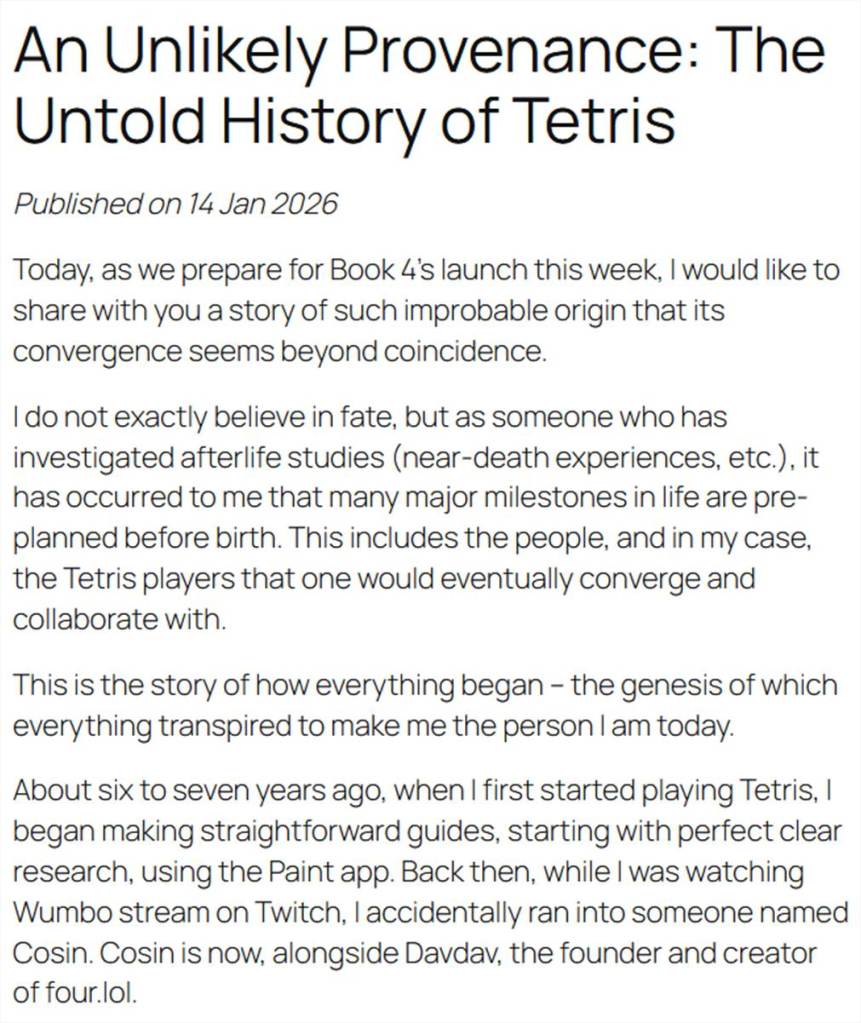
Many of them rose quickly, but likewise burned out quickly.
As a result, among the serious players in this group, I was one of the few who kept playing after seven years.
This was because I played Tetris for its own sake, without pushing myself.
I did not consider it work, nor did I consider working on my Tetris books as work.
They were just subjects of passion, which allowed me to produce high-quality work without feeling like I had worked at all.
Personal, Social, and Global Applications
Fixing Over-Work Cultures
Japan faces one of the most serious demographic aging issues among the world’s most developed nations today.
However, the reasons are multifaceted and structural.[3]
Many mayors have tried to resolve the issue through various methods: tax breaks, birth packages, paid maternity leave, fostering a child-friendly culture, breaking free from corporate overtime culture, and so forth.
None of them have worked.
This is because Japanese people are unwilling to have children for many reasons:
- Corporate overwork and hustler culture, nomikai, and so forth force salarymen to have no time or spare energy to raise a family.
- The work culture is so ingrained that, even though the government has implemented many policies to fix it, people still have a difficult time leaving work early.
- The inverted population pyramid means that, if one were to have kids, they will have to take care of them and many older parents and relatives before them.
- A stagnant economy arising from the lost decades means fewer resources to implement large-scale social and automation changes.
- The loneliness pandemic: young people are getting lonelier, sometimes isolated as hikikomori, and are unwilling to date.
- People are burned out from work.
As a result, Japan faces deep systemic and structural issues that social policies alone cannot fix.
Instead, one way out is to follow the Nordic countries’ lead by fostering a culture of play and fulfilling work.
Instead of making work about earning a salary in an unfulfilling, hectic job, institutions can reform to offer shorter, higher-quality work hours with more rest (people perform better when well-rested).
The mindset would then have to shift from a “work-only” mentality to a “play” perspective, where the individual is central to the economy.
The economy serves the individual. It is not the other way around, which constitutes economic or corporate slavery.
Combined with other social and economic reforms and automation, this could potentially reverse part of the fertility decline, leading to more fulfilling lives and work.
[1] Stuart Brown, Play: How It Shapes the Brain, Opens the Imagination, and Invigorates the Soul (2009). Play as a purposeless yet vital drive is most developed in cognitively advanced species, such as humans, dolphins, and whales.
[2] Michael Newton, Destiny of Souls (2000). Newton’s regression subjects described the between-life state as primarily characterized by recreation.
[3] Akihiko Matsutani, Shrinking-Population Economics: Lessons from Japan (2006).

