“Freedom is nothing else but a chance to be better.”
—Albert Camus
Introduction
The One who is omniscient, omnipresent, and omnipotent faces the ultimate paradox.
Such a divine being, call it God in whatever religion as you will, would be in all places, times, and states simultaneously.
It would be entirely perfect, with a complete dissolution of concrete and finite form into the absolute and infinite.
In many spiritual, religious, and philosophical teachings, this union with the absolute is what many yogis, arhats, and spiritual adepts aspire to reach. This mystical oneness is sometimes experienced through states of profound enlightenment during deep meditation.
In many near-death experiences and afterlife research studies, this is what every soul eventually unites with to become part of an eternal, infinite consciousness.
However, the One faces a problem: if it is everywhere and every time all at once, it would no longer relish the gift of mystery and ignorance.
It would manifest every possible state and choice. Ironically, this means it would have neither choice nor free will.
Free will is the game that the One plays on the physical and finite realms. This is because, to choose, one must be given limitations and finite resources.
Likewise, the One that has dissolved itself and merged with the absolute has no ‘other’ to love and learn from.
Therefore, the One pluralizes itself, fragmenting into infinite finite forms, each beginning with ignorance to come to know and discover itself and its divinity.
In the many, the One finds itself ignorant again, unaware of many unknowns. The One can then, from this multiplicity, relish the gift of not-knowing and, once again, choose.
Because free will can only occur in finite forms, there is no single universal notion of free will.
The free will of a billionaire, like Bill Gates or Warren Buffett, will differ from, but not be superior or inferior to, the choices of a beggar or mendicant.
The free will of a dolphin, being more emotionally centered, is vastly different from that of a human, who is more intellectually oriented.
Free will does not have to be relegated to only that of an intelligent being. Even stars and planets have their distinct forms of manifestation.
The free will of one being is simply different from another, and never superior or inferior. To each, their unique path.
Tetris as an Analogy
Tetris is a finite game with extremely limiting conditions, such as having only a 10×20 board to play on. It also only has seven distinct tetrominoes, which must be arranged to deal with many problems:
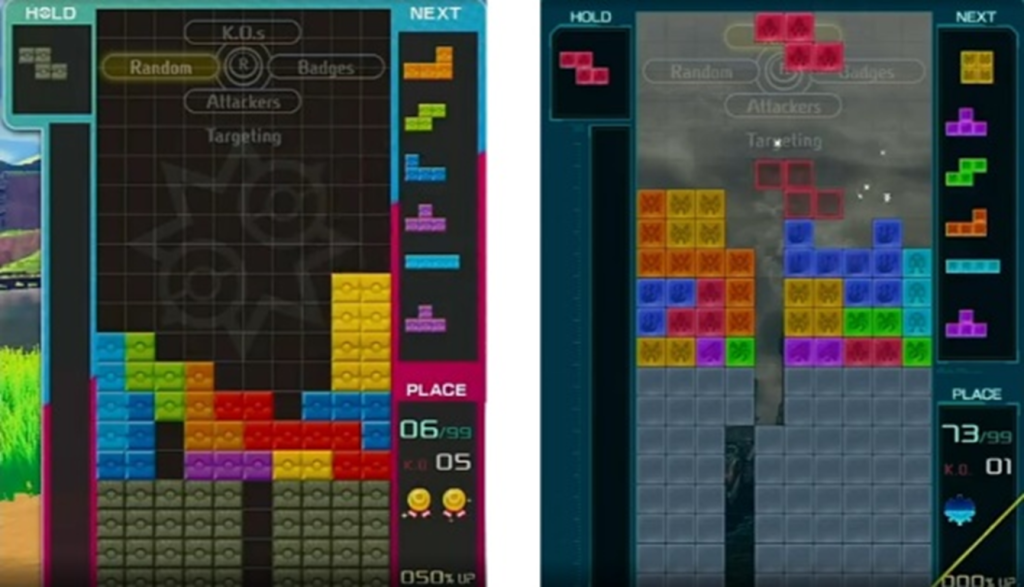
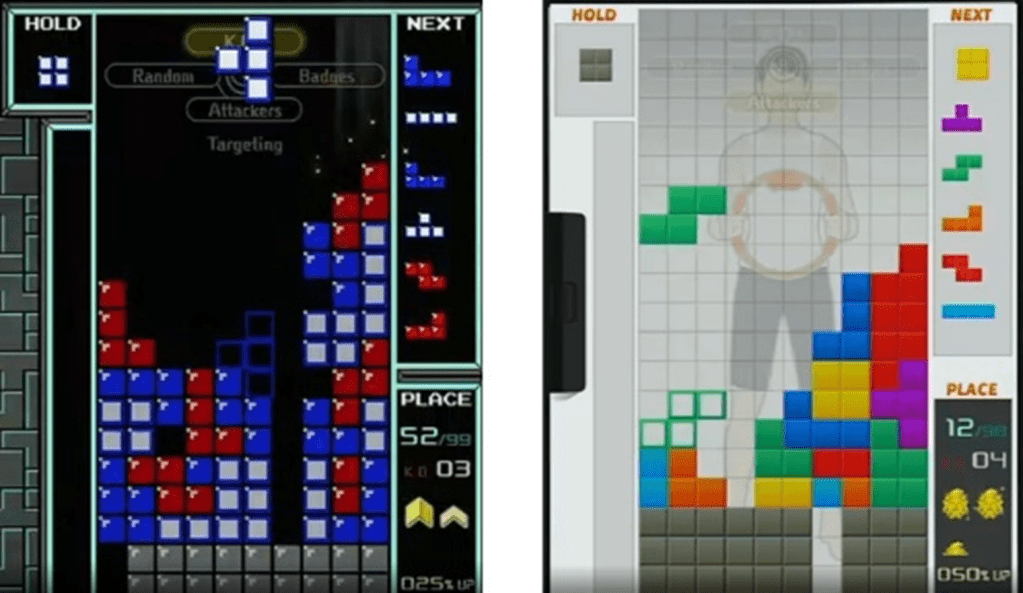
Why would any sane human being, who is so accustomed to the unrestrained three-dimensionality of physical life, play this limited game? Why would any person who can easily travel a thousand miles to Rome to observe the Colosseum deliberately imprison themselves in such a restricting game?
This is for the same reason why souls, who are largely unbound in the spiritual realms, come to incarnate in a dense and constraining form like that of a human.
In Tetris, because the conditions are so limiting, you are forced to play the game of free will on Tetris’s terms.
You must make choices, such as the following:
| Diagram Set 3-1 | |
| 1 | 2 |
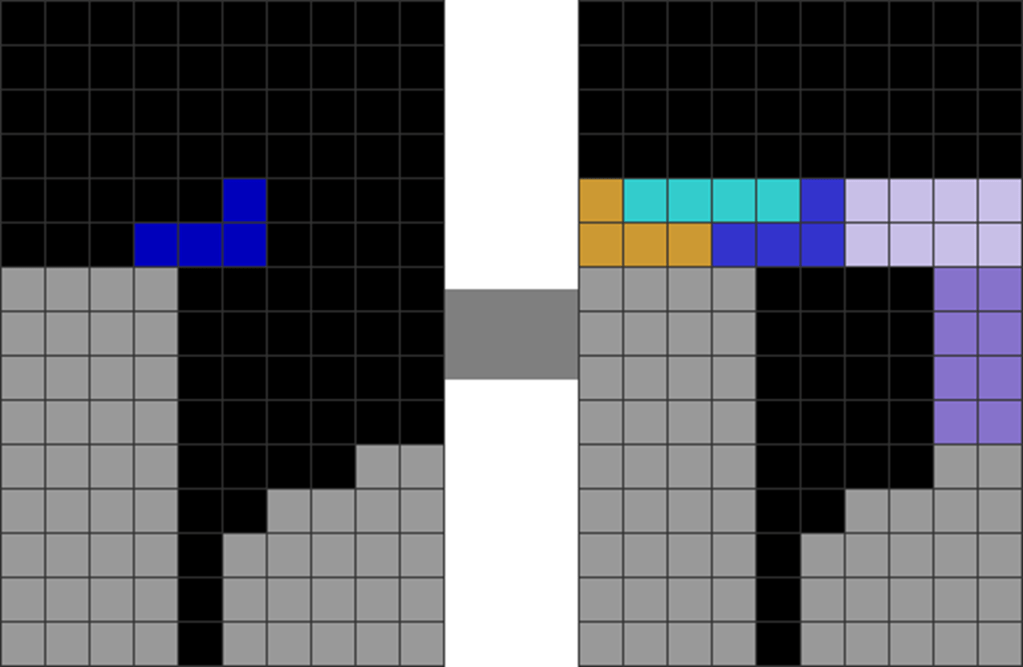
| The player makes a near-lethal misdrop that seems impossible to deal with. The J is suspended over the garbage hole below. | A skilled player merely upstacks with L, J, I, and the top two lavender layers to skim off the top two rows. |
Here, a player misdrops a J piece in step 1 so high that it seems like the game is doomed. However, he recovers by skimming off the top layer in step 2 and cleans up the field.
| Diagram Set 3-2 | |
| A | B |
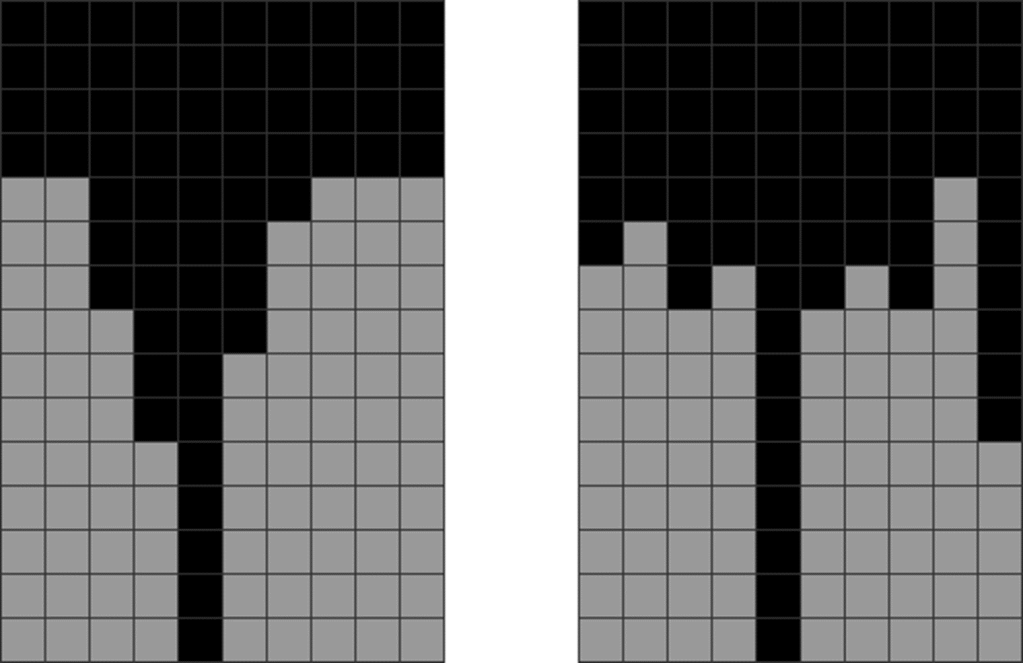
| A well-like shape that has no clear T-spin chance. | An extremely jagged and overstacked field. |
Here, above, the player also stacks into dead-ends, where the field is incredibly jumbled, with no room to make offensive attacks, such as clean T-spins.
However, many players relish and thrive on such adversity. Those who develop the patience and endurance to recover from these mishaps are rewarded. They eventually ascend to the highest levels of Tetris, where they are nearly unbeaten across many versions.
This is the same for the human condition, as to why souls choose such a difficult physical realm to incarnate in.
The human realm, being one of an infinite number of schools in the cosmos for souls, provides many vital lessons that can hasten one’s spiritual progress.
The terrible conditions, where there are so many limitations, provide souls here a chance to cultivate fortitude and grow through challenges.
If Earth had been a perfect realm with no challenges and difficulties, no soul would come here, as there is nothing substantial to learn from.
The logic is the same for many challenging video games, such as Dark Souls, known for its steep learning curve.
Despite such games’ difficulties, many people play them for the same reason people play Tetris, and for the same reason souls choose Earth to incarnate in.
It is ultimately a game of free will that souls voluntarily play, forgetting their divine selves so they can learn through finite situations.
Personal Applications
Because we are all here voluntarily to learn the harsh lessons of earthly existence, the application is straightforward.
Every trial we encounter on this planet is a way our souls have arranged pre-life to give us the chance to make choices.
Hence, whenever you are faced with a tumultuous situation, instead of being unsettled by it or avoiding it, pause and think: What purpose does the challenge seek to help me grow spiritually?
Instead of yielding to it, embrace the challenge and see how you can outgrow your current limits to become something more evolved.
Likewise, suppose we are in less-than-optimistic situations, such as working as a janitor or a beggar. In that case, we need not be jealous of those who are more fortunate or wealthier than we are.
We have each chosen specific life circumstances to manifest certain available options. There is no “better” or “worse” life.
Social and Global Applications
I explore this further later in the law of eternal reflection.
 How to Tetris