“Freedom is nothing else but a chance to be better.”
— Attributed to Albert Camus
Introduction
The Paradox of Omniscience
Near-death experiences (NDEs), afterlife research, and esoteric schools of thought, like Theosophy, have revealed important information about the cosmos’ spiritual architecture.
They suggest that we are all individual soul fragments that will one day return and re-merge with a source of infinite consciousness.
This union with the absolute is what many yogis, arhats, and spiritual adepts aspire to reach. Some experience this mystical oneness as profound enlightenment during deep meditation.[1]
Nobody can truly accurately portray what actual union with the divine is in the afterlife.
My closest approximation is a cosmic, divine consciousness that exists in a timeless, spaceless state, where all knowledge is known, and it continuously engages in the eternal creation of new universes to explore.
However, this leads to the ultimate problem, which I realized:
The One who is omniscient, omnipresent, and omnipotent faces the ultimate paradox.
Such a divine being, call it God in whatever religion you will, would be in all places, times, and states simultaneously.
It would be entirely perfect, with a complete dissolution of concrete and finite form into the absolute and infinite.
However, the One faces a problem: if it is everywhere and every time all at once, it would no longer relish the gift of mystery and ignorance.
It would manifest every possible state and choice. Ironically, this means it would have neither choice nor free will.
It would simply experience the all-that-there-is, but could not contribute to its ongoing participation.
This paradox is explored cinematically in Everything Everywhere All at Once (2022). The main character, Evelyn, who simultaneously becomes aware of all possible realities, finds herself paralyzed by infinite choices rather than empowered.
She could not choose and truly live until she realized that life and choices are meaningful only when we focus on our unique timelines to honor the whole.
Hence, that is where we come in.
The Escape from the Paradox
The One that has dissolved itself and merged with the absolute has no ‘other’ to love and learn from.
Because the One has no true “free will” and only experiences the cosmos as it is, as an endless now, that is where we come in.
Therefore, the One pluralizes itself, fragmenting into infinite finite forms, each beginning with ignorance to come to know and discover itself and its divinity.[2]
In the many, the One finds itself ignorant again, unaware of many unknowns. The One can then, from this multiplicity, relish the gift of not-knowing and, once again, choose.
The many would be us: fragments of this eternal and infinite consciousness that have voluntarily split off the whole to adorn the gift of ignorance and limitation.
Free will is the game that the One plays in the physical and finite realms through individualizing itself into us. This is because, to choose, one must be given limitations and finite resources.
We assume the veil of forgetfulness when we restart life afresh in each physical life, with new lenses, to continuously create and explore the infinite universes.
This is the spiritual solution to the One’s existential anguish of having no free will, and is a primary theme in the opening paragraph of my The Eternal Reflection novel series’ first book.
Respecting All Kinds of Free Will
Human beings conceive of free will from a purely human-centric, reasoning-based perspective.
NDEs and modern physics have suggested that eternal inflation creates new universes at every moment.[3]
Each universe likely has different laws of physics. And if they do harbor life, their lifeforms may have different kinds of consciousness, not limited to “conventional IQ.”
Because of this, there is no single universal notion of free will. Every being’s free will is different.
The free will of a billionaire, like Bill Gates or Warren Buffett, will differ from, but not be superior or inferior to, the choices of a beggar or mendicant.
Being Bill Gates allows a soul to explore the free will of a wealthy CEO with the power to create humanitarian movements that benefit the world.
Being a beggar allows one to empathize with the conditions of economic poverty and learn the financial survival skills to cope.
The free will of a dolphin, being more emotionally centered, differs vastly from that of a human, who is more intellectually oriented.
Human beings are a movement-oriented, masculine, and intellectual species that lets us explore this trinity.
Being a dolphin lets us explore sentient behavior and psychology from an intelligent being that cannot manipulate tools.
Free will does not have to be relegated to only that of an intelligent being. Even stars and planets have their distinct forms of manifestation.
Whoa, that is a bold, seemingly pseudoscientific claim! But please hear me:
Some NDE and past-life regression accounts suggest that some souls have previously inhabited radically different forms — flying or swimming beings on other planets, or even stellar consciousnesses.[4]
Some channeled sources have also explored the past lives of many individuals in other non-human forms, such as gaseous or plasmic creatures, or even planets.[5]
I invite the reader to validate this for themselves by reading Dr. Michael Newton’s research.
Hence, consciousness likely has infinite variation. As a result, the free will of one being is simply different from another, and never superior or inferior.
We are all just playing different “games,” manifesting and celebrating the infinite diversity of consciousness in different forms.
To each form, its unique path, and we should cherish the cosmos’ infinite free will in all its manifestations.
Only when each part honors its own form of free will can the whole be complete, manifesting all possible realities.
Tetris as an Analogy
Tetris is a finite game with extremely limiting conditions, such as a 10×20 board. It also only has seven distinct tetrominoes, which must be arranged to deal with many problems:
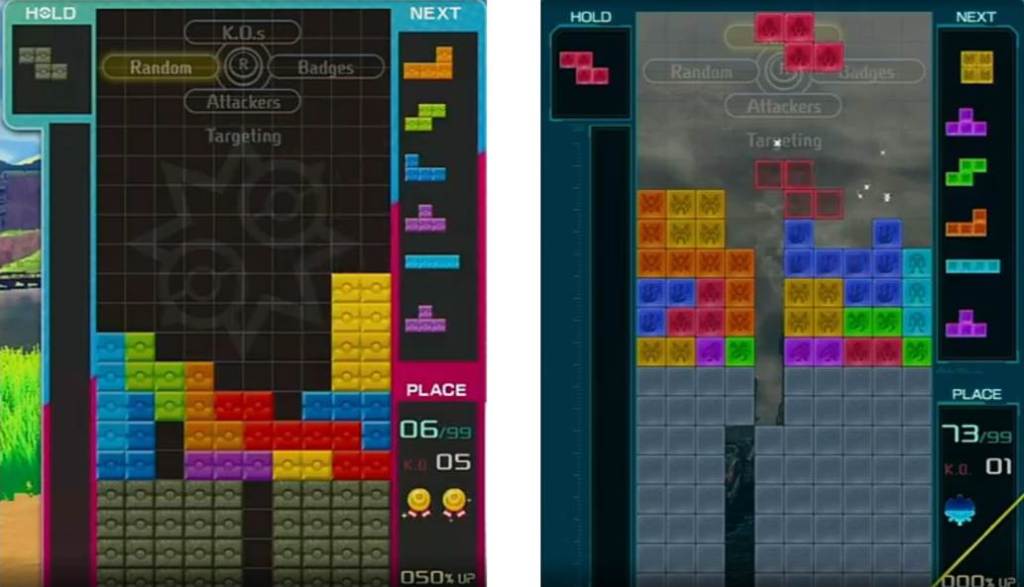
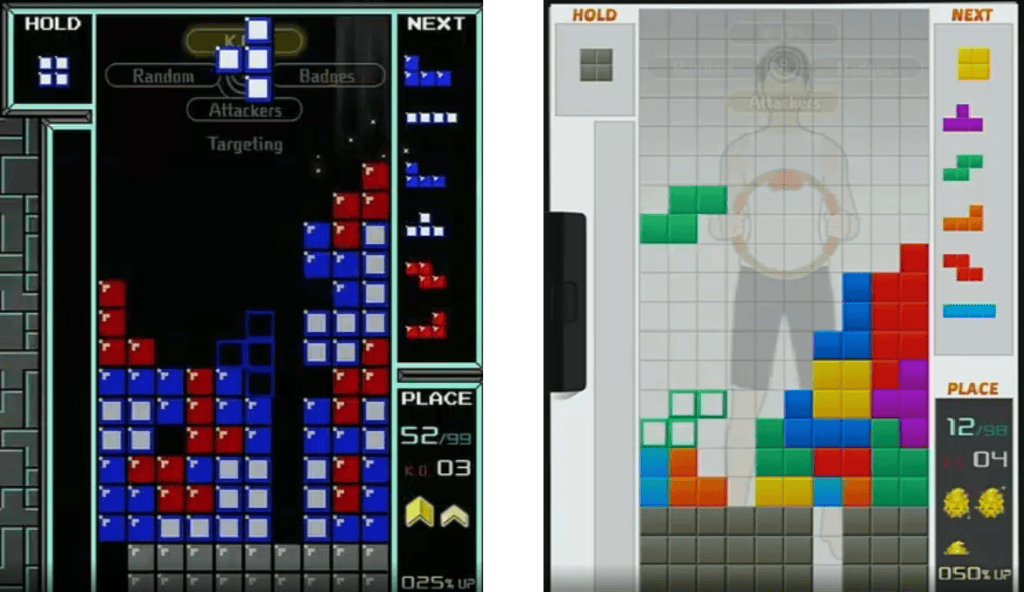
Why would any sane human being, who is so accustomed to the unrestrained three-dimensionality of physical life, play this limited game?
Why would any person who can rather travel the globe on a world cruise to explore cities in all their splendor deliberately imprison themselves in such a restricting game?
This is for the same reason why souls, who are largely unbound in the spiritual realms, come to incarnate in a dense and constraining form like that of a human.
In Tetris, because the conditions are so limiting, you are forced to play the game of free will on Tetris’ terms.
You must make choices, such as the following:
| Diagram Set 3-1 | |
| 1 | 2 |
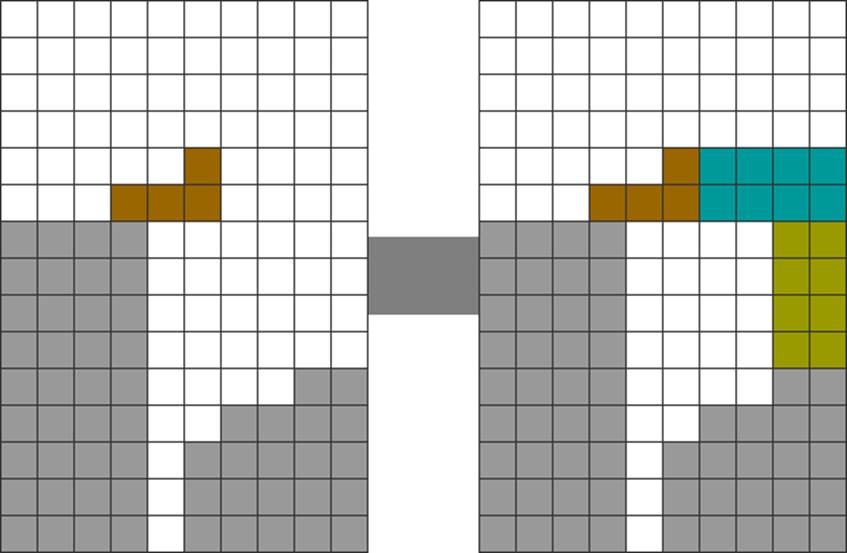
| The player makes a near-lethal mistake that seems impossible to deal with. The L piece is suspended over the garbage hole below. | A skilled player merely stacks with the L, I, and O pieces on the right side to “climb up” to the misplaced L piece. |
| 3 | 4 |
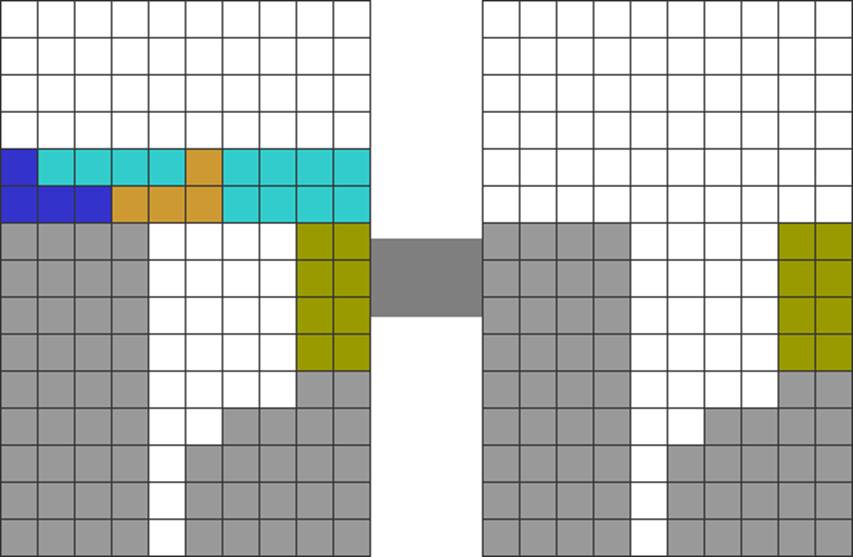
| The player fills up the left side with J and I pieces to skim off the top 2 rows. | The resultant field is clean and safe again! |
Here, a player wrongly places an L piece in step 1 so high that the game seems doomed. However, he recovers by skimming off the top layer in step 3 and cleans up the field.
Now, let us consider other dreadful situations:
| Diagram Set 3-2 | |
| A | B |
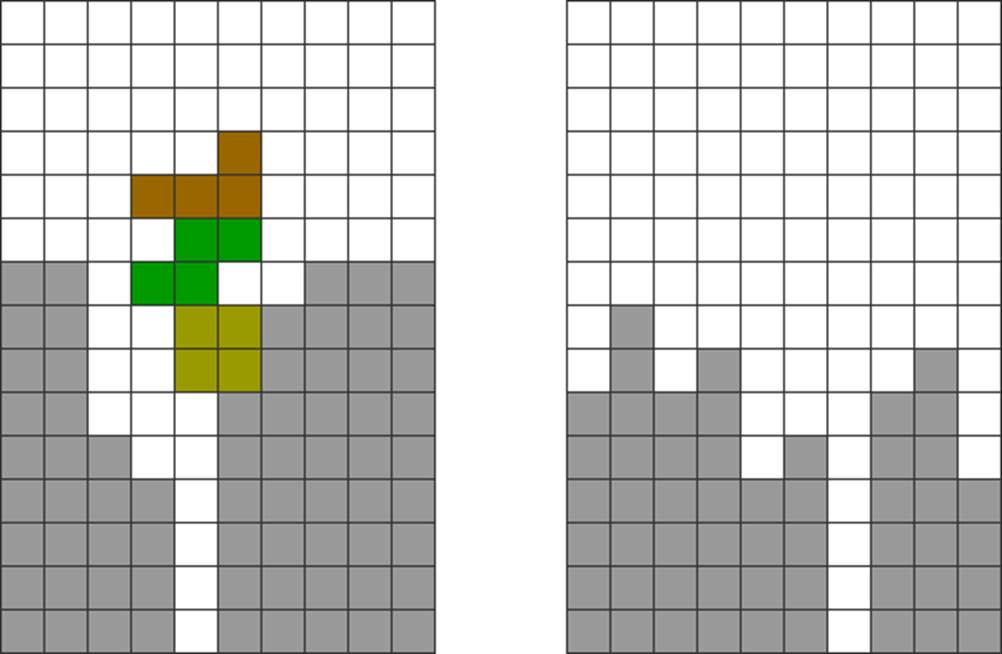
| A field with many misplaced pieces: the O, S, and L pieces were accidentally dropped this way. | An extremely jagged and divided field. It cannot accommodate the flatter orientations of some pieces. |
In the 2 situations above (A and B), the player also stacks into dead-ends, where the field is incredibly jumbled and full of mistakes that require skill to clean up.
However, many players relish and thrive on such adversity. Those who develop the patience and endurance to recover from these mishaps are rewarded. They eventually ascend to the highest levels of Tetris, where they are nearly unbeaten across many versions.
This is the same for the human condition, as to why souls choose such a difficult physical realm to incarnate in.
The human realm, being one of an infinite number of schools in the cosmos for souls, provides many vital lessons that can hasten one’s spiritual progress.
The terrible conditions, where there are so many limitations, provide souls here a chance to cultivate fortitude and grow through challenges.
If Earth had been a perfect realm with no challenges and difficulties, no soul would come here, as there is nothing substantial to learn from.
The logic is the same in many challenging video games, such as Dark Souls, which is known for its steep learning curve.
Despite their difficulty, many people play these games for the same reason people play Tetris, and for the same reason souls choose Earth to incarnate in.
It is ultimately a game of free will that souls voluntarily play and explore, forgetting their divine selves so they can learn through finite situations.
Personal Applications
Embracing Our Free Will
Near-death experience (NDE) accounts share many similarities. One commonality is that many souls chose difficult lives to overcome and evolve.[6]
For instance, some souls chose severely handicapped situations, like Helen Keller, who was both blind and deaf, to experience this limitation.
They do so because many trials we encounter on this planet are a way our souls have arranged in pre-life to give us the chance to make choices.
So, whenever you face a challenging situation, instead of being unsettled by it or avoiding it, pause and ask: What purpose does this challenge serve in helping me grow spiritually?
Instead of yielding to it, one can embrace the challenge and see how one can outgrow one’s current limits to become something more evolved.
Likewise, suppose we are in less-than-optimistic situations, such as growing up in poverty. Poverty could test the soul, who might have chosen that situation to learn financial independence and survival.
Each situation, whether rich or poor, is its own unique “game,” with its own life themes to learn from.
It is just like reading the novel Hunger by Knut Hamsun, which portrays a poor, prideful writer battling starvation, poverty, and mental deterioration on the streets.
Compare this to The Age of Innocence by Edith Wharton, which depicts a wealthy lawyer struggling to reconcile his privileged life with his desire for a non-traditional love.
One book is written from the perspective of a poor person; the other from that of a rich person.
Neither is superior, and we need both perspectives to make the cosmos whole.
We have each chosen specific life circumstances to bring certain available options into being. There is no “better” or “worse” life.
Embracing Mistakes
What will happen in a world that we do not allow mistakes to happen?
Imagine a perfect “utopia,” where everyone is shown an ideal path to reach their goals. No mistakes happen because everything has been foreseen.
The result will be a world where everything appears scripted.
Many Tetris gurus encourage players to get fast by practicing a lot and pushing their speed to the limits.
However, I disagree with this and instead encourage players to master the game by playing slowly at first.
In my fourth Tetris guidebook, How to Finish Tetris, I wrote a chapter showing how not to play Tetris.
I encouraged players to slow down, contemplate every step, and deliberately make mistakes.
Only by making mistakes can one learn what not to do in Tetris. This helps players avoid dangerous mid-game stacking patterns.
If a player trained quickly without internalizing these mistakes to avoid, they would only accelerate their mistake rate.
Hence, mastering Tetris comes from knowing what to do and what not to do.
Likewise, in life, it is vital to know what not to do, even if it means making a painful mistake to learn about it.[7]
A soul that has climbed the corporate ladder and hedonistic treadmill to reach vast successes and wealth may not have learned empathy for the less fortunate.
Sometimes, a single, massive loss, such as losing their wealth in the stock market, may be the catalyst to force them to open their hearts and learn compassion and humility.
A soul that is too over-identified and co-dependent on others may not have learned spiritual independence.
A painful rejection may be needed to force them to retreat inwards, reflect, and cultivate autonomy and inner stability.
Finally, a soul who has explored many philosophies and believes that is all to life may not have learned how to harmonize them with living.
A single experience of terror, showing the gulf between their philosophy and life, may be needed to force them to re-evaluate and finally accept life’s ups and downs.
Without any of these mistakes, souls would not see the “what-ifs” and learn from them.
As the ancient dragon Paarthurnax asks in The Elder Scrolls V: Skyrim — “What is better — to be born good, or to overcome your evil nature through great effort?”
We can sometimes only fully develop free will when we experience the big picture and life’s highs and lows.
Social and Global Applications
Free Will is Holistic
Free will is not simply individual. When hundreds or thousands of people come together, their collective free will, manifested in their actions, can affect the whole.
However, many people see only the immediate effects of their free will and believe that they have little power over the whole.
This helplessness is often evident in the divide between grassroots democracy and broader national democracy.[8]
Often, people delegate their country’s management to the government. Hence, perhaps in the USA, people expect those they have voted into power to manage the economy well.
Pay one’s taxes, and nothing concerns us — let the government handle the rest.
In the US, people are often bogged down by the inefficacy of both the Democratic and Republican branches.
They often criticize the government for being unable to pass bipartisan bills that benefit people, such as building high-speed trains, implementing universal basic income, providing health coverage, or addressing homelessness.
They also complain about how the middle class and working class are not represented by their parties, and how the country is devolving into an oligarchy instead of a democracy.[9]
Then, many people do nothing about it.
The reality is that there is no gulf between citizens at the micro-scale and the government at the macro-scale.
There is only a collective “we.”
This gulf exists only as long as people allow it to persist through inaction.
Hence, while one may bicker about the eternal contestation between the two dominant US parties and do nothing, one could instead use one’s free will to fix the problems of US democracy.
For instance, one can initiate a grassroots democratic movement at the municipal level. I have seen this on the news and how it could be implemented.
One real-world example is participatory budgeting. Ordinary citizens directly vote on how a portion of their city’s budget is spent. It began in Brazil in 1989 and spread to cities across the US, including Chicago and New York.[10]
The results were simple: when people stopped waiting for “the government” to fix things and took part themselves, they could help decide what needed fixing and where public money should go.
Hence, free will does not have to be segregated between the macro- and micro-levels.
Free will at the individual level can permeate higher levels, benefiting civilization as a whole, and then have its positive effects trickle down to us.
The Self-Reinforcing Downward Spiral of Culture and Corporations
In cultural studies, certain forms of culture are reproduced in a cyclical manner.[11]
People embody certain cultures, which become norms. Norms then become institutionalized and enforced by a higher governing structure. Then, a new wave of people absorbs, accepts, and reproduces it.
Unfortunately, this cycle can be misused to endanger humanity’s collective freedom.
Nowhere is this more echoed than in the film WALL-E. The movie follows a robot that seeks life on Earth after a doomsday event.
Humanity had escaped to a ship called the Axiom. However, the new generations of humans now live obese and immobile on comfort chairs that fed them a screen of endless entertainment, social media, and advertisements.
Babies were taught from a young age to consume and “worship” their main corporation, Buy N Large (BnL). As they grow up, they become passive, mindless consumers with no free will.
Unfortunately, this is the case for many corporations now, which inculcate babies with images of Ronald McDonald and Mickey Mouse so they will idolize and consume McDonald’s and Disney products as adults.
This unhealthy policy extends to some companies like Temu, which increasingly uses mild gambling campaigns (disguised as discount coupons) to hook audiences, secure a larger market share, and then price products indefinitely higher.
This likewise extends to many forms of social media, such as Instagram, TikTok, YouTube Shorts, X, and so forth, which perpetuate cultures that maximize conformity, black-and-white thinking, and lower critical-thinking skills.[12]
The result is a culture that feeds on its own mediocrity and the manipulations of large corporations, shaping people into future mindless consumers.
Ultimately, humanity becomes a passive civilization, transformed into obedient consumers with little artistic, creative, or spiritual capacity.
Until this cycle is broken and consumers are empowered with stronger critical-thinking skills and greater consumer rights, this downward spiral may continue.
And we might lose our collective and individual free will.
We can reverse the cycle by becoming educated consumers and understanding the oppressive forces shaping our consumption decisions about social media, goods, and services.
[1] Sri Aurobindo, The Life Divine (1939); see also Patanjali, Yoga Sutras (c. 400 CE) on samadhi as union with the absolute.
[2] Lao Tzu, Tao Te Ching, Chapter 1 (c. 6th century BCE): “The Tao that can be spoken is not the eternal Tao. The nameless is the origin of heaven and earth; the named is the mother of ten thousand things.” The moment the One differentiates into the many, choice becomes possible.
[3] Max Tegmark, Our Mathematical Universe (2014); Hugh Everett III, “Relative State Formulation of Quantum Mechanics,” Reviews of Modern Physics (1957).
[4] Michael Newton, Journey of Souls (1994), Chapter 12.
[5] TruthLoveEnergy, “Grand Cycle Species,” TLE Library, Michael Teachings Knowledge Base.
[6] Kevin Williams, Near-Death Experiences and the Afterlife, http://www.near-death.com; Edgar Cayce readings, compiled in Noel Langley, Edgar Cayce on Reincarnation (1967). Both sources document accounts of souls voluntarily choosing difficult incarnations for hastened spiritual growth.
[7] José Stevens and Simon Warwick-Smith, The Michael Handbook (1990); Shepherd Hoodwin, Journey of Your Soul (1995). The Michael Teachings describe how different soul ages require different catalysts for growth — loss, grief, or terror.
[8] Alexis de Tocqueville, Democracy in America (1835). Tocqueville warned that democratic citizens delegate political responsibility upward and become passive.
[9] Kishore Mahbubani, “Democracy or Plutocracy? America’s Existential Question,” in The Asian 21st Century (Springer, 2022). Mahbubani argues that the US has effectively become a plutocracy.
[10] Gianpaolo Baiocchi, Militants and Citizens (2005). Participatory budgeting began in Porto Alegre, Brazil, in 1989 and spread to cities across the US, improving public services and citizen participation.
[11] Stuart Hall, Representation: Cultural Representations and Signifying Practices (1997). Hall’s encoding/decoding model describes how dominant cultures are reproduced through media and institutions.
[12] Noam Chomsky and Edward Herman, Manufacturing Consent: The Political Economy of the Mass Media (1988). Chomsky and Herman documented how mass media filters information to manufacture public consent for corporate and governmental agendas.

