“All that we see or seem is but a dream within a dream.”
— Edgar Allan Poe, A Dream Within a Dream (1849)
Introduction
The Grand Illusion of Maya
A veil entraps us more than any prison or cage. This veil exists throughout our lives, closing our eyes to the broader spiritual fabric and reality.
This is the illusion we adopt whenever the One incarnates in different finite forms and limited universes to rediscover and know itself.
By its definition, personality implies uniqueness and requires specific physical traits. The latter implies finiteness and limitation; therefore, it involves putting on this veil.
The ancients called this veil ‘Maya’ or illusion. It is the veil that the infinite One puts on to experience finiteness and therefore manifest free will.[1]
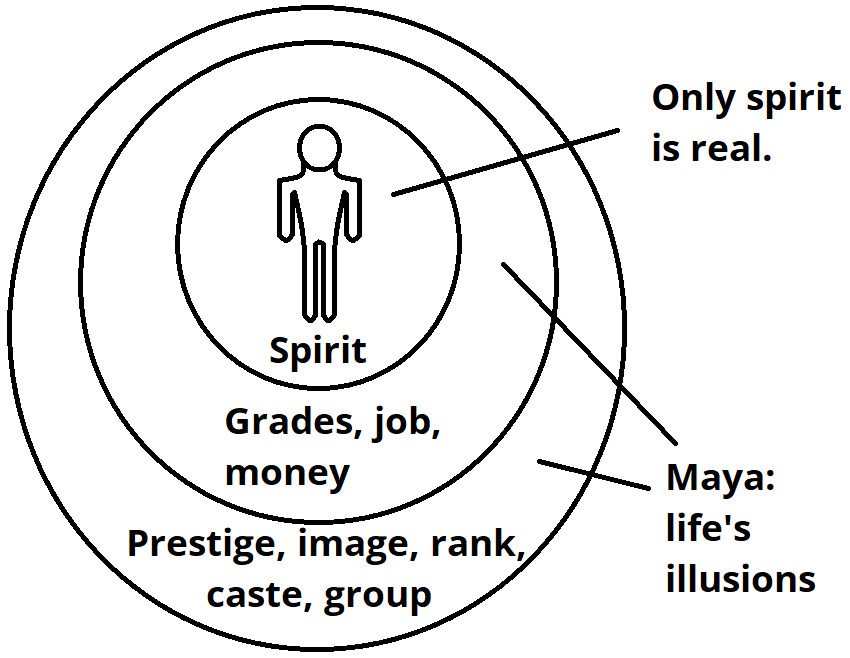
Maya imposes ignorance, limited understanding, and inaccurate perceptions of the world.
Without it, the soul that incarnates will be all-knowing and all-present.
This would defeat the purpose of physical incarnation, which creates the finite limitations that allow growth from ignorance.
However, when we identify too much with Maya, we become blinded to our spiritual nature.
Traditional and Modern Interpretations of Maya
Maya is a concept not confined to Hinduism. It has been covered many times across many religious traditions:[2]
- Christian Gnosticism has often embraced the idea of a veil that blocks one’s perception of the celestial perspective, called the pleroma.
- Christian mystics, such as Meister Eckhart, have often spoken of maintaining silence to peer into the incomprehensible, infinite reality beyond.
- Lao Tzu, the purported author of the Tao Te Ching, wrote that the Tao that can be spoken of is not the actual reality. In contrast, the Tao that cannot be spoken of is the actual reality beyond.
- Theosophical teachings often speak of the Mayavic veil that prevents us from directly perceiving the divine reality, as this veil is necessary for spiritual growth and individual experience.
Beyond religion, modern science and philosophy have also explored Maya:[3]
- Modern neuroscience’s views parallel those of Immanuel Kant’s The Critique of Pure Reason. The idea is that the mind, with its billions of neurons, creates an imperfect internal model of the world for the person to understand and operate by.
- In quantum physics, what we perceive is a collapsed probabilistic wave function once a consciousness perceives an original quantum state.
The true, actual, absolute reality is always hidden from finite beings. It can only be experienced by souls who have united with the all-that-there-is.
In my view, such beings are no longer subjected to time and space.
Maya in Concrete Terms
What does Maya comprise, in everyday language and actions?
One who is embedded in Maya would perceive only the outward, external manifestations of reality and identify with them.
Consider who you are right now: most people would define themselves by their careers, salaries, social groups, jobs, religious beliefs, political affiliations, nationality, caste, wealth, status, rank, or prestige.
A person who lives strictly by this narrow perspective can be overly identified with such external traits.
They would often require a lot of external and social validation and approval to feel good about themselves.
They often need to ride the hedonistic treadmill of materialism, going on shopping sprees to buy the best brands and photographing themselves on Instagram to earn thumbs-up and feel good.
However, when these needs go unmet, many bodily, mental, and spiritual afflictions can arise.
Hundreds of teenage girls have taken their lives over excessive social comparisons on Instagram or TikTok when they cannot reach a particular social image or bodily figure and weight.
Millions of people get mentally depressed each year because they are conditioned to believe that their career and prestige are all that there is. If they cannot reach these, they consider themselves failures.
However, the person who can see past Maya and recognize the true nature of reality can transcend many of these issues, or at least make their lives far easier.
So what is the true nature of reality that we can view from within?
It is the spirit and our consciousness.
This is why this law is called the law of reality: consciousness is the most fundamental reality, while Maya is the veil that clouds us from it.
Tetris as an Analogy
When I played Tetris earlier in my career, I always wanted to maximize certain statistics in my Tetris 99 account or achieve a high ultra score in Puyo Puyo Tetris.
An ultra match is a three-minute single-player mode in which a player stacks and uses various attacks to score as high as possible within the time limit.
During my first year of playing, I worked feverishly toward my ultra score and, by the end, reached 70,000.
However, it came at the severe cost of a tragic state of mental health. It led to self-esteem issues because I compared myself to others. Some scored 100,000.
I also took competitive versus matches in Puyo Puyo Tetris quite seriously. However, I never played the game for its own sake or simply to have fun.
After stopping competitive Puyo Puyo Tetris, I moved on to Tetris 99, which is far more chill.
Despite this, I would work towards maximizing my T-spin per line clear ratio, as shown below:

Magnified and AI-upscaled for clarity:

The higher this ratio is, the more efficient you are.
This number became an obsession until I realized it was worth nothing.
In Tetris 99, players can level up from 1 to 99; then you become a single-star player and re-level from 1 to 99. Then, you become a double-star player, reaching level 99 again. This signifies your experience.
The picture above shows that I was a level 25 double-star player when I took it.
Many players have climbed the ladder to level 99 double star (the highest level), but it soon meant nothing to me.
Just like my ultra scores and the number of T-spins done in Tetris 99, they were simply Maya or an illusion.
They were like the external vestments of diamonds and rubies one adorns. Still, I grew so attached that I forgot I am the person inside, not the clothing.
Hence, I ceased identifying with Maya in Tetris and simply played the game for its own sake. I played in a manner that I found entertaining, not merely to win.
Today, I do not care about a high ultra score, my Tetris 99 level, any other achievement, or setting a world record.
That was how I moved from a competitive to a casual Tetris player.
And it is much more fulfilling and authentic.
Personal Applications
The Imperfect Veil of Beliefs and Thoughts
The veil of Maya makes us see the world not as it is, but as our brains and socio-cultural upbringing shape it.
Your thoughts and beliefs are not the world as it is. They are mere imperfect and sometimes inaccurate representations.
However, how we view the world affects how we react to it.
Let us consider the following cases of how the Mayavic veil clouds our objectivity and channels us into less conducive behaviors:
Example 1:
A person may suffer from severe depression, which completely masks the person’s worldview.
They see everything as negative, even if it is not true, and it is just a figment of their imagination.
Then, the person retreats inwards, isolating themselves from society for many months.
I know this because I experienced it when I was young and observed it in some friends.
This was cinematically portrayed in the movie Black Swan.
Example 2:
During my undergraduate days, someone was jealous of my intellectual accomplishments.
She badmouthed me and accused me of having hostile, selfish intentions.
However, I proved her wrong when I helped her project group, dispelling that impression.
Example 3:
A corporate worker can be so clouded by Maya that he thinks the world is purely matter, and that we are defined only by our rank, prestige, jobs, caste, and social status.
Then he works 50 to 60 hours per week just to make money to live like Jeff Bezos.
He gets ill and loses all his money on medical treatment.
I know many real-life people I have met who display this behavior.
Dismantling the Veil
Hence, Maya’s lens can mask our ability to develop our inner spiritual gifts and freedom.
This imaginative lens also causes many misunderstandings and problems in the world.
When we dispel Maya’s lens, we can perceive reality more accurately and more closely to the truth.
Only consciousness and our spiritual nature are real, along with our virtues, beliefs, emotions, and thoughts.
When we realize this, we can discard the Mayavic veil and focus on more spiritual matters: our artistic, philosophical, intellectual, spiritual, moral, and emotional abilities.
When we shift our inner perspective to something more accurate or constructive, beyond the cloud of Maya, our inner world can become real through our actions.
When we fixate on the illusion of the materialistic prison, the external world becomes a living hell.
But when we fixate on our authentic spiritual nature, involving traits such as love and trust, the external world becomes a living heaven.
The Centrality of Consciousness and the Necessity of Maya
The ancient Vedic sages once said that consciousness is the only real thing in the cosmos. Everything else is Maya and is subordinated to it.[4]
It is true in the sense that without consciousness, there would be nothing left to perceive, feel, or reflect about the cosmos.
Everything would just be a haphazard mess of particles dashing across the cosmos with no sentience.
Hence, consciousness serves as the node in which external reality and one’s inner world converge for one to make sense and act in the world.
However, this does not mean that Maya is always something to avoid.
We are born into a cosmos of illusions, assuming the perspective of a being limited by ignorance.
If we knew everything clearly and truthfully beforehand, it would ruin the thrill of immersing ourselves in the world.
By definition, having a personality means having unique and finite traits. Being finite in time and space implies initial and ongoing ignorance.
This ignorance of the divine lets us appreciate and experience many roles from a unique perspective to evolve.[5]
The cosmos is like a Shakespearean theatre, with its many actors and actresses assuming roles in plays such as Macbeth, Hamlet, King Lear, or The Taming of the Shrew.
When actors and actresses perform their roles, they sometimes report feeling as if they have become the characters themselves. They forget what they were in real life and adopt new, living personalities.
Hence, Sir Ian McKellen might actually believe that he is a gloomy King Lear, weeping over the death of his daughter Cordelia.
If it were not the case, he may not have been acting to his fullest potential.
The same is true of the Mayavic veil: we put on the illusory nature of humanity to experience emotions such as greed, indignation, vengeance, and humor, even though they are mere concepts that only humans can understand.
Through this, our lives become a truly Shakespearean play: we get lost in Maya to learn from it, just as Hamlet learned the importance of life in his famous “to be or not to be” scene.
The main danger lies in identifying so closely with Maya that one entirely forgets the transcendental reality of spirit.
Hence, a soul playing the role of a billionaire hedge fund manager who has become completely infatuated with wealth while neglecting any inner development could live a very empty life.
However, when he dispels the Mayavic veil, it would be far easier to stop over-identifying with his possessions, possibly opening his heart to compassion and inner growth.
The Danger of Social Media
Modern social media has greatly benefited us by making communication across vast distances easier.
However, social media sometimes amplifies the Mayavic veil that shackles us to the external world of superficial appearances.
Communication Apps
Social media apps, such as WhatsApp, WeChat, Facebook, and Discord, have allowed us to connect with the globe.
However, the irony is that we can be surrounded by ten thousand so-called Facebook “friends” and yet feel more isolated than ever.
How many of the “friends” we have followed actually assist us when we are truly in need? How many can engage in deep philosophical conversations with us?
In all my years of using Facebook, I have found almost no one.
Thus, many forms of social media allow us to connect more broadly but less deeply because of their commercialization.
Dating Apps
Dating has never been more challenging, with singlehood rising to unprecedented levels.
Dating apps, such as OkCupid and Tinder, use algorithms that over-reward female participation and under-reward male participation.
Algorithms ensure women are overwhelmed with choices and male matchups, while the opposite is true for males.[6]
That was the vibe I got when I used OkCupid to find spiritually and philosophically deep partners. I found no one.
People end up immersed in a world of fantasy, where love becomes shallow and commercialized.
Instagram and TikTok
Teenage girls on Instagram have among the highest suicide rates of any demographic. Why is it so?[7]
Because in our endless pursuit of all things sensational and superficial, the ongoing TikTokification and Instagrammification of society has created impossibly high, shallow expectations and standards for people to follow.
And many fall for the ruse, blindly following the latest trends in fashion, glamor, and sensation.
They do this while idolizing the veil of Maya and forgetting that their true gift and essence stem from their inner beauty and consciousness.
Social media, such as TikTok, Instagram, and YouTube Shorts, also teaches people to conform to harmful, prevailing social trends.
On TikTok, a popular trend called “girl math” leads influencers to encourage their audience to avoid developing a proper understanding of financial literacy. They influence viewers to go on spending sprees and accumulate significant debt.
Some channels also promote false information, such as claims that the Roman Empire never existed. Interestingly, many people follow these trends.
The result is an overall dumbification of society, where viewers unknowingly wrap themselves in the veil of disinformation, essentially a form of Maya.
Why Many Spiritually Awake People Leave Social Media
The above reasons are why many people leave most social media behind after their spiritual awakening:
They can no longer play the illusory game of Maya; instead, they return to embrace the true reality of consciousness, delving into their artworks, writing, or other authentic hobbies.
However, this may be for the better, as it motivates people to have real-life, tangible meetings and relationships.
Social and Global Applications
The veil of Maya makes us see the world in many negative and imprecise ways.
The Illusion of Nationhood
One of the greatest veils of Maya lies in the concept of nationhood.
As historians like Eric Hobsbawm and Benedict Anderson have shown, nationalism is not innate but learned — a socially constructed identity produced through schools, media, and state narratives.[8]
The Rwandan genocide is one example of this. For centuries, the Hutu and Tutsi lived together harmoniously and saw themselves as one community.
However, under German and Belgian rule, rigid ethnic categories were imposed, and the Tutsi were artificially created as an elite. This led to constructed divisions that led to the 1994 genocide.
Hence, many people over-identify with nations or any finite groups. When this happens, people imagine and manufacture divisions.
What was once whole has now fragmented.
This is like Cixin Liu’s sci-fi trilogy, The Remembrance of Earth’s Past, which explored a time when the cosmos was eleven-dimensional. Everyone was one.
However, it fractured, and all civilizations used dimensional-collapsing weaponry to reduce the universe to three spatial dimensions.
Now, every civilization feared it would be targeted. So they remained hidden, striking first when they heard signals from other civilizations. Is this not how human civilization works now?
However, when we dispel the Mayavic veil, we dispel the false boundaries between us all.
When we see all as one, the One will no longer hurt itself.
And there will be no reason for wars.
The Price of Materialism
In many modern post-industrial nations, society has devolved into a paradoxical state:
They possess great wealth and the latest medical technologies. Yet, its citizens live by the corporate rat race, overworking to earn money, yet living unfulfilled lives.
Japan is known for its notorious nomikai and karoshi cultures.
The former involves long, unfulfilling after-work socializing, where workers get drunk just to appease their bosses.
The latter involves working up to 12 hours per day, only to spend 2 hours commuting home, then fall onto the bed to sleep.
Many literally work to death from strokes, heart attacks, or other diseases.
Little time remains for family, leisure, or fulfilling activities such as art or appreciating profound literature.
One’s entire worldview becomes one’s status and allegiance to the company, essentially making one a cog in an iron web of bureaucracy.[9]
In South Korea, this is far worse because of the overemphasis on appearances and on being number one.
There, people are heavily pressured into adhering to the ideal Korean standards of beauty by undergoing plastic surgery to adjust their noses and eyelids.
They sometimes do this because many companies impose strict standards on people’s appearances. Those who do not meet them are not employed.
Many South Koreans also feel an overwhelming drive to live like the Lee family, who run Samsung.
The result is always clear: humanity becomes alienated from itself, its work, its society, and the environment, reduced to mere soulless tools of a capitalistic society.
To transcend this, broad structural changes must be accompanied by a shift in mindsets.
We already see this happening in countries such as China, where the new generation literally “lies flat” in revolt against their corporations’ 996 culture (working from 9 AM to 9 PM, six days a week).
China’s government then stepped in to deem the 996 practice illegal.
The Academic Trap
I hail from a small country of merely six million people, Singapore.
In my generation, formal education is defined by endless rote memorization to earn top grades in our graduating exams, such as the PSLE, O Levels, and A Levels.
I came from a top-three prestigious Junior College (for 17- to 18-year-olds).
Did I enjoy my stay there? No.
Everything there was tailored to just one purpose: producing students with the highest possible grades to boost the school’s ranking.
It also manufactured students to be funneled into top overseas schools, such as Oxford, Cambridge, or Harvard.
When I was there, most of what other students talked about was grades, grades, and grades.
You were either with the establishment, an academic high-flyer, or stigmatized as an outcast.
I remember little about people who really cared and asked me for my humanity back then. Something mattered only if it contributed to the A-level result certificate; otherwise, it did not.
This happens when the Mayavic veil of academic grades outstrips everything else, reducing students to mere numbers.
Nowhere is this case more obvious than in South Korea and Japan.
In South Korea, students are brought up from age six to compete strongly against their peers.[10]
They are often sent to the notorious “cram schools,” where they spend many more hours each day than their Western counterparts, cramming as much information as possible to pass the infamous Suneung college admission exam.
After that, they must take an even tougher corporate entry exam to enter big companies such as Samsung.
The stakes are devastatingly high, and in South Korea, there can be an all-or-nothing mentality: if one is not accepted by big companies such as Samsung, one is often relegated to less desirable jobs.
To them, the latter can carry a stigma throughout life: one is either a “Samsung Man” (a person working for a top-tier company) or is nothing.
Unfortunately, this depersonalizes many individuals by assigning them a social categorization that ignores their inherent spiritual abilities in other areas.
To see students as their complete selves, we must see them as more than grades.
This has already been implemented effectively in the Scandinavian countries, such as Finland, Sweden, and Norway.
In those countries, there is little segregation between people of various abilities.
Finland abolished academic tracking entirely. Smart and less-endowed students are raised together, with the former serving as mentors to support the latter. They are not separated by test scores.
Every student there receives a daily hot meal, health services, dental care, and psychological counseling. No standardized tests; teachers assess children rather than rank them against each other.
The result is a more holistic education system in which students are not just a means to an end.
They are the end itself.
[1] For Maya in Hindu philosophy, see Adi Shankaracharya, Vivekachudamani (8th century CE). For its broader cross-traditional parallels, see Aldous Huxley, The Perennial Philosophy (1945).
[2] On Gnostic pleroma, see Elaine Pagels, The Gnostic Gospels (1979); on Meister Eckhart, see Meister Eckhart: The Essential Sermons (1981), trans. Edmund Colledge; on Lao Tzu, see Tao Te Ching, Chapter 1; on Theosophical Maya, see Helena Blavatsky, The Secret Doctrine (1888), Vol. 1.
[3] On Kant’s model of perception, see Immanuel Kant, Critique of Pure Reason (1781); for neuroscientific parallels, see Anil Seth, Being You (2021); on wave function collapse and consciousness, see Roger Penrose, The Emperor’s New Mind (1989).
[4] See Adi Shankaracharya, Vivekachudamani (8th century CE); also Swami Vivekananda, Raja Yoga (1896).
[5] José Stevens and Simon Warwick-Smith, The Michael Handbook (1990). The Michael Teachings describe personality as the finite vehicle the soul adopts for each life —limited, unique, and initially ignorant.
[6] Gareth Tyson et al., “A First Look at User Activity on Tinder,” IEEE/ACM ASONAM (2016). Confirms that female profiles receive dramatically more matches than male profiles.
[7] Jonathan Haidt, The Anxious Generation (2024). Documents how Instagram has driven unprecedented rises in depression and suicidal ideation among teenage girls through social comparison.
[8] Benedict Anderson, Imagined Communities (1983); Eric Hobsbawm, Nations and Nationalism Since 1780 (1990).
[9] Max Weber, The Protestant Ethic and the Spirit of Capitalism (1905). Weber’s concept of the “iron cage” describes how rational bureaucratic systems trap individuals within impersonal structures.
[10] Michael Seth, Education Fever: Society, Politics, and the Pursuit of Schooling in South Korea (2002). Seth documents South Korea’s hyper-competitive education system, cram school culture, and the social consequences of the high-stakes university entrance examination.

