Introduction
In my experience, many Tetris coaches and experts suggest training by playing as quickly as possible.
They suggest training modes, such as 40-line sprints, and reaching a quick Personal Best (PB).
They also suggest thinking as quickly as possible without slowing down during a competitive match.
However, in my opinion and experience, this advice is detrimental to beginner and intermediate Tetris players.
This is because if a player simply “plays quickly” without cultivating important decision-making skills, they will play inefficiently. They will simply accelerate the rate at which they make mistakes.
Going Slow to Encode New Information
I knew an Australian female Tetris player who occasionally streams TETR.IO. She plays rather quickly at around 3 PPS. However, she would often make the following mistakes:
| Diagram Set 4-1 | |
| 1 | 2 |
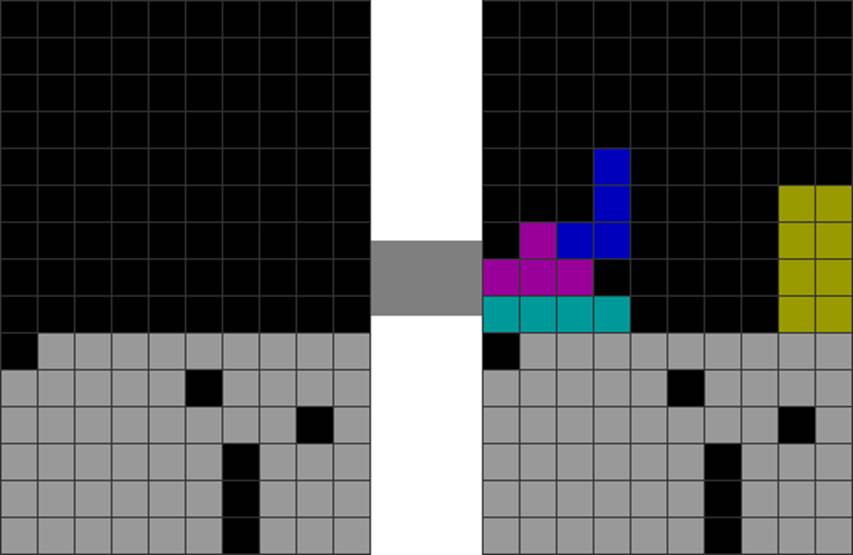
| Starting field. | The player makes a T-spin overhang. She used 1 T piece to make it. |
| 3 | 4 |
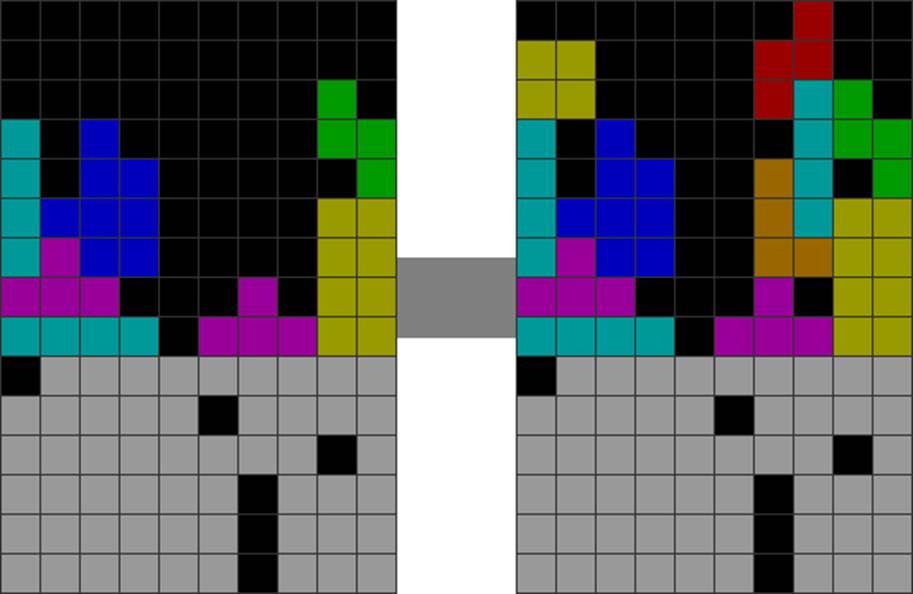
| She uses a second T piece to make the T-spin base. Using 2 Ts is already very inefficient. | She stacks poorly and uncleanly, all just for 1 T-spin single. |
Here, she constantly messes up her entire field just to make one T-spin. Then, she has to skim off her over-stacked areas and get down, repeating the same cycle.
The result is that she plays fast, but because she never cultivates subtle, efficient tactical choices, she only speeds up her mistake rate. Her efficiency never improved.
This is where my training advice differs from other Tetris coaches: to train your efficiency and tactical decision-making, you must slow down.
Your brain needs time to encode new information into long-term memory.
Only by slowing down and thinking through certain tactical placements deeply can you learn from your mistakes and store a series of more efficient moves in long-term memory.
If you simply “go fast,” your brain has no opportunity to encode new information and improve strategically and tactically.
An Encouragement to Slow Players
In this fast-paced age of quick content, many Gen Z players are impatient and want fast results.
They aspire to play like top players, such as Kazu or Furea, within months of training.
However, in my experience, this is often impossible. Training requires many periods of slow, deliberate thought to encode information.
This may be discouraging, but here is my story:
- I started off being a very slow player in my first year. I played at around 1 PPS in official guideline Tetris games.
- During my second and third years, I trained by thinking thoroughly over my many mid-game decisions.
- It was only during the fourth year that I began to train speed. This was possible as I had already trained my efficiency. So, by “going fast,” I would not increase my mistake rate as quickly as the Australian female player I mentioned earlier.
It may be frustrating, but this is the reality. You may be extremely slow during the first few years, but once you master efficient placements, speed can come naturally.
The Lure of Slow-Paced Tetris Games
Official guideline Tetris games, such as Puyo Puyo Tetris, Tetris 99, Tetris Effect: Connected, and Tetris: The Grand Master 4, are considered to be “slow” Tetris games.
This is because their handling is slower in the following ways:
| Diagram Set 4-2 | |
| 1 | 2 |
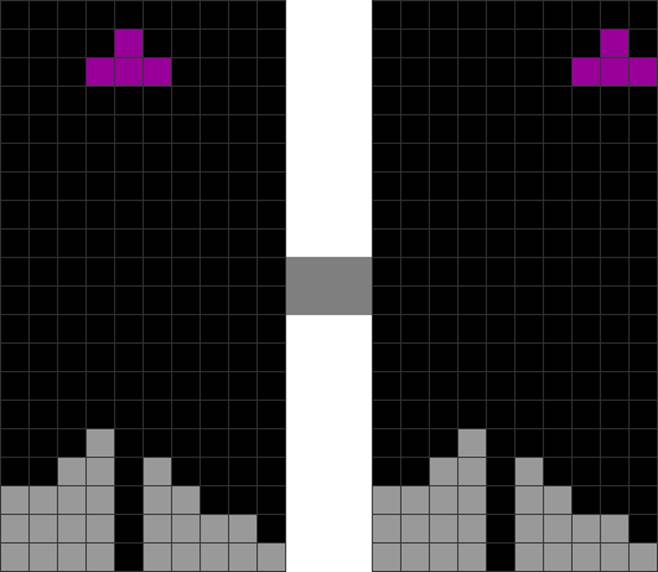
| Starting field. The T piece spawns. | The player presses “move right.” The T piece takes a while to zoom to the right side. |
Did you notice that when you press down the “move right” key, the piece takes a while to zoom in the held direction?
Also noticed that soft drops are typically quite slow?
Finally, do you notice line clears have a significant animation delay?
These input delays are common in official Tetris games.
However, many unofficial Tetris games, such as TETR.IO and Jstris, have uncapped speed. This means several things:
- When you hold down a movement key, the piece zooms to the held direction instantly.
- Soft drops are much faster, with a higher gravity.
- There are no line clear delays.
- There are no piece spawn delays.
This allows a player to play much faster than in official Tetris games.
In my experience, the maximum speed in official Tetris games is typically around 3 pieces per second (PPS). In unofficial games, it can go up to 5-7.
However, this means many players in unofficial Tetris games prioritize speed over efficiency.
In official Tetris games, the delays give you more time to think. For instance, you can think during line clear delays and soft drops.
This means official Tetris games offer more opportunities for deeper, more efficient strategic and tactical placements.
In uncapped speed games like TETR.IO, many players use the “infinite downstack” method to survive:
| Diagram Set 4-3 | |
| 1 | 2 |
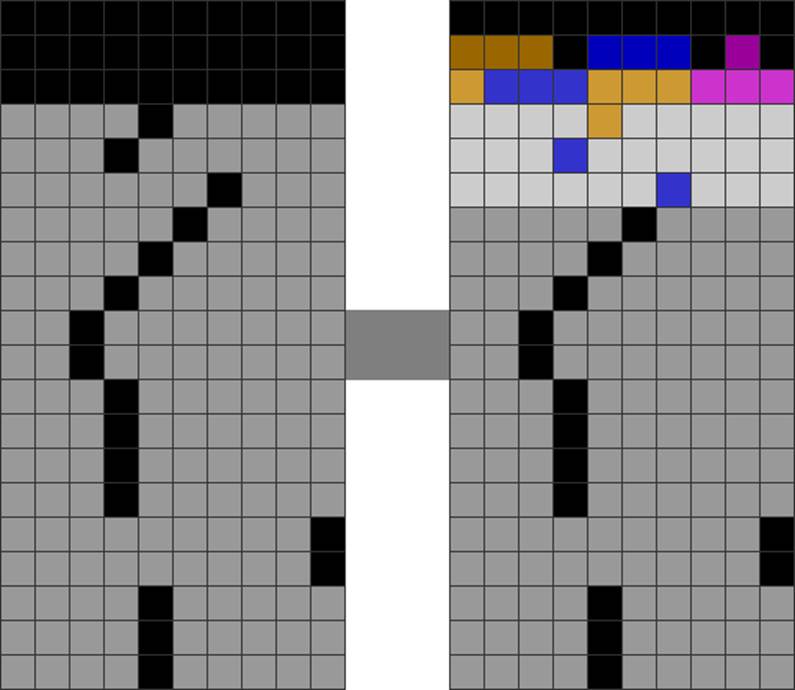
| The player is nearly topped out. | The player employs “infinite downstacking.” Note how inefficient the skims are: the placed pieces often cover the next garbage hole while downstacking. |
Here, a player is close to the top. However, they skim non-stop with inefficient skims to get down. There are minimal downstack combos.
In slow-paced official Tetris games with line clear delays, this is self-destructive because too many skims create excessive animation delays.
Thus, slow-paced Tetris games encourage deeper, deliberate thinking.
Hence, I would recommend that players occasionally return to play slower-paced official Tetris games to train their efficiency.
In a Nutshell
| Key Points |
| I suggest training slowly and thinking through every placement deeply to form new experiences and brain connections. Do not be disheartened if you are a slow player: you are doing it right. Speed naturally comes after you have fully trained your mid-game efficiency, after a year or two. |

