Introduction
In Tetris, in my experience, the best way to learn setups or techniques is to train them slowly.
Your mileage might differ on what it means by “slowly.” As a general guideline, that means learning about 1 to 4 methods at a time.
My recommendation is 2 or 3.
When you search for certain Tetris websites, you may be bombarded with a hundred Tetris methods. A player may then be compelled to learn all of them simultaneously (like 15 to 20 at once!).
However, in my experience, doing this overloaded my brain.
Hence, the optimal training method for me was to handpick around 2 to 3 methods. These can be methods such as Cut-Copy, DT Cannon, or certain specific T-spin donations.
I would then enact the next section’s 5-step process.
How to Train Each Specific Method
Here are the steps to train each specific method, after you have handpicked 2 to 3 to train simultaneously:
i) Understanding
First, read and understand the method. This involves memorizing its mid-game shape:
| Diagram Set 5-1 | |
| A | B |
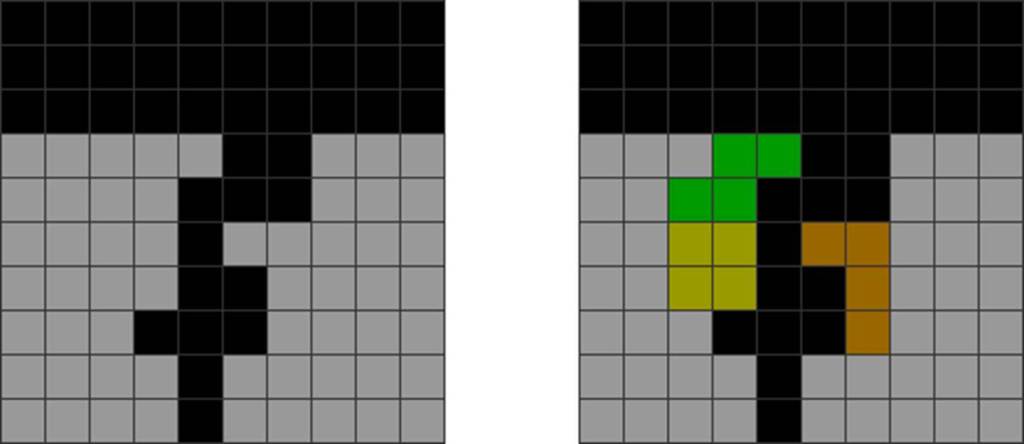
| A DT Cannon setup’s shape. | Placing the S, O, and L pieces this way helps form parts of the DT Cannon. |
Here, the player learns to create a mid-game DT Cannon. It is a setup with 2 T-spins.
They first analyze how to create specific parts of the setup using the right piece combinations.
ii) Simulation
Use a tool such as Four-tris or the Jstris mapmaker to create the mid-game setup. Practice creating them for as long as you need.
| Diagram Set 5-2 | |
| 1 | 2 |
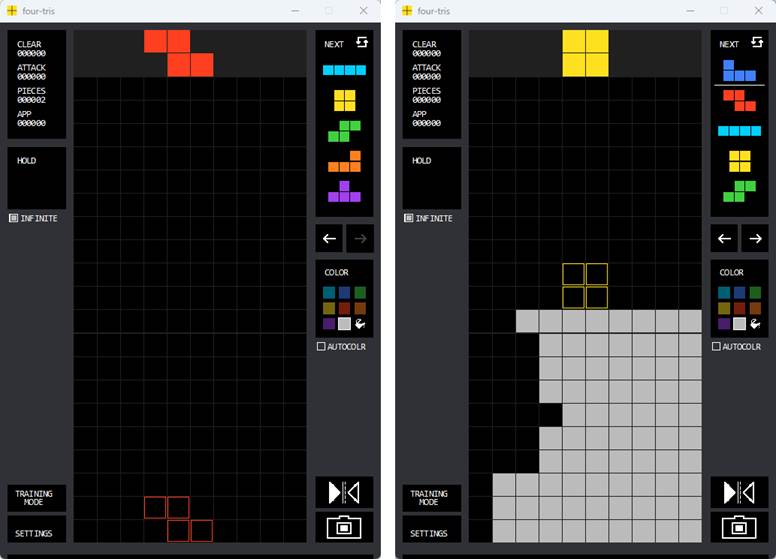
| An empty field at the start of a Four-tris simulation. | The player paints a mid-game DT Cannon opportunity. |
Note how I used Four-tris to paint a mid-game DT Cannon chance. You can then do this:
| 3 | 4 |
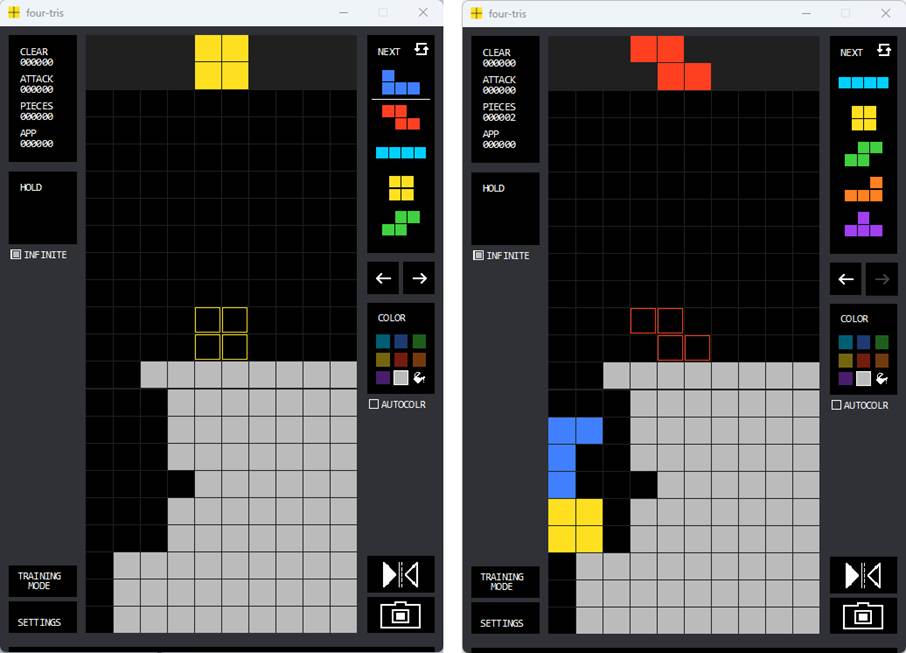
| The player recognizes the DT Cannon mid-game chance. | The player places O and J this way to complete a DT Cannon. |
Here, I trained by placing the right pieces to upgrade the mid-game situation into a DT Cannon.
iii) Mid-Game Opportunity Recognition
Play several slow-paced games, such as Tetris Effect: Connected’s Journey Mode or a Tetris client that lets you set gravity to zero. Play “normally” until you spot the methods’ mid-game setups. Create them.
| Diagram Set 5-3 |
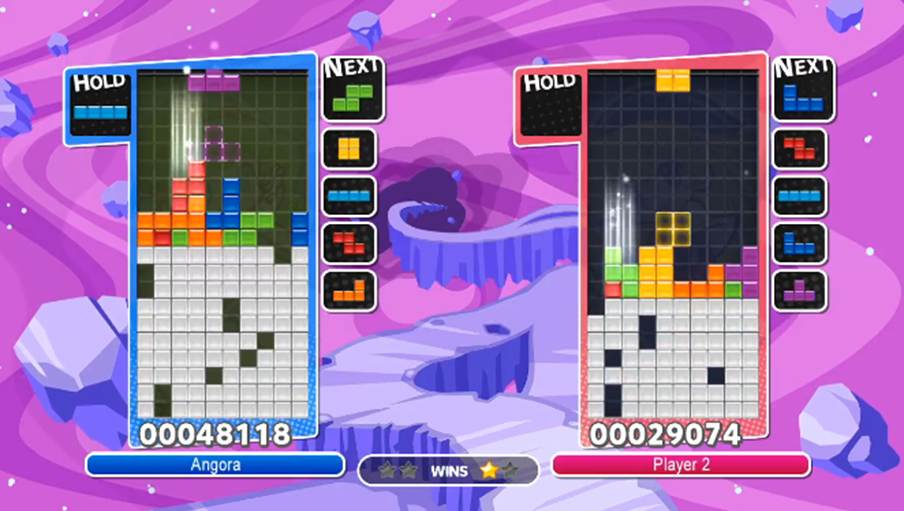
| A typical match in the game Puyo Puyo Tetris. |
In this picture, I am the player on the left. I recognized and set up a T-spin triple (it just needs an overhang).
iv) Actual Competitive Use
Then, move on to actual competitive versus matches. Slow down if you must to train and spot mid-game chances for those methods.
| Diagram Set 5-4 | |
| 1 | 2 |
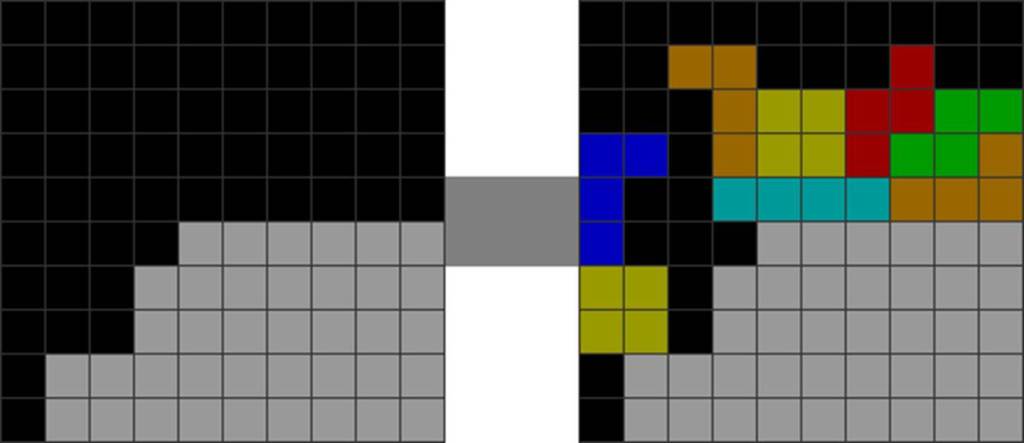
| A mid-game DT Cannon chance in an actual Tetris versus match. | The player spots the situation and constructs the rest of the DT Cannon. |
I recommend finding a player of a comparable skill level so you do not get instantly overwhelmed. It is vital to find a partner that gives you enough time to think.
If this is not possible, play against an AI bot, such as Zetris, set to a very slow speed. You can also play Tetris versions that are more generous with time in the starting phases, such as Tetris 99’s regular lobbies or TETR.IO’s arena mode.
v) Practice
Keep practicing and reinforcing the method until you can quickly recognize and create it mid-game.
The trainee should not be discouraged if they have to slow down to think. As mentioned earlier, slowing down helps you encode new information and experiences. You are doing it right.
Once you have mastered the set of 2 to 3 methods, you can then move on to another group of 2 or 3 methods.
Experience is accumulative. The more you repeat this “grounded” approach, the more you will grow as a Tetris player, eventually mastering hundreds of methods.
This grounded methodology avoids the pitfall of being overwhelmed by learning a hundred methods at once.
In a Nutshell
| Key Points |
| Train Tetris slowly by deliberately thinking through every step consciously. Focus on recognizing the mid-game opportunity, then applying it slowly until you are fast and confident enough to use the methods competitively. |

