“Love and compassion are necessities, not luxuries. Without them, humanity cannot survive.”
—Dalai Lama
Introduction
Once we have dispelled the veil of separation that divides us all by caste, race, ethnicity, nationality, religion, politics, belief, class, or gender, understanding the next law becomes instant and intuitive.
Since every object, creature, person, soul, planet, galaxy, or universe is not separate from us, their “stuff” is ours, and vice versa.
Every positive, growth-fostering thought, emotion, and action we send out is an act of nourishment that also benefits us.
Love happens when we take action that enlarges others’ perspectives, fosters their growth, brings them happiness, resolves their problems, contributes to their well-being, or enhances their prosperity or functionality.
The opposite of strife, where we seek to limit another’s growth, perspective, wisdom, well-being, or freedom, would instead constrict.
Every act of love opens the mind and soul, connecting us to others until we learn to give for its own sake, without asking for anything in return.
Every act of selfishness narrows the mind, leading us to fall into the illusion of the false self, or ego.
When we love, we dispel that ego and work towards mystical union with others and the all-that-there-is.
The love that I speak of is not the kind that a mother gives to her child, the erotic love between lovers, or the beneficial love that comes from marriages of convenience.
I speak of a universalizing, all-encompassing, and cosmic love founded on the principles of universal brotherhood and sisterhood.
It is the kind of love that transcends human boundaries and concepts, that we freely give to others unconditionally.
However, since we are still spiritual beings having a human experience, we cannot fully manifest that kind of cosmic love that many near-death experiences have witnessed or felt.
Instead, we should balance the merits of this cosmic love with the human form.
Tetris as an Analogy
The law of love mandates that we acknowledge and accept that everything in the cosmos has value and purpose, no matter how big or small.
In Tetris, one often favors a specific tetromino. Many believe that some pieces are necessarily “better” than others.
However, if one dissolves into the cosmic reality and perceives the panoramic nature of everything, then everything serves a function.
All tetrominoes have distinct values and purposes, and all are integral to the whole. The whole cannot make do without them.
For instance, the S and Z pieces are often the most ideal pieces to make T-spin overhangs:
| Diagram Set 6-1 |
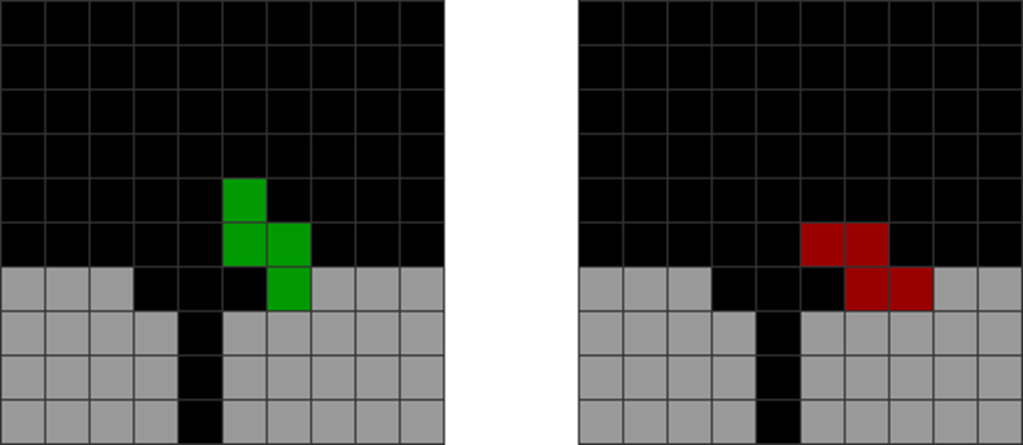
| S and Z pieces are most easily used for T-spin overhangs compared to other pieces. |
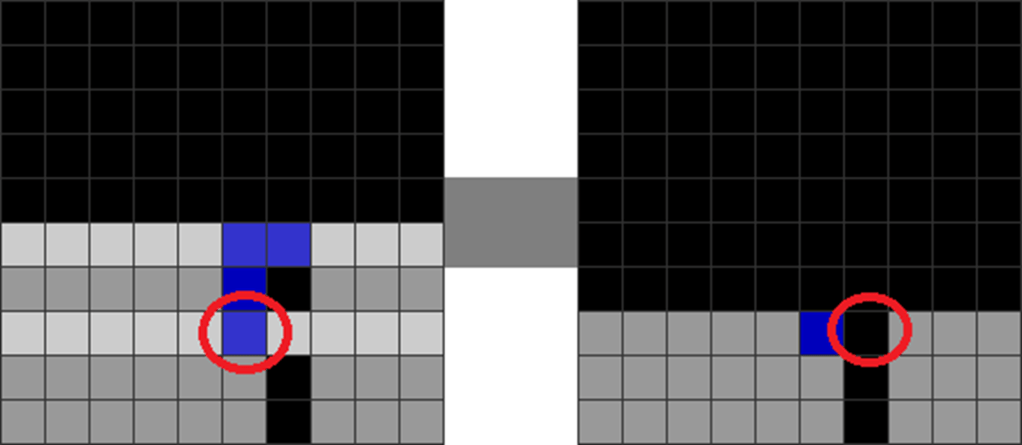
S and Z pieces, however, are sometimes not ideal for downstacking, as they leave a jagged block. Instead, L and J pieces are most suited for that function:
| Diagram Set 6-2 | |
| 1 | 2 |

| Diagram Set 6-3 | |
| 1 | 2 |
| Diagram Set 6-4 | |
| 1 | 2 |
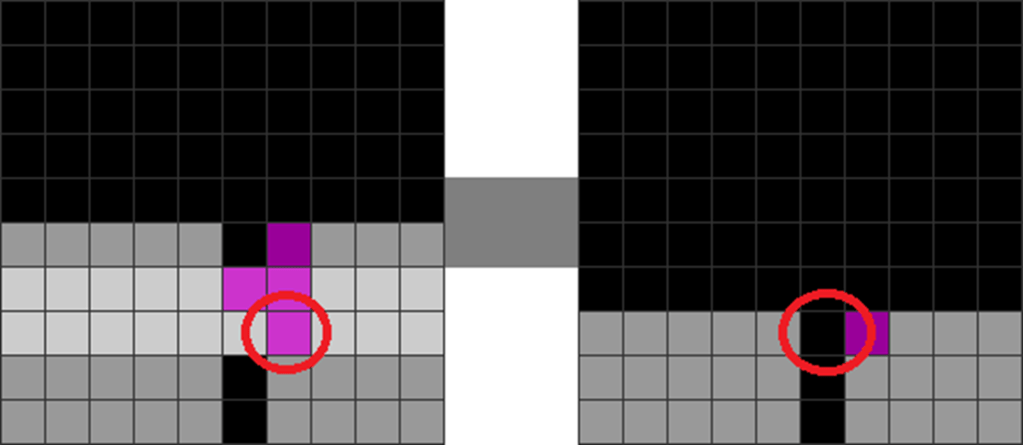
| In every diagram pair’s step 1, the garbage hole before the line clear is in row three. The garbage hole is shifted after the L, T, or J is used to skim with a single line clear from step 1’s red circle to step 2’s red circle for each set. |
L, J, and T pieces are optimal for downstacking because of a property called hole-switching.
This means they can switch the location of the primary upcoming garbage hole to a more strategic one.
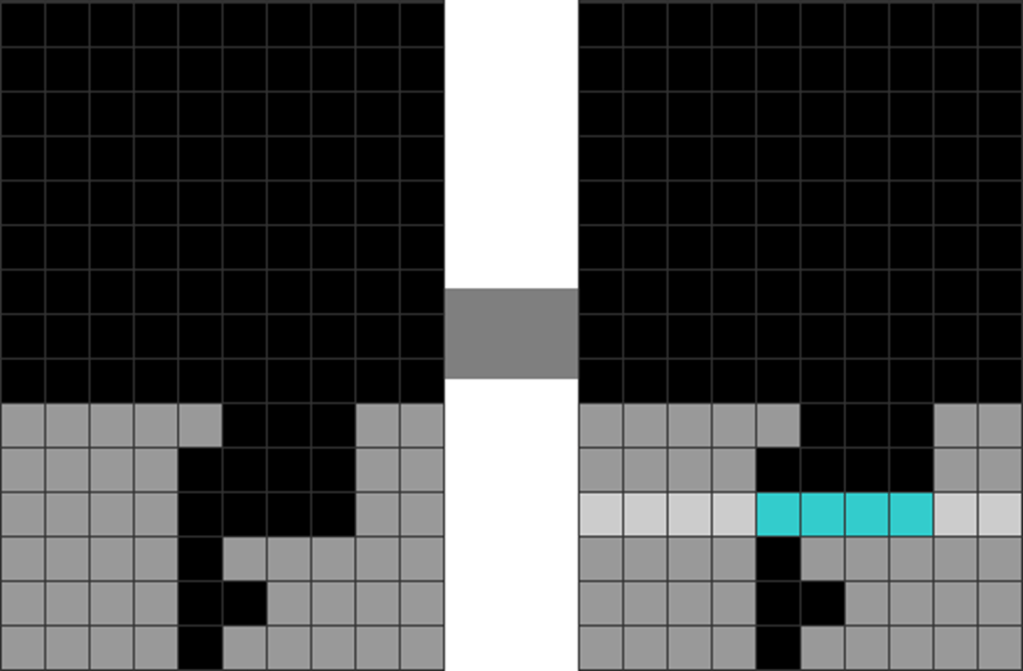
I pieces are the most flexible piece for repairing misdrops (accidental and wrong piece placements):
| Diagram Set 6-5 | |
| 1 | 2 |
| 3 |
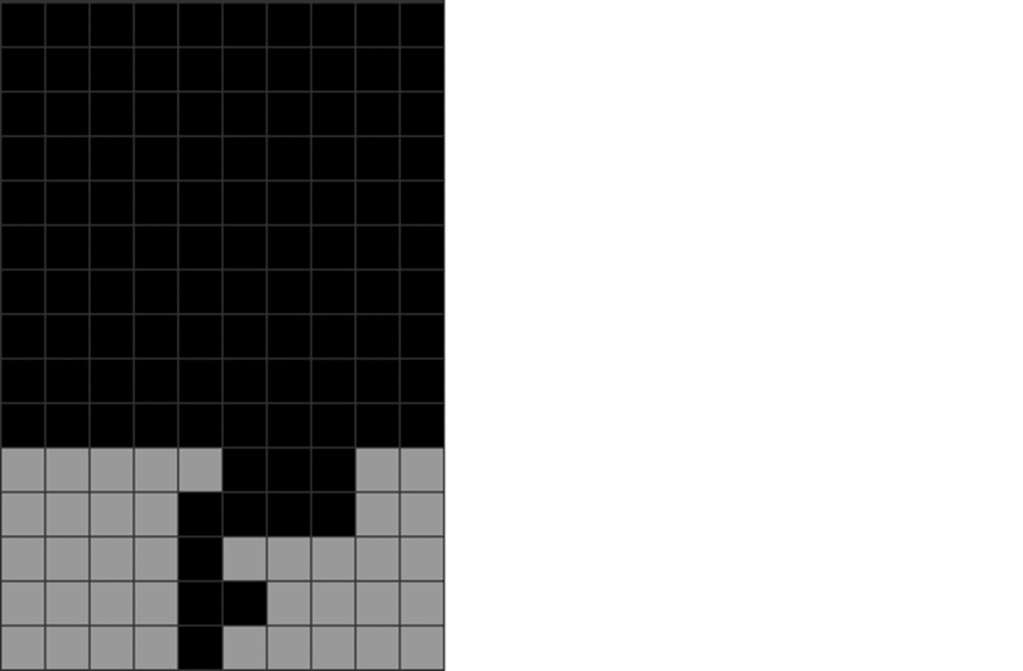
| The player uses a horizontal I to skim, turning the cavity into a functional T-spin triple. |
And lastly, T pieces are most optimal for making perfect clears. They have a property called parity alteration, which alters the balance of even and odd blocks.
In the following example, lavender blocks are even, while gray blocks are odd. A field can only be perfect cleared if they are the same. In many cases, only the T can reset this difference between the odd and even blocks to neutrality:
| Diagram Set 6-6 | |
| 1 | 2 |

| A perfect clear opener. The lavender minus gray blocks is +2. | The player makes a single with an L-skim. |
| 3 | 4 |

| The lavender minus gray blocks is -2. | Adding a T resets parity back to 0, making the pattern solvable. |
Hence, every single tetromino serves a unique mathematical function in Tetris.
And just like in life, every creature—from the smallest cells to the most exalted human presidents—each serves a divine role in the grand cosmic scheme.
Every being is part of the whole and must therefore be loved, included, cherished, and accepted.
Personal Applications
What does it mean to love on a personal level?
First, it is impossible to genuinely love another universally unless one has cultivated self-love.
To love oneself, two things can be done: (i) accepting and (ii) forgiving oneself.
Accepting Oneself
Many people face severe self-esteem issues, where they believe that they must meet certain societal or cultural expectations to be loved by others. If they do not reach a specific level of wealth, prestige, or social influence, like living like the Joneses, they are deemed failures.
Unfortunately, many such people fall into depression, believing themselves to be a tumor to be excised. They fall into melancholy and cope with destructive habits such as drinking, gambling, sex, binge eating, smoking, drugs, doomscrolling on their phones, or partying to bury their problems.
The reality is that universal self-love has no conditions. You do not owe society or others to begin loving yourself.
To begin, accept yourself. I invite you to imagine a garden metaphor.
In a typical garden, a typical gardener may prune away all kinds of weeds and insects. They may plant only specific types of plants or flowers, such as daisies, chrysanthemums, or lilies.
Weeds and insects are seen as pests to be eradicated, while only certain flowers or plants are allowed to exist.
However, in nature, before the formation of all preconceptions, ego-based beliefs, expectations, and conditionings, there are no gardeners who favor some species and filter out the rest.
Every plant and creature exists in nature, living harmoniously with each other. Each one serves a specific purpose, and none are filtered out for being inherently useless.
This is the case of human civilization as well. You do not need others to permit you to lead your life in your own unique way.
By simply accepting that you are both part and integral to the entire functioning whole of the cosmos, you are manifesting the divine nature of the One.
The One needs every being of every variety to be made manifest to ensure its own completeness.
Therefore, being a pauper or a millionaire are two sides of existence that must necessarily exist to complete the divine cosmic canvas.
With this realization, one can then simply be oneself and live authentically. Be it the pursuit of art, science, music, architecture, gaming, or one’s hobbies, living the fullest to one’s own given abilities is to realize God within oneself.
One can then easily accept oneself.
Forgiving Oneself
Self-love cannot be complete until one has learned to forgive oneself.
There are no coincidences in life. Everything happens for a reason.
Per my studies of the afterlife and near-death experiences, souls arrange for certain milestone events to occur in their lives.
Some may choose to go through difficult times or be abused to experience negativity and grow from that perspective.
Hence, many circumstances that you face, such as having made terrible mistakes in this life, may have arisen because you had planned for that to happen in this life.
Likewise, per the law of connectivity that I will cover later, the ripples of one’s actions may never truly be known until maybe decades or centuries later.
One may blame oneself for not having done enough to care for one’s child. However, perhaps, thirty years later, that child may grow into a well-known president. Possibly, the child may have used that neglect to cultivate independence and self-sufficiency—vital skills for such a monumental task and job.
Even the janitor who believes himself to be useless may have unfelt ripples that consummate years later. He may have cleaned an entire apartment so well that it positively affected the mental state of a scientist who would then develop a Theory of Everything (TOE).
Hence, our inability to forgive ourselves can stem from our failure to recognize our role in the grander cosmic plan.
It can also come from being so identified with the ego that we fail to dispel it.
A person may blame himself for losing his entire family’s fortune by making terrible business decisions that led to the downfall of his company. He then falls into depression because he had grown so attached to outcome and financial wealth—external things he uses to validate his ego.
Once you transcend the ego and see the greater cosmic picture, self-forgiveness becomes easier.
This is because every act of ‘failure’ exists only as a temporary node that appears to be a setback. However, with enough time, even the vaguest actions may lead to something more fruitful.
I illustrate this with the method of strategic dirtiness in Tetris:
| Diagram Set 6-7 | |
| 1 | 2 |
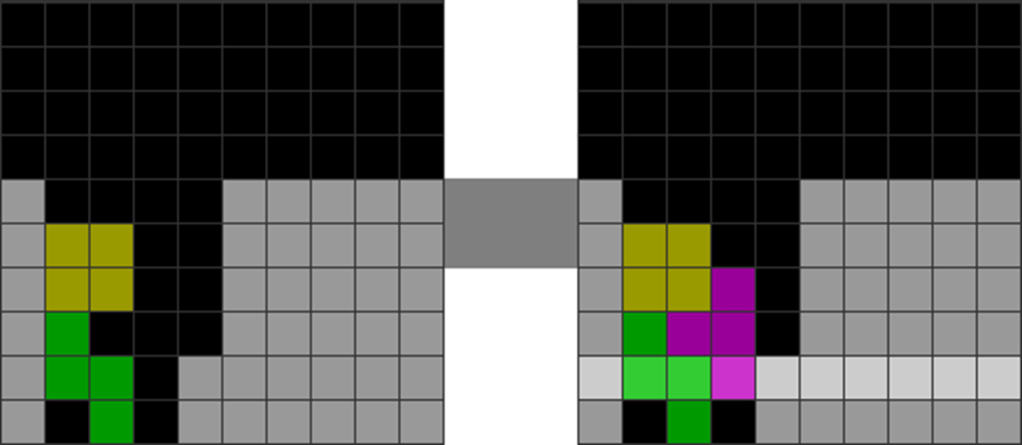
| Make a dirty T-spin with the O overhang. | A T-spin single finishes. Ensure that T is rotated vertically. |
| 3 | 4 |
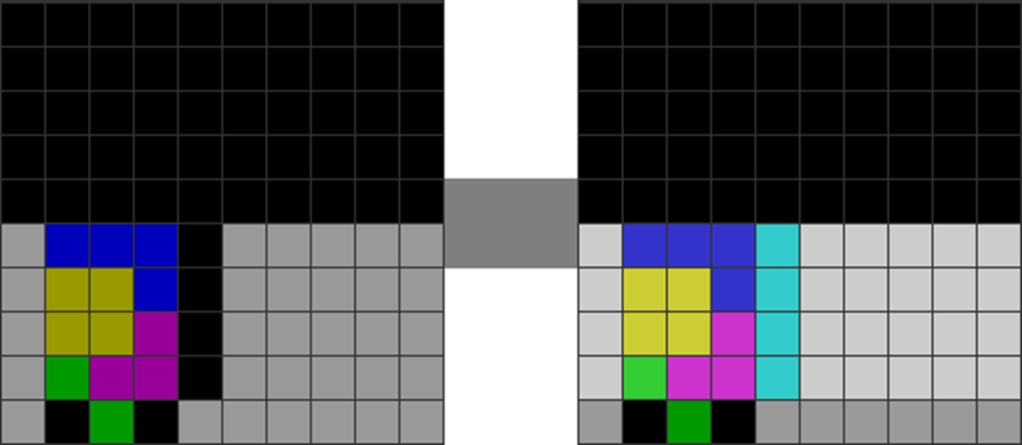
| Put a J like this. | Complete with a clean Tetris line clear. |
In step 1, the player deliberately sets up a dirty T-spin. The O piece, which is the overhang, covers the garbage hole at column two.
However, this dirtiness is short-lived. In steps 2 to 4, the player strategically chooses piece placements to create a clean Tetris line clear. This cleanly exposes the next garbage hole.
Hence, cleanliness is restored in the long run.
Social and Global Applications
Once one has cultivated self-love, one can then confer its merits upon others.
To cultivate the love of others, one should start from the most rudimentary and fundamental.
First, one can go on solitary, meditative trips through nature or botanical gardens. Talk to every tree, flower, fungus, lichen, grass, weed, or fern, either out loud or in your mind.
Greet them like people, and confer your blessings upon them by wishing the best for their prosperity and well-being. Accept their role in the park’s ecological, hydrological, or soil cycles.
Next, expand this awareness to animals. Visit zoos or nature reserves to interact with animals. Be it a squirrel or a marmoset, talk to them and cuddle them as if you were treating them as your children.
Then, one can move on to people, starting with one’s family. For instance, one can begin conferring more acts of love, such as gifts or counsel, to one’s aging parents. Then, one can move on to helping one’s friends.
One can then move on to the societal and global levels. I often like to walk to the nearby supermall, NEX, from my home. I would, in my head, wish others well and bless them to cultivate my love for others.
On a global scale, universal love, when embodied at the collective level, can move entire mountains or continents.
Imagine the terrible gulf between China and Japan as of the time of this book’s writing, where the latter’s prime minister made a blatant remark to re-militarize Japan, forgetting its renunciation of violence from World War II.
If universal love can pervade at this level, no longer will the two countries be at loggerheads with each other.
Now, imagine the extreme wealth inequality in the United States. Three people own half of the country’s wealth.
Greedy corporations, such as Boeing and Monsanto, have sought to maximize profits above all else, rather than ensuring engineering quality and workers’ welfare.
When a new society based on universal love takes root, these corporations will evolve into a socialist, egalitarian system that ensures their workers are well-treated and much better paid.
For myself, I wrote this book, made entirely free on my howtotetris.com website, because I wanted to change people’s perspectives by elevating them to a higher consciousness.
When their perspectives are broadened, they will then manifest them in their actions and affect the entire global grid.
I ask for nothing in return.
 How to Tetris