“Whatsoever a man soweth, that shall he also reap.”
— Galatians 6:7, King James Bible
Introduction
What the Law of Cause and Effect Is
We are the sum of our past negative actions and habits until we have learned to overcome them.
We are likewise the sum of our past positive tendencies accumulated over the eons.
This is the law of cause and effect. Every intended action leads to a manifested physical or behavioral outcome in the cosmos.
This reinforces our current tendency to repeat the act unless we decide to break this cycle.
The following diagram illustrates this mechanism using the concrete example of overcoming depression:
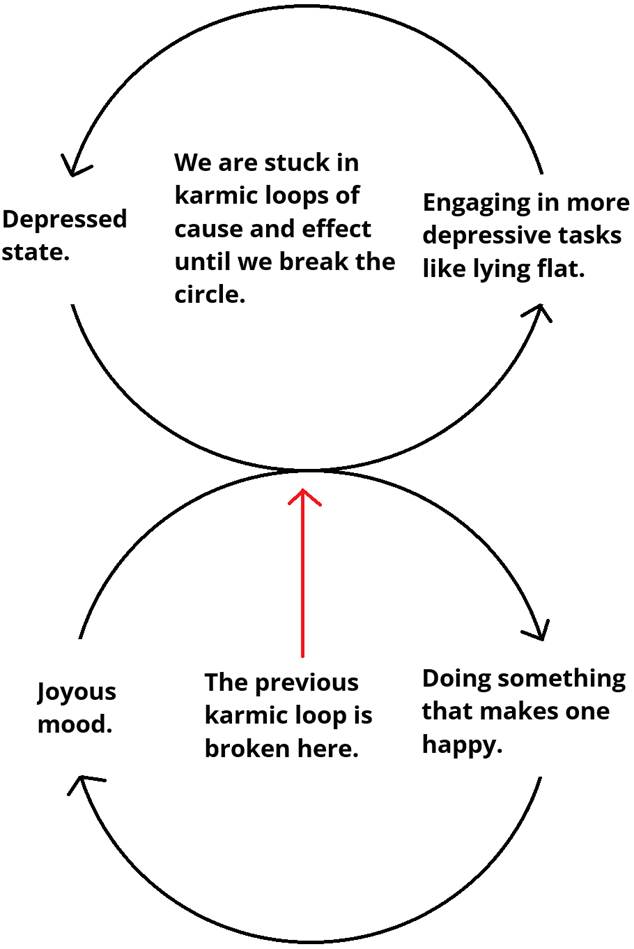
The ancient sages, prophets, and rishis call this ‘karma’: everything has a repercussion, positive or negative, based on the merits or demerits of one’s actions.
A Common Misconception
I dislike using the term “karma” because of its religious connotations. I use it only because “karmic” is shorter and more convenient than “cause and effect.”
Its many religious connotations have led to many misunderstandings, such as how one would burn in the eighteenth story of Buddhist hell if one commits horrendous acts. It also leads to the superstition that one is reborn as a cockroach for one’s vile deeds.
I neutralize this law by describing it in terms of objective consequences, cycles, and repeated patterns that impact one’s life.
However, it is commonly mentioned in NDE and afterlife research that some souls choose to be murdered in one life by the victims they have murdered in an earlier life.[1]
I cannot fully confirm why this is the case.
However, I suspect that it is because doing harm to another soul links the two souls psychically in the afterlife with a negative emotion (like hate).
This is because, in the afterlife, your spiritual state creates reality. Two beings with a negative karmic link could harbor a “grudge” or “guilt” towards each other. This occasionally “reminds” them uncomfortably of negative feelings.
This negative emotion may take a very long time to subside. However, this karmic “repayment” arrangement might neutralize it faster.
More developed souls, however, use more peaceful karmic resolution methods. Instead of murdering another person in a future life, they instead ask the perpetrator to do them a good deed (like performing a life-saving surgery on them).
Because of this, karma is not a moral law. It is just an effect of a psychic mechanism (just like gravity).
I also suspect that karmic “repayment” is voluntary, and some souls may simply let time cause the psychic link to subside.
However, this might differ in other universes with different psychic mechanisms or laws of physics and consciousness.
How It Might Differ in Other Realities
Gravity on Earth accelerates everything downwards at 9.81 m/s². Hence, humans on this planet protect themselves from falls by honoring this physical law.
However, in outer space, gravity is minimal. People have to adapt by exercising more to avoid muscle and bone degradation.
Physicists have theorized the existence of multiple universes, ranging from infinite parallel realities to branching quantum worlds and repeating cosmic cycles.[2]
An infinite number of universes may truly exist, per the latest findings in cosmology.
Hence, in other possible universes, the law of cause and effect may not apply as much as it does here on Earth or in our universe.
The law of cause and effect implies that time flows linearly, which perhaps holds for this physical universe and its higher layers, such as the astral, causal, or mental planes.
It may not be true in other universes with different laws of physics.
According to some channeled spiritual teachings, in the higher spiritual dimensions one advances to in the afterlife, time is subject to existence, but existence is not subject to time.[3]
Therefore, it is possible that within the greater, infinite cosmos, there could be universes with temporal physics so different that the laws of causation may not apply there.
Yet the law of cause and effect seems relevant and true on our planet.
Tetris as an Analogy
Of all the spiritual laws in this book, I have found Tetris to be the ideal metaphor for the law of cause and effect.
Here is an illustration below. In Tetris, you almost always want to stack flat. If you stack in a jagged fashion, this happens:
| Diagram Set 7-1 | |
| 1 | 2 |

| The player stacks both sides of the field in a jagged manner. | Subsequent placements make the field even more jagged. |
| 3 | 4 |

| There is no room to place the O piece cleanly. It is stacked over a hole. | The next L piece also has no room to be placed cleanly. The field becomes a mess. |
Here, the player commits a common mid-game error by stacking into jagged surfaces.
The player eventually finds that a jagged surface cannot accommodate the flat orientations of some pieces, like the O and L pieces.
This leads to further jagged stacking, messing up his field.
The cycle is finally broken by learning the following beneficial habit of stacking flatly:
| Diagram Set 7-2 | |
| 1 | 2 |

| The player stacks flatly. | This accommodates most incoming pieces, resulting in a flat aftermath. |
Here, the player stacks flatly, resulting in a safer, flatter, and cleaner aftermath that avoids the jagged dead-ends of diagram set 7-1.
Hence, one carries negative habits into future games, reducing one’s win rate until one breaks them.
This law can be illustrated in the following concrete terms, in relation to real life:
- A person copes with their lack of self-esteem by constantly smoking or taking drugs. This creates a destructive cycle in which one is increasingly compelled to repeat the behavior. The result is emaciation and spiritual deprivation.
- A person believes that material existence is all that there is. He accumulates vast wealth and lives like the Joneses, offering no solace or aid to those in need. This person continues this superficial existence, focused solely on external things, until he breaks the cycle.
- A person sinks into depression and gets into destructive habits of self-harm every time she is met with a difficulty in life. She does not broaden her horizons or develop resilience, ultimately increasing her chances of self-harm with each life trial.
- A person is used to carrying out intimidation against others to induct people into his cult, all for the purpose of controlling others. He believes that his religious dogmas are gospel and massacres everyone who does not believe in them. If this continues, his worldview will become his prison.[4]
The law of cause and effect can also be a positive one, such as:
- A person performs many benevolent and charitable deeds throughout his life. He never judges others and accepts them for who they are. He donates generously to help people experiencing homelessness. A person like this would slowly transcend his ego and see the bigger picture of life.
- A soul has had many past lives on Earth and other planets, during which it has developed intellectual abilities to their fullest potential. In this current Earth life, he inherits and manifests this gift, becoming a scientific prodigy who contributes to humanity’s well-being.
- A soul has had many past lives in other realms, where she developed profound psychic intuition. She applies this gift to channel spiritual teachings and help broaden others’ perspectives.
Positive actions and merits in past lives, if done intentionally, can confer merits in the current one by transcending the limits of one’s ego.
Likewise, a destructive, intentional habit can shrink one’s worldview and inflate one’s ego.
We can now look at the applications.
Personal Applications
Self-Karma
To apply this chapter’s lessons to one’s personal life, one only needs to first introspect and reflect.
What problems and grievances does one have in this current life? Of these, there are two categories:
- External issues that are not the fault of one’s inner state.
- Manifested problems that reflect one’s inner state.
The former involves life difficulties over which one has little or no control, such as a natural disaster or illness.
These events are not karmic. However, how one reacts to them can be. That is why the latter matters are self-karmic.
For instance, if a person continuously avoids dealing with tough issues in a positive light, as shown in this chapter’s earlier examples, they may become less and less inclined to cope with courage.
Another example is a person who develops kleptomania because of her inner insecurities. She may be compelled to keep stealing until she breaks the cycle. This could arise from fears about her looks, affecting her self-esteem.
The cycle will continue until the person breaks out of it.
Life is an agglomeration of many similar karmic cycles.
Many souls may incarnate in over 1,000 lives over 30,000 years. However, they may still be a beginner soul.[5]
This is because they did not cultivate the awareness to gaze into their inner states. Without identifying them, no action can halt or reverse such karmic cycles.
This is why journaling or deep reflection during solitary walks is critical. When we are aware of the problems, we can trace their root causes and effects.
Then, we can break down the problems and outgrow them.
For instance, if one is depressed, one can participate in events that instead make one happy to break the cycle.
It all begins with self-awareness.
Relational Karma
Relationships break down when too much relational karma or friction exists between people.
I experienced this before with a female friend, with whom I had to sever ties permanently in 2022. I cannot name this person to protect her privacy.
During the relationship, this person did the following:
- She never acknowledged that she was in the wrong, all the time.
- She blamed others for her misfortunes, while never accepting responsibility for herself.
- She used others as an emotional trauma dump, while never showing empathy or hearing out other people’s problems.
- She believed she was at the center of the world and was entitled to attention.
- She continuously disrespects the space of others and lashes out whenever others ask her to stay away.
- Uses anger to control others.
- Explodes in anger whenever she feels others are smarter than her.
Why did this happen?
Knowing her too well, she:
- Had many unresolved inner traumas from her family’s abuse in her childhood days.
- Had developed a sense of profound inferiority complex because of scoring poorly on psychometric tests.
- Had too many severed relationships that rejected her.
- Had too many relationships that once broke her trust.
I would not hold her accountable for many of the issues life has thrown at her.
However, the fact remains that she could not transcend her negativity arising from the above clauses.
This led to a continued cycle of cause and effect whereby she continuously binge-ate, squandered money, projected her anger onto others, and cut her arms, just to cope.
The result? An implosion of repressed feelings that ended up as projection and infantilization towards others.
In such cases, any meaningful relationship with that person cannot continue unless they change their ways.
Because she could not resolve her inner karma and outbursts, I had to leave her permanently.
This actually happened in my earlier years. In my late teens to early twenties, I was quite similar and had many unstable relationships.
However, the major difference was that I overcame my inner karma. Now, I have many stable long-term friendships.
In Jungian psychology, we all have a shadow element to our personality. We repress our darker fantasies, unrealized selves, and negative emotions.[6]
Then we project this subconscious element onto others as anger, control, jealousy, and other negative emotions.
This is why many early marriages lead to breakups: the two partners are not physically old enough to have the mindset to resolve the shadow, resulting in constant, mutual projections.
Until one has internalized a stable sense of inner karmic balance, it is difficult to maintain stable relationships.
Social and Global Applications
The law of cause and effect permeates from the individual to the collective level and back again.
Housing in Late-Stage Capitalism
In mid-2026, Elon Musk became the first trillionaire in human history. His proprietary SpaceX stock skyrocketed within days of opening, becoming valued at more than a trillion dollars.
How did he get so rich?
Simple. I borrow Professor Richard Wolff’s analogy: imagine a town experiencing severe flooding. The people came together to build a dam to permanently circumvent all future flooding.
When the dam was finished, the mayor came in and awarded a $10,000 paycheck to just one woman: Mary. Crazy, right?
In late-stage capitalist societies, such as the US, large corporations like Meta, Nvidia, Microsoft, Monsanto, and Amazon gobble up everything.
They gain so much power that they intrude on matters like land ownership, sometimes using BlackRock or Blackstone to acquire land, then rent it at maximum prices to the middle and working classes.
Hence, even a one-room flat in Manhattan may cost over $4,000 a month, while, ironically, the super-slender high-rise residences on Billionaires’ Row sit empty because rich oligarchs bought them for speculation and investment.
These billionaires then leverage their positions to lobby for political influence, resulting in bills that benefit only them at the expense of the average Joe and Jane.
This cycle of cause and effect continues with the rich becoming richer, and the poor becoming poorer. You get a reverse Robin Hood situation, where the former indirectly obtains wealth from the latter.
Hence, this spiritual law permeates the broader macro level and trickles down to the individual level.
To halt this cycle, laws must be implemented at the broader level to limit oligarchs’ power so wealth can be distributed more fairly.
In China, the government ensures that housing is used for living rather than speculation.
So, when they saw the Evergrande property bubble getting out of hand, they deliberately popped it in a controlled manner.
Now, years after the bubble, the economic ripples have significantly abated, making houses far more affordable.
Renting a 5-bedroom apartment in Shanghai costs only $2,000-3,000 per month as of 2026 — a fraction of comparable housing in New York or London.
Only by breaking this karmic cycle in the US can property finally be fairly distributed to the proletariat.
Infrastructure in Late-Stage Capitalism
The law of cause and effect also applies to infrastructure.
In the USA, because society has devolved into a largely free-market, capitalist system, utilities such as power, water, and sanitation are liberalized.
The government steps back from ensuring that bridges, railway tracks, roads, pipes, and electrical grid lines are well maintained.
As a result, no private company is willing to take charge and perform charity by maintaining the USA’s infrastructure.
This is why America’s infrastructure is more problematic than that of most developed countries.[7]
One example of its karmic effects is the Francis Scott Key Bridge in Baltimore, which collapsed after a cargo ship accidentally rammed into it.
I played a turn-based strategy video game called Galactic Civilizations. One faction was the Dominion of Korx.
That civilization developed until one company monopolized all their assets. People were left homeless or dead if they could not afford transportation, homes, insurance, or medical bills.
Greed ran the entire civilization. This is the direction we are headed based on current trends.
To prevent it, Earth’s governments should nationalize many infrastructure assets so they can provide high-quality, safe systems for citizens.
The current system is driven by greed and neglect, which will ultimately endanger more lives until a government that truly cares for its people fixes the crumbling infrastructure.
Escalatory Military Dominance
Escalatory dominance is a strategy employed by certain countries to retaliate in ways that are many times harder than their adversaries’.
Some countries employ this strategy.
A specific nation’s armed forces, which I will not name, regularly retaliate against regional militants with far greater force.
As for that country’s intention, I will not judge and will remain neutral.
Every country’s national psyche arises from many unpredictable historical and cultural influences. Only historians can fully judge objectively with the benefit of hindsight.
After an attack that killed more than a thousand people, that nation’s armed forces commenced a major military campaign in a small territory that subsequently resulted in tens of thousands of civilian deaths.
Here is another example:
During a major military confrontation in 2026, one superpower and a regional Middle Eastern adversary exchanged escalating strikes. Each side retaliated against the other in a mounting cycle of attack and counterattack, targeting scores of military sites across multiple operations.
I do not wish to take sides. I am sure both sides have their respective rationales.
However, the most pragmatic way to think about this is by analyzing its causes and effects. From this, we can devise a solution.
Objectively, the two cases show a classic retaliatory tit-for-tat that leads to a self-fulfilling prophecy.
For instance, in the first example, the bombing campaign may harden the militant group, leading to greater recruitment and potentially a worse attack than the one that triggered it decades later.
The superpower’s attack on the regional Middle Eastern adversary may ironically push it toward pursuing nuclear weapons, spurring neighboring states to seek their own nuclear deterrence.
The result is a cycle of constant revenge, where neither side is prepared to back down.
If this cycle continues unbroken, future generations will simply suffer escalating amounts of violence on both sides.
Then, this trickles down to the individual level. If nuclear proliferation in the Middle East leads to a global nuclear catastrophe, no longer can any developed nation have its current prosperity levels.
My solution is simple: when both sides still harbor a simple us-versus-them mentality, this perspective will justify a perpetual onslaught.
In relation to the Law of Oneness chapter, the key is to dismantle, transcend, or expand beyond the narrow categories of us-versus-them.
Theories of moral and ego development suggest many stages of growth.[8]
As we grow spiritually, our paradigm of the world shifts from (i) an initial “me” versus others to (ii) a collective “us” versus others, and (iii) a broadening “us” that transcends narrow categories (beyond ethnicity, nationality, etc.).
Richard Bucke’s concept of cosmic consciousness suggests that human beings eventually evolve into a race with a cosmic “we” perspective, in which we see everything as one.[9]
The goal is to expand people’s mindsets to a more encompassing level.
When that happens, hurting others is the same as hurting oneself.
When each warring side realizes this, there will be no further justification for continued escalation.
I hope the two mentioned conflicts will be resolved peacefully and diplomatically. The world is big enough for countries to coexist.
[1] Michael Newton, Destiny of Souls (2000). Newton’s regression subjects describe pre-life arrangements where souls voluntarily experience harm from those they previously harmed — not as punishment but for dissolving psychic bonds.
[2] Max Tegmark, Our Mathematical Universe (2014); Sean Carroll, Something Deeply Hidden (2019); Roger Penrose, Cycles of Time (2010).
[3] See Lee Carroll, Kryon Book One: The End Times (1993); José Stevens and Simon Warwick-Smith, The Michael Handbook (1990); Darryl Anka, Bashar: Blueprint for Change (1990).
[4] Jeff Guinn, The Road to Jonestown: Jim Jones and Peoples Temple (2017). Shows how Jones used religious dogma, intimidation, and psychological control to trap followers in paranoia that led to the Jonestown massacre of 1978.
[5] Michael Newton, Journey of Souls (1994); see also Destiny of Souls (2000).
[6] Carl Jung, The Archetypes and the Collective Unconscious (1959), CW Vol. 9, Part 1; see also Robert A. Johnson, Owning Your Own Shadow (1991) for an accessible treatment.
[7] American Society of Civil Engineers, 2021 Report Card for America’s Infrastructure (2021). The ASCE gave US infrastructure an overall grade of C-minus.
[8] Lawrence Kohlberg, The Philosophy of Moral Development (1981); for ego-developmental parallels, see Jane Loevinger, Ego Development (1976); also Ken Wilber, Integral Psychology (2000).
[9] Richard Maurice Bucke, Cosmic Consciousness: A Study in the Evolution of the Human Mind (1901).

