Introduction
Once you have mastered dozens of Tetris sub-areas, the key test of your mastery comes in integrating or synthesizing them together.
During my first year of playing Tetris, I was more of a scholar, documenting and memorizing many Tetris techniques.
However, I did not do much actual Tetris gameplay. As a result, once I got into them, I lost most of my matches (though, arguably, my Tetris matchups were against pretty hardcore players in a legendary Tetris Discord server).
As I always like to repeat the Zen mantra: Experience is the essence of existence and not observation.
You can study and learn a thousand and one methods by watching other players or reading guides. However, if you never play Tetris, that knowledge will remain as pure knowing, not experience.
Sooner or later, you will have to overcome your fear of fighting real humans and clash with them in real Tetris matches.
Transitioning to Practice (Application)
If jumping straight into competitive versus modes is too anxiety-provoking, the reader can ease this transition by choosing less intense modes.
Only after gaining confidence can one transition to fighting real opponents.
Here are a few transitionary means to reach the stage of applied practice:
Solitary Modes
Players can start with a few single-player modes across various Tetris games.
Puyo Puyo Tetris, Tetris Effect: Connected, TETR.IO, and Jstris offer variations of an Ultra mode.
This involves scoring as high as possible, typically by using back-to-back T-spins and Tetrises, within a certain time limit.
Play this mode until you are confident enough to transition to the next section’s mode.
Other modes include Marathon mode:
| Diagram Set 8-1 |
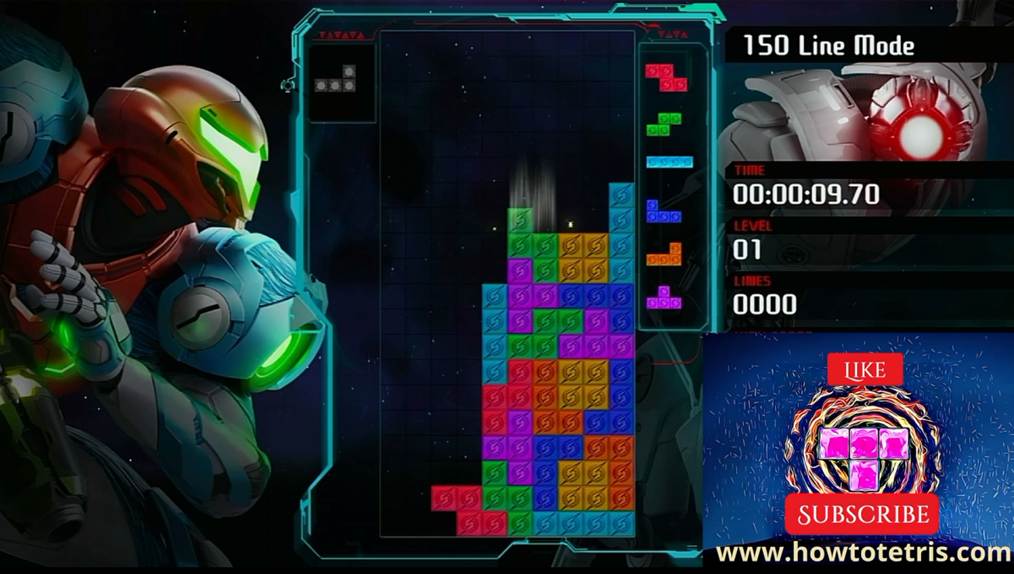
| Tetris 99’s marathon mode. This is a gameplay screenshot from my YouTube Tetris video. |
AI Versus Modes
A few bots can simulate the feeling of going up against another human player.
By “bots,” I do not mean the poorly programmed default AI bots in games like Puyo Puyo Tetris or Tetris Effect: Connected.
Those bots are poorly programmed and generally do not know how to perform advanced T-spin setups beyond a certain point.
However, the default bots in those games are easy enough for an absolute beginner to train against.
Tetris Effect: Connected’s AI can be adjusted from level 1 (easiest) to level 10 (hardest).
Games like Jstris and TETR.IO also offer bots with adjustable speeds. I suggest starting slow.
However, when you get more proficient, you can install the Zetris, Cold Clear, or Wataame AI bots on Puyo Puyo Tetris.
Cold Clear also has a stand-alone version you can download and set to turn-based mode for more thinking time:
| Diagram Set 8-2 |
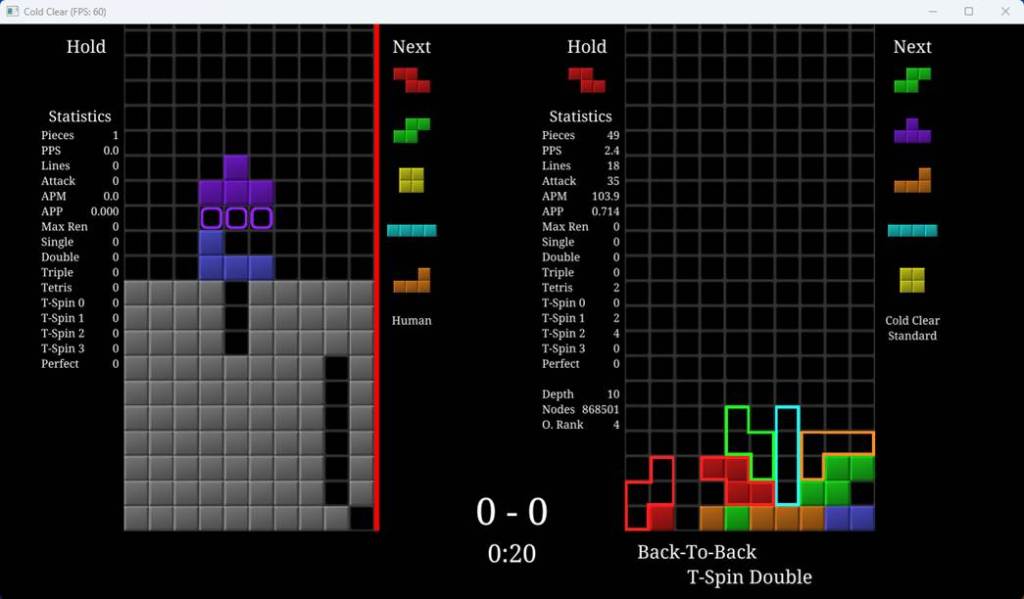
| The human player (left field) fights the Cold Clear AI player (right field). |
Misamino is also a stand-alone bot that is not as powerful as Cold Clear, but still offers enough challenge for more advanced players:
| Diagram Set 8-3 |
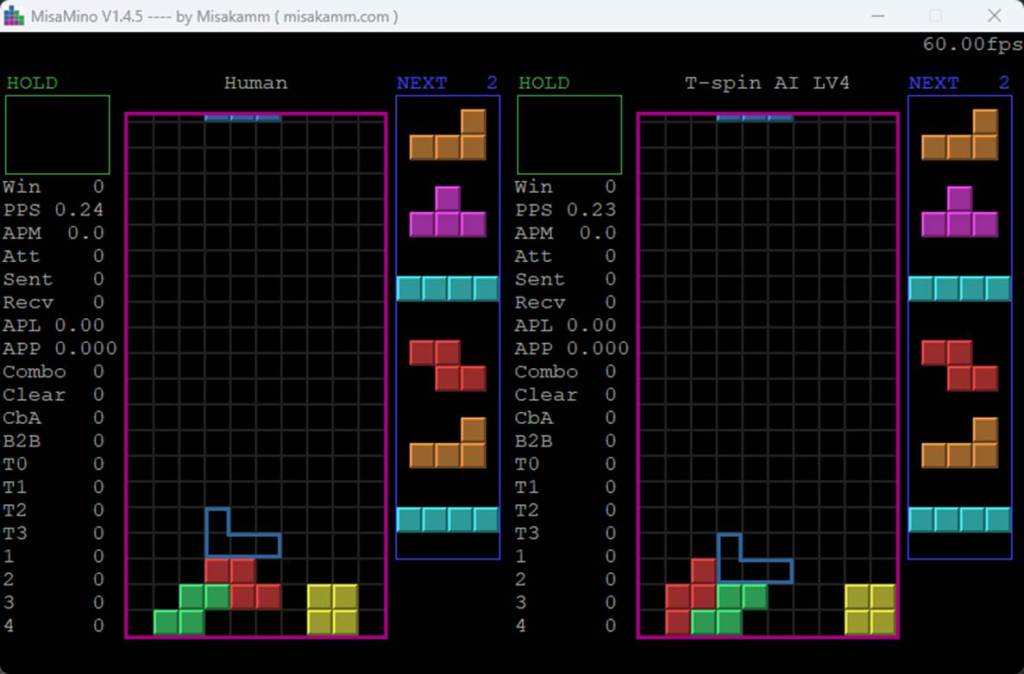
| The human player (left field) fights the Misamino AI player (right field). |
Slow-Paced Versus Modes
If you are ready to face real humans, some slower-paced modes can help you get started.
TETR.IO and Jstris offer an arena mode where you play a free-for-all match against many opponents at once.
Typically, at the start of a match, the incoming garbage pressure is manageable, giving you enough time to think and train.
Tetris 99’s regular or team lobbies also offer a great training opportunity. Their early phases tend to have less pressure, with incoming opponent garbage pressure slowly increasing as the game progresses.
Serious Versus Modes
When you are confident enough, start to play against real human opponents in one-versus-one settings or more challenging modes, such as Tetris 99’s Invictus mode or lobbies filled with skilled players (like Tetris 99’s periodic tournaments that offer new unlockable themes).
| Diagram Set 8-4 |
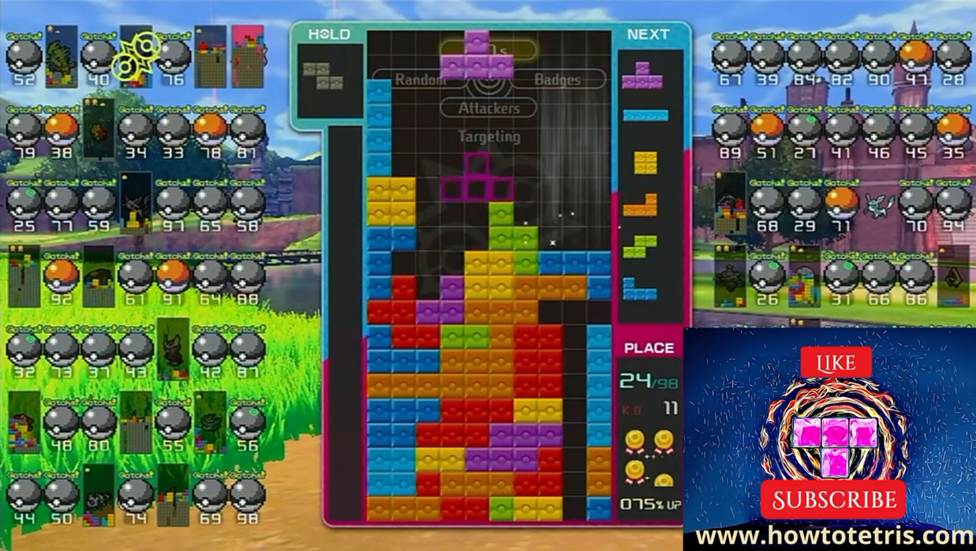
| My Tetris 99 gameplay screenshot from my YouTube channel. |
Harmonizing Theory and Practice
While I have given a rather experiential curriculum in this chapter, it is still vital to harmonize practice with theory.
Pure experience alone cannot accelerate a player’s mastery of Tetris.
I know of many Tetris 99 players who were at level 99 double star (the maximum level). However, when I watched their gameplay, they failed to show a basic understanding of critical concepts like parity and field harmony.
This is because they never used theory and understanding to make sense of their experiences.
As said earlier, one grows not through experience; one grows by reflecting on it.
Ideally, players could start learning Tetris in any order: either by learning theory or by gaining experience through play.
However, they should alternate between the two occasionally to make sense of their experiences through understanding.
My many How-to-Tetris guides help provide such an understanding. Many other guides serve the same purpose.
I illustrate this using the example of field harmony.
Field harmony is roughly defined as how well your pieces stack to form a continuous, smooth surface that maximizes stacking options for upcoming tetrominoes.
| Diagram Set 8-5 | |
| 1 | 2 |
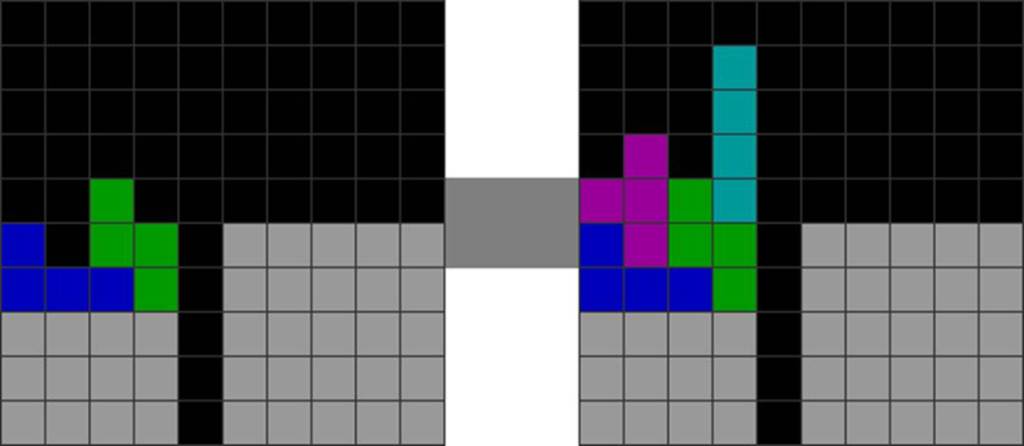
| The left stack is not field-harmonized. | The subsequent stacking compounds the jaggedness. |
The above diagram set shows a poorly field-harmonized stack. The field is divided and jagged, leaving limited stacking options. Almost all of them compound the field division, leading to jarring shapes. Soon, the player will stack into a dead end and lose.
| Diagram Set 8-6 | |
| 1 | 2 |
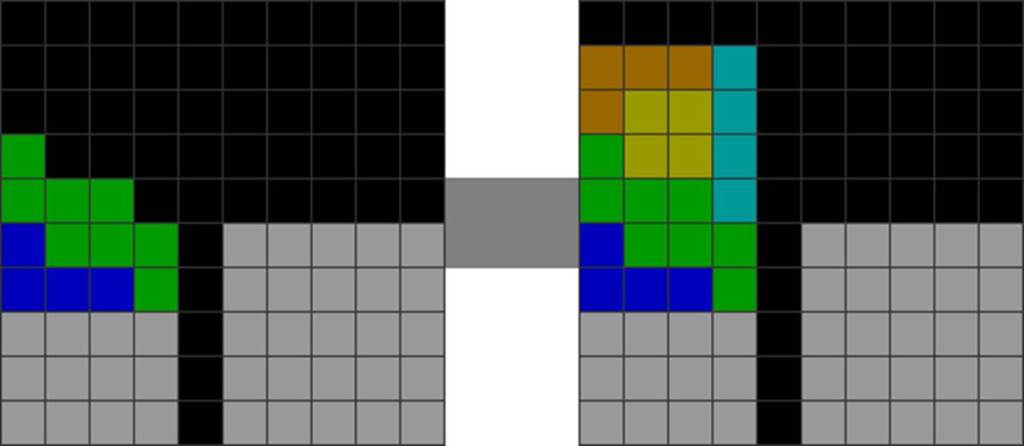
| The left stack is field-harmonized. | The subsequent stacking is far smoother. |
However, here, the player stacks into a nice field-harmonized stack. Notice how they can easily stack in a way that connects the field, increasing the possibilities for placing future pieces.
Now, observe the following player’s gameplay:
| Diagram Set 8-7 |
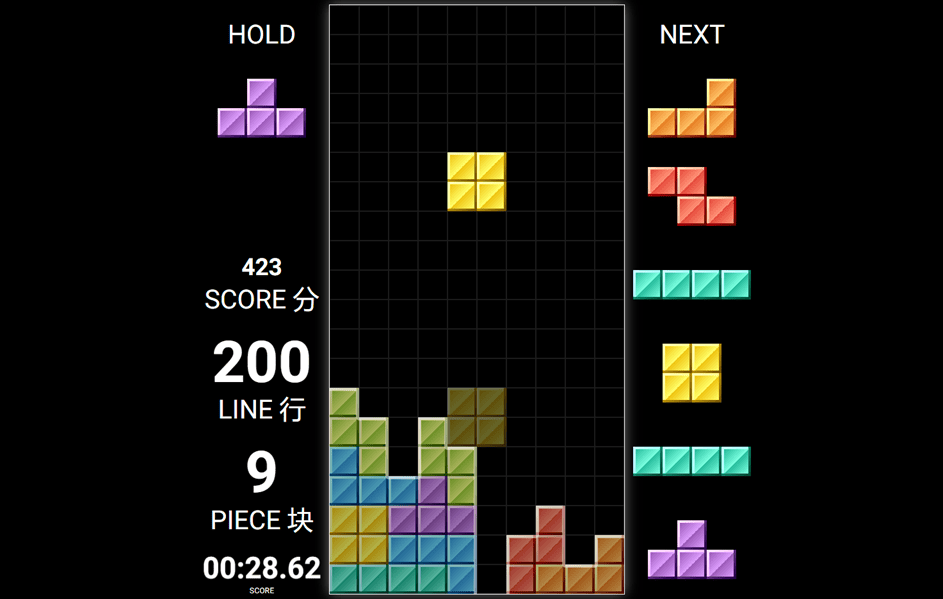
| The player stacks into many poorly field-harmonized parts on the left and right stacks. |
Here, the novice player stacks into a poorly field-harmonized stack.
Most beginners who do not receive coaching or learn field-harmony theory rarely progress beyond this messy stacking style.
However, when a player is shown the theory of field harmony and is introduced to several concrete ways below to join the stack and achieve a field-harmonized field, they can easily and quickly improve:
| Diagram Set 8-8 | |
| 1 | 2 |
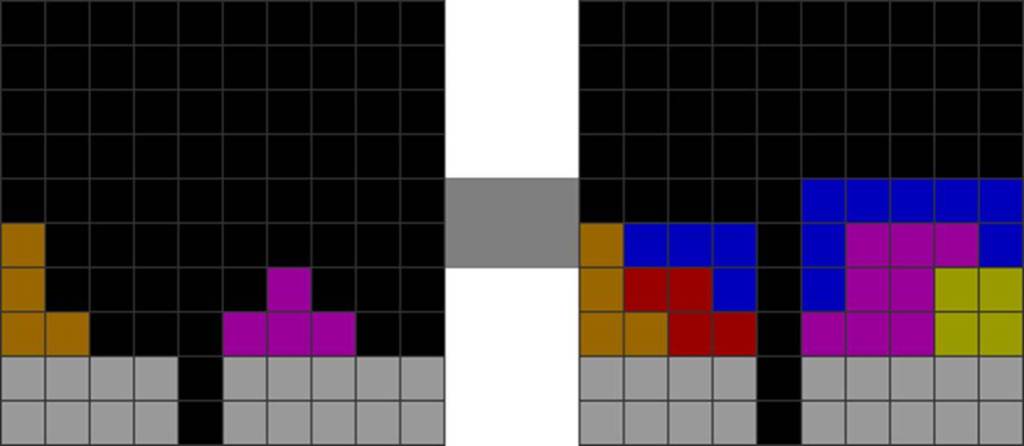
| Starting field. | The player places pieces properly to harmonize the stack. |
Once the player understands this, they can apply field harmony to improve their gameplay.
As the player gains experience, they may encounter other poor gameplay habits, such as poor parity management.
This vital concept is roughly defined as how one manages a field’s jaggedness.
| Diagram Set 8-9 | |
| 1 | 2 |
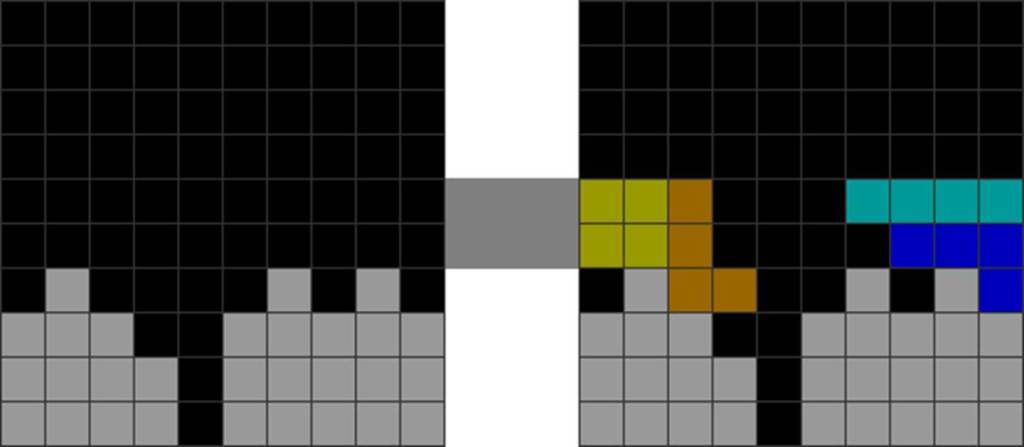
| The field has many parity imbalances (is very jagged). | The player cannot accommodate the flat orientations of O, L, J, and I cleanly. |
Here, a player stacks into a parity-imbalanced (super jagged) stack that cannot accommodate the flat orientations of L, J, and O cleanly.
The player would then have to study means to resolve parity imbalances by placing Ts in the stack like this:
| Diagram Set 8-10 | |
| 1 | 2 |
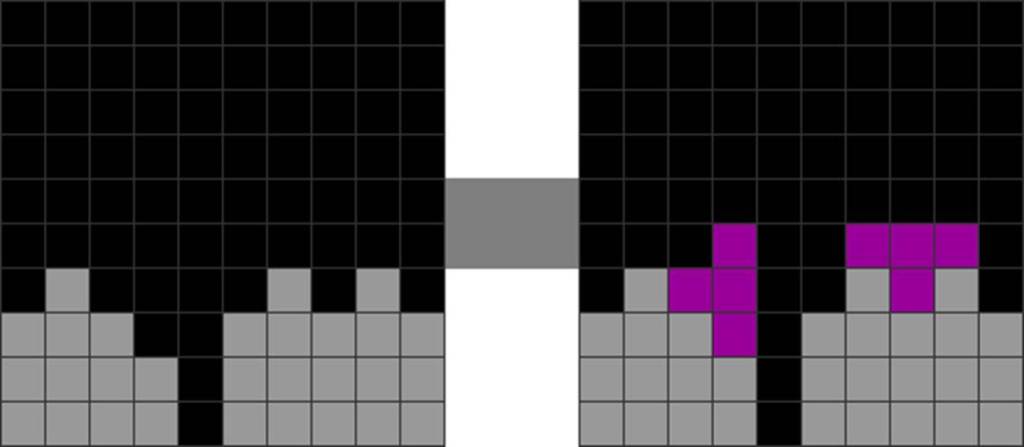
| The field has many parity imbalances (is very jagged). | The player places T pieces to flatten the stack. It is now parity-balanced (flatter). |
Then, they can return to applying this in actual gameplay:
| Diagram Set 8-11 |
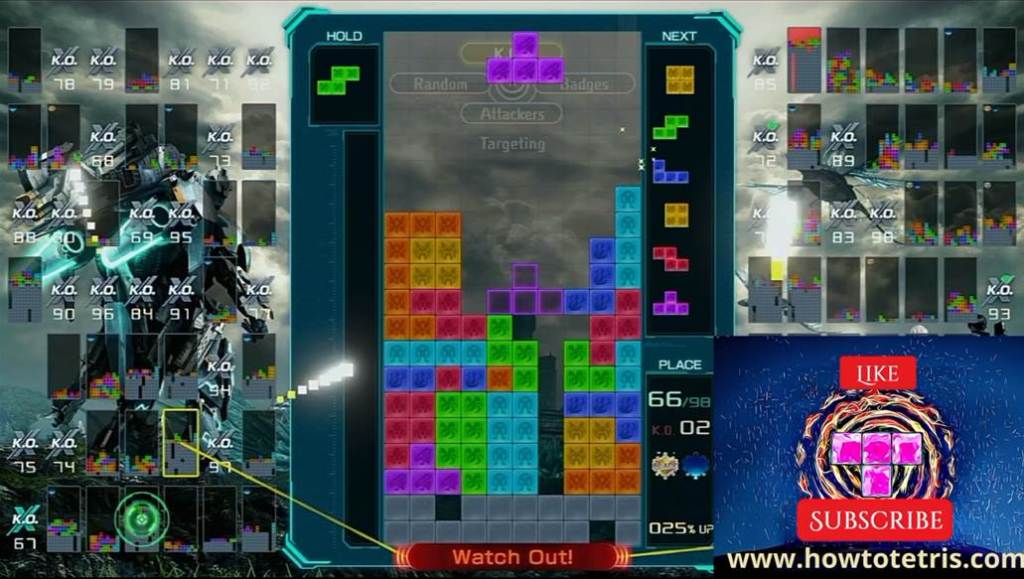
| My Tetris gameplay from my videos. |
In the above chart, notice how well I managed my parity. The field’s surface is almost always flat and accommodates many flat placements. I can also make T-spins and downstack more easily and smoothly.
So once you integrate parity theory into your gameplay, you can reap the benefits of better stacking, downstacking, and T-spin chances.
This ongoing, mutual cycle between experience and theory vastly accelerates one’s Tetris skill.
Too much experience without theory leads to stagnation. Too much theory without experience leads to pure intellectualizing.
Only when you harmonize the two can you progress faster and more comprehensively.
My How-to-Tetris website has 7 free Tetris books uploaded to help you understand Tetris theory across many domains.
In a Nutshell
| Key Points |
| Slowly build up confidence and transition from slow, single-player modes to fast-paced competitive Tetris games. Tetris progression comes not merely from studying or gaining experience. You have to balance the two to progress faster. |

