“When you touch one thing with deep awareness, you touch everything.”
—Lao Tzu
Introduction
Every act that we carry out with intention becomes ripples that circulate the entire cosmos.
Some ripples may return as small wavelets seconds or minutes later, such as when we are punched by someone whom we have attacked earlier.
Other ripples may take days, weeks, or months, such as the financial returns from investing in the stock market.
Even greater are ripples that take decades or centuries to return to oneself. These can often return as enormous waves that one can harvest their positive results later in life or after one’s life.
This is the nature of the lower planes of existence, such as the physical plane, where our current universe dwells. It could differ for other universes with different laws of nature.
Everything is bound by the law of cause and effect, where even the slightest intended act may have lasting ripples on reality.
This is because of the earlier discussed law of oneness, where the separation between everything is nothing more than artificial boundaries in the minds of mapmakers.
In modern science, this is illustrated by chaos and catastrophe theory, in which a single butterfly flapping its wings could contribute to a hurricane on the other side of the world.
This is the law of connectivity, that nothing in the cosmos is isolated. By the nature of the term ‘universe,’ everything is causally bound within the same domain.
As such, even a single isolated event or act can have monumental effects on others.
Rather than cower at the majesty of such a powerful law, we should take solace in the fact that it shows how powerful we are. That we are beings of free will, where, with the right intentions and circumstances, our acts can lead to vast ramifications, positive or negative, on others.
Hence, the law of cause and effect is localized. The law of connectivity is universalized.
Tetris as an Analogy
I illustrate this spiritual concept using Tetris 99 as an example.
Official guideline Tetris games have several variants, many being released between 2015 and 2025. These involve the following: Tetris 99, Puyo Puyo Tetris 1, 2, and 2S, Tetris Ultimate, and Tetris Effect: Connected:

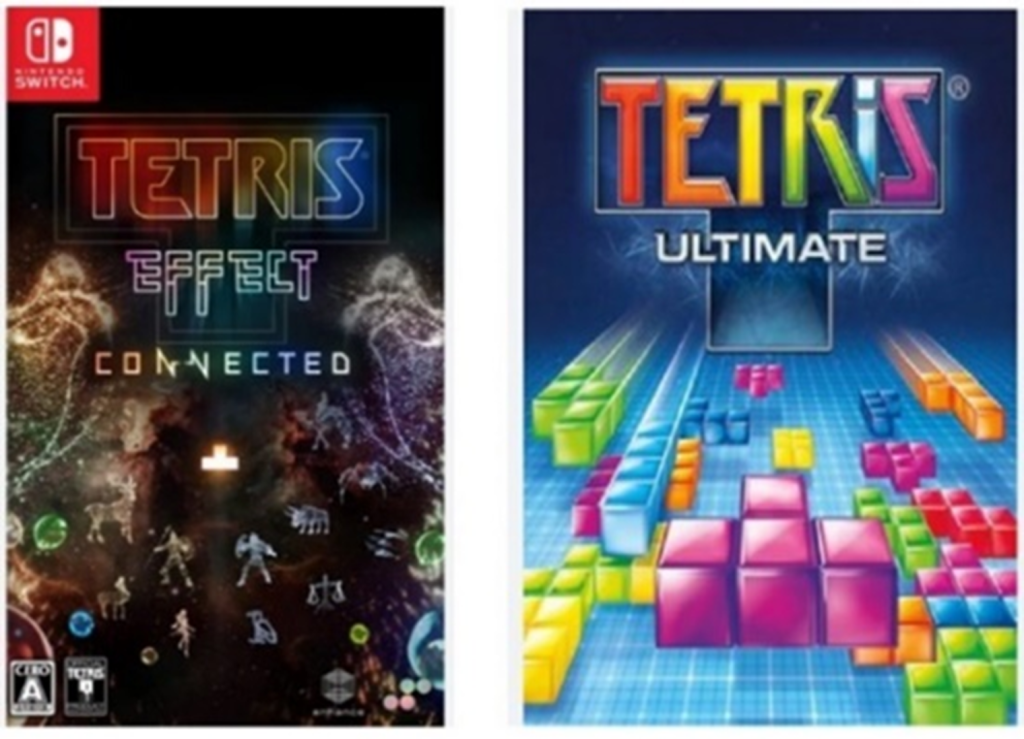
These official Tetris games share many commonalities, as most offer a versus-based one-versus-one matchup between two players.
However, nothing is more interesting to me than Tetris 99, which is my main game.
It is a Tetris game, where up to 99 human players join a regular lobby to battle each other. Only one victor may triumph above all else.
Here are some of my sample fancy T-spin setups in Tetris 99. As an expert Tetris 99 player, I often terrorize regular lobbies by doing up to 100 T-spins in some matches:
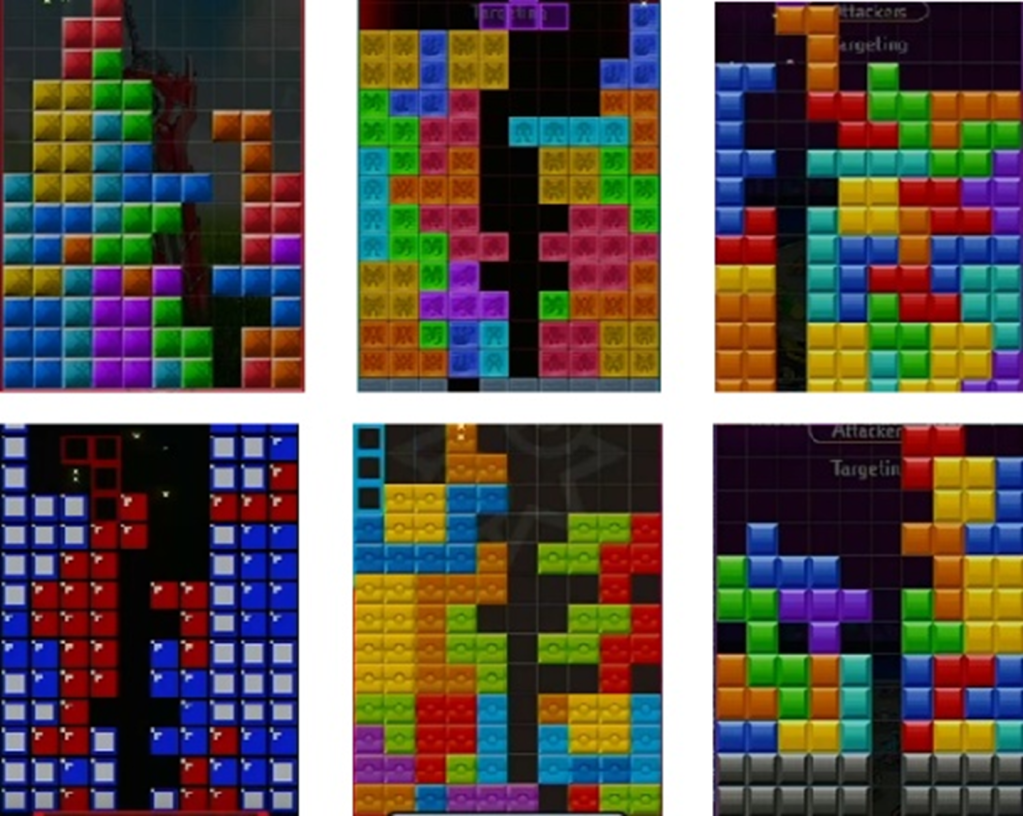
The game is split into three phases. In the first, 99 players remain. Gravity is forgivably low, and there is plenty of time to think. In the second phase, with 50 players left, gravity accelerates, and the time before receiving garbage decreases. Finally, in the third phase, with 10 players left, this leeway becomes even tighter, and gravity is at its maximum.
Tetris 99 lobbies are the perfect illustration of the law of connectivity for the following reasons:
- When the game first begins, in the first phase, one typically makes many T-spin setups to knock out opponents to harvest their resources (badges) to boost one’s own firepower.
- Later in the game, in the second phase, one is forced to place pieces cleanly and stack safely. If one does not do so, the field would become extremely cluttered, such as this:
| Diagram Set 8-1 | |
| 1 | 2 |
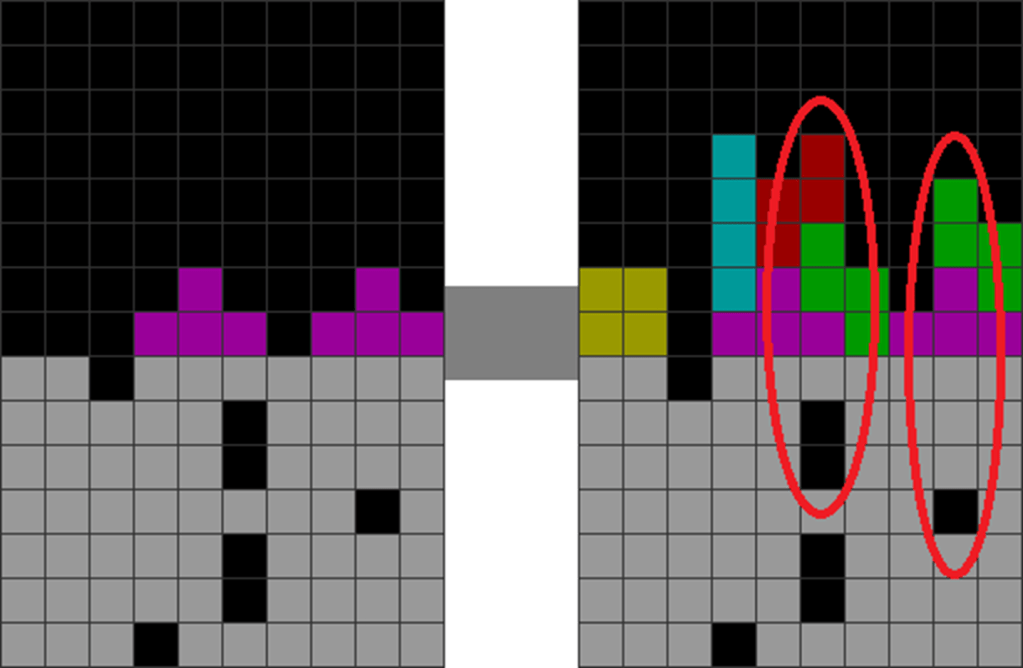
| The player creates two local parity imbalances by placing Ts poorly. | This jagged pattern causes tall S, Z, and I pieces to be placed. They upstack over future garbage holes. |
Here, the player stacks dangerously, with many field divisions. As gravity accelerates, one may not be able to place some pieces flatly in some regions. This leads to catastrophic overstacking in step 2.
Instead, a player should play safely by stacking cleanly like this:
| Diagram Set 8-2 | |
| 1 | 2 |
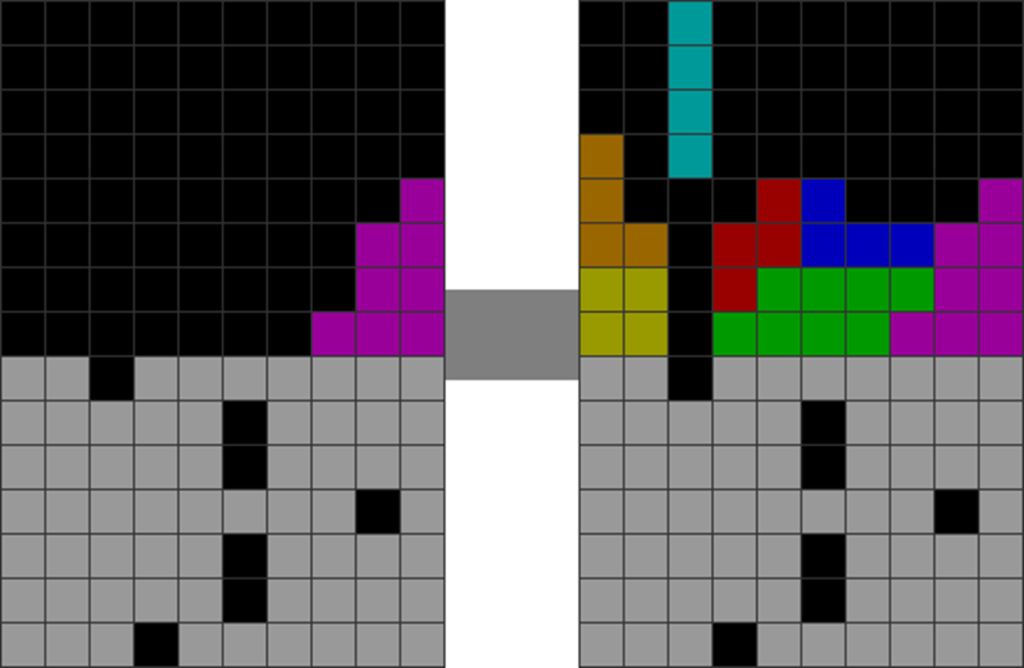
| The player places two touching Ts instead of separating them. This neutralizes local parity. | The player can then more flatly stack the incoming pieces for a clean Tetris line clear. |
If this does not happen, the poor, jagged stacking will carry over into the third phase, where the prohibitively high gravity would worsen the stacking and cause one to be topped out.
Hence, under clause (1), the badges one harvests will not reach their full impact until much later. It is only in the final stage that, if a player has harvested the maximum of four badges, one’s firepower can be maximized.
For clause (2), whatever terrible stacking that one creates in the earlier stages carries forth to the next stage unless the matter is resolved.
Therefore, the law of connectivity is an extension of the law of cause and effect, albeit a vastly delayed one, in which its effects ripple outward in many dimensions and eventually return to oneself.
Personal Applications
One word summarizes this law’s application: consequences.
Whenever you act, consider the karmic effects, which can take place over specific durations:
- Immediate: When you punch someone, and they punch you back, it is instant karma.
- Short-term delayed: When you show negativity and anger towards someone, they may remain quiet at first. A week later, you may realize they have blocked you on social media.
- Mid-term delayed: When you invest $10,000 in a company stock that you know is in a bubble, such as today’s massive AI bubble, you may realize six months later that your value has halved after a crash.
- Long-term delayed: When you abuse a child, that person may return one day to burn down the village just to feel its warmth.
The language of the spirit is intention. This is the cause. The language of the physical realm is the effect.
Hence, every action here may lead to something that returns even decades later.
Social and Global Applications
Anything that happens within ourselves can affect the broader social fabric in the long term.
Many psychologists have studied how individual psychological development affects the collective whole.
Carl Jung showed how personal shadow integration influences the collective unconscious.
Erik Erikson showed that healthy individual development leads to healthier societies.
Theodor Adorno argued that unresolved inner conflicts can scale into harmful mass behavior.
Before World War II, Carl Jung famously predicted the war because he saw many of his clients harbor nightmarish dreams and signs of neurosis. These were signs of the eventual disturbance of the collective consciousness.
Even the smallest act of mistreating a child can lead to such consequences.
Famous dictators such as Hitler and Stalin have had tragic and abusive childhoods. These might have led them to develop complexes that led to their ruthless dictatorships.
Hence, many positive social changes begins within ourselves. Even if we cannot properly nourish our future descendents, we could, at least, minimize such abuses and be neutral.
 How to Tetris