“Knowing others is wisdom; knowing yourself is enlightenment.”
— Laozi, Tao Te Ching
Introduction
Expanding the Law of Cause and Effect to the Whole
In modern science, chaos theory states that a single butterfly flapping its wings could contribute to a hurricane on the other side of the world.[1]
This is an exaggerated metaphor. However, it is more likely to happen with people who have tremendous power and influence.
In the famous British comedy, Blackadder: Back & Forth, Blackadder travels to 1815 to steal the Duke of Wellington’s boots for a bet.
He accidentally knocks out the Duke, causing Britain to lose the Battle of Waterloo. Returning to 1999, Blackadder finds the UK has become a French territory.
Hence, while the law of cause and effect is largely a localized mechanism that occurs within ourselves or among smaller groups, it can sometimes permeate the broader social system.
This is the law of connectivity: nothing in the cosmos is isolated.
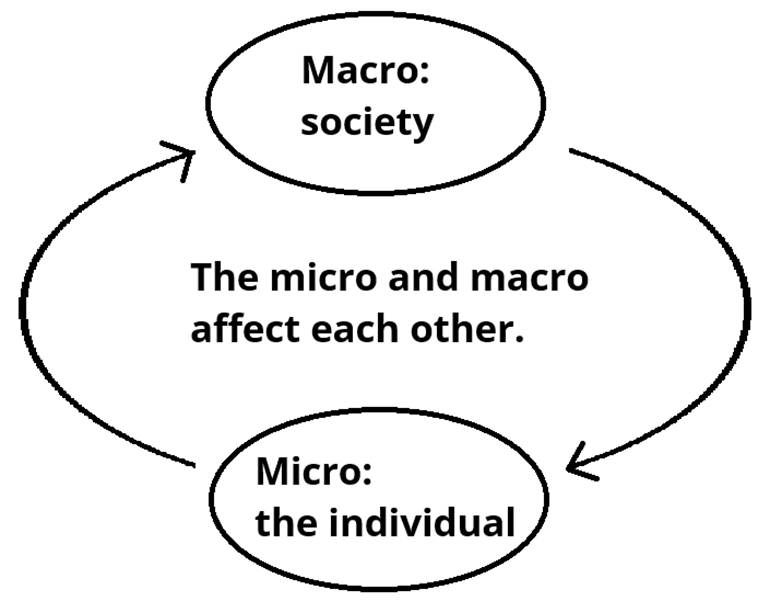
Simply put, every individual act we carry out with intention sends ripples that circulate through the cosmos.
Some ripples may return as small wavelets seconds or minutes later, such as when we are punched by someone whom we have attacked earlier.
Other ripples may take days, weeks, or months to materialize, such as the financial returns from investing in the stock market.
This is because of the law of oneness, where the separation between everything is just an artificial boundary in the minds of mapmakers.
As such, even a single isolated event or act can have monumental effects on others.
Rather than cower at the majesty of such a powerful law, we should take solace in the fact that it shows how powerful we are.
We are beings of free will, and with the right intentions and circumstances, our acts can have far-reaching ramifications, positive or negative, for others.
Tetris as an Analogy
I illustrate this spiritual concept using Tetris 99 as an example.
Official Tetris games are those directly licensed by The Tetris Company (TTC).
They have several variants, many released between 2015 and 2025. These include the following: Tetris 99, Puyo Puyo Tetris 1, 2, and 2S, Tetris Ultimate, Tetris: The Grand Master 4, and Tetris Effect: Connected:


These official Tetris games share many commonalities, as most offer a versus-based one-versus-one matchup between two players.
However, nothing interests me more than Tetris 99, my main game.
It is a Tetris game where up to 99 human players join a regular lobby to battle each other. Only one victor may triumph above all else.
Here are some of my sample fancy T-spin setups in Tetris 99. As an expert Tetris 99 player, I often terrorize regular lobbies by doing up to 100 T-spins (the game’s most efficient attack method) in some matches:

There are few players who can create such high-level setups mid-game. *Grins* I might be the only one, but more are picking them up from my Tetris books and videos.
Each Tetris 99 match has three phases.
- In the first phase, 99 players remain. Gravity is forgivably low, and there is plenty of time to think.
- In the second phase, with 50 players left, gravity accelerates, and the time before receiving garbage decreases.
- Finally, in the third phase, with 10 players left, this leeway becomes even tighter, and gravity is at its maximum.
Tetris 99 lobbies are the perfect illustration of the law of connectivity for the following reasons:
- When the game first begins, in the first phase, one typically makes many offensive setups to knock out opponents to harvest their resources (badges) to boost one’s own firepower. Each badge increases your offensive output.
- Later in the game, in the second phase, one is forced to place pieces cleanly and stack flatly and safely because gravity instantly pulls down all pieces. If one does not do so, the field would become extremely cluttered, such as this:
| Diagram Set 8-1 | |
| 1 | 2 |
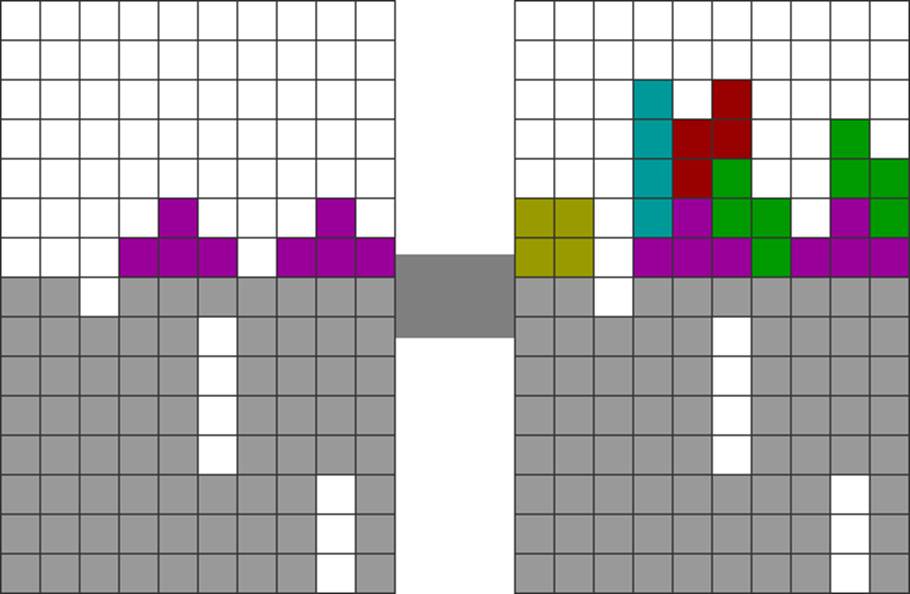
| The player places 2 T pieces improperly, which makes the field’s surface extremely jagged. | The player then places tall S, Z, and I pieces. This compounds the jaggedness. |
Here, the player stacks dangerously on a field riddled with holes. As gravity accelerates, a player may not be able to place some pieces flat in some regions.
This leads to catastrophic overstacking in step 2. The field becomes a towering and jagged mess.
Instead, a player should play safely by stacking cleanly like this:
| Diagram Set 8-2 | |
| 1 | 2 |
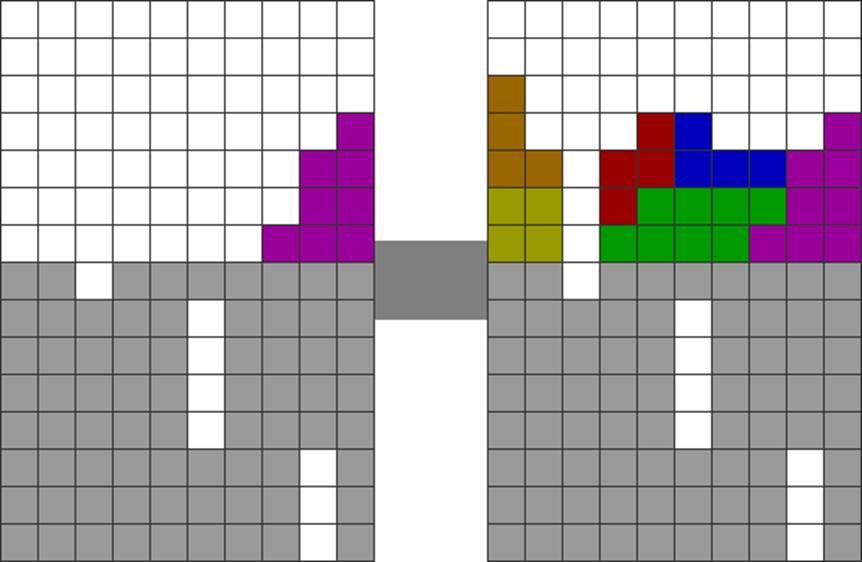
| The player places 2 touching T pieces instead of separating them. This avoids the jaggedness of the previous diagram set’s scenario. | The player can then stack the incoming pieces more flatly. |
If one does not stack flatly and cleanly, the poor, jagged stacking will carry over into the third phase, where the prohibitively high gravity would worsen it and cause one to be topped out (i.e., lose).
The next two paragraphs are technical. If you are intimidated, please skip ahead to the non-technical summary below them:
- Hence, under clause 1 (a Tetris 99 match’s first phase) from about a page ago, the badges one harvests will not reach their full impact until much later. Only in the final phases (second and third) can a player who has harvested the maximum of four badges maximize their firepower.
- For clause 2 (the match’s second phase), whatever terrible stacking you create in the earlier stages carries into the next stage unless you resolve it.
For the non-Tetris-playing reader, this means: whatever you do in the early game affects the later game. Play poorly at the start, and your late-game suffers.
Therefore, the law of connectivity is an extension of the law of cause and effect, albeit a vastly delayed one, in which its effects ripple outward in many dimensions and eventually return to oneself.
Personal Applications
Different Kinds of Consequences
One word summarizes this law’s application: consequences.
Whenever you act, the action’s karmic effects can take place over specific durations:
- Immediate: When you punch someone and they punch you back, it is instant karma.
- Short-term delayed: When you show negativity and anger towards someone, they may remain quiet at first. A week later, you may realize they have blocked you on social media.
- Mid-term delayed: When you invest $10,000 in a company stock that you know is in a bubble, such as today’s massive AI bubble, you may realize six months later that its value has halved after a crash.
- Long-term delayed: When you abuse a child, that person may return one day to burn down the village just to feel its warmth.[2]
The language of the spirit is intention. This is the cause. The language of the physical realm is the effect.
Hence, every action here may lead to something that returns even decades later.
As a result, it may help to think long-term about consequences before acting.
Individual Acts Affect the Collective
Some people who have experienced near-death experiences (NDEs) report that they are given a life review, where their entire life flashes before them.
Many people interpret NDEs differently. Some remember seeing religious figures, such as Jesus Christ, asking them how far they have loved others in their lives.
Others have more non-religious, neutral experiences in which no entity promotes any virtues.[3]
However, in my investigation of NDEs, a common trend seems to unify them all: consequences.
NDE experiencers often report not just seeing their own actions. Instead, they also experience the effects of their actions on others.
For instance, an NDE experiencer (NDEr) once said that he bludgeoned someone in a moment of road rage. During the NDE, he felt the exact pain he had inflicted on that person.
In another memorable NDE that I read, a young child once captured a mother bird in physical life. In his NDE, he was shown that act caused the mother bird not to return home, causing the deaths of her offspring.
Howard Storm had one of the most detailed NDEs in recorded history. Before his NDE, he was an unpleasant person who used anger to control others.[4]
However, his NDE revealed the effects of his actions on others, leading him to become a Christian minister, writer, and painter afterward. He is now a compassionate, pleasant, and loving person.
What was staggering about his NDE was that it showed the future of humanity depending on our current actions.
In one version, his spirit guide showed him that if humanity became altruistic and compassionate, we would evolve into a group mind in which everyone is included.
Future utopian villages of art, science, and any technical field could exist, where people lived without discrimination.
However, another reality can emerge if humanity chooses the destructive path.
In that timeline, humanity will be plunged into many global wars, a global financial meltdown, and widespread environmental and climate-related disasters.
Neither has happened yet, but either can, depending on our collective choices that shape broader social reality.
Unfortunately, the second scenario seems to be where we are headed now.
This means the physical realm we inhabit is like a massive simulation of cause and effect.
Everything is bound in this enormous web, whereby a single wobble in one thread can send ripples throughout, which could one day return to the starting point.
The implication and application are simple.
Just as in Christopher Nolan’s Oppenheimer, the eponymous protagonist is haunted by his role in creating the atomic bomb. It led to the mass arming of nuclear weapons by the USSR and the USA.
None of us, including society as a whole, are truly spared from the effects of our individual actions.
Perhaps the most neutral way to think about this is to cultivate foresight by looking ahead across multiple layers and time frames before we act as individuals and as a collective.
Social and Global Applications
Civilizational Consciousness Reflects the Individual
What happens within us can affect the broader social fabric over the long term.
Many psychologists have studied how individual psychological development affects the collective whole.[5]
Carl Jung showed how the personal shadow influences the collective unconscious.
Before World War II, Carl Jung famously predicted the war because he saw many of his clients harbor nightmarish dreams and signs of neurosis. These were signs of the eventual disturbance of the collective consciousness.
Erik Erikson showed that healthy individual development leads to healthier societies.
Theodor Adorno argued that unresolved inner conflicts can scale into harmful mass behavior.
Even the smallest act of mistreating a child can lead to such consequences.
Famous dictators such as Hitler and Stalin experienced difficult and, in some respects, abusive childhoods. These experiences may have led them to develop complexes that fueled their ruthless dictatorships.[6]
Hence, many positive social changes begin within ourselves. Even if we cannot properly nourish our future descendants, we could at least minimize such abuses and remain neutral.
Declining Educational Standards
In many Western countries, such as the United States, students are experiencing a “reverse Flynn effect.”
This means that their average IQ scores are declining with each generation. This is quite apparent in Generation Alpha (those born between 2010 and 2024).[7]
Many schools report that many students can barely read or do basic arithmetic. Their problem-solving skills have likewise declined or are already almost non-existent.
Possible reasons why this has happened are that (i) the newer generation of parents and kids have de-prioritized the importance of reading, (ii) kids now over-rely on reading on devices instead of physical books, and (iii) kids now over-rely on AI.[8]
As a result, many basic skills have not even been learned because AI seems to do everything better.
The law of cause and effect applies here: ignorance leads to more ignorance.
This can be dangerous because, according to psychologist Erich Fromm, ignorant people can overconform and lack critical thinking skills, especially when it comes to seeing through propaganda or advertisements.[9]
This is already happening, as big companies like Disney expose children to images of Mickey Mouse from a young age to influence them to become adult consumers who can spend thousands of dollars on “magical” Disney Park trips.
The same is true of many mainstream Western media outlets, such as Fox News and CNN. Their coverage can sometimes portray nations perceived as geopolitical rivals of the United States in strongly negative terms, reflecting bias.[10]
Since the Smith-Mundt Modernization Act of 2012, the American government has shaped public information domestically. However, its 200+ interventions in other countries have received less attention.
Without proper critical skills, democracy can degenerate into a tyranny of the majority, as John Stuart Mill feared.[11]
To reverse this karmic imbalance, educational systems would need to introduce more critical thinking and basic literacy skills, as in the Nordic countries.
The broader sociological changes can then permeate to the micro-level, per the law of connectivity.
[1] Edward Lorenz, “Predictability: Does the Flap of a Butterfly’s Wings in Brazil Set Off a Tornado in Texas?” (1972), presented at the American Association for the Advancement of Science.
[2] Famous African proverb.
[3] Raymond Moody, Life After Life (1975); Kenneth Ring, Heading Toward Omega (1984).
[4] Howard Storm, My Descent into Death: A Second Chance at Life (2005).
[5] Erik Erikson, Childhood and Society (1950); Theodor Adorno et al., The Authoritarian Personality (1950); Carl Jung, The Collected Works, Vol. 10: Civilization in Crisis (1964).
[6] Alice Miller, For Your Own Good: Hidden Cruelty in Child-Rearing and the Roots of Violence (1983). Miller documented how Hitler’s childhood abuse shaped his psychological development and subsequent capacity for mass violence.
[7] James Flynn, Are We Getting Smarter? (2012). Flynn documented the long-term rise in IQ scores across generations — the Flynn Effect. Later researchers have identified a reverse trend in some Western nations since the 1990s.
[8] Ha! I am so glad to be the generation that wrote out my master’s thesis and The Eternal Reflection novels before AI generation was available!
[9] Erich Fromm, Escape from Freedom (1941). Fromm argued that ignorance and lack of critical thinking make individuals susceptible to authoritarianism and mass conformity.
[10] Edward S. Herman and Noam Chomsky, Manufacturing Consent: The Political Economy of the Mass Media (Pantheon Books, 1988).
[11] John Stuart Mill, On Liberty (1859). Mill warned that democratic majorities could suppress minority viewpoints and critical thought.

