Introduction
When choosing a Tetris community or mentor, pick those that resonate with your goals or nature.
An Important Psychological Theory
Many psychologists and philosophers have tried to map human psychological and spiritual development.
One such prominent figure is Ken Wilber, an influential American philosopher and spiritual writer. According to him, human consciousness develops through many stages, each more encompassing and inclusive than the last.
He argues that human consciousness develops through a 9-stage model, loosely inspired by Spiral Dynamics. Each stage is sometimes referred to as a “vMeme.”
Each later stage in the model can handle more complexity; this is not a claim that later stages are morally better.
The chart beneath visually summarizes the 9 stages:
| Diagram Set 9-1 |
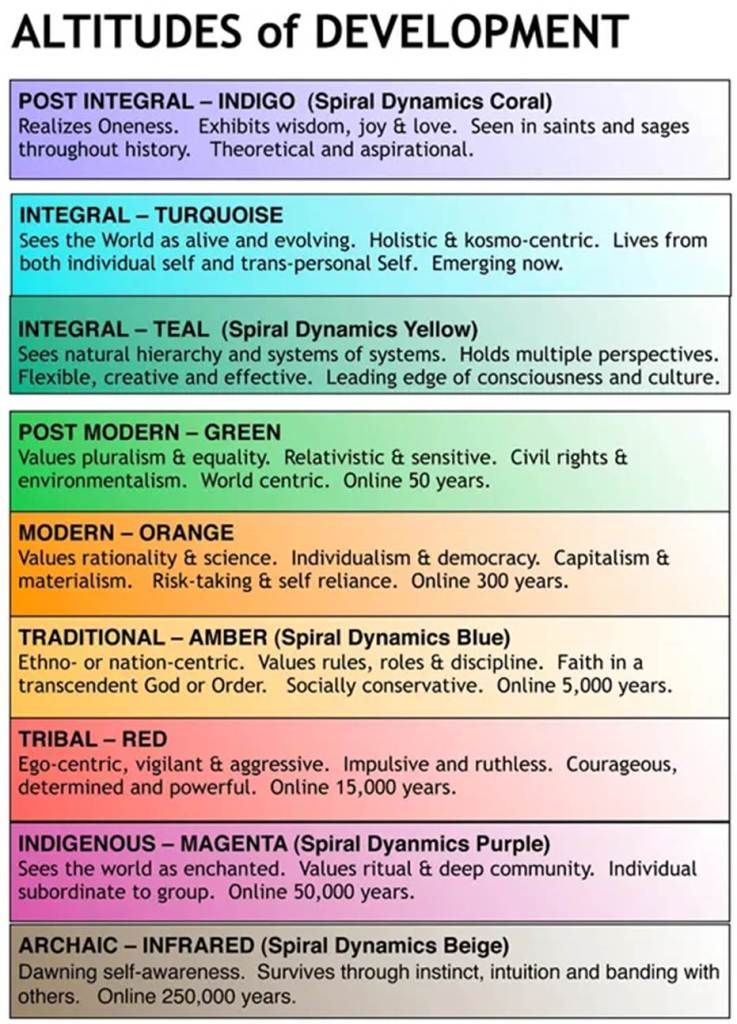
| Source: The Daily Evolver, “The Evolution of Humanity — and Each Human — in One Chart” (2018) |
No stage is better or worse. Every stage is integral to society as a functioning whole.
Ken Wilber likes to use “lower or higher levels or stages” because English has a limited conceptual vocabulary. This does not mean one stage is better than the “lower” stage; it just means it is more expansive, encompassing, inclusive, and broader. Having all stages makes society interesting and varied.
Every vMeme has positive and negative poles or manifestations (pros and cons).
Going through all these in depth is not the focus of this short Tetris guidebook.
I will only cover the 4 most prominent vMemes in the world’s and Tetris community’s demographics:
The Amber vMeme
The Amber vMeme is characterized by a preference for structure, tradition, clear rules, and in-group loyalty.
25 to 30% of the world resonates at this level.
In Tetris, this vMeme’s positive manifestation is that they tend to be rule-following players who strongly abide by the “right way” to play Tetris. It can sometimes help to emulate their gameplay because they often prefer proven optimal setups.
For instance:
| Diagram Set 9-2 | |
| A1 | B1 |
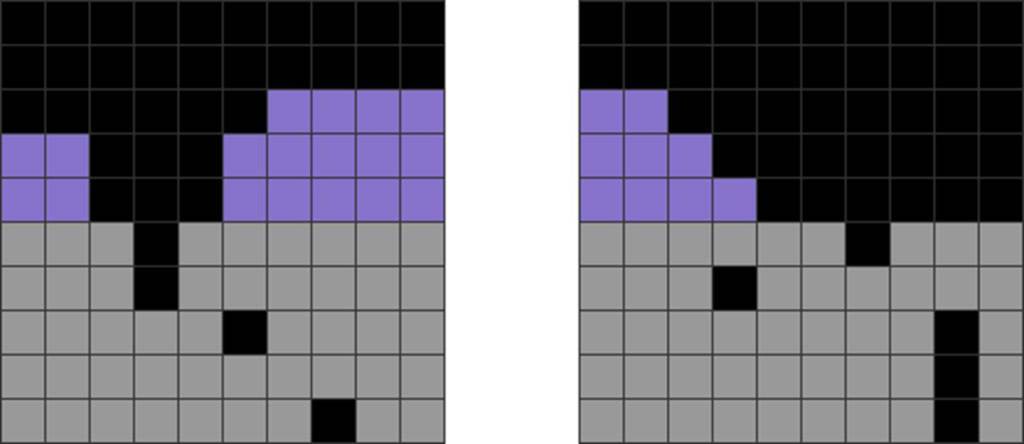
| The starting fields of 2 mid-game situations. |
Both A1 and B1 respectively lead to A2 and B2 of the following set:
| Diagram Set 9-3 | |
| A2 | B2 |
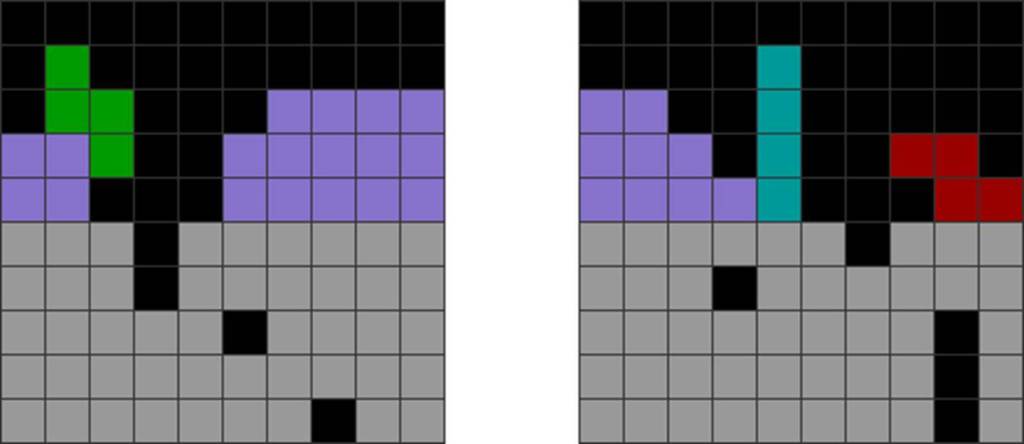
| These are the simplest, safest, and most efficient setups. An Amber vMeme player just goes for these “correct” and “most optimal” options. |
However, this is the negative manifestation, or pole, of this stage: Players who resonate with this vMeme may insist there is “only one right way to play Tetris,” such as to win, or that there is only one fixed ideal solution for many Tetris situations. Anything else is seen as a “non-standard” or “incorrect” choice. They may be pushy about their preferences.
The Orange vMeme
Many hyper-competitive Tetris communities fit Wilber’s Orange vMeme consciousness: a mentality defined by external achievement, competition, status, and measurable results.
In this state of development, morality and relationships are more transactional and goal-based.
30 to 35% of the world’s population resonates with the Orange vMeme.
The positive pole: In Tetris, these are the types who constantly seek world records and outcompete others, striving to become number 1. They are the most likely demographic to push themselves to the absolute limits (to improve), host events, create new Tetris software and games, and keep Tetris alive.
For instance, in their positive manifestation, they will almost always go for mid-game meta strategies, such as LST stacking, because they are the most efficient methods:
| Diagram Set 9-4 | |
| 1 | 2 |
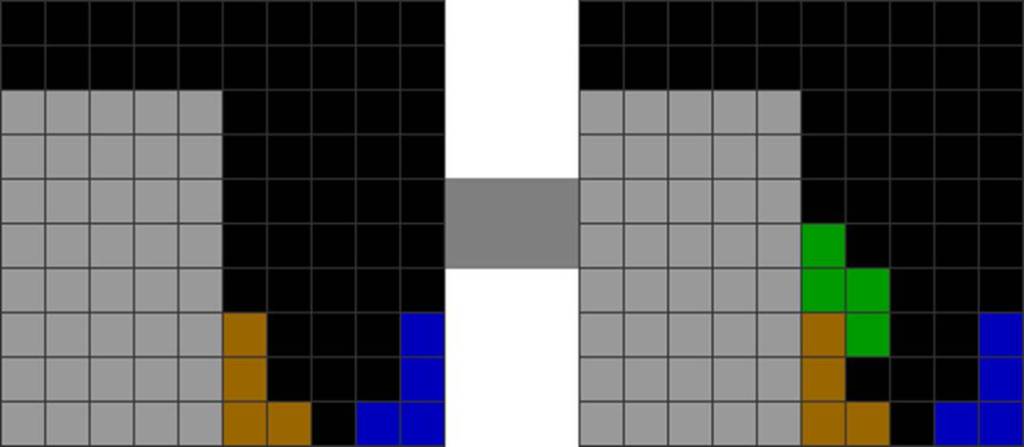
| Place L and J vertically this way in a 5-block-wide area. | Create a T-spin overhang with an S piece. |
| 3 | 4 |
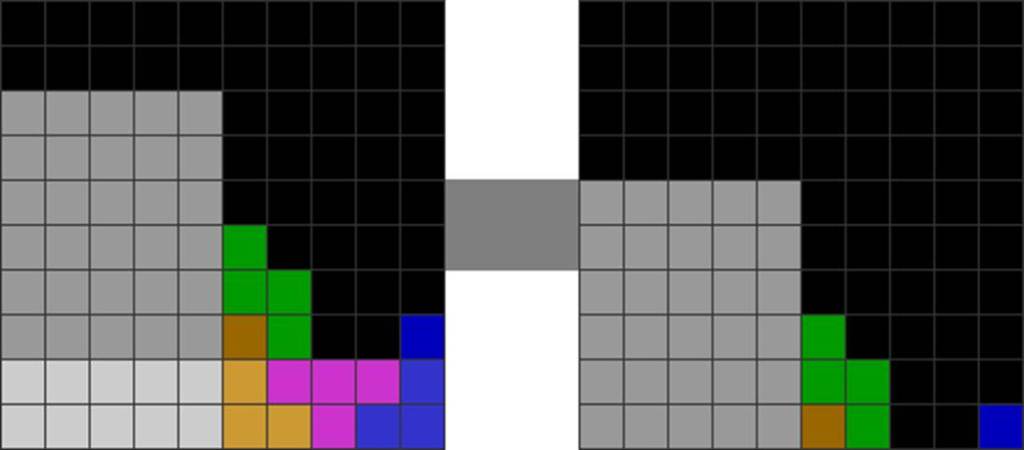
| Complete the T-spin double. | You will get this leftover pattern. |
The above sequence is a typical LST stacking sequence. Emulating such players can be useful because it helps you to reinforce game-winning meta strategies.
On the negative pole, they are also likely to over-promote themselves. They can get entangled in rivalries and community friction, occasionally showing moments of overconfidence.
The Green vMeme
A broader state of conscious development is the Green vMeme, which focuses on empathy, community, emotions, and pluralism.
15% of the world’s population resonates at this level.
The positive pole: They can be very social and friendly, playing casually to experiment with setups for humor and not take the game too seriously.
For instance, they may just play for fun and use line clears to create funny shapes for pure entertainment and laughs with their community:
| Diagram Set 9-5 | |
| A | B |
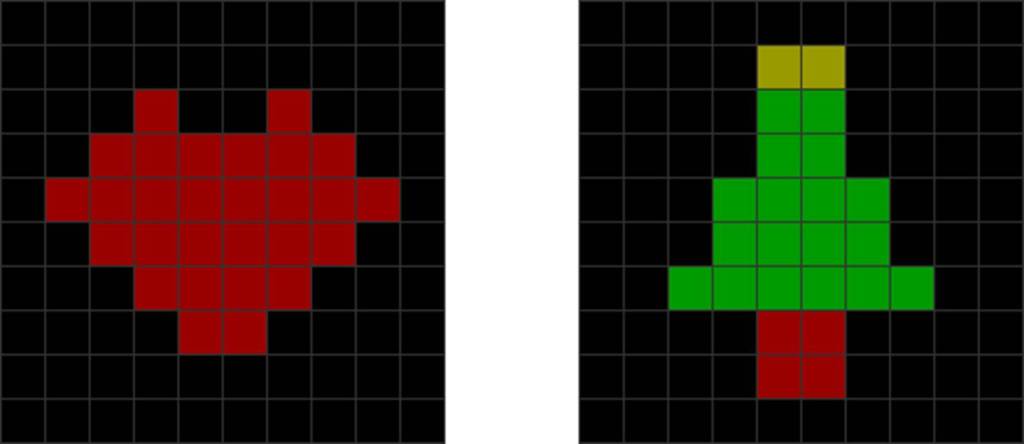
| The player creates a heart shape. | A Christmas tree. |
The negative pole: Because they tend to be more communally driven than game-driven, they may prioritize social fun over competitive improvement.
The Teal vMeme and More
Other broader vMemes exist and make up less than 5% of the world’s population.
The Teal vMeme sees the big picture of the world and tends to be very spiritual and philosophical.
The positive pole: They do not take Tetris too seriously, as they tend not to overly identify with or become attached to external achievements. They just play it for fun, and they can philosophize at great length on Tetris.
For instance:
| Diagram Set 9-6 | |
| A | B |
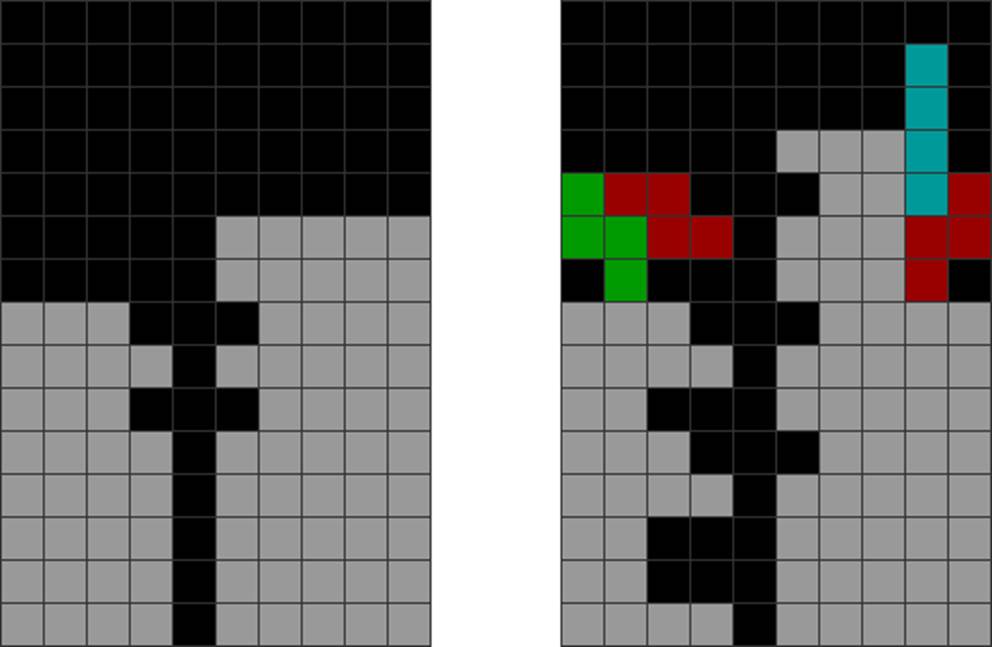
| This is a simple, compact, and efficient Fractal setup. Hence, one should use it often. | This is a loosely packed T-spin setup. A Teal vMeme does not care about societal judgment; they go for it because they want to go with the flow of Tetris and embrace it spiritually by realizing the importance and value of every method. |
The negative pole: They may not be motivated by serious competitive play. They see Tetris as one game among many. They are not motivated to achieve world records or other external achievements in the game.
The Relevance to Tetris
From my life experience and knowledge of Ken Wilber’s work and many other ego-developmental theories (my master’s degree partly specialized in this), I see an interesting social dynamic in each interaction within and between each vMeme group.
Some groups and people resonate more with others, and less with others.
Later in this section, I will show how this works to map out the ideal Tetris community and mentor for you.
To find out which vMeme you resonate with, introspect and see which stage you fit into based on the characteristics in diagram set 9-1.
Tetris Communities
I have been around in the Tetris community for 7 years as of writing this book. I have seen all kinds of dramas and relationships across these groups, even if I have remained a detached observer in some of them.
All kinds of things happen in Tetris communities. I will not name any individual or group.
There are several red flags to identify people or groups that you should be cautious about in your search:
The Red Flags
I recommend being careful towards these kinds of Tetris communities or Discord groups:
i) Groups That Manifest in the Negative Pole Too Much
Honestly, my 7 years of Tetris experience have taught me one thing: the more competitive the community, the more likely you are to face people who critique or speak negatively about others when they are not present.
I have seen players put on a guise of friendliness in front of someone. Yet when they are away, they criticize that person’s playstyle or character in unhelpful ways.
This is hard to avoid in highly competitive communities, where many players compete for the same world record, attention, rank, or tournament prize.
One therefore may encounter such people in hyper-competitive groups.
Such groups, like the Orange vMeme, can manifest at either the positive or negative pole.
In the positive manifestation, these groups are industrious, ambitious, and highly motivated by external factors.
In the negative pole, these groups can lead to drama, gossip, and social pressure.
Generally, if you encounter a Tetris group that manifests in the positive pole and you want to improve competitively, it can be ideal for you. You want some competitiveness and industriousness in the community to encourage and push you higher.
However, if it manifests too far in the negative pole, I suggest stepping back. Such groups can involve unhealthy comparison, cliques, and internal politics. It is okay to leave if a group consistently affects your well-being.
The Amber vMeme may resonate with people who want structured, fixed answers, or the most optimal gameplay methods.
However, if they get imposing or insistent that their gameplay style is always right, it is best to leave them.
ii) Groups That Are Out-of-Sync With You
Some Tetris groups resonate more with some people than others.
Ken Wilber’s theory applies here again. Please refer to diagram set 9-1 for the various stages of development.
Generally, from my experience and intuition, birds of a feather flock together. People of the Amber, Orange, Green, and Teal vMemes generally thrive better when they find communities that psychologically resonate with their stage of conscious development.
Hence, if you are a Tetris player who treats the game as a medium for socializing on a deeper, emotional level (i.e., Green vMeme), you may not feel comfortable with people who play extremely competitively (Orange vMeme).
Likewise, if you resonate at the Orange vMeme level, which typically involves people who explore new frontiers and methods, you may not resonate well with those at the Amber vMeme level, who strongly prefer clear, fixed rules and may insist that some methods are superior to others.
In summary: find a Tetris community that resonates with your vMeme and is a good fit for your style and goals.
However, psychological harmony is only one factor. You may sometimes want to interact with other vMemes to achieve specific, non-psychological goals, as the next section covers.
vMeme Interactions
People with similar vMemes do not always flock together.
Sometimes, different vMeme groups cooperate or interact, bringing many mutual benefits. Conversely, it might not.
For instance, an Orange vMeme player may mingle with Amber vMeme communities for several reasons: the latter’s strong preference for the “right way” to play Tetris might align with highly optimal gameplay habits. By interacting with, or being coached by them, the Orange vMeme player may advance to greater heights competitively.
An Orange vMeme player may also benefit from interacting with a Teal vMeme player. The latter’s detachment from, and philosophical orientation toward, Tetris may help the former avoid over-identifying with external achievements in an unhealthy, materialistic way.
A Green vMeme player might benefit from interacting with an Orange vMeme player because the latter can infuse their competitiveness to help offset the former’s less serious nature. This could inspire the former to improve faster.
Conversely, some vMemes, especially those manifesting in the negative pole, may not get along well with other vMemes.
For instance, an Amber vMeme player may find the Green or Teal vMeme’s experimental or fancy gameplay uncomfortable. The latter two groups may find the former’s control challenging to work with.
A Green vMeme player typically gets along well with Teal vMeme players. However, both are less serious in competitive Tetris. As a result, prolonged interaction may not motivate either player to improve.
An Orange vMeme player may also find a Green vMeme’s social focus uncomfortable, which may not suit intensive training.
Altogether, the interactions are complex. However, 2 simple things stand out and can be easily applied:
- Resonance: Regardless of your vMeme, if you find a specific group or person’s vMeme energy useful to your Tetris goals, then joining the group can help (like benefiting from an Orange vMeme’s competitiveness).
- Dissonance: If you are dissonant with a person of a specific vMeme, even someone of a similar vMeme to you, and it does not suit your Tetris goals, then it is alright to depart from them (like 2 Teal vMemes not having the required competitive drive from each other).
The goal of applying Ken Wilber’s model is not to encourage separation between different vMeme groups.
Instead, interacting with different vMeme groups provides both pros and cons.
Tetris Mentors
Tetris mentors fall into many different types.
I will not name anyone. These perspectives are based on my own observations and could differ from others’ views.
Generally, the following are green flags. If you see these positive traits in a Tetris mentor, they are possibly right for you:
i) Humility
All Tetris masters and experts are still fallible like all of us.
They know that despite their skill levels, Tetris has vast permutational complexity. Hence, it is impossible to master every mid-game situation or method.
Ideally, find a Tetris coach who is humble about their abilities. This is because someone who is humble has less ego, and with less ego, they are more likely to treat you as an equal.
That is a vital quality in a good Tetris coach.
ii) Relevant Skill Level and Communicative Skills
Generally, you want a Tetris coach who is more skilled than you.
However, another factor matters just as much: this person’s ability to communicate.
If a Tetris coach overwhelms you with difficult, abstract concepts and fails to explain them concretely, you would not be able to relate, so there is a mismatch.
You should preferably find a Tetris coach who has: (i) a big-picture perspective of all Tetris, (ii) sufficient Tetris experience, and (iii) can translate extremely abstract Tetris concepts into simple, concrete, and succinct terms without over-complication.
Other Considerations
Some Tetris coaches will charge money for their services.
However, many are willing to give free advice or minor coaching on certain Discord servers.
In a Nutshell
| Key Points |
| To find an ideal community, be cautious towards those with red flags and find those with green flags. They are typically the ones you resonate with most. People and groups of different vMemes can have both benefits and disadvantages to you. Choose the group that resonates most with your current Tetris goal and nature. To find an ideal tutor, find those who are humble, are more skilled than you, and have proper communication skills. |

