A player who knows only Tetrises needs to upstack four lines to attack. This becomes mechanical over time, as a Tetris is just a single quad line clear with an I piece – it’s a repetitive attack with only one variation.
But T-spins completely upheave the old world order.
T-Spin Definition
A T-spin is a method where one can rotate a T piece into a cavity resulting in a line clear that sends enhanced lines of garbage to the opponent.
A T-spin is more efficient than a Tetris because it sends twice as many garbage lines per line cleared as the latter.
The Three-Corner Rule
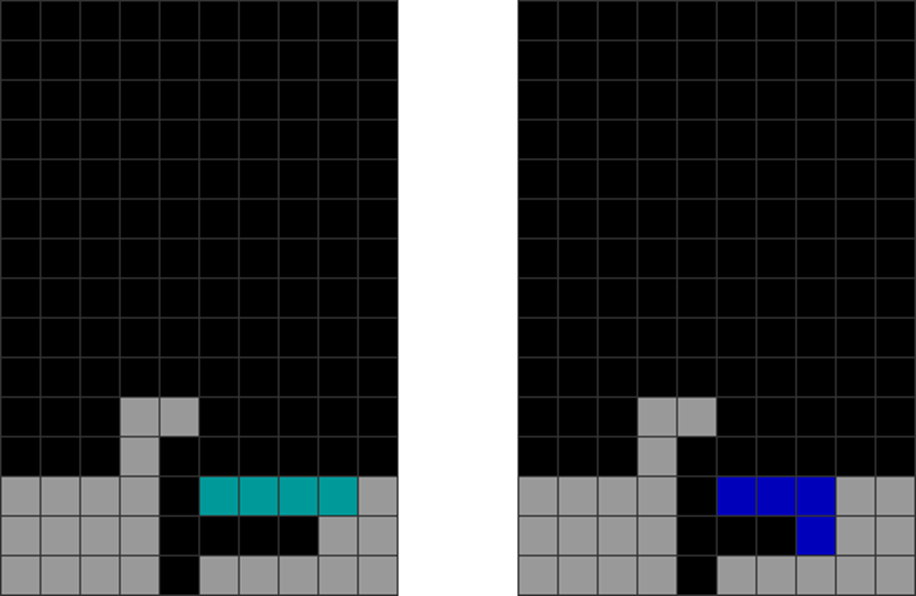
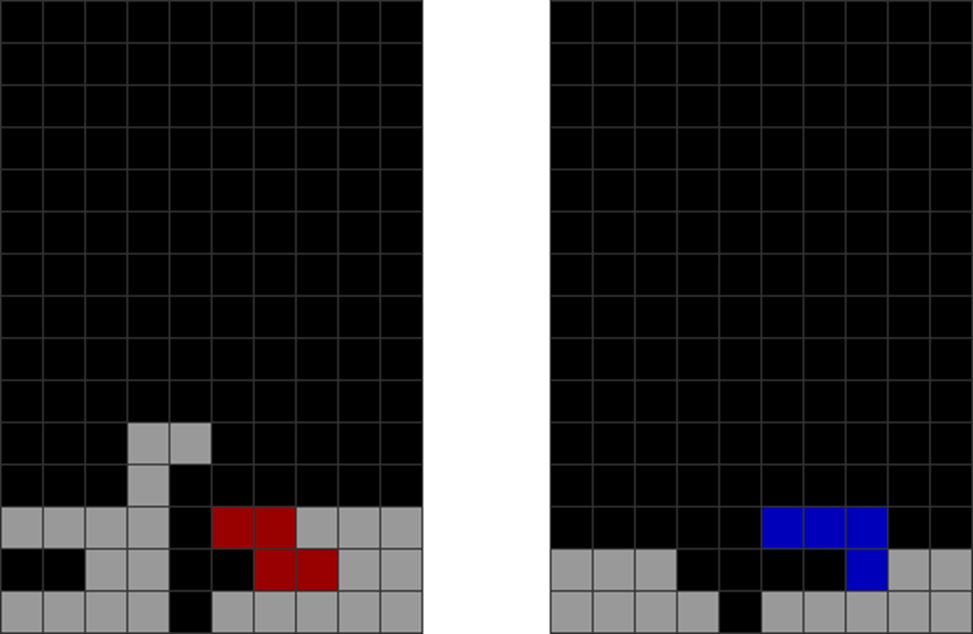
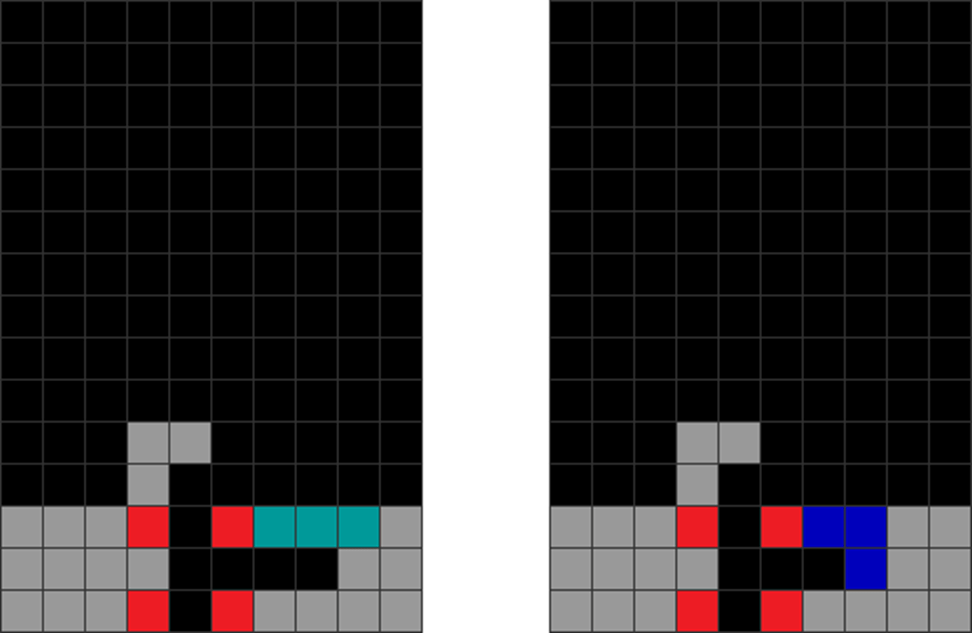
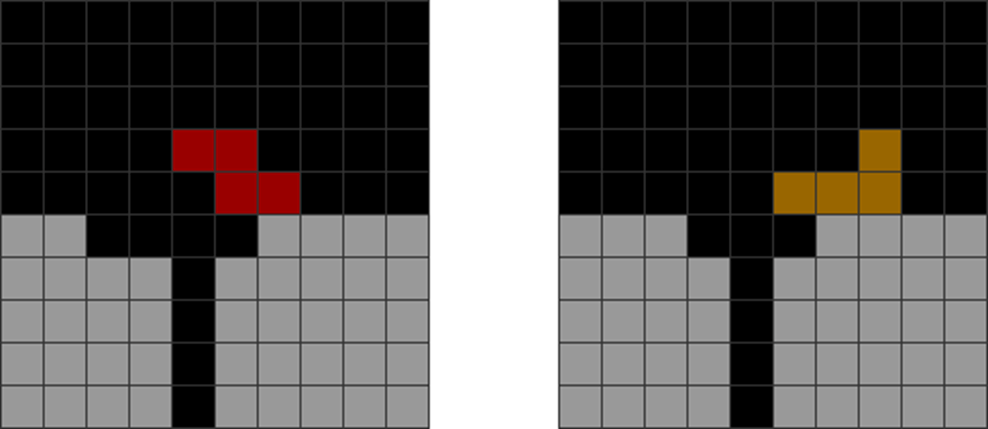
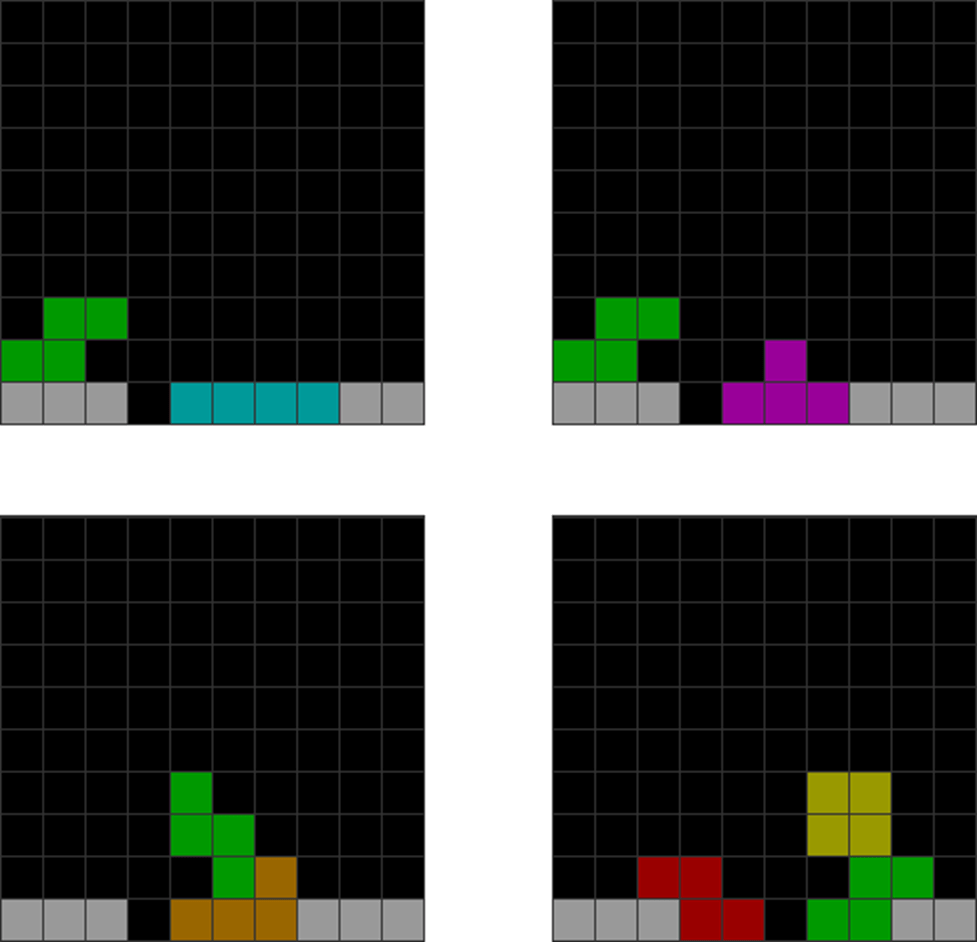
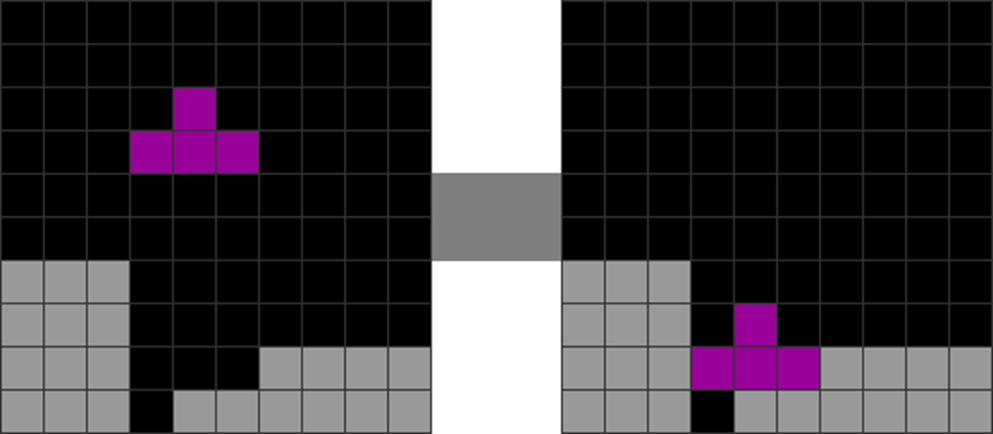
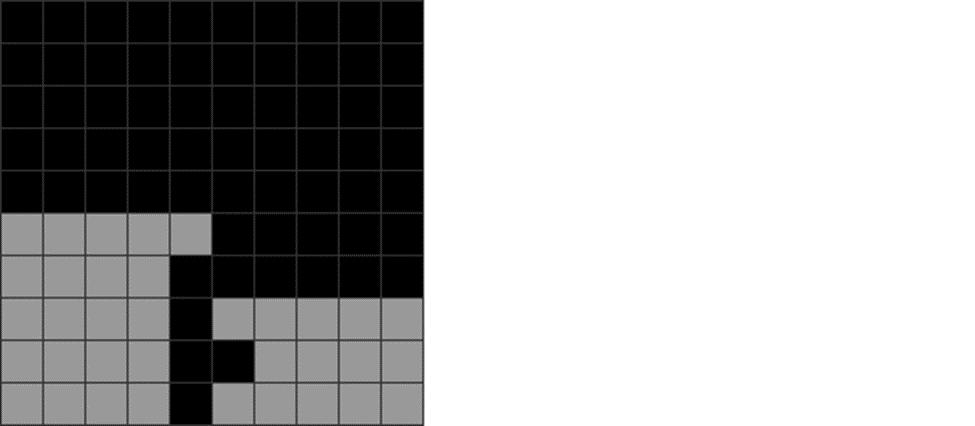
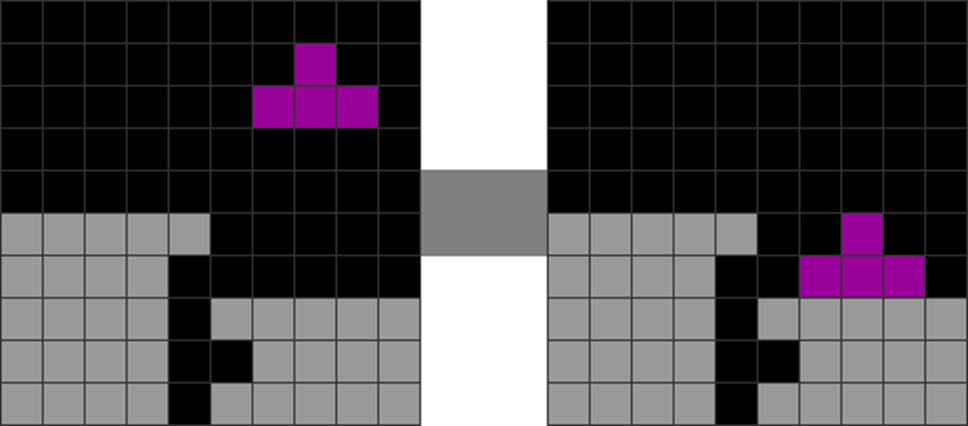
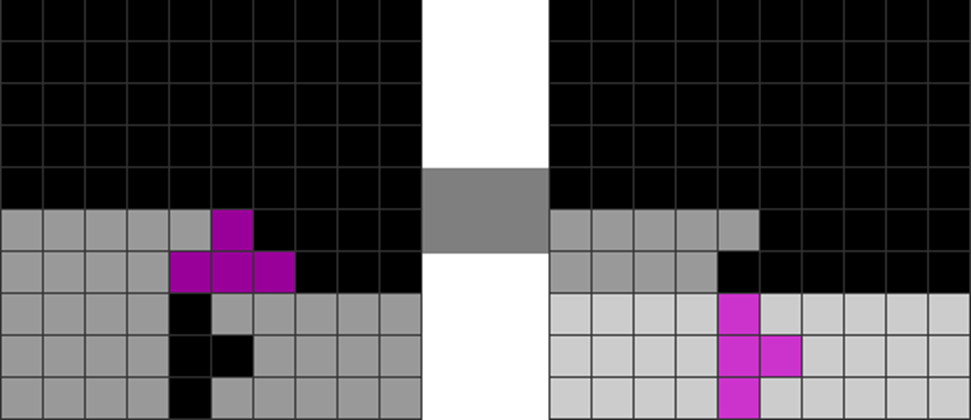
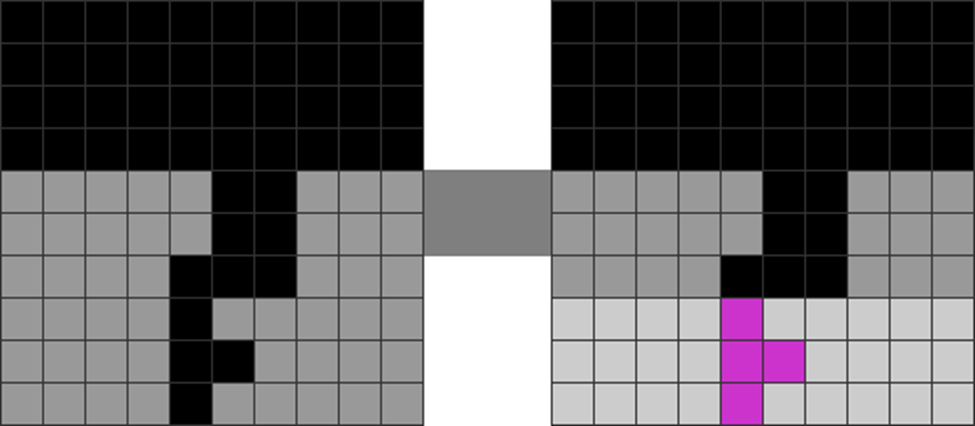
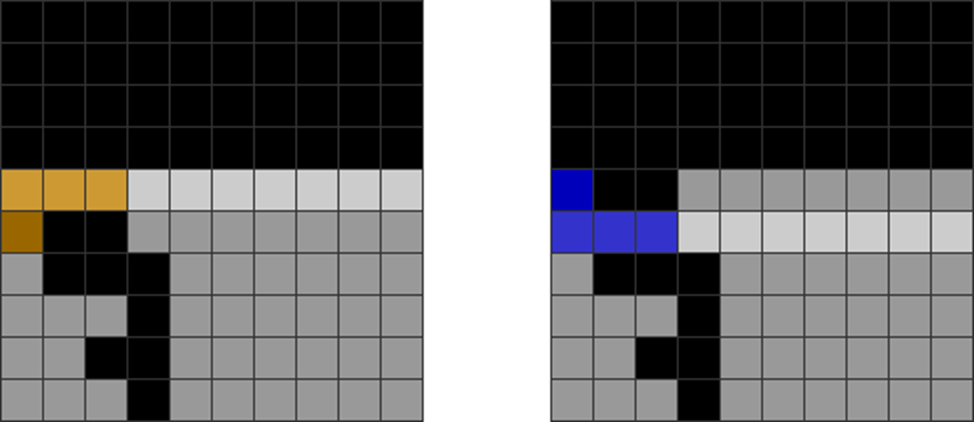
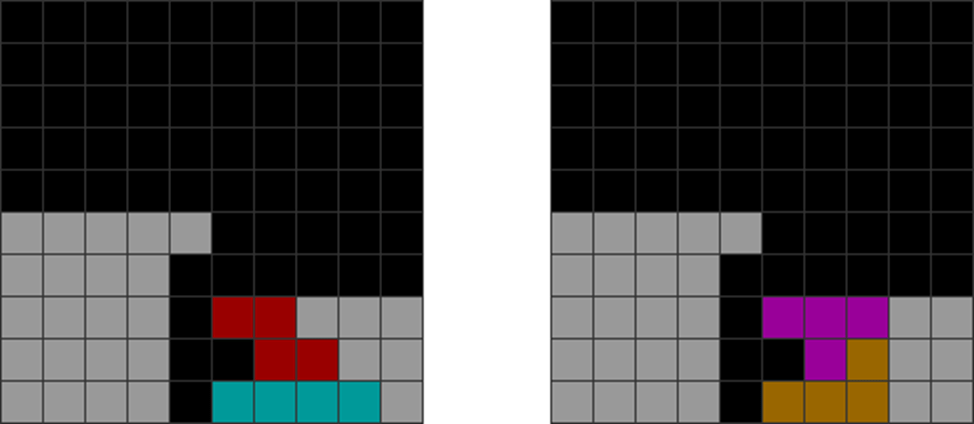
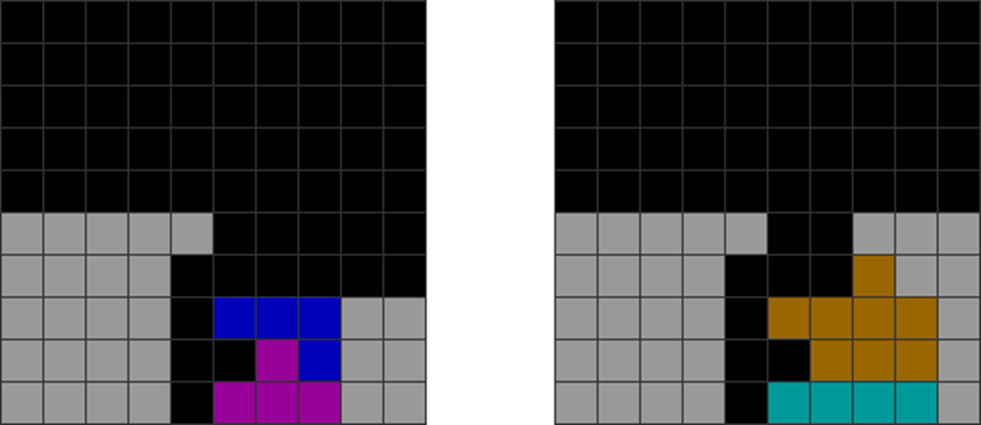
There is a simple, general rule of thumb to evaluate if something is a T-spin: the 3-corner rule. Here are examples below.
Are these T-spins?
Diagram Set 8-1
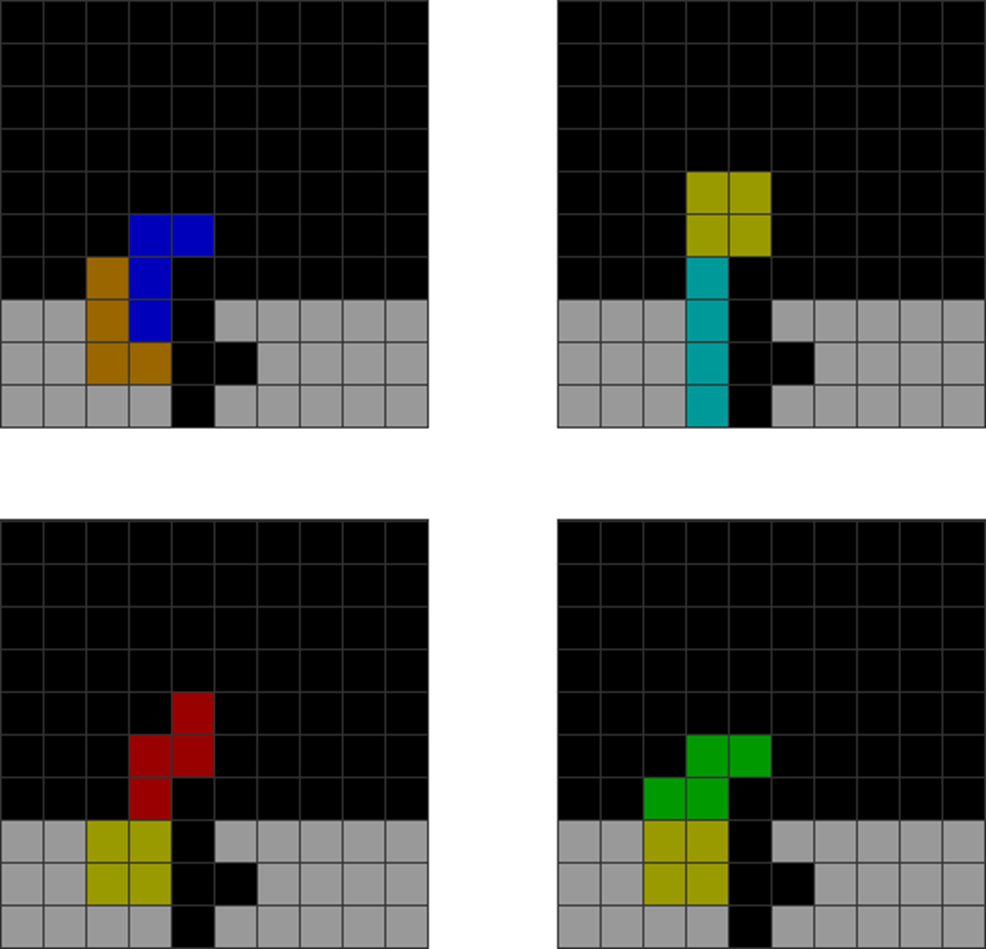
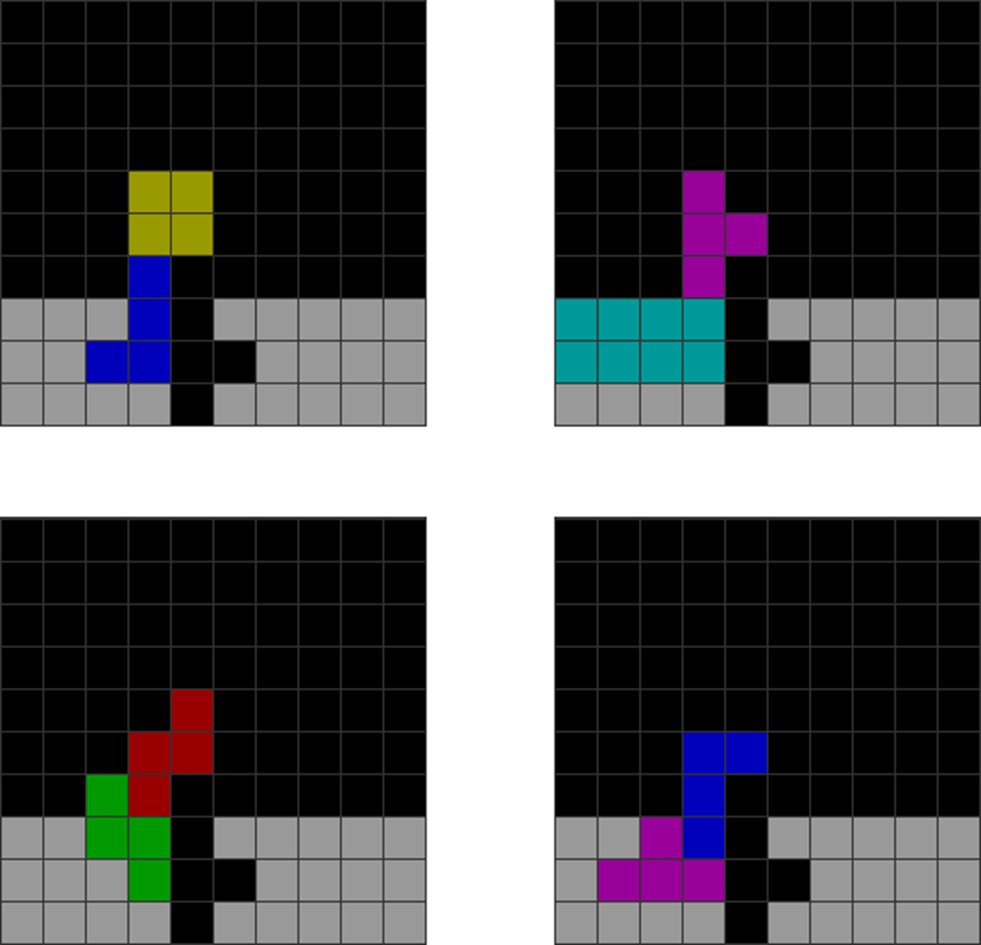
Yes, because of the 3-corner rule:
Diagram Set 8-2
Set: The 3-corner rule states that 3 out of 4 corners of the above red-colored blocks must be filled for the cavity to be considered a T-spin.
Therefore, the above four setups are all T-spins if you insert a T in the cavity through rotation to lock them in. In some older Tetris games, this rule may not apply.
A) The Basics of T-Spin Singles and Doubles
T-spins may seem complex, but I’m here to guide you from their most basic forms to the more advanced ones.
1)The Basics of T-Spin Overhangs
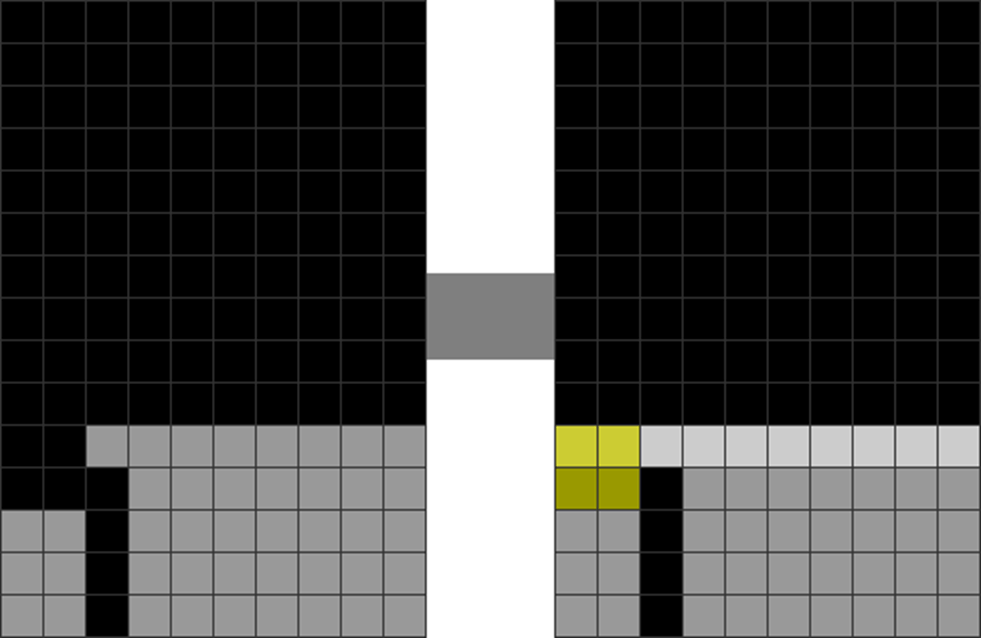
T-spin singles and T-spin doubles are the most elementary T-spins. The former refers to T-spins that clear a single line. The latter are those that clear two lines simultaneously.
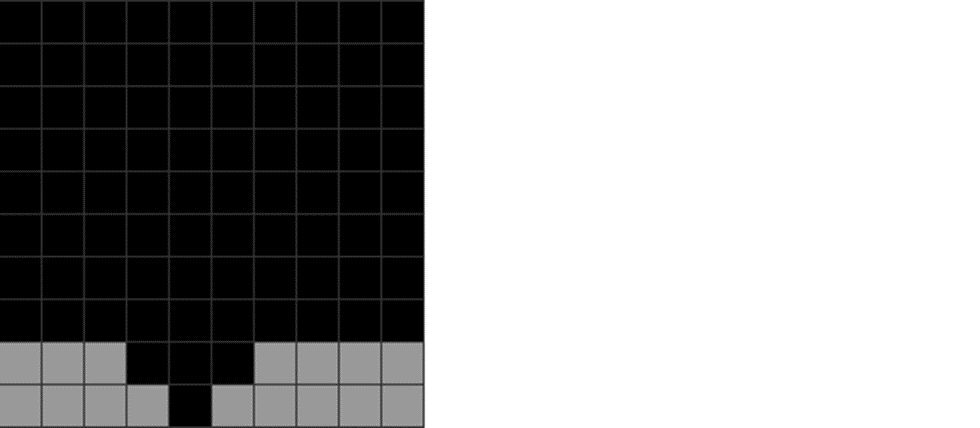
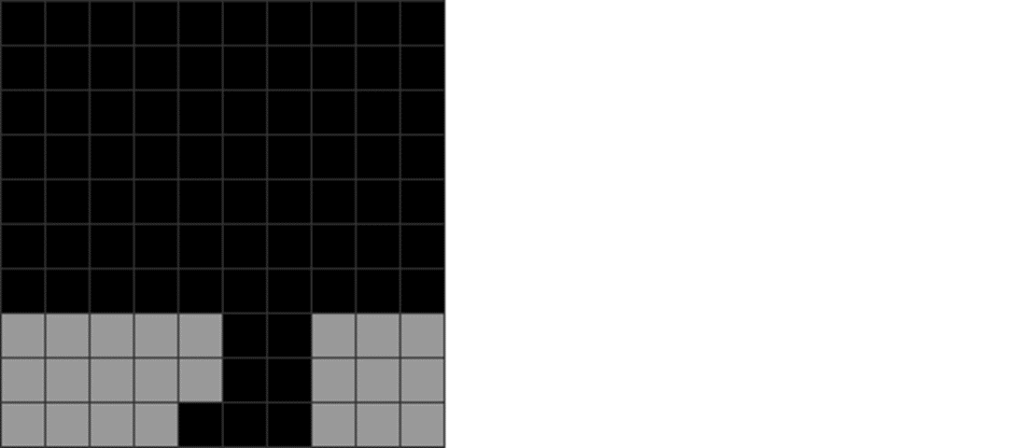
First, recognize this basic shape in the following images below:
Then, an overhang above the T-shaped cavity creates a T-spin double. This can be done as shown below:
To perform the T-spin double, do this:
Diagram Set 8-3
1
2
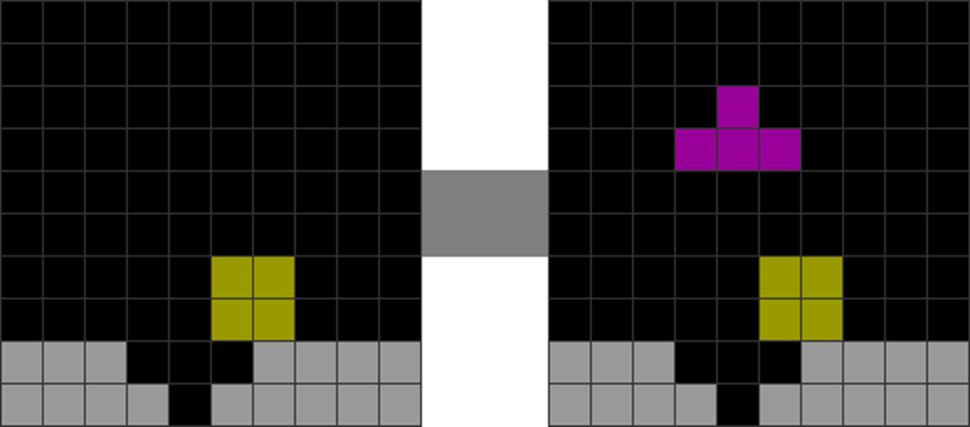
Make an overhang with the O piece over the T-shaped cavity.
Move the T piece to the height above the T-spin cavity.
3
4
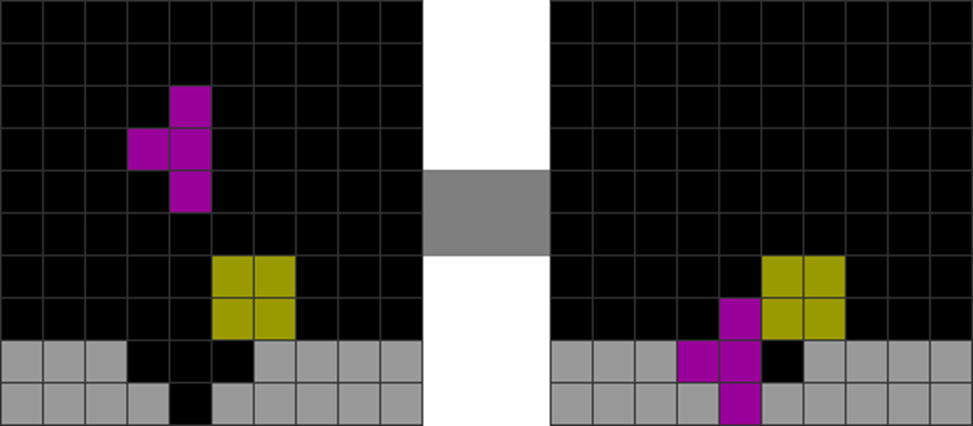
Rotate it in the correct direction just above it to soft drop it down.
Soft drop it into the cavity below. Rotate it to make it fit into the cavity.
5
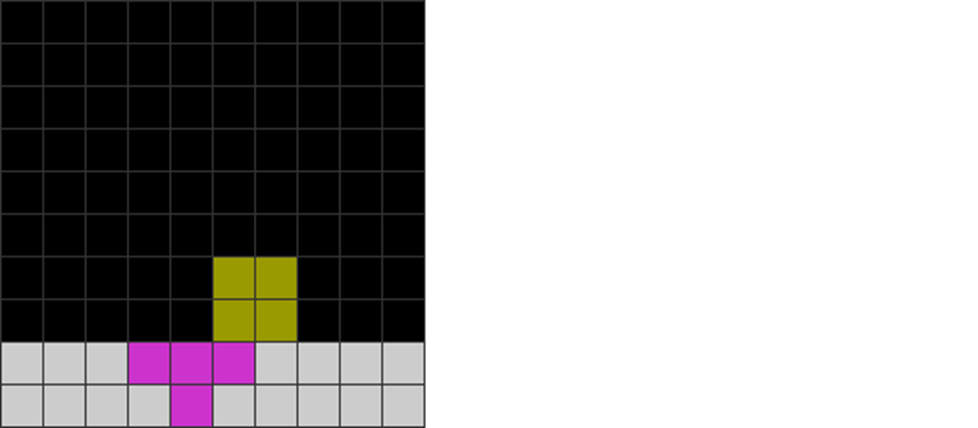
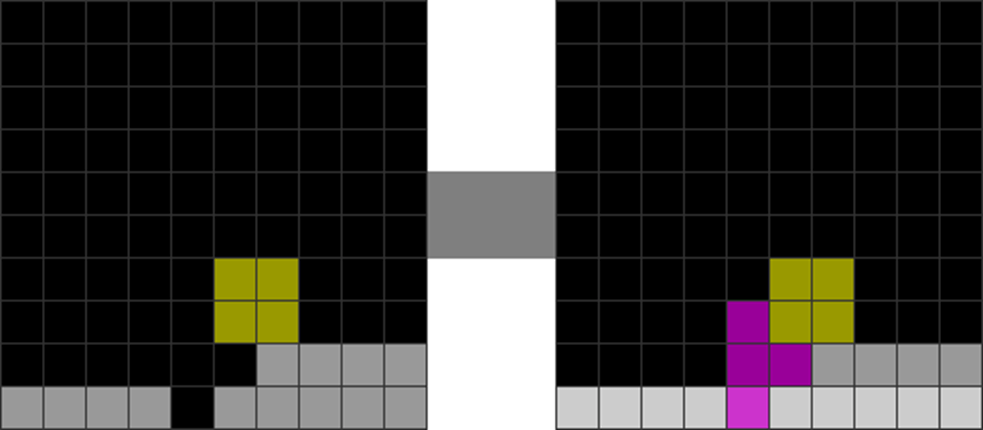
Once the T piece locks, it leads to a T-spin double with two lines cleared.
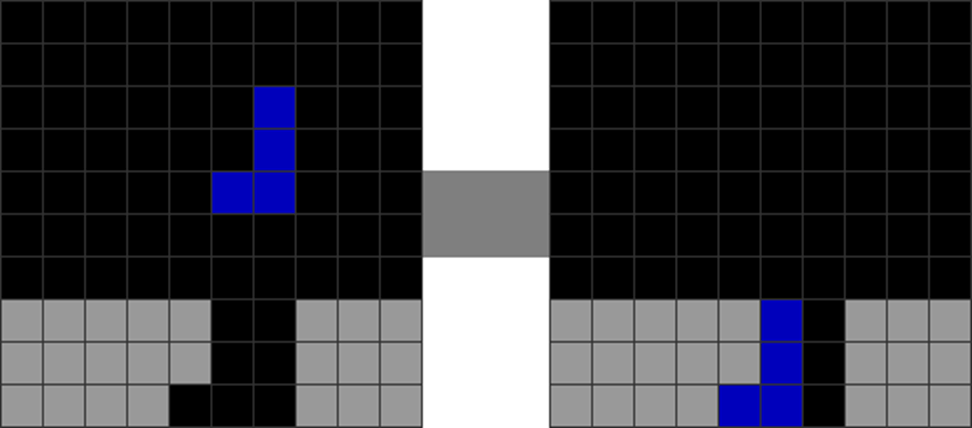
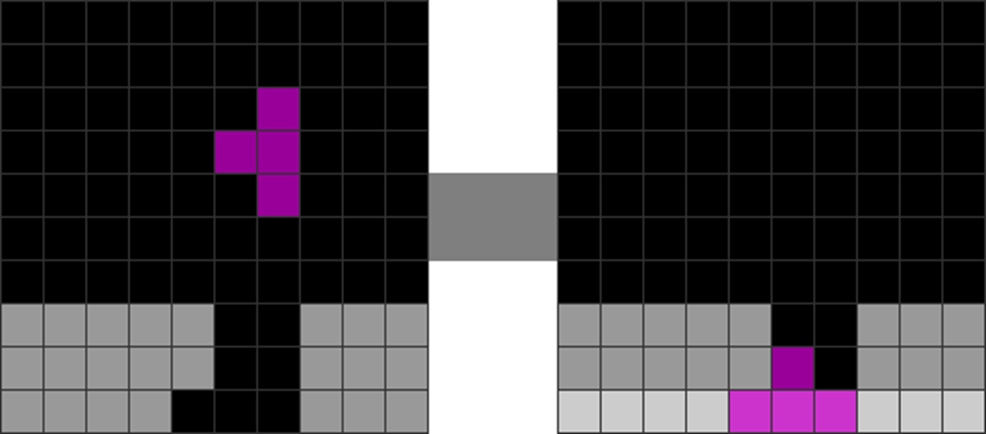
T-spin singles occur when only a single line clear occurs. This happens in the following examples, often when the base is only one block high.
The two sequences below show two different ways of completing a T-spin single:
Diagram Set 8-4
1
2
The T is rotated such that its final placement is vertical.
Diagram Set 8-5
1
2
The T is rotated, so its final placement is horizontal.
The following are non-exhaustive ways to create the T-spin double by making a deliberate overhang with various minos. It is easy to spot T-spin double opportunities when both sides of the stack (the left and right stacks next to the empty columns below) are even (of the same height):
Diagram Set 8-6
The number of ways to make T-spin overhangs is limitless. The second-last example is a T-spin single.
While overhangs can be made using the S and Z overhangs like the first column’s last two examples, it is ill-advised. This is because they require a soft drop to tuck a piece under the hanging cavity to fix. This slows down one’s gameplay.
Likewise, using a T as an overhang is ill-advised, as it would waste a single T piece to do the actual T-spinning. This may create a T-piece drought that mandates waiting up to 12 more pieces for another T-piece to do the T-spinning.
Using an I as an overhang is alright, but you may wish to save an I piece to do Tetrises instead of using it as an overhang.
2)Creating the T-spin Base
Sometimes, the T-spin base (the bottom-most part of a T-shaped cavity) is unavailable. Thus, it would help if you created them by putting pieces to build the foundation, as shown below. In these examples, I used I, T, L, J, S, and Z as the base for five situations:
Diagram Set 8-7
.
A basic T-spin single or double involves a base followed by an overhang. There are many opportunities to create these, as shown above.
Be creative.
B)The Basics of T-Spin Minis
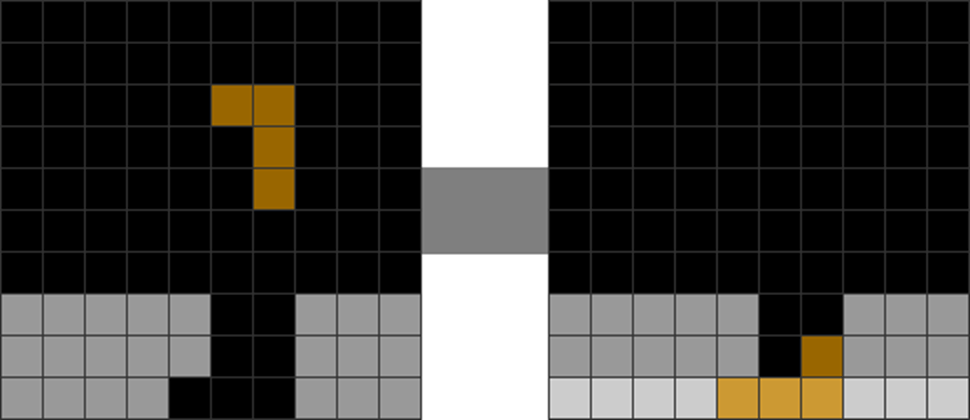
T-spin minis are another type of T-spin. It is a single line clear caused by the following method:
Diagram Set 8-8
1
2
One soft drops the T piece into the cavity.
The T piece touches the base.
3
4
The player rotates and causes the jutting T part to slide over the ground to enter the cavity in column 4. This action leads to a single line clear.
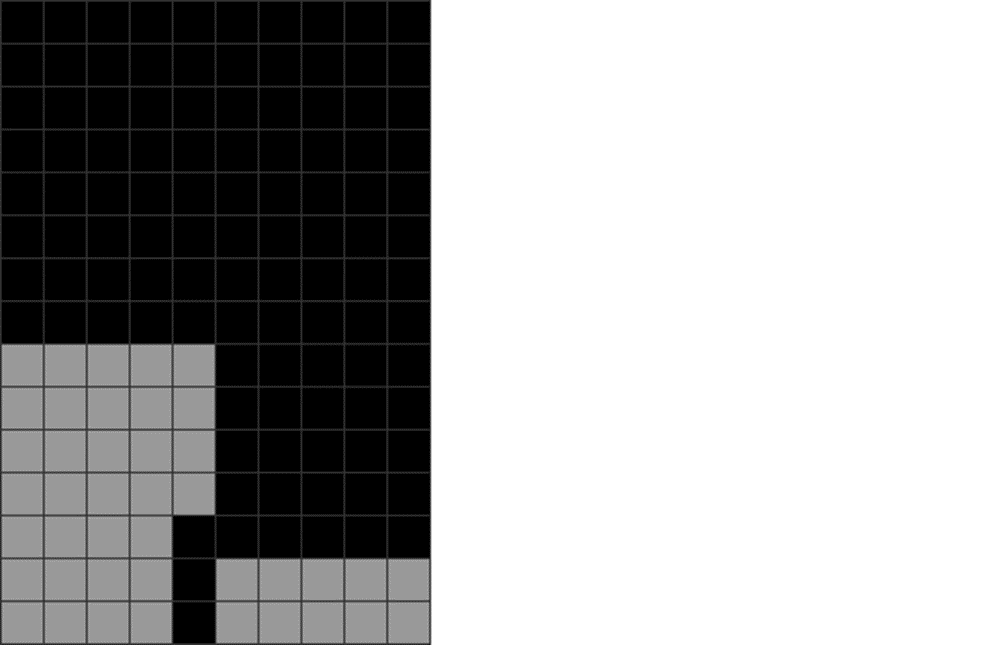
After the line clear, you get this pattern.
Step 3 leads to a T-spin mini. It doesn’t rotate into a T-shaped cavity like a T-spin single.
It sends zero lines of garbage. However, if the back-to-back bonus is on, it sends one line of garbage. It also sustains and triggers back-to-back bonus. If the back-to-back bonus is not already on, it starts, making the next T-spin or Tetris maintain the back-to-back bonus but not the current round.
C)The Basics of T-spin Triples
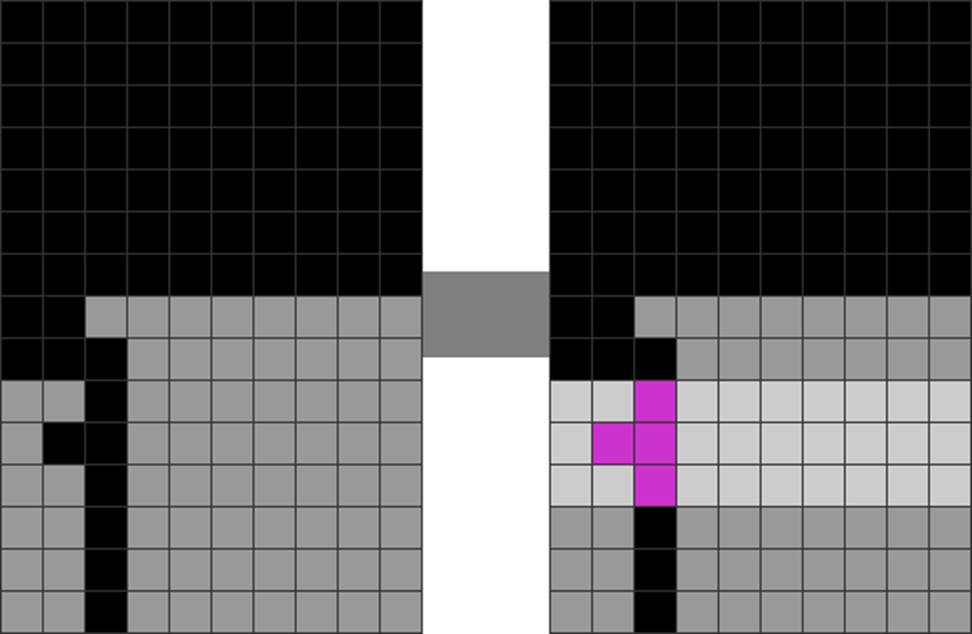
Apart from T-spin singles and doubles, there are also T-spin triples. This involves making the following general shape:
To perform the T-spin triple, do this:
Diagram Set 8-9
1
2
Soft drop the T piece into the cavity’s level in its default spawn position.
Slide it in such that the T piece touches the overhang.
3
4
Rotate the piece to get it in.
Once the T piece locks, you will perform a T-spin triple, clearing three lines. You can hard drop when the T piece fits for a slight bonus speed to let it clear instantly.
C)The Basics of T-spin Triple Overhangs
Just like T-spin singles and doubles, T-spin triples require making an overhang, such as those in (these are not exhaustive!):
Diagram Set 8-10
.
The above shows many permutations with the 7 minos to create the T-spin triple overhang.
Please experiment.
Unfortunately, T-spin triples have one major disadvantage compared to T-spin singles or doubles: they are unclean (except for C-spins, which will be covered later):
Diagram Set 8-11
1
2
This is a T-spin triple setup.
The player slides and rotates in the T piece to make a T-spin triple line clear.
3
The outcome leaves this unclean cavity with an overhang.
Thus, T-spin triples typically leave an unclean overhang that needs to be cleaned up.
Likewise, they take longer to build than a T-spin single or double. They may also disorganize the field’s flatness and stability. Thus, many expert players like me emphasize T-spin doubles over triples.
Here are some ways to follow up properly by filling the leftover cavity:
Diagram Set 8-12
1
2
Diagram Set 8-13
1
2
Diagram Set 8-14
1
2
Diagram Set 8-15
1
2
All last four sets: All four sequences involve inserting a piece into the cavity. The examples here use J, T, S, and L.
Many new and intermediate players make the mistake of going for unclean T-spin triples, such as:
Diagram Set 8-16
1
2
3
This T-spin triple setup is unclean, as the above red-circled overhang covers the garbage hole below.
Thus, it would help if you skimmed off the overhang to make the stack clean again.
If the overhang is short, you can skim it off like this:
Diagram Set 8-17
1
2
This is an unclean T-spin triple setup.
The player performs a T-spin triple by inserting the T piece into the cavity.
3
4
You get this unclean shape.
The player uses an O piece to skim off the overhang, exposing the garbage hole again.
Sometimes, you get into this situation and can’t T-spin triple because the red-circled ‘wall’ must be at least two blocks high:
For such cases, you can use the following emergency skim if an I piece can’t arrive in time to make a tall ‘wall:’
Diagram Set 8-18
Here, the respective L and J skim causes the “wall” on the left to become 2-blocks-high.
The player can then successfully rotate in the T piece to make the T-spin triple.
2)Creating the T-spin Triple Base
Like T-spin doubles, you can create the T-spin triple’s base when a T-spin triple opportunity doesn’t arise easily. You can do this with the following non-exhaustive methods:
Diagram Set 8-19
T-spin triples can be created in more ways than T-spin doubles because of their greater complexity. Memorizing these is optional as it is more vital for the player to freestyle them mid-game.
Summary and Conclusion
This chapter covers the most rudimentary T-spin methods. They are opportunistic and easy to spot, given a few days to a week of training.
Concept
Summarized Rules-of-Thumb
Flow
Pass up T-spin triples for cleaner T-spin doubles if needed.
Form
Use overhangs that are flatter and more conducive for T-spins. Memorize the ways to combine pieces to make the T-spin base and overhangs.









 How to Tetris