Classic Tetris, created by Alexey Pajitnov in 1984, is a puzzle game where players fit falling tetromino shapes into complete lines.
It gained popularity in the Soviet Union and later internationally. Nintendo’s release of Tetris on the Game Boy in 1989 propelled it to worldwide fame. Legal battles over licensing rights ensued. Tetris remains a classic, enjoyed on various platforms, with its addictive gameplay and enduring legacy captivating players across generations.
As a disclaimer, I, Galactoid, am a modern Tetris expert. Although I have written this chapter for completeness, I have made it succinct and simple to avoid overstepping my area of expertise.
The Goal of Classic Tetris
The goal of Classic Tetris is to score as highly as possible, typically achieved by stacking with a hole on the extreme right side and focusing on Tetrises (4-line clears or quads). This strategy gives the highest score possible, as singles, doubles, and triples yield lower points.
In Classic Tetris tournaments, two players compete side by side, but there is no direct interaction between their playfields. Players aim to achieve the highest score possible while surviving under increasing difficulty levels (e.g., starting at level 9 or higher). The winner is determined by who tops out their screen last or achieves the highest score before topping out. Unlike modern Tetris games, Classic Tetris does not involve sending garbage lines to an opponent’s field, as it is a single-player experience adapted for competitive play.
The level increases as the game progresses, with advanced players reaching levels far beyond 19, up to the theoretical maximum of 255. Gravity increases with each level, becoming noticeable at level 8 and speeding up significantly at higher levels (e.g., level 18 and beyond). This substantial increase in speed can catch players off-guard and disrupt their stacking strategies.
A) Classic and Modern Tetris Differences
Classic Tetris:
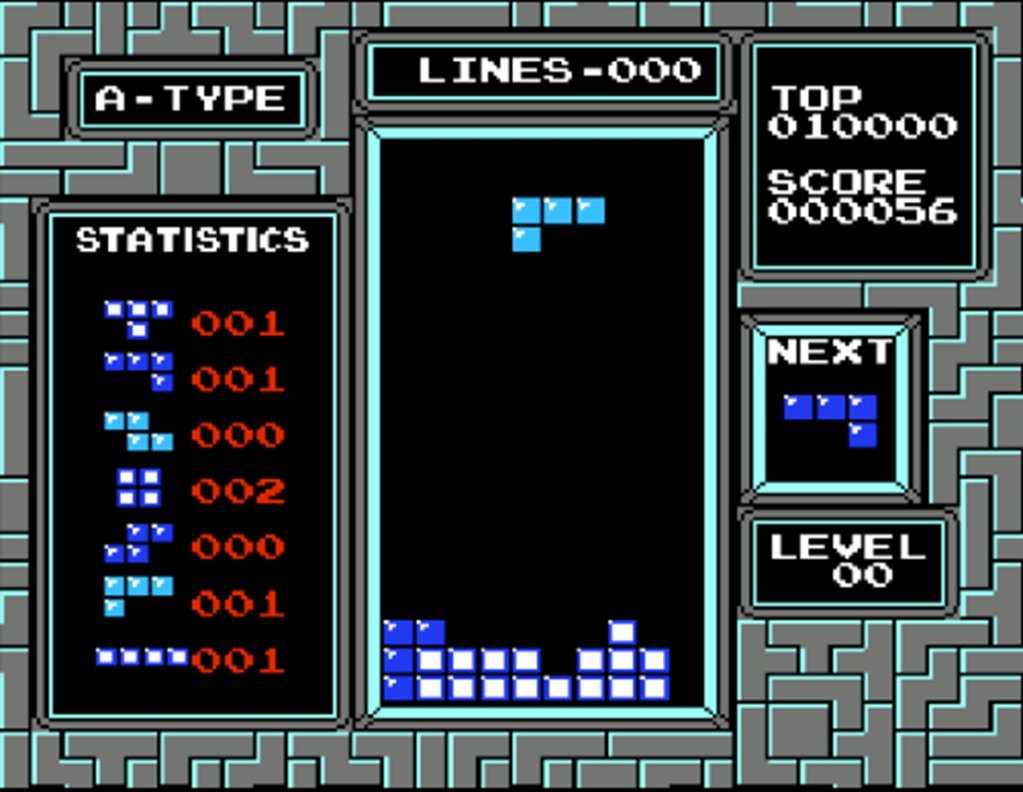
Modern Tetris:
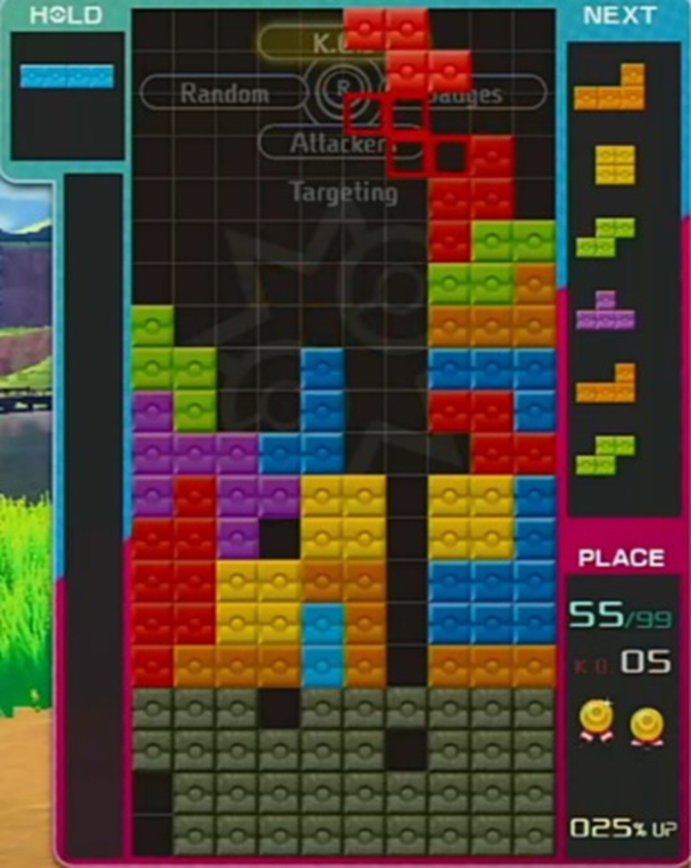
Note the differences in the piece colors, preview, hold function, ghost piece, and garbage. These captures from Tetris 99 and NES Tetris are reproduced under fair use for instructional analysis.
Classic Tetris can sometimes be brutal compared to modern Tetris because some mechanisms make life harder. For instance, here are the differences between classic and modern Tetris:
1) No hard drops
Classic Tetris has no hard drop. Its pieces spawn differently and have no bonuses awarded to T-spins. It likewise does not have a garbage system or a dedicated one vs one system.
Modern Tetris, conversely, has hard drop, T-spins, garbage, and multiplayer modes.
2) No wiggling
In modern Tetris, you can wiggle a piece before it locks down, allowing you more time to place pieces. In Classic Tetris, pieces almost instantly lock when they touch the stack.
3) No 7-piece randomizer
This is perhaps the thing that makes Classic Tetris considerably harder than modern Tetris. Without a 7-piece randomizer, you can take as long as a hundred pieces to get a specific piece.
Thus, if you stack poorly with many piece dependencies, you will over-stack poorly if you wait for the piece (known as ‘fishing’). The same is true with I-piece droughts, which mandate that one skims using other pieces to avoid topping out.
4) Pieces spawn differently
Some pieces in Classic Tetris spawn upside down compared to modern Tetris. This thus requires a unique set of movement finesse for piece placements compared to the latter.
5) No T-spins and some spins don’t work
Some spins rewarded in modern Tetris, such as T-spins, are absent. Thus, this makes the game more focused on Tetrising. Likewise, specific spin configurations that work in modern Tetris won’t work here – they will lead to an instant lock if you try. Thus, this restricts stacking possibilities.
B) General Classic Tetris Tips
Many skills in modern Tetris are directly transferrable to classic Tetris. However, they are different games, and each deserves unique gameplay strategies.
1) Proper Stacking
There are three stacking guidelines to follow when playing Classic Tetris. These have been elaborated further in the Stacking and Sprint chapters with more illustrations.
Rule 1: Join the field when stacking
The ideal way to stack well is to avoid too many field divisions while stacking.
Rule 2: Flat stacking
Likewise, I recommend keeping the field as flat as possible, except occasionally creating a few bumps to place S and Z pieces with no need for soft drops. Doing so avoids the sin of over-stacking, which can lead to dead ends.
Rule 3: Maximize stacking follow-ups
The player should stack to place almost any piece as far as possible. Some players stack in a jagged manner that can’t allow for L, J, or O pieces to be placed. Others stack too flatly, so S, Z, and T pieces can’t be placed.
Because of the highly random nature of Classic Tetris, where you can’t hold pieces or count on modern Tetris’ 7-bag randomizer, it’s best to stack openly and broadly with minimal field divisions.
2) Minimizing Piece Dependencies
| Diagram Set 11-1 |
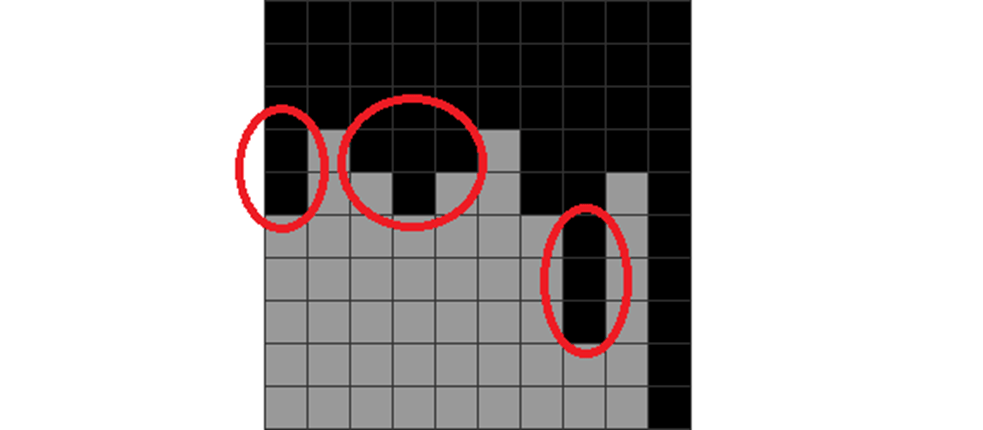
| This field shows three red-circled areas with severe piece dependencies. |
Let’s consider them from left to right. The first can only be filled with I or J. The second can only be filled with S, Z, T, or I. The last can only be filled with an I. When there are too many piece dependencies, you may not get the right pieces to fill these cavities. This will likely result in messy stacking over holes.
Thus, stack in a way that minimizes piece dependencies as far as possible. This is more important in Classic than modern Tetris because of the absence of the 7-piece randomizer.
When you have piece dependencies, you may need to wait for over seven incoming pieces to get the right piece in modern Tetris. However, this can be up to dozens of pieces in Classic Tetris! This may, thus, lead to overstacking as you wait for the right piece, which is often suicidal in Classic Tetris!
3) Using Generous Skims to Keep Low
| Diagram Set 11-2 |
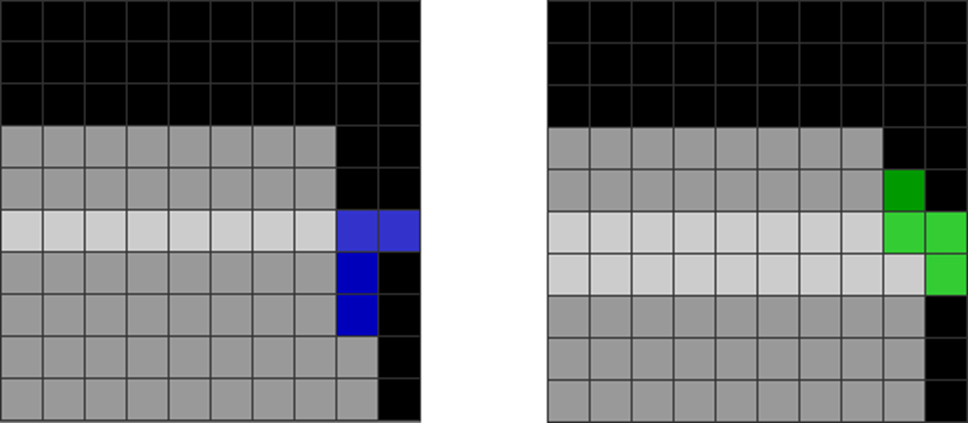
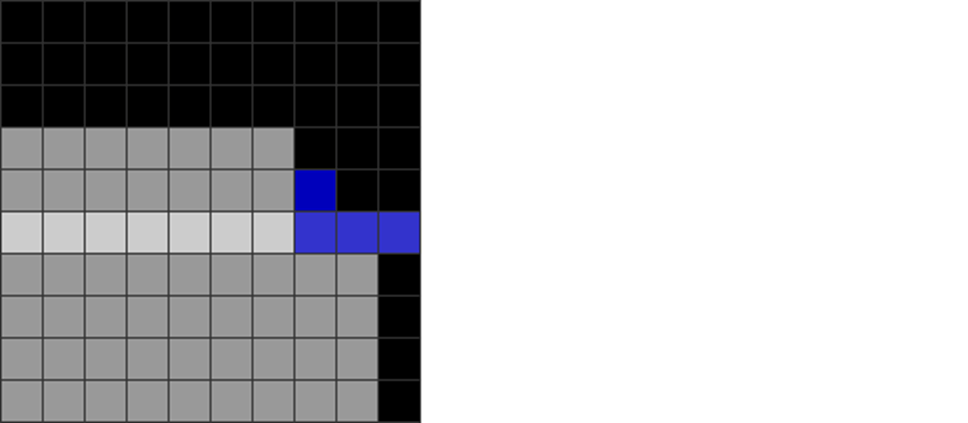
| These three diagrams show examples of the kinds of skims you must do in Classic Tetris. The Tetris hole is on the far right. |
Make do with every piece in Classic Tetris because there is no hold or 7-piece randomizer function. This will lead to cases where you have sub-optimal placements, such as overstacking.
Using skims, especially at the corners, like in the above diagram, helps to even out the field and keep it flat and clean. It also ensures you won’t overstack and cause high gravity to prevent you from placing pieces at the top.
Skimming also helps you keep your stack low. Stacking high is dangerous when gravity increases and maxes out. Even the fastest DAS charging or hyper-tapping cannot move pieces to the desired location if stacked too high. Gravity will pull it down completely and instantly lock the piece. Therefore, it is vital to skim and keep low before this dead-end happens, which is the primary way most players lose.
This is a core strategy used by many top Classic Tetris players. Good skimming is a mandatory skill to learn.
4) Put the Garbage Hole on the Extreme Right and Maximize Tetrises
| Diagram Set 11-3 |
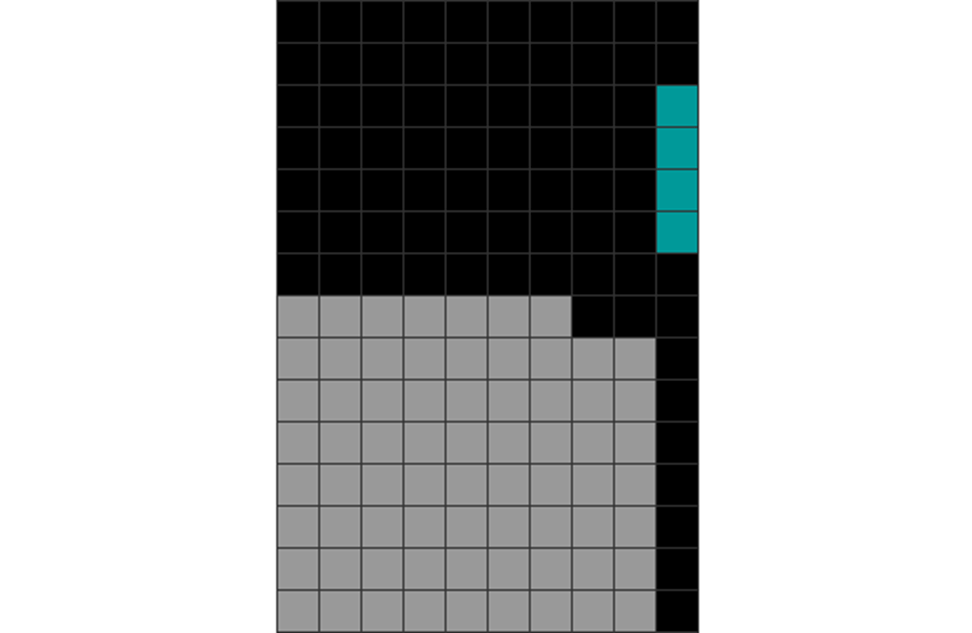
| I recommend placing the Tetris hole on the extreme right. This is opposed to putting it on the extreme left. |
In NES Tetris, pieces spawn slightly to the right of the center. Placing the Tetris well on the far right aligns with Classic Tetris’ spawn positions and rotation mechanics, facilitating more reliable and efficient piece placements.
Putting Tetris holes in other columns is not recommended as it divides the field and severely constricts piece placement continuities.
It is vital to prioritize Is for Tetrises as soon as possible. Whenever your field is at least four blocks high, go for a Tetris!
5) Proper Jaggedness Management
The most important thing is to manage the field’s jaggedness. When the field is jagged, it can create many dead-ends, leading to horizontal L, O, and J pieces not being able to be placed. However, when the field is flatter, most pieces can be placed. Here’s an illustration:
| Diagram Set 11-4 | |
| 1 | 2 |

| The field is jagged. | The player can only place vertical S, Z, and I pieces, further worsening the stack. |
| Alt. A |
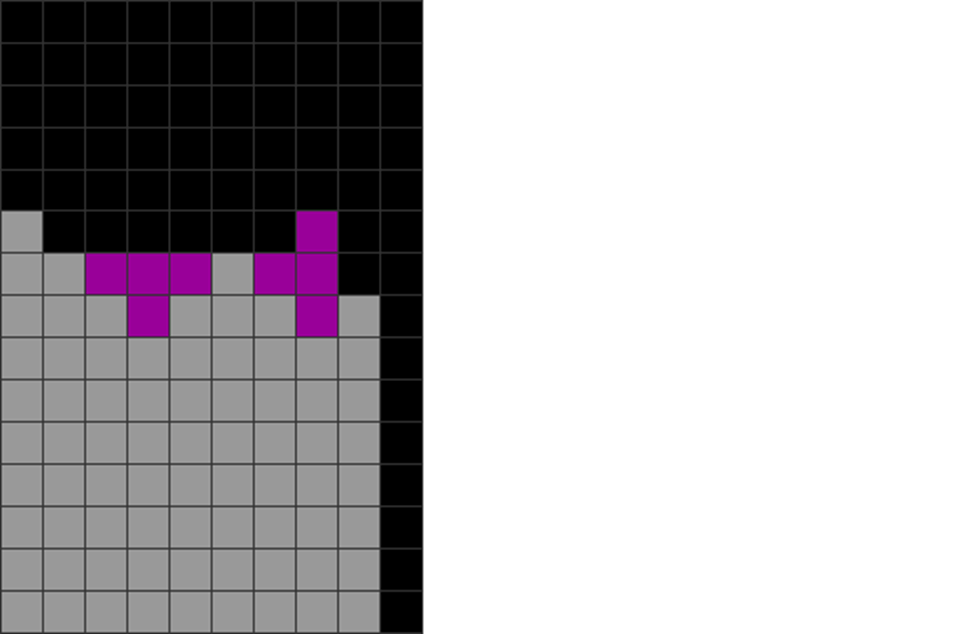
| This shows how to use T pieces to stabilize and resolve jaggedness. This then flattens the stack, making stacking easier and smoother. |
The Dangers of T Floods
When you have multiple Ts in a row, it could severely mess up jaggedness. This happens when you place Ts in the wrong way like this:
| Diagram Set 11-5 | |
| 1 | 2 |
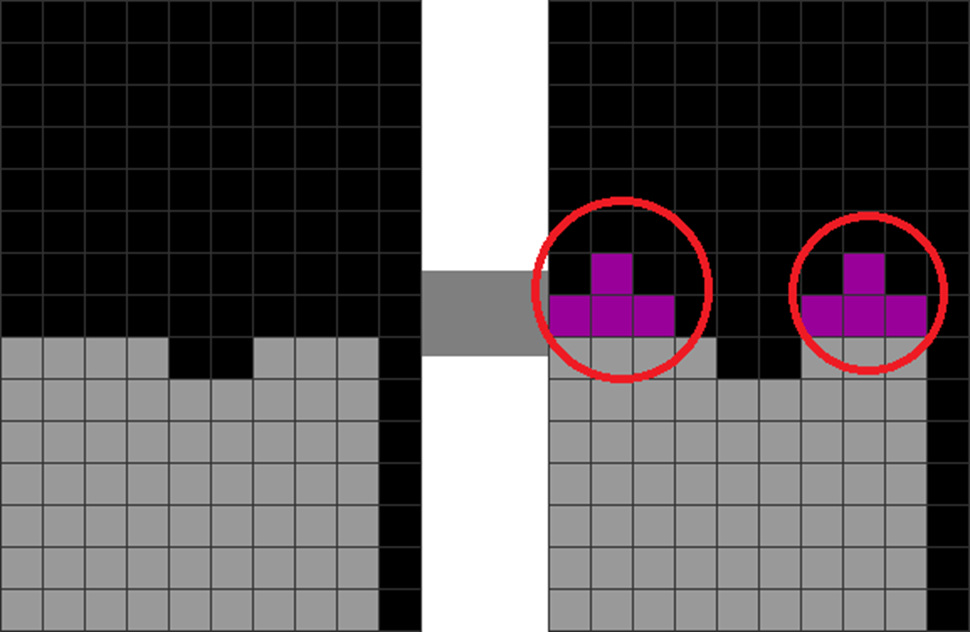
| This field is originally flat. | The player places two Ts far apart in the originally flat areas (red circles). |
| Alt. A |
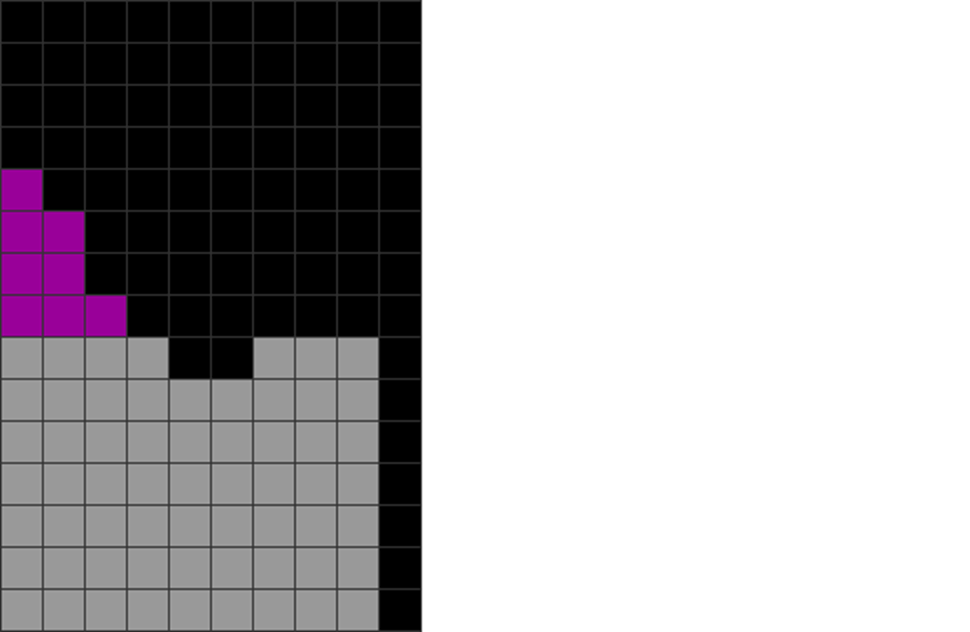
| Combining the two T pieces creates a better placement. |
Step 2 creates two jagged areas, which need another two Ts to stabilize, which is scarce in Classic Tetris in a T drought.
If you get multiple Ts, pairing them side-by-side to fix jaggedness in Alt. A is best.
If there’s no incoming T and your field is jagged, use singles, triples, and separate line clears to flatten the stack. This is sometimes a must, as Classic Tetris is unforgiving with its random sequences.
Summary and Conclusion
Classic Tetris is sometimes considerably more challenging for a modern Tetris player because of the higher indeterminacies of the game.
Although the number of strategies is far lower than that of modern Tetris (because of the lack of T-spins, garbage, and other modern mechanisms), it emphasizes clean stacking, skimming, and neuro-motor requirements more. Other than the highest levels, it also emphasizes speed less.
| Concept | Summarized Rules-of-Thumb |
| Flow | Avoid excessive field division and jaggedness. Stack flatly and openly. Maximize stacking follow-ups.Maximize Tetrises. |
| Form | Put the garbage hole in the extreme right column. Know how to manage jaggedness to make the field flatter. Know how to handle T floods. |
| Balance | Minimize piece dependencies. Skim if you must clean up the field and make it flatter or eliminate excess pieces. |
 How to Tetris