Downstacking is defined as lowering the overall stack’s height.
Because garbage is received such that each row has only one cavity, downstacking refers to getting down from a garbage hole on top to another at the bottom and reducing the stack’s height. This is done with line clears.
| Diagram Set 7-1 | |
| 1 | 2 |
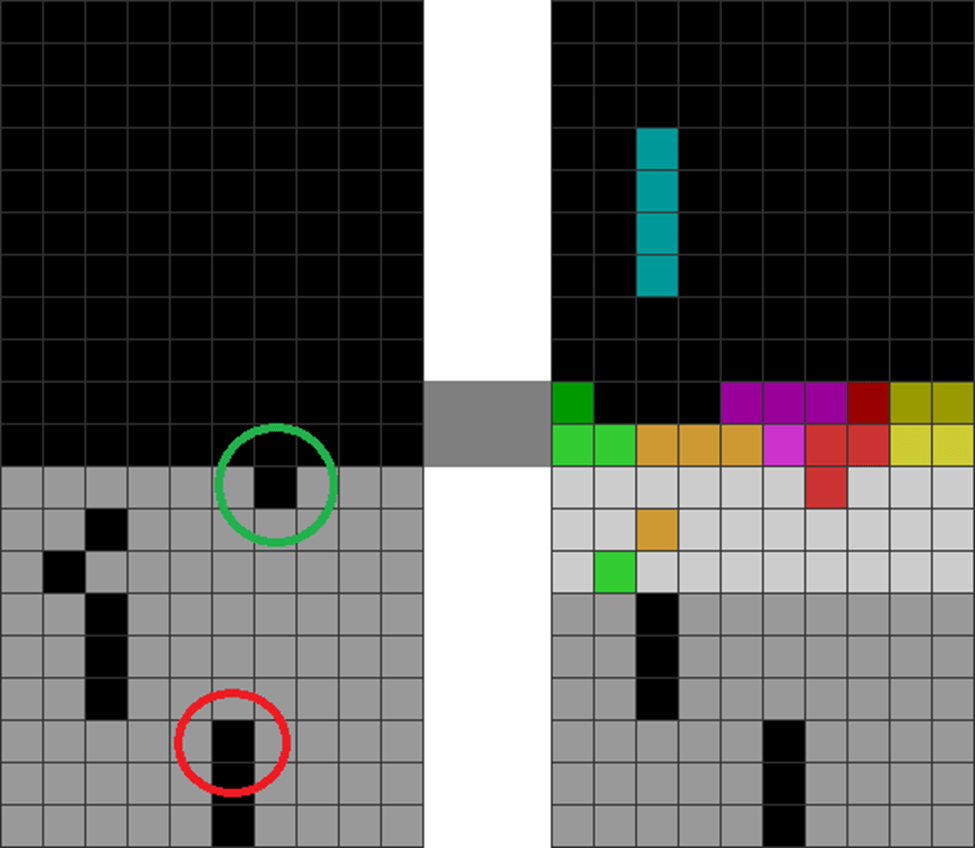
| Downstacking aims to get down from the green-circled cavity to the red-circled one below. | A player downstacks using S, L, T, O, I, and Z to skim, opening up the hole in the third column for the Tetris to perform a triple. |
This lowers the stack’s height, completing a downstacking sequence.
Downstacking is highly important, as it involves the ability to play defensively. When you receive garbage from opponents, you wish to get down as soon as possible to avoid topping out. A good player knows how to balance downstacking and upstacking.
Here is the most important general and fundamental rule of downstacking:
The Golden Rule of Downstacking: The flatter and less divided a stack, the higher the downstack combo chances, and the smoother the downstack with fewer upstacked pieces or wastage.
Core Downstacking Fundamentals
Here are the most basic and common skills I learned in downstacking.
1) Don’t Cover the Next Garbage Hole Too Much
This is the most elementary of all downstacking skills. Here’s what I mean:
| Diagram Set 7-2 | |
| 1 | 2 |

| This is the starting field, with semi-dirty garbage. | The player uses a vertical Z piece to downstack the first garbage hole. |
| 3 | 4 |
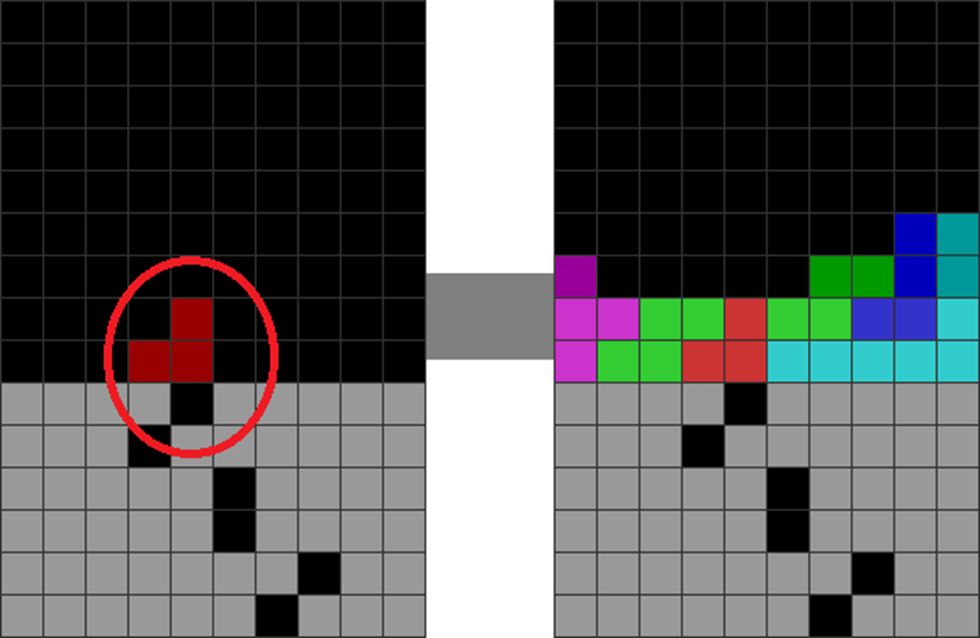
| This leaves a red-circled area where the two red-colored blocks are upstacked over the next garbage hole. | A player must build up two layers to skim through it to expose the next garbage hole. |
Conversely, a player can do this instead:
| Diagram Set 7-3 | |
| 1 | 2 |
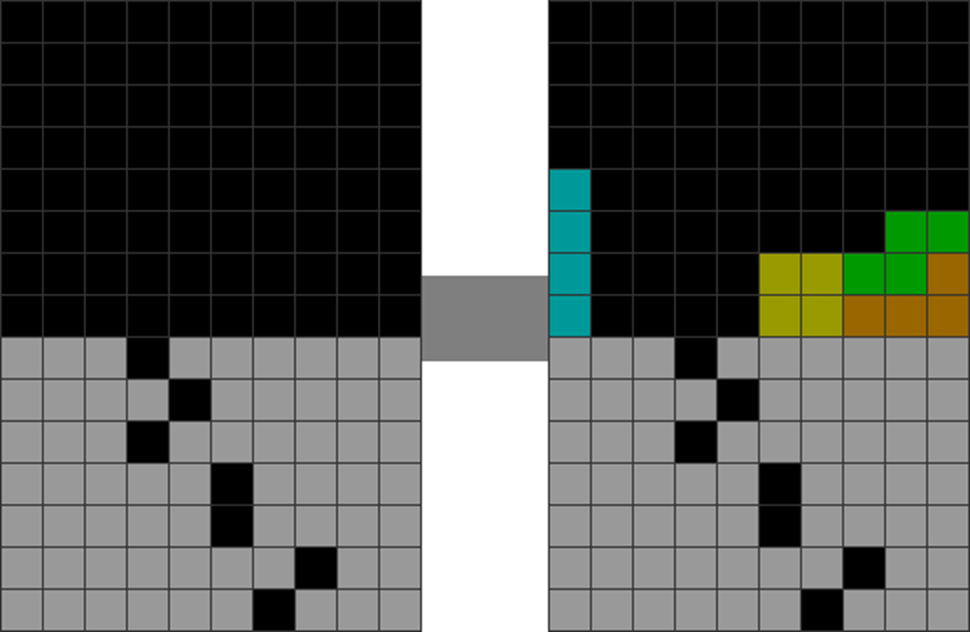
| This is the same starting field as the last diagram set. | The player upstacks a bit. |
| 3 | 4 |
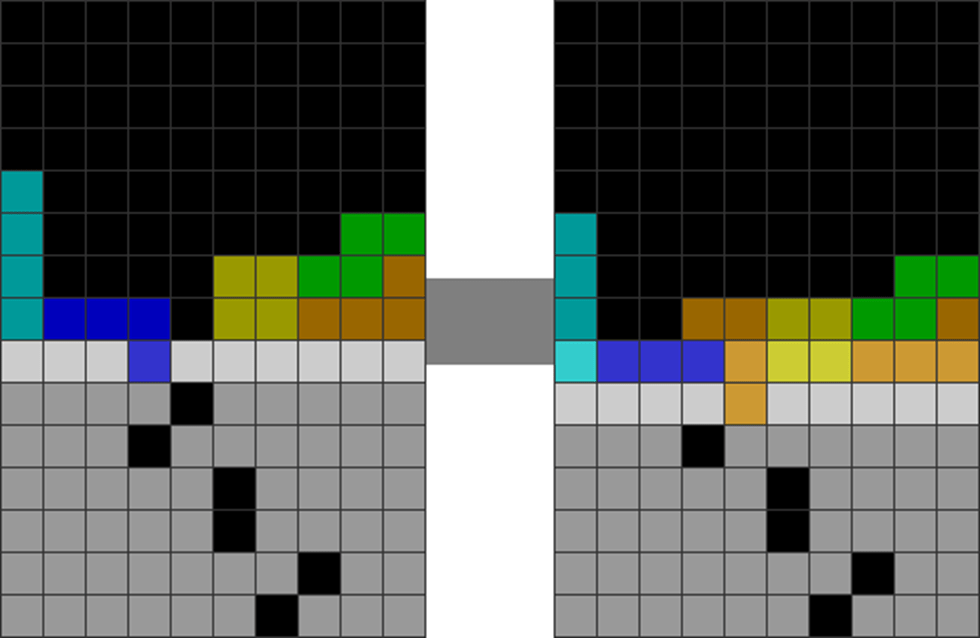
| He uses a J to skim and downstack, opening up the second garbage hole. | The next garbage hole is downstacked with an L. |
| 5 | 6 |

| Then, an O. | Finally, a Z skim opens up the garbage hole in column 6. |
This entire sequence joins the attack, which means the downstack is continuous, setting up a massive downstack combo to increase one’s offense while downstacking.
See how much smoother this is?
Upstacking a bit lets you connect attacks to create more offensive power with combos. It also sizably increases the downstacking smoothness by reducing residue pieces that block the garbage hole and must be skimmed off, which reduces efficiency.
Therefore, not upstacking excessively over the next garbage hole is essential.
2) Hole Switching
Hole switching is the concept of changing the position of the garbage hole through line skims.
Hole switching lets you manipulate a shape to shift a garbage hole slightly so you can access the bottom garbage holes. It improves downstacking vision:
| Diagram Set 7-4 |
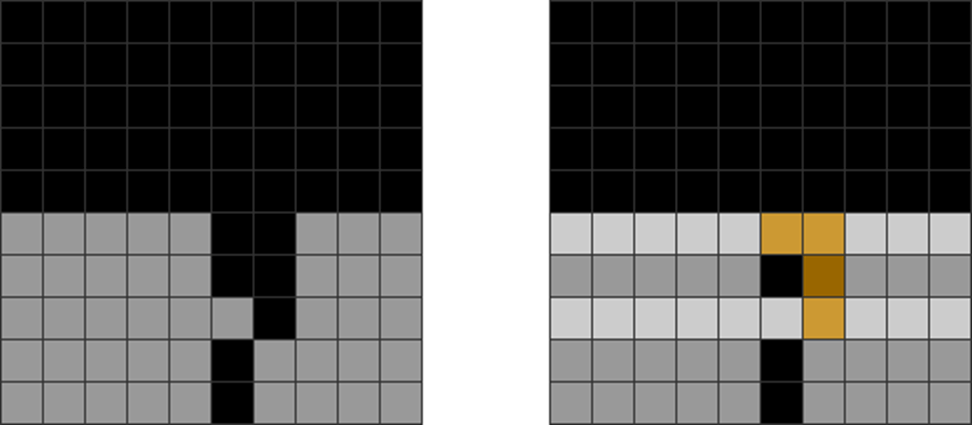

| L and T pieces here switch holes. In the second diagram, the L changes the main garbage hole from columns 7 to 6. For the third diagram, the T does the same. |
Note how the garbage line at the center is deleted and opens up the bottom-most garbage line? This is hole switching.
For the above reason, L, J, and T pieces are the most essential for downstacking. They can resolve rose patterns (scattered garbage) like the above through hole switching.
Though less obvious, I pieces can also hole switch:
| Diagram Set 7-5 | |
| 1 | 2 |

| An I double line skim deletes rows 3 and 5 from the bottom. This exposes the garbage hole, changing it from columns 5 to 4. |
However, this is rare and may need separate line clears.
Hole switching is a core downstacking skill that must be learned.
3) Knowing Every Mino to Downstack Better
From my experience, each piece serves a function in downstacking. I arrange them in ascending order of importance (O is the least important, L and J are the best):
- O pieces are the worst as they only have one orientation and can fit into a 2-wide hole.
- S and Zs might lead to jaggedness.
- T pieces sometimes divide the field but are useful in switching holes.
- I pieces are great for cleaning up but have only two orientations.
- L and J pieces are amongst the best pieces to downstack, as they have the most orientations and can fill 1, 2, and 3-high cavities.
Every 7 tetrominoes have common and uncommon ways to place them. This sub-section highlights the configurations of each piece. I recommend memorizing them to extend downstack chances.
L and J
| Diagram Set 7-6 |
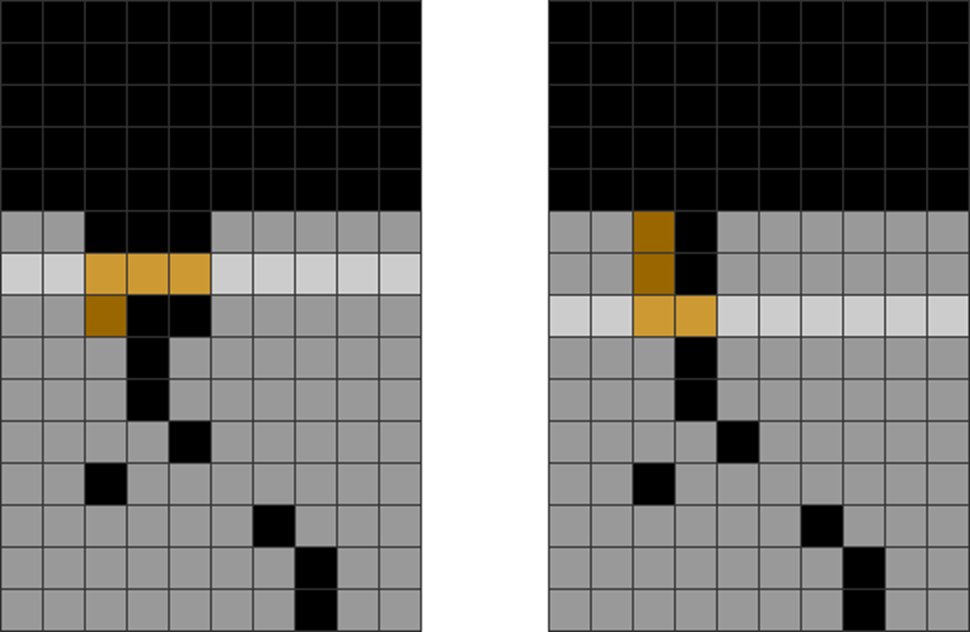
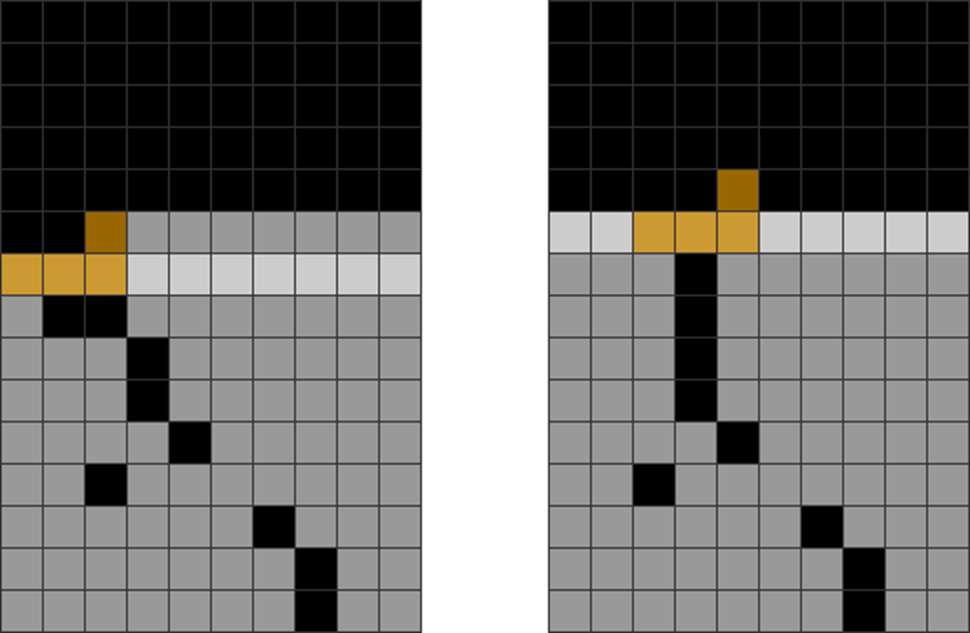
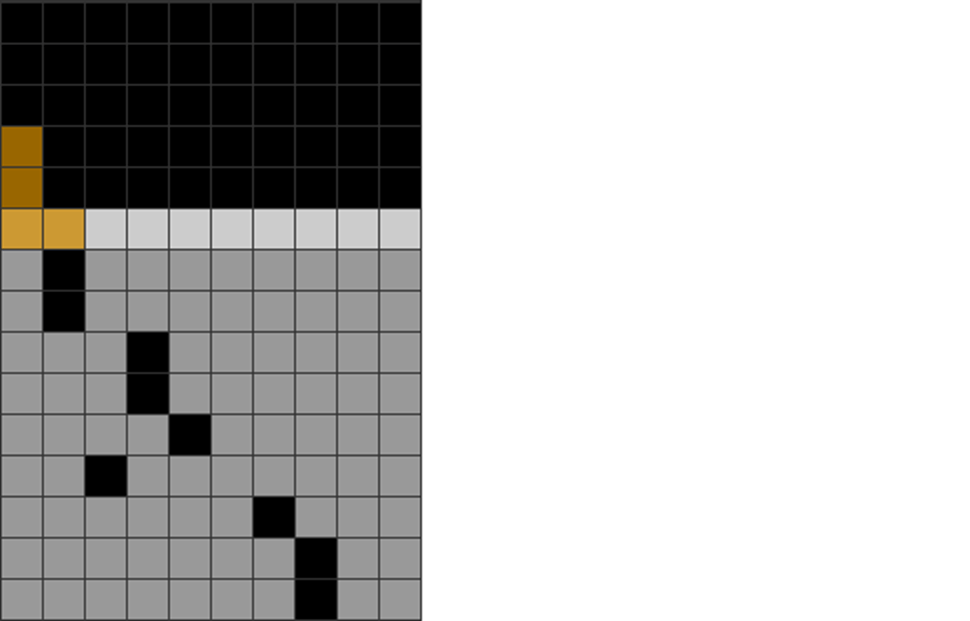
| This diagram set shows many vertical and horizontal L and J orientations to skim and downstack through various cavities. |
S and Z
| Diagram Set 7-7 |
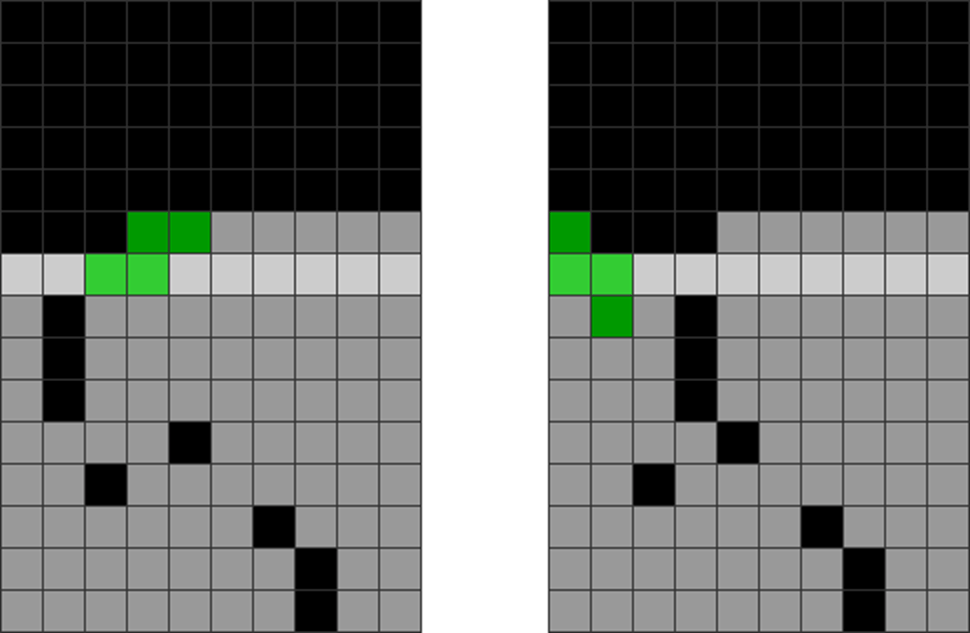
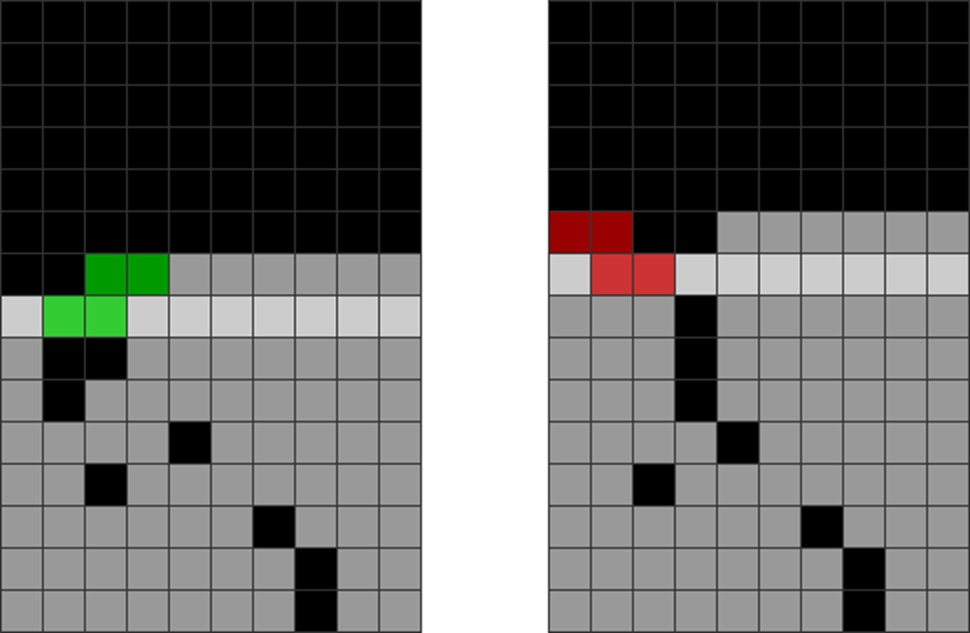
| This set shows various S and Z orientations to downstack through a cavity. |
I
| Diagram Set 7-8 |

| I’m surprised how many beginner and intermediate players can’t spot the horizontal I skim in the first diagram! |
T
| Diagram Set 7-9 |
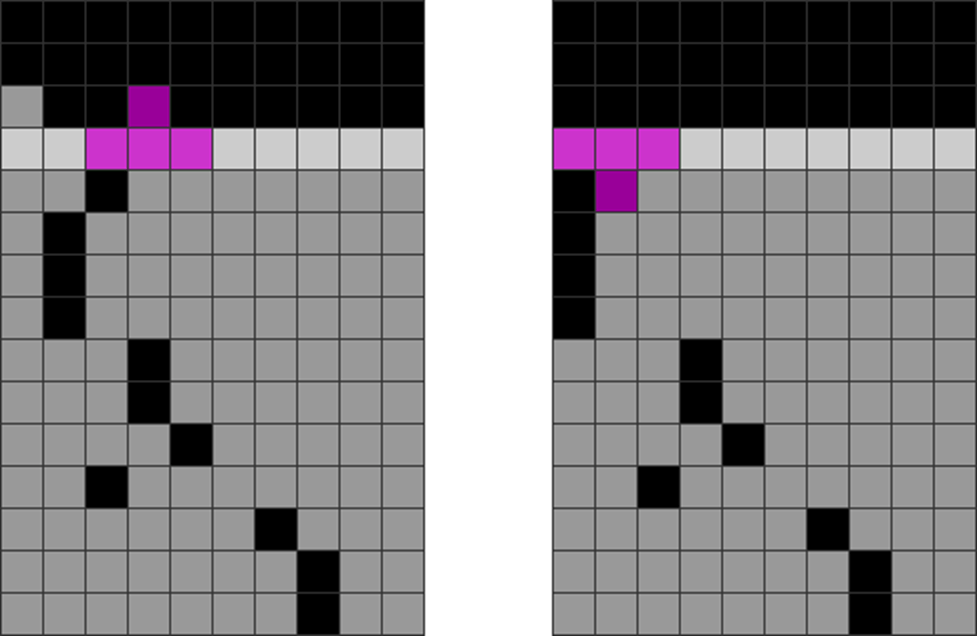
| These T orientation downstack options are subtle; many players can’t spot them. |
O
| Diagram Set 7-10 |
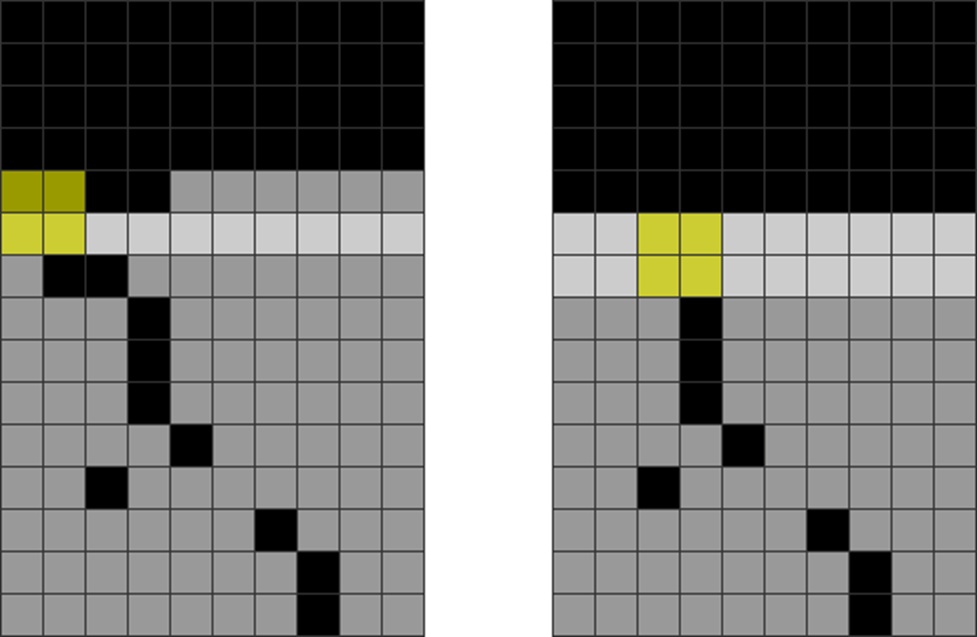
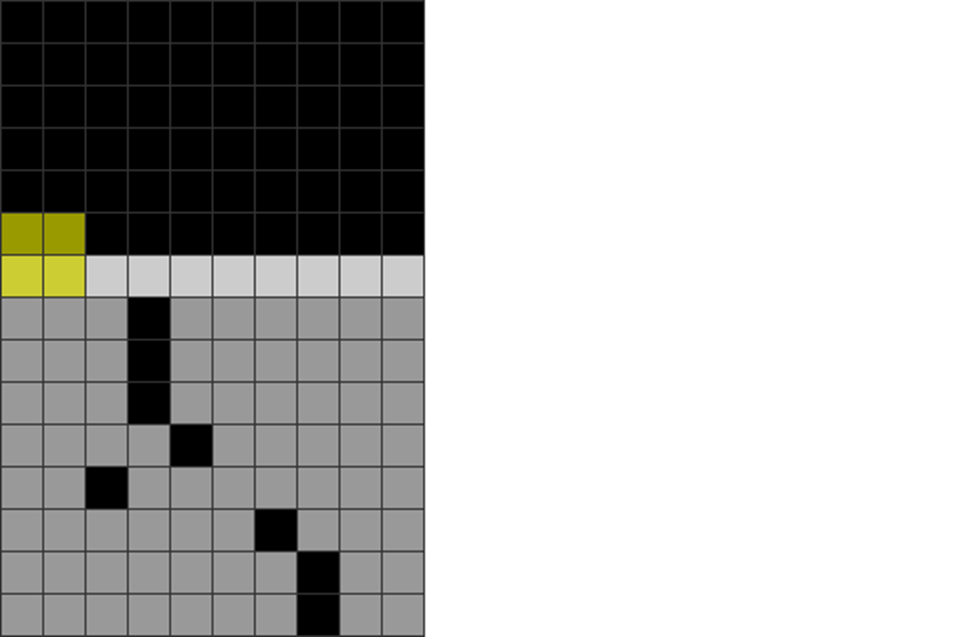
| O only has one orientation to downstack through a cavity. However, they have varied ways of being placed into a cavity to skim off the top layers. |
The above diagram set’s pictures 2 and 3 feature more common O skims.
4) Most Important Downstacking Habits
These core, common decisions will streamline the vast permutations to consider, thus reducing thinking time.
i) Fill Piece Dependencies and Cavities First
Cavities often lead to bad downstacking smoothness. Not filling cavities leads to excessive line clears.
A typical beginner error is to make lots of skims and incur heavy line clear delays (in guideline Tetris games). This wastes a tremendous amount of time. Even if you upstack to make a double or triple, it is still much better than making many single line-clears.
| Diagram Set 7-11 |
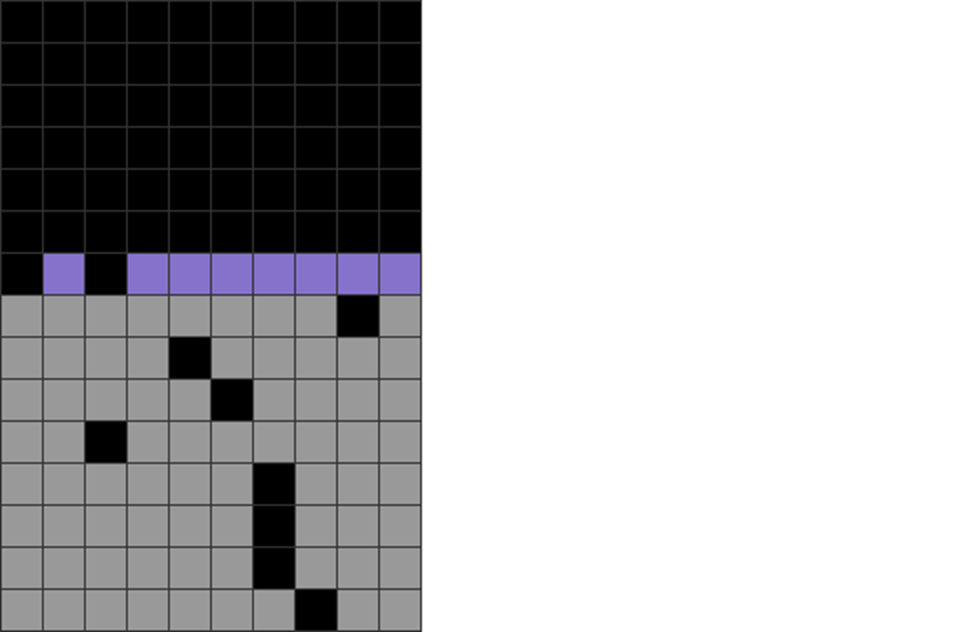
| How do we downstack this pattern? |
| Diagram Set 7-12 |
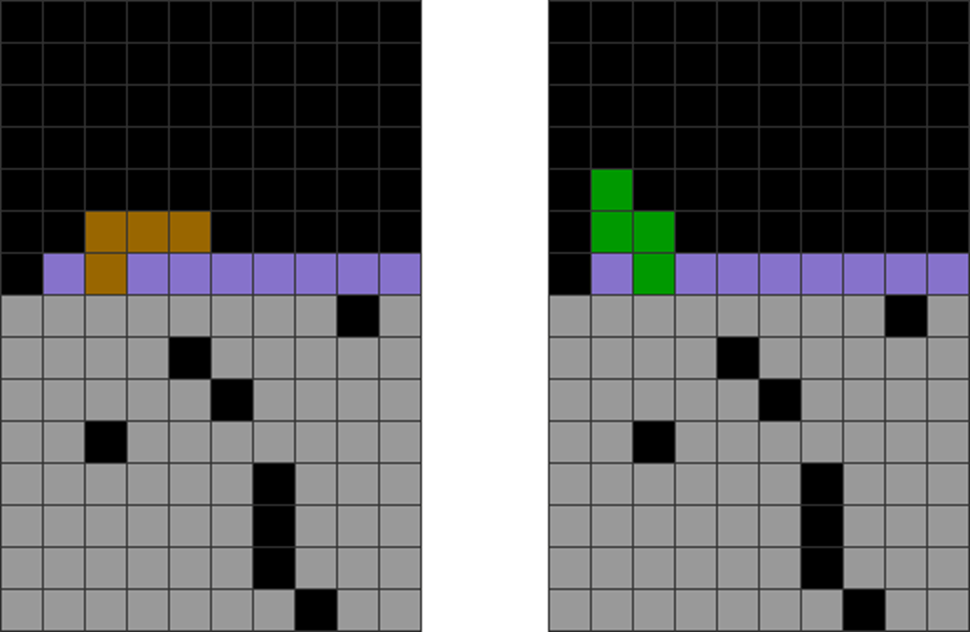
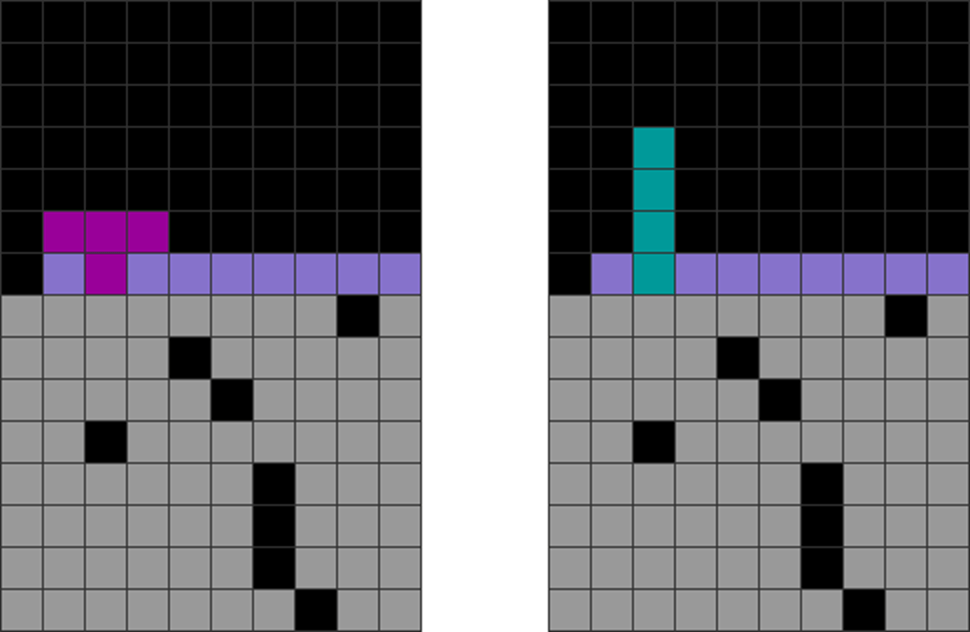
| In all four examples, before you can downstack, you must fill column 3’s (from the left) cavity with a cost – an added one line of upstack over it. |
All L, S, T, and I configurations above will leave at least two vertical blocks of upstack over column 3’s hole. This decreases downstacking efficiency.
Therefore, cavities must sometimes be paired with a piece to stabilize it and create an unnecessary upstack like this:
| Diagram Set 7-13 | |
| 1 | 2 |
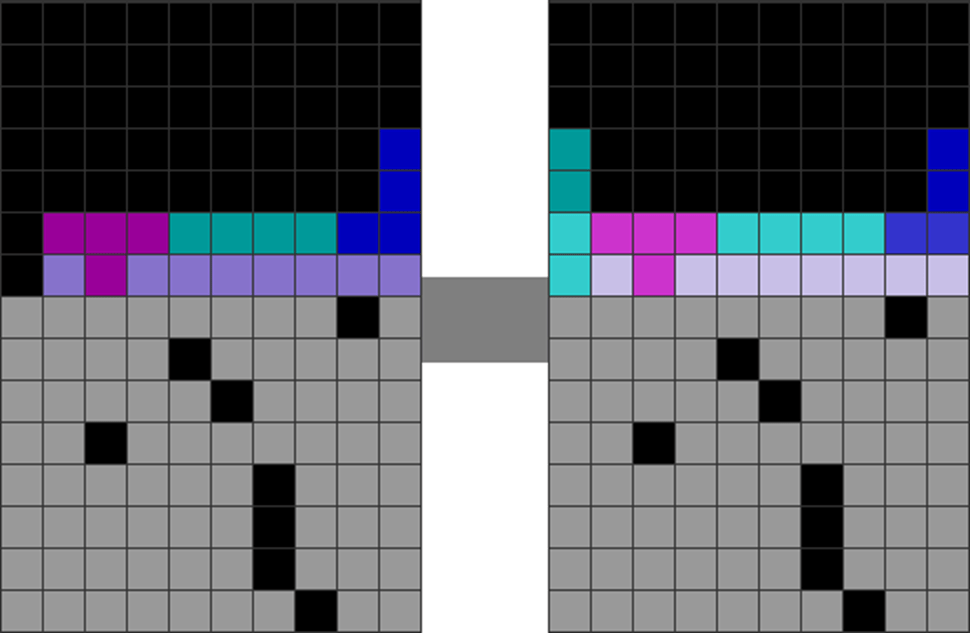
| This continues from the last diagram set’s third example (with the T). The player pairs the T with I and J. | He then downstacks with an I, making a double line clear. |
As seen above, after being filled with a T, the single block cavity (column 3) must have the T paired with pieces to make two lines of upstack before the cavity’s row can be skimmed off cleanly.
Suppose it was diagram set 7-12’s fourth example with an I. In that case, you need an additional three lines of upstack (four total) to cleanly skim off the cavity’s row.
Therefore, flattening the field out as soon as possible is recommended.
Now, consider:
| Diagram Set 7-14 | |
| 1 | 2 |

| The starting field is jagged and messy. | The player skims 1 line with a J. |
| 3 | 4 |
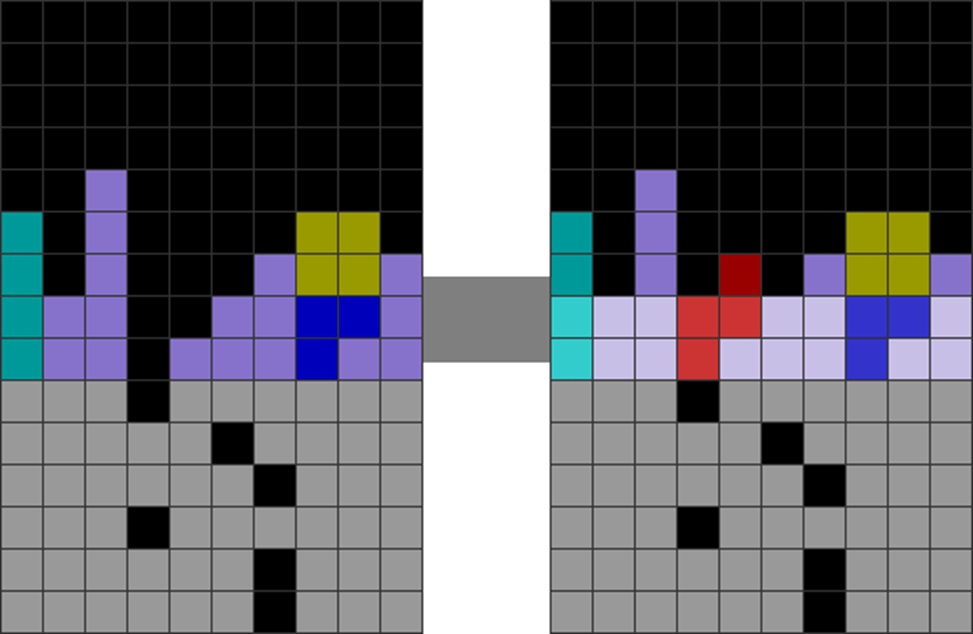
| He upstacks a bit with I and O. | He skims two lines with a Z. |
| 5 | 6 |

| He continues a 1-combo with an I single skim. | He finishes with a T-skim double. |
In this of 6 steps, the player does not fill cavities or resolve jaggedness first. Thus, he excessively incurs 4-line clears, only to upstack a bit, then repeat, incurring hefty line clear delays and sending minimal garbage!
A more innovative option is this:
| Diagram Set 7-15 | |
| 1 | 2 |

| This field continues from step 1 of the last diagram set. The player upstacks and fills cavities first with J, T, S, and J. | He then finishes with a clean Tetris quad. |
Here, the player averted set 7-14’s 6 steps’ catastrophe. This maximizes garbage while incurring only 1 line clear.
One should sometimes upstack before making doubles, triples, or Tetrises to minimize line clear delays.
2) Minimizing Line-clear Delays When Downstacking
Official Tetris games like Puyo Puyo Tetris or Tetris 99 have penalizing line clear delays. I recommend emphasizing more doubles and triples in games with line clear delays to avoid excessive line clear delays.
Here’s an example of excessive, dirty skimming:
| Diagram Set 7-16 | |
| 1 | 2 |
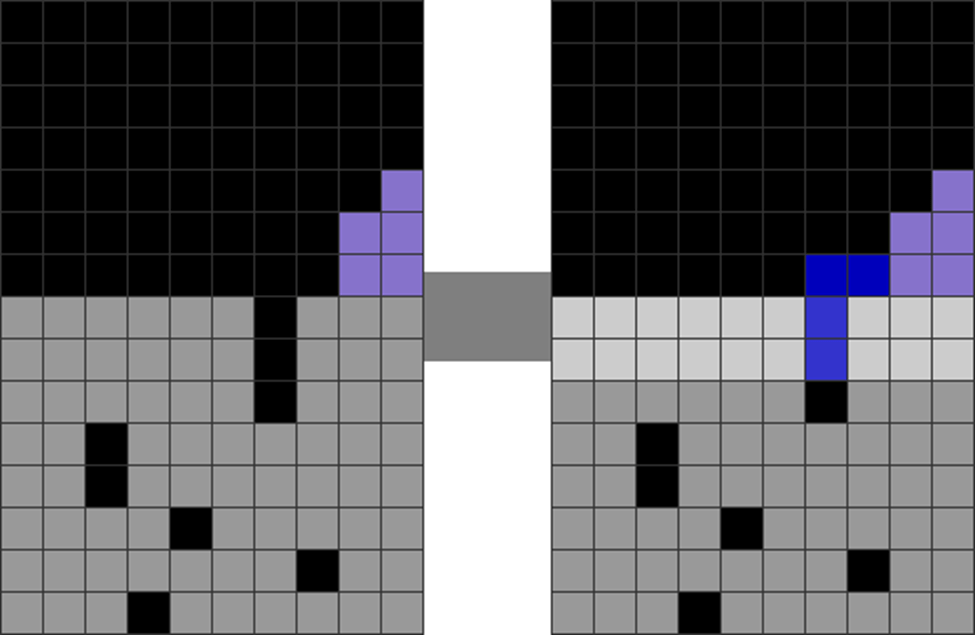
| This is the starting field. | The player skims with a J, which is dirty: it upstacks over the garbage hole in the seventh column. |
| 3 |

| The player must then place O and L on the left before using an I to skim down. |
This leads to extra line clear delays being incurred. In games with line clear delays, this can be suicidal if done too often, as you are vulnerable to being spiked.
Here’s how to deal with the same situation with clean skims:
| Diagram Set 7-17 | |
| 1 | 2 |
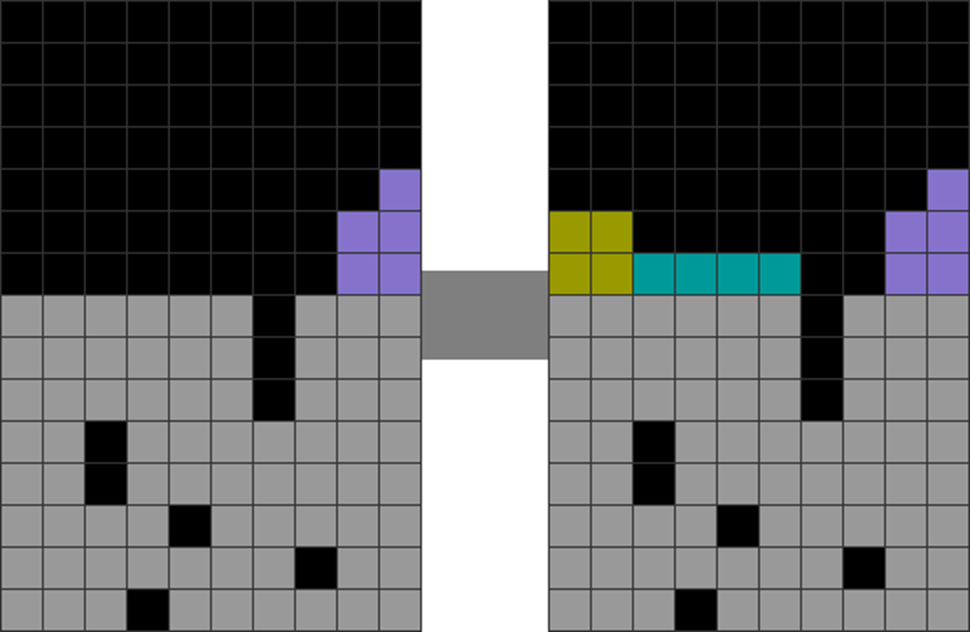
| This is the same starting field as the last diagram set. | Instead, the player upstacks the left side with O and I. |
| 3 |
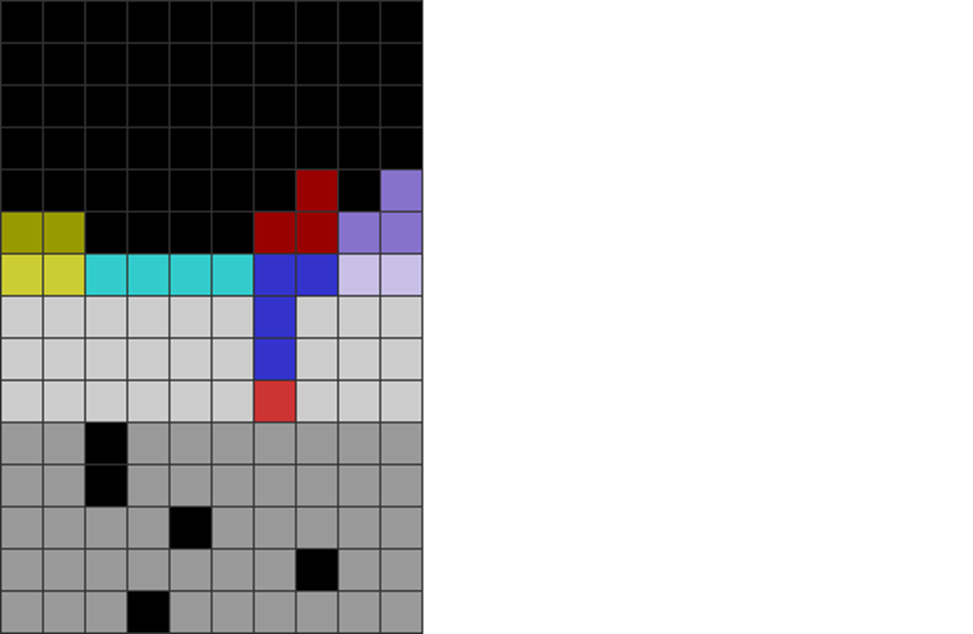
| The player starts the downstack sequence with J and Z, saving many line clear delays. |
Note how the two skims in step 3, with J followed by Z, expose the next garbage hole in the third column.
It is clean and faster to get down. It also minimizes non-combo singles, creating an initial triple to send some garbage to counter an opponent’s attack. It is thus more defensive.
3) Doing Clean Downstacks
For the smoothest gameplay experience, I recommend that downstacking be as clean as possible.
This means while downstacking with singles, doubles, triples, or quads, it’s ideal not to leave a residual overhang that upstacks over the next garbage hole, which mandates skimming. Here’s a list of tips:
| Diagram Set 7-18 | |
| A | B |
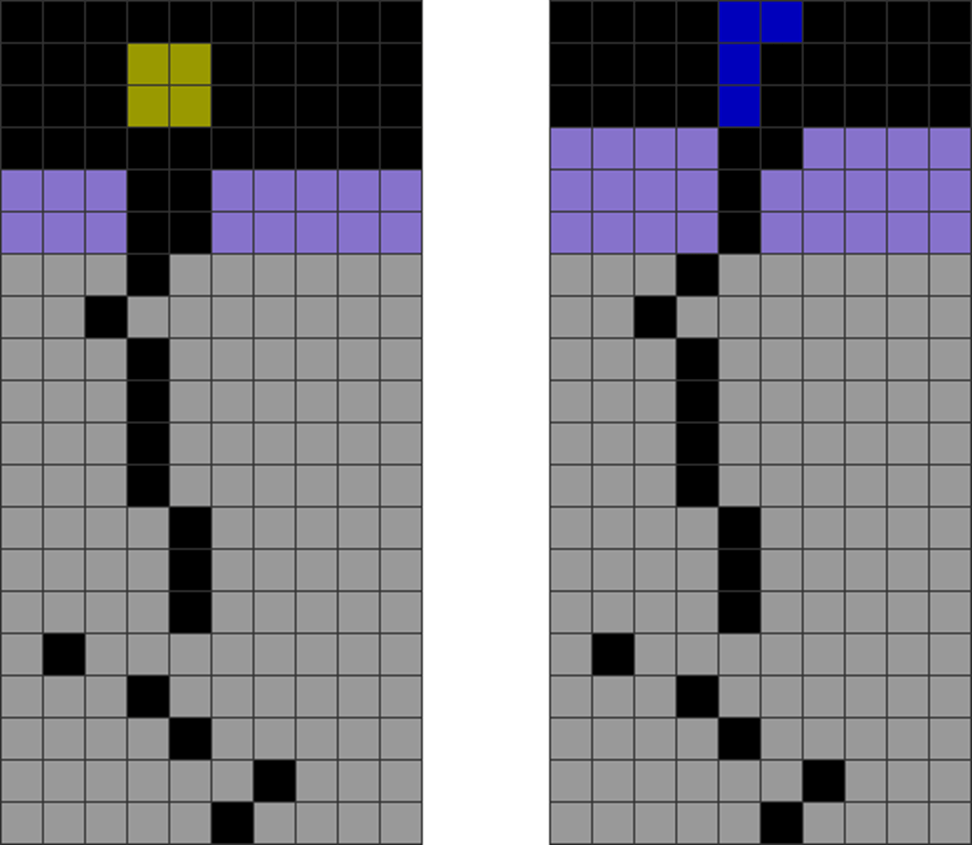
| In these two examples, once the O and J pieces are placed into the O-shape and J-shaped cavities, respectively, it makes a perfect line clear that cleanses off the lavender-colored blocks, exposing the next garbage hole cleanly. |
Hence, doubles and triples should be clean and not leave a residue when you line clear.
Thus, knowing how to create and spot clean doubles and triples is essential as it opens up more options to downstack fast cleanly.
4) Downstack Combo Cleanly and Maximizing Offense
Here’s a vital rule-of-thumb to improve your attacking and downstacking prowess mid-game:
Connect the field as far as possible with joined skims (to extend combos) to allow a continuous downstack that leaves as few overhangs as possible and maximize downstack combos for offense and cleanliness.
| Diagram Set 7-19 | |
| 1 | 2 |

| In this sequence, the player joins all attacks to maximize downstack combo in the order: L, Z, T, J, I, L, and S, respectively. This creates a 6-combo, which sends a deadly amount of garbage. |
This shows the general law of good downstacking to join the field well. This grants more combo chances.
This takes a lot of practice and experience, but good Tetris players can typically see a string of downstacking options.
Summary and Conclusion
Downstacking is a skill that many intermediate players fail to prioritize. Instead, they learn T-spins and use too many of them in an unclean manner. They make setups that lead to too much residue upstack that must be skimmed off. This makes them very vulnerable to attacks.
A good player balances between downstacking and offensive abilities.
| Concept | Summarized Rules-of-Thumb |
| Flow | Hole switching is one of the most important mid-game methods to use. Minimize line clear delays. Upstack and make Tetrises or T-spins if a downstack continuation is not available. |
| Form | Ensure jaggedness is resolved for optimal and smoother downstacking. L, J, and I pieces are the best ones for cleaning up. Memorize every mino’s rotated configurations to downstack better. Downstack cleanly – minimize the covering of the subsequent garbage holes with piece placements. Minimize jagged placements. |
| Balance | Minimize cavities and I-dependencies as they reduce downstack smoothness. |
 How to Tetris