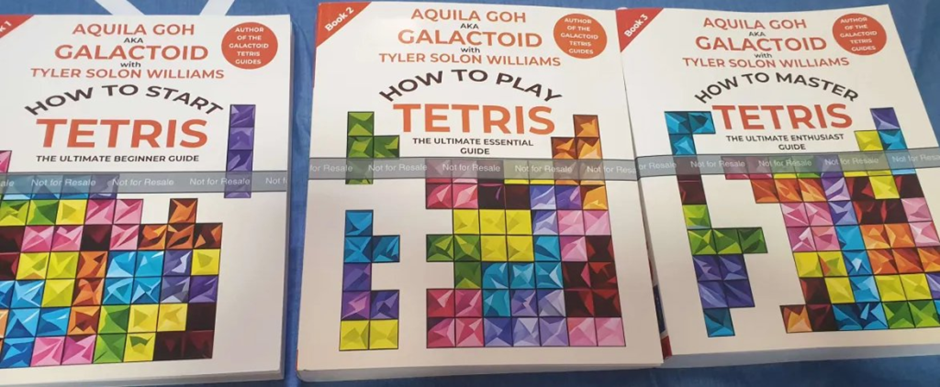
Many interested Tetris players, who have shown interest in my Tetris books, have asked me how my guidebooks differ from other guides (online websites, physical books, and Google documents). I elaborate here in-depth.
First, I will discuss how existing Tetris content faces numerous presentation and content issues that my books aim to address or fill the voids. Then, I will show how my guidebooks fill a void.
The Problems with Other Existing Tetris Guides
Existing Tetris guides face many problems. I say this constructively and objectively, not critiquing the creators. Thus, I will only mention them generically, without specifically naming the sources or websites (except for my own Galactoid Tetris WordPress website, which is plagued with issues!). I respect their role in creating these guides for the betterment and edification of other learning and progressing players. They are still positive contributions to Tetris knowledge. However, they all face many collective issues:
- An Excessive Focus on Superfluous Methods
Some online Tetris guides focus excessively on too many redundant methods. Two related Wiki websites face this pressing problem. One of them, if one goes under their T-spin methods category, has a list of around 100 individual Wiki entries. However, about 85 to 90% of them showcase redundant F-tier openers that are impractical for normal use (such as God-spin), compared to the traditional old-school openers (like Hachispin, DT Cannon, etc.).
The other 10% of the entries feature decent methods, like Cut-copy or STMB Cave. However, they face systemic issues in their presentation, which I will cover next.
- They Use Sub-Optimal Examples that are too General or too Specific for Practice
Many of these entries above use examples that can be polished.
For instance, some may use dirty T-spin triples (when the T-spin triple finishes, it leaves a dirty overhang that covers the next garbage hole; such T-spin triples should have been avoided). Some use overly specific or general methods. In some Wiki entries, such as one on Polymer T-spins, the follow-up examples involve T-spin follow-ups that are so specific to a rare 1-in-10,000 case that the method is virtually impractical for most people. Likewise, some guides, like the Parapet Wiki entry, are sparse on information. Others provide too general information that lacks context and does not effectively illustrate how to use such methods.
- An Excessive Focus on Concrete, Canonical Methods without Addressing Common Fundamentals
Many guides simply list canonical methods, such as DT Cannon, Fractal, LST stacking, Infinite TST, or Trinity, then show how to construct them mid-game. However, the problem with this, per my website’s marketing headline, is that they “show you 30 methods,” instead of showing you the underlying fundamentals, principles, and contexts behind each.
They only show you how to create them, without actual understanding of the fundamentals, such as building them only when: (i) there are enough incoming Ts, (ii) when the field’s parity is relatively stabilized, (iii) when there are enough upstacked residues so you only have to put a few pieces to make the set, (iv) when your field is not extremely highly stacked, and (v) when you do not have too many piece or field dependencies.
Therefore, these guides can sometimes be detrimental, as they create the notion that players should merely memorize and regurgitate without understanding the essential principles or contexts in which to use them. This includes the pros, cons, mid-game situations, and contexts of each method.
- They Lack Thematic Organization, Coherence, Unity, and High-level Strategic Depth
There are very few guides around that organize everything into broader themes, such as attacking (back-to-backs, T-spins), defending (skimming, timing to cancel garbage, downstacking, combos), or versatility (openers, advanced PC methods, recovery, situation dependency).
Instead, as mentioned earlier, they simply list many specific canonical methods without explaining their underlying concepts and principles for effective use.
The problem with this is that readers would not have a comprehensive understanding of whether to attack, defend, or shape their field. The lowest-level Tetris tutelage involves memorizing specific methods. Mid-level Tetris coverage involves learning general cases to make each type of setup (like how the broader genera of “downstacking” includes specific methods like hole-switching and platform stacking). High-level Tetris involves knowing, when faced with a mid-game situation, what to choose among the various strategies, such as downstacking, T-spinning, Tetrising, skimming, timing, and repairing, among others.
This is the most pressing void that many Tetris guides face.
- Quality Control Issues
Many guides have inconsistent agreements among them, as they were written by 50 to 100 people, especially on various Wiki websites. Likewise, many have quality issues, such as inaccurate facts.
My Galactoid Tetris WordPress website is sometimes guilty of this. As a precursor, I founded the website primarily to document and write my raw, unpolished Tetris research notes before refining them to create higher-quality guides, such as my Tetris guidebooks and howtotetris.com. It sometimes makes mistakes or has less-than-fancy graphics because my goal was to share the methods as soon as possible, with minimal editing, as people do not have to wait 5 years for the final result.
This also affects many other guides, which raises questions about their level of professionalism.
- A Lack of a Clear, Curriculum-based, Step-by-step Pedagogy
I have received complaints from some high-level Tetris players, who have critiqued another well-known Tetris guide website for its perfect clear methods. That website covers the seven perfect clear bag patterns and solutions. However, it primarily presents the patterns and solutions without clearly explaining their meaning. That website also has some unfinished and questionable subpages (such as the kicks of pieces) with little to no explanation.
This leaves gaps in knowledge that make the content inaccessible to beginners and intermediate players. Only an extremely niche, advanced player base can comprehend and appreciate the depth of this content.
There are no guides that provide a comprehensive (covering all facets of Tetris like attack, defense, versatility, etc.), curriculum-based tutelage that provides clear step-by-step illustration and elaboration of every vital Tetris skill set. This means that players must use trial and error to consolidate hundreds of individual Tetris guides, wasting a significant amount of their time and often lacking clarity on the essential concepts.
Tetris guides nowadays are therefore scattered and without unity. There is no one to hold one’s hands slowly as they learn to crawl before walking or running. Many guides assume that one is already ready to run a marathon.
- They May Not be Sufficiently Experience-backed
While I will not dispute the experience levels of the Tetris guide makers, the truth remains that, as I read these guides, many seemed to be founded on an incomplete understanding of the contexts in which to use the methods.
Therefore, many guides offer untested methods that are neither practical nor workable.
When enough of these methods appear throughout the internet, many players may simply learn and regurgitate them without understanding. My guidebooks will address this.
How My Guidebooks Address These Issues
This is where my guidebooks come in to address the void and problems that other existing guides are facing.
In my Tetris guides, I have written the content such that:
- Teaches Universal Fundamentals, Principles, and Contexts
My guidebooks were written with the motto that instead of showing you all 30 methods, I teach you the underlying principles and fundamentals that underlie them. I also show you the contexts in which to use and when not to use the methods.
I will show you step-by-step everything, leaving little voids in between, suitable for even beginners to ascend the skill ladder to complete mastery.
- Provide Thematic Unity and Organization
Instead of giving 30 specific methods, I organize them into important themes or broad Tetris skill sets, such as attacking or defending. I then show you how to choose between each of these broad Tetris skill sets, given the situation. The goal is to cultivate the highest level of strategic thinking, rather than employing concrete, mindless methods through mere regurgitation.
Other guides show you the what and how. I will show you the how, when, why, and why-nots.
- Provide Exhaustive Comprehensiveness
My guidebooks have been authored with comprehensiveness in mind. I disagreed with my consultant collaborator, who pressured me to condense everything into an overly simplified 100 pages, with too many chapters removed, resulting in an incomplete resource. This proposition was absurd, and I rejected it.
I understand the mindset of the Tetris community. Some want beginner-friendly, streamlined methods, which is what Book 1 does.
However, I know that many Tetris players are highly fanatical about learning Tetris as exhaustively as possible. Therefore, I have written books 2 and 3, which total 1000 pages. My goal is to ensure that you all also learn about as many practical Tetris methods as possible, leaving little gaps in between.
There will be no gaps in knowledge and no voids left unfilled.
Only the most impractical and redundant methods are excluded (such as the useless God-spin), which may be included again in Book 4 to provide closure (but, honestly, yuck to God-spin!).
- Is Experience-backed
Every single method that I have covered in my three Tetris guidebooks has been thoroughly vetted through more than just fact-checking or mere testing. Instead, I have mastered them, knowing precisely when to use them and when not to, and also how to use them properly. This may include the spliced Trinity 4-T-spin-double Altair method (that Yakine uses) and advanced polymer T-spins.
If a method is completely impractical and irrelevant, after much testing and experience, I would exclude such redundancies. This will leave only the gold-gilded gemstones that matter most, saving you time and effort.
Instead of having you spend 1,000 hours testing and filtering out superfluous methods, I have done it for you, so you can save that 1,000 hours and master Tetris in a fraction of the time others would take. Spend those 1,000 hours and work towards the Nobel prize instead!
This is perhaps one of the most vital parts of my guides – everything is backed by my 3000+ hours of Tetris experience and thousands more in Tetris research.
- Has High Quality
I have reviewed everything word-for-word and picture-for-picture three times each to ensure minimal errors. I have also fact-checked many technical details manually and with 3 AIs to spot what I could not spot.
I have also rewritten and restructured the content and chapters at least three times, removing lower-quality content and replacing it with better content.
While I am still human, and this is a one-man-army task, my self-published works have reached a higher degree of quality control compared to more than 99% of other authors. While the occasional, sporadic mistakes may remain, I have done my utmost best to ensure that the works comply with my high standards of publication.
I may plan to release a second edition in the future, with new updates to these three books, but upgrade them to hardcover and premium color ink. It currently utilizes paperback and standard color ink to strike a balance between quality and price, resulting in a 60% reduction in costs. This makes the books affordable.
- Has Hundreds of Truly Novel, Insightful, and Practical Tactics
While skimming through the physical print copies of my three books today, I was surprised not just by the “why” methods, but also by the “how” techniques. Even I was astounded at how I came up with so many novel, yet practical and insightful methods.
Books 2 and 3 contain hundreds of gemstones – practical tactics that most guides or high-level players would never have conceived of. One example is the use of a partial STSD donation to follow up a T-spin triple or Kaslideoscope cleanly and practically. Another approach is to use a Kaidan donation to follow up on a T-spin triple composite method, such as a DT Cannon’s subsequent T-spin triple. Another is the use of corner and floating props to cleanly and safely create new T-spins during 9-0 stacking. These were delivered with appropriate mid-game situations to facilitate easy memorization, as they are shared with other common methods.
The number of such methods shocked even me, and I was in utter disbelief at how I managed to conceive, compile, and write them out in a streamlined, comprehensible, and easily applicable manner (I was re-reading my proof copies on July 29, 2025, and went, “WTF!?”). Even high-level players would benefit from Books 2 and 3, as they contain valuable tactics.
A Final Word
These 3 Tetris books are the labor of 5 years of work (2.5 years of research and 2.5 years of writing and editing) and much Tetris mastery.
I have sacrificed thousands of hours consolidating notes, sifting through, and pruning unnecessary content to provide the ultimate Tetris guidebook series, which I hope will benefit future Tetris players for generations to come.
This project has come at the expense of my mental and emotional health, and my zeal for Tetris, and I am unlikely to ever recover my passion for playing the game. Now, I can only casually play and stream Tetris once or twice per month. Pretty much, the only time I play Tetris is whenever I stream it. And now, I have to see a therapist to recover from the immense and Herculean task that I set out to create 5 years ago.
I hope that you all will enjoy this Tetris guidebook series and that I have made high-level Tetris accessible for all.
Thank you and happy stacking!
 How to Tetris