My Tetris guidebooks have many illustrations to show vital steps, signifying changes in a Tetris field over time.
Understanding the book’s pictorial format helps clarify its meanings.
1. Color Schemes and Legend
I use several colored blocks in my books’ illustrations:
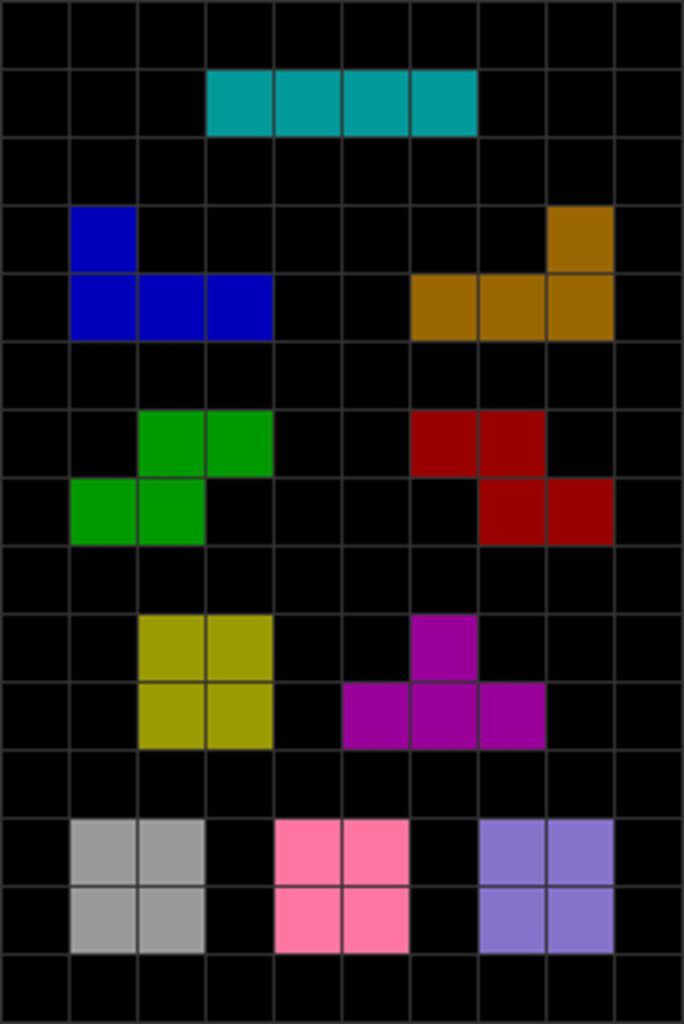
The color schemes are:
- Blue: J pieces or leftover blocks originally from J pieces after line clears.
- Orange: L pieces or leftover blocks originally from L pieces after line clears.
- Cyan: I pieces or leftover blocks originally from I pieces after line clears.
- Yellow: O pieces or leftover blocks originally from O pieces after line clears.
- Green: S pieces or leftover blocks originally from S pieces after line clears.
- Red: Z pieces or leftover blocks originally from Z pieces after line clears.
- Purple: T pieces or leftover blocks originally from T pieces after line clears.
- Black: Unfilled or empty blocks.
- Gray: Garbage blocks. However, I sometimes use them to describe miscellaneous shapes if I do not show specifically how some parts of a field are made from the 7 minos.
- Lavender: Upstacked blocks. They are typically above the garbage line (gray blocks). I use these if I do not show specifically how some parts of a field are made from the 7 minos.
- Light Pink: A new color I added to highlight something crucial for greater clarity.
Apart from the above, there are also brighter variants of some of the above:
- Light blue: Shows that a blue block is being line cleared.
- Light orange: Shows that an orange block is being line cleared.
- Light cyan: Shows that a cyan block is being line cleared.
- Light yellow: Shows that a yellow block is being line cleared.
- Light green: Shows that a green block is being line cleared. (Because this is a lighter shade, it may appear faint in print.)
- Light red: Shows that a red block is being line cleared.
- Light purple: Shows that a purple block is being line cleared.
- Light gray: Shows that a gray block is being line cleared.
- Light lavender: Shows that a lavender block is being line cleared.
- Very light pink: Shows that a pink block is being line cleared.
2. Diagrams
Each diagram comprises Tetris fields (up to 10×20 playfields). I vary their heights to save space. However, they are typically 10, 15, and 20 blocks tall.
At the bottom of most diagrams, there will be a gray, highlighted table that explains the diagram.
There are many ways to read the diagrams. There are also many variations of how I present them:
i. Step Diagrams
Step diagrams are enumerated to show that there is a temporal sequence of a specific series of steps:
| Diagram Set 2-24 | |
| 1 | 2 |
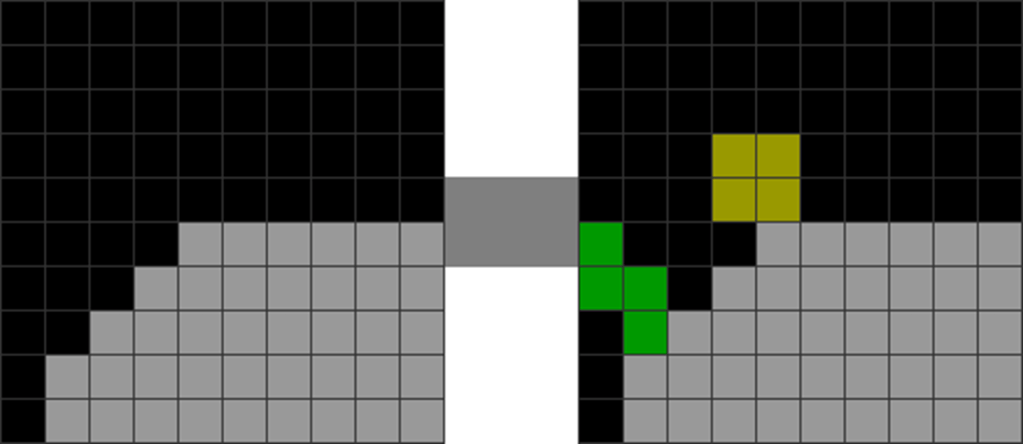
| Starting field. | One places S and O to make a T-spin. |
“Diagram Set 2-24” means it is the 24th diagram set in chapter 2.
A gray bridge between the 2 steps connects them causally. Here, step 1 is the left diagram. After putting an S and O piece, it progresses to step 2 in the right diagram. The rest is self-explanatory. Gray blocks represent a generic shape. Yellows correspond to O pieces. Green corresponds to S pieces.
In this book’s terminology, I will sometimes refer to a specific block as being in column 2 and row 3. This means the block is in the second column from the left and the third row from the bottom.
Here is a more complex sequence:
| Diagram Set | |
| 1 | 2 |
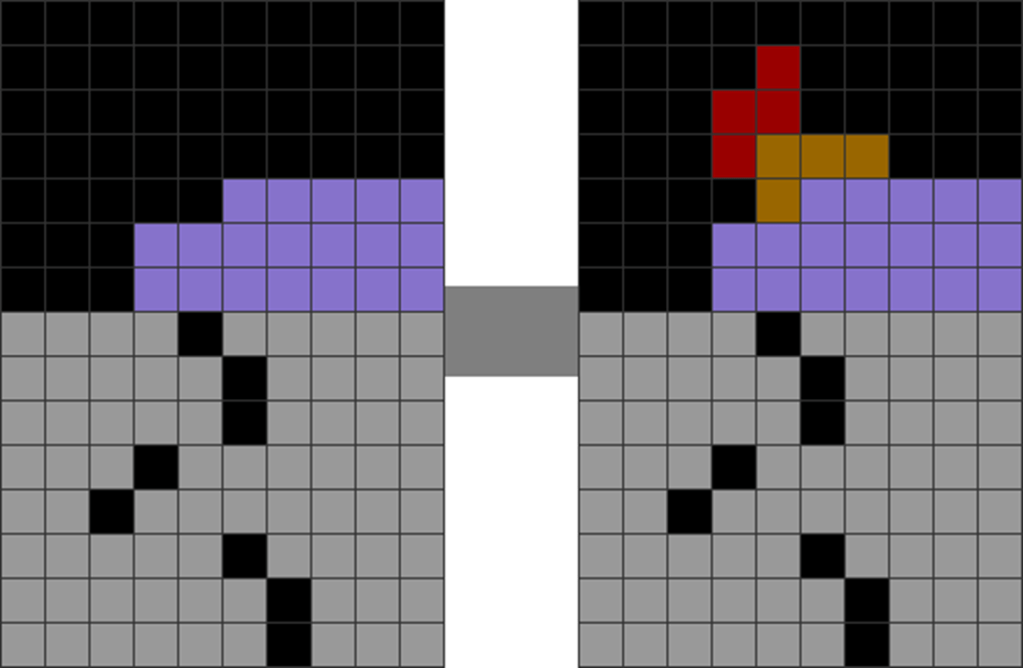
| Starting field. | The player makes an overhang with L and Z. |
| 3 |
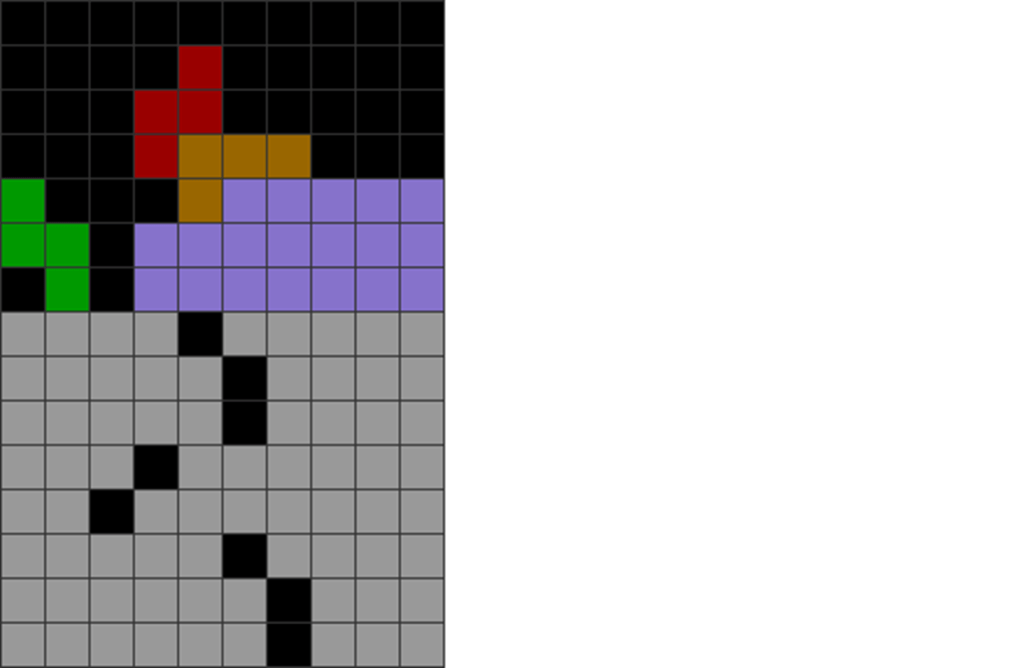
| He then uses S as a base to make a T-spin double. |
This is a 3-step sequence. The gray blocks represent garbage lines. The lavender blocks represent generic, non-garbage, upstacked blocks. I would then sometimes put colored, specific mino blocks on top of the lavender and gray blocks.
ii. Non-Step Diagrams
Non-step diagrams are non-causally linked diagrams, such as:
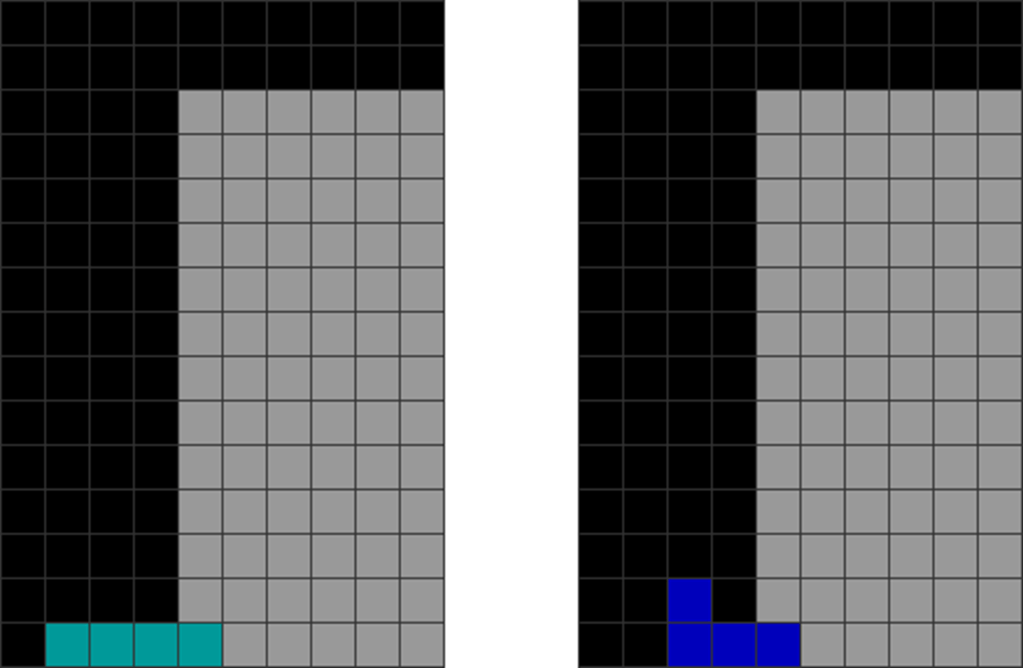
| C | D |
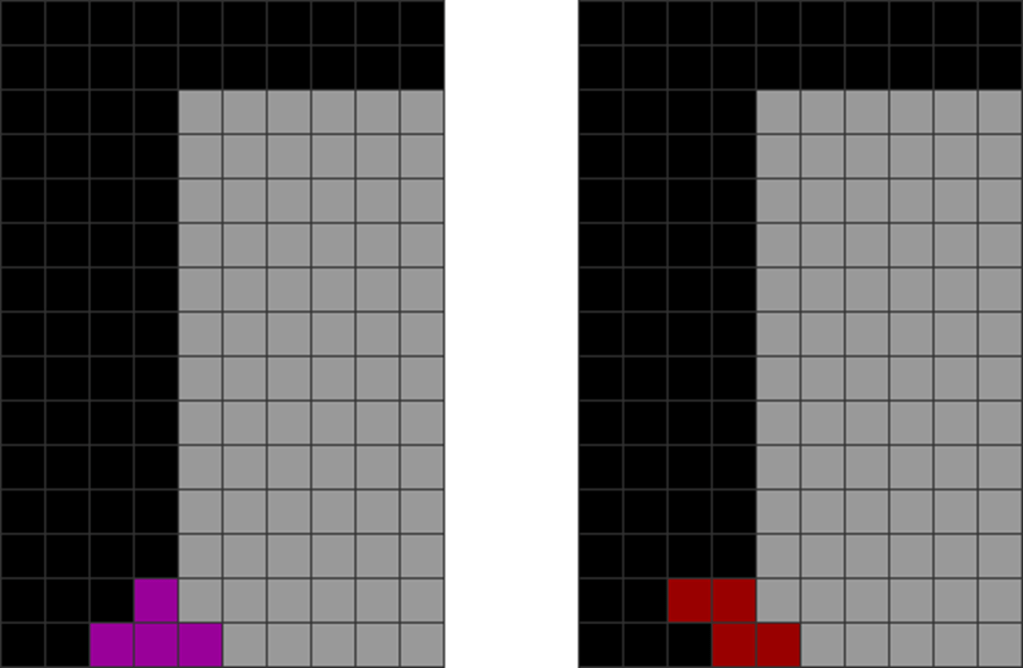
| These are 4 ways to make side 4-wide. |
The 4 examples above are not causally linked by steps. They are independent of each other. The words in the gray box describe the diagram set.
I will sometimes label the fields as Alt. A or Alt. B. This means alternative choices to an original sequence. Alt. A1 and Alt. A2 means the 2 steps are casually connected: the former is step 1, and the latter is step 2.
iii. Circles and Symbols
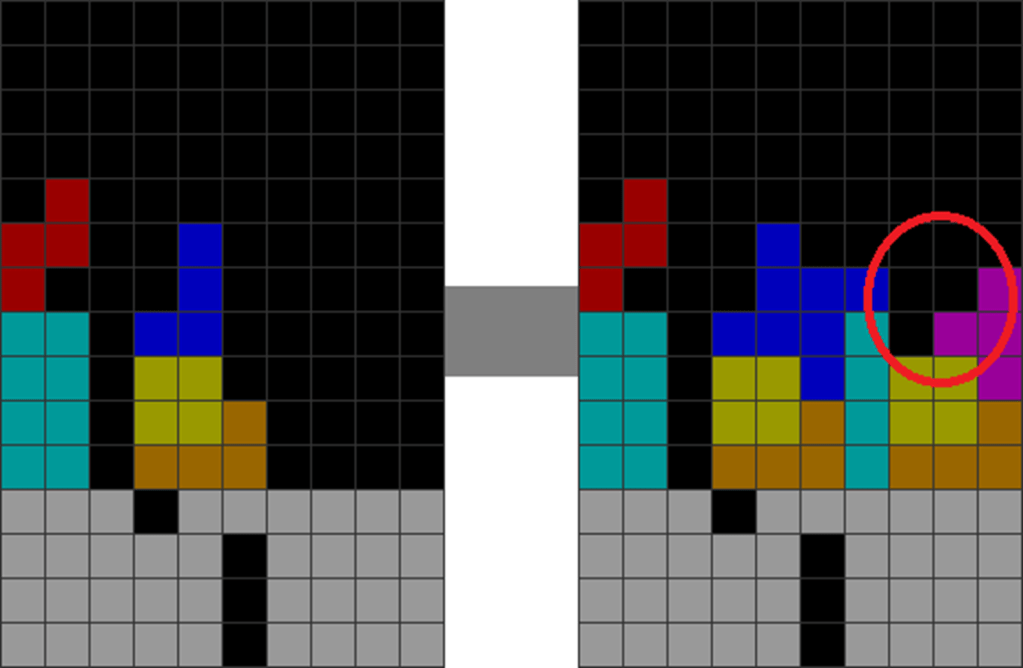
Some diagrams have commentaries, circles, and sometimes arrows:
| Diagram Set | |
| 1 | 2 |
| 3 |
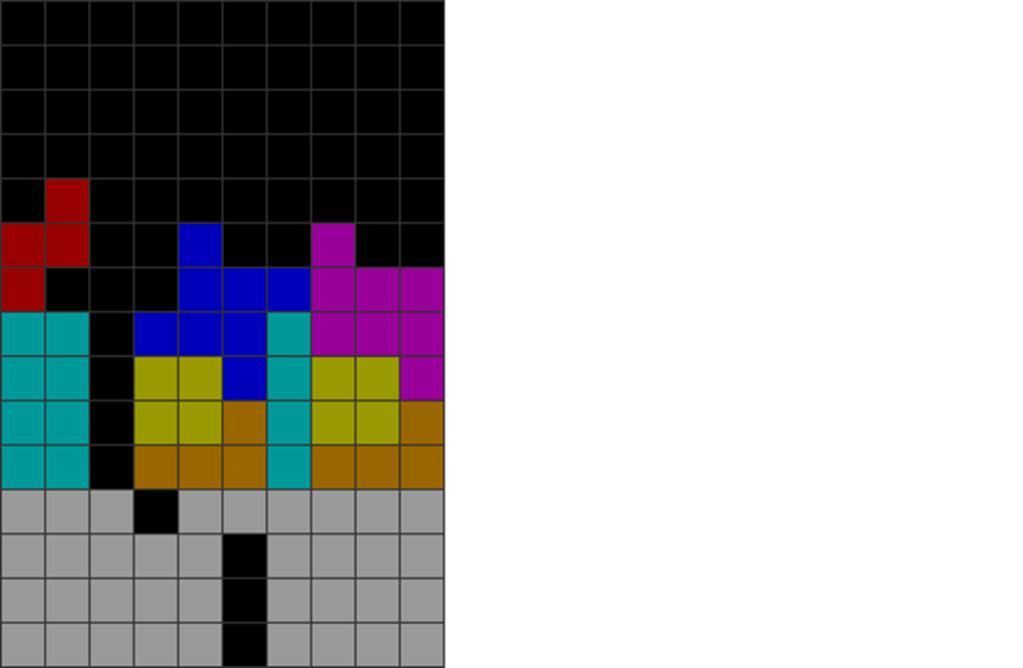
This sequence of 3 steps has a red circle in step 2. I sometimes do this to highlight specific parts of a field. I sometimes use green or blue circles, depending on the severity of the situation. Red typically shows severe issues, while green and blue show more forgivable ones.
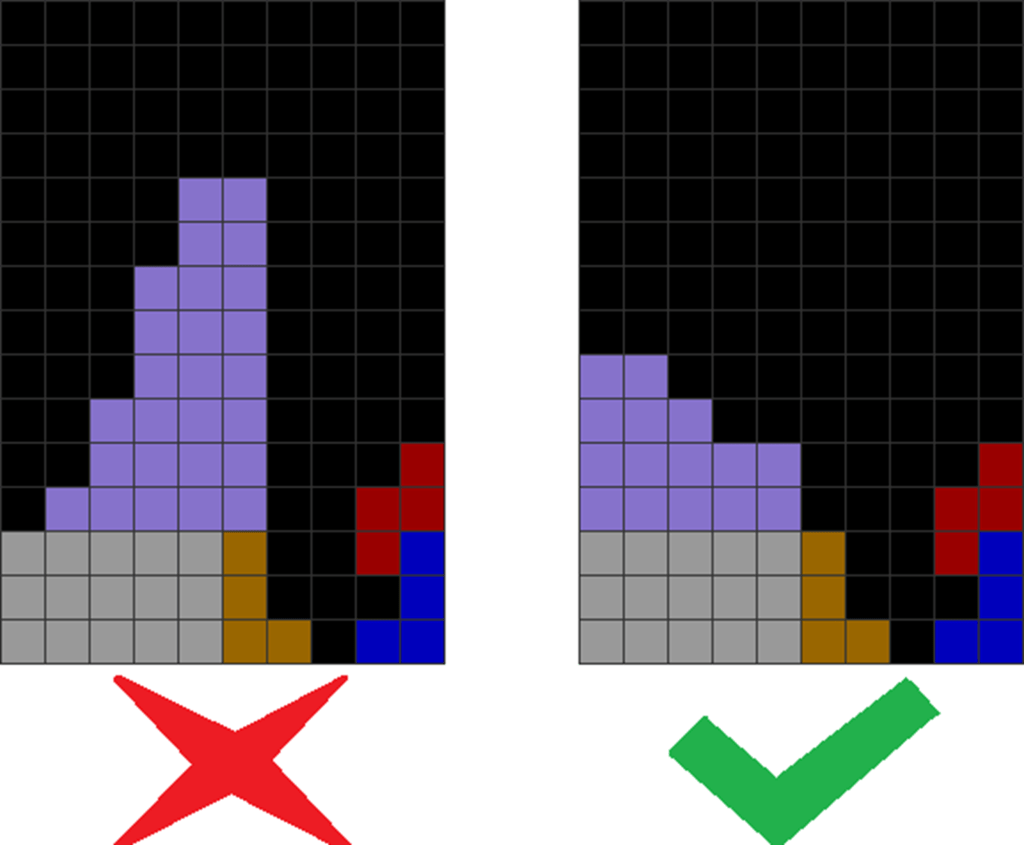
Occasionally, some pictures have ticks and crosses to show if they are recommended choices (ticks) and unrecommended ones (crosses):
 How to Tetris