I have observed some people’s critiques of the content and my playstyle in my Tetris books. Therefore, I wish to respond to them piecemeal here, addressing specific questions and dispelling certain mysteries.
Critiques are fine if they are constructive and delivered in a civil manner. I am open to them as long as they are respectful.
As of this article’s publication, only Book 1 has been published on this website. Thus, I will update this page accordingly as more books are released.
1) Many People Find It Strange Regarding Book 1’s Ordering
Some people, on some modern Tetris servers (which I lurk using a secondary Discord account), have mentioned how Book 1’s “Skimming” and “Tetrises” chapters are after the “Basic T-spins” chapter. Let’s address this.
This is because I wrote the books linearly, which provides knowledge precedents and background before I can move on to more advanced concepts. Therefore, some chapters require that earlier chapters be read to understand their context fully.
For instance, the “Skimming” chapter in Book 1 covers some skims that shape the field to make T-spins while stacking along a line. Obviously, “Basic T-spins” must therefore be covered first, or introducing T-spins here would have no context. If too many chapters do this, it would lead to severe repetition. In Book 2, the “Skimming” chapter is significantly expanded, approximately three times its original length. It encompasses skims with all-spins that shape the field into viable T-spin setups. Therefore, Book 2’s T-spin chapters must precede this.
The “Tetrises” chapter in Book 1 features sections that involve clearing a Tetris line to a prophecy T-spin. Therefore, T-spins must be introduced earlier. In Book 2’s heavily expanded Tetrises chapter, this covers even more forms of Tetrises to predict T-spins (such as a Tetris to STSD, etc.). Therefore, T-spins must be introduced in an earlier chapter first.
Now, let’s cover a part of Book 2 that hasn’t been released. The Openers chapter comes almost last. This may be strange to many players – don’t openers get learned first? Here’s how I differ: I will never teach openers until a player has established a firm foundation in stacking, parity management, field harmony, follow-ups, and T-spins. Why? Let’s consider the standard DT Cannon. Most beginners simply memorize and regurgitate the pattern. After the first two T-spins, they poorly stack the right side as they cannot observe parity balance and stacking theory. Therefore, after their initial T-spins, their follow-up pressure is gutted. Their field is jumbled. This is worse for advanced openers like C-spins, which have an even more challenging follow-up continuation.
Therefore, the content of the books has been arranged linearly for maximum flow and readability.
2) On Whether I Will and Should Include Advanced Setups
This includes advanced setups such as Polymers and advanced spliced T-spins (like the Altair four-T-spin-double spliced Trinity setup).
The answer is a resounding YES.
However, it comes with many caveats regarding how to use them, when to use them, and when not to use them. Let’s break them down concretely:
Polymer T-spins will be covered in Book 3. I consider them an integral part of the Tetris experience. However, many players deem them as mostly impractical for fast-paced Tetris variants like TETR.IO, despite them being useful for slower variants like Puyo Puyo Tetris.
This is all true. That is why, in Book 3’s Polymer T-spin chapter, I wrote that mainly Fin T-spin doubles are practical. The rest are highly situational, and I provide only specific, niche circumstances in which they may be used. I also offer highly generalized guidelines on how to follow them up properly, avoiding the sin of overly-specific ones (i.e., those that apply to only 1 in 10,000 situations, which I deem mostly “useless”).
In the advanced spliced methods chapters of Book 3 (there are two), I have deliberately placed them towards the end of the book. This is because of their vast impracticality in most situations. However, a skilled Tetris player would know that they are sometimes optimal placements in rare, specific mid-game situations. Therefore, I have provided a list of to-dos and not-to-dos in that chapter, along with many practical mid-game situations to use them in. I also emphasize the proviso in that chapter (in fact, all books) that one should, as far as possible, use simple, safe, clean, and quick T-spins – never forsake them in favor of a fancy and complex donation or spliced setups.
To me, I regard many of these advanced T-spins as highly practical if one masters them and can execute them quickly enough. However, even in my playstyle, 95% of the time, I prioritize straightforward T-spins and play safely.
3) On My Unique Playstyle
Let’s clear the white elephant in the room, regarding my highly fancy and unique playstyle by emphasizing that, in serious matches, I prioritize clean, safe, simple, and quick setups with maximal stacking, downstacking, and T-spinning continuations.
Here are some videos of what I mean:
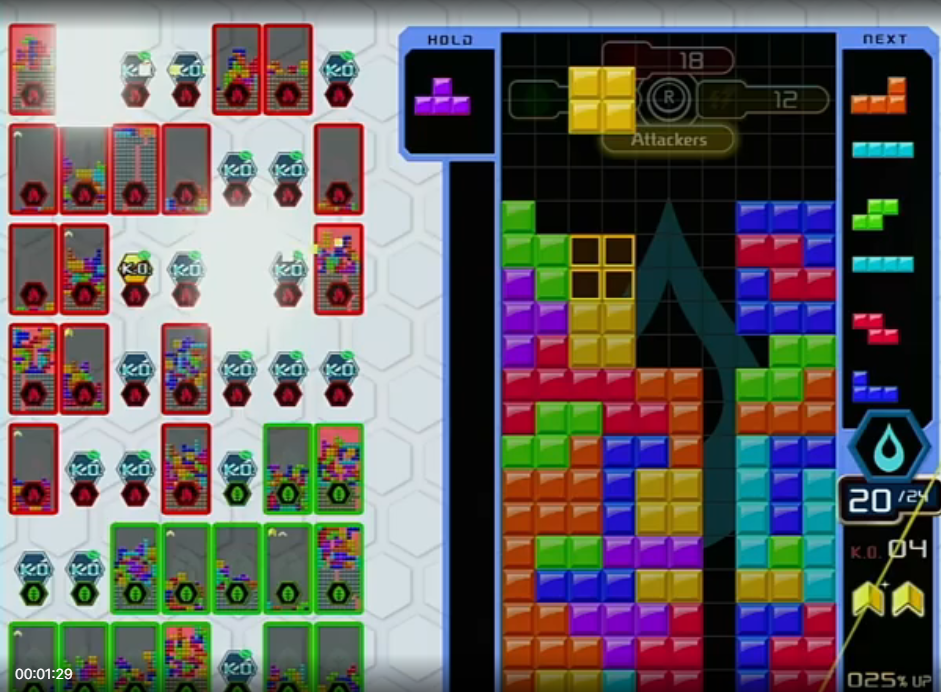
https://www.twitch.tv/videos/2518379297
In the above Tetris 99 Team Battles match, do you notice something? I simply stack cleanly and go for straightforward and safe setups throughout the entire battle. No fancy setups (Although, that’s subjective! To a novice, any basic T-spin is fancy!)! This is because the situation and context demand such. In serious matches, especially in Team Battles, where safe stacking is necessary and risks are higher, I adjust my playstyle to meet that requirement.
However, in Tetris 99, regulars are more experimental and have a lighter tone. Regardless, because the context has changed, and considering the more cavalier circumstances of the “99-players-remaining” phase, I can be highly experimental and fanciful at times. In the video below, I combine clean stacking with the occasional fancy T-spin, as seen in the thumbnail. To me, these are perfectly acceptable as I can spot them instantly and create them cleanly, while avoiding all the demerits of parity imbalances, poor stacking, and inappropriate timing.
Please pardon the below video’s initial 2 or 3 misdrops in the first 5 minutes or so. It was my first battle of the day, and I was just warming up after not having played Tetris in 6 weeks:
Notice how, later in phases 2 and 3 (with 50 and 10 players remaining), I prioritize heavy defenses, such as mid-game downstack combos, recovery, and clean skimming? I also prefer more Tetrises and simple T-spins over fancy setups. That’s what I meant by situational dependency: I adjust my playstyle according to the risks of a specific Tetris game, mode, or sub-phase.
In the most extreme situations, where I know I won’t be spiked, I can do absolutely lunatic and insane setups like these:
These are my notorious ultra-advanced, spliced setups. There’s more:
These are my infamous floating T-spin barrages. Then, there are these:
These are my criminal and overly fancy T-spin and Tetris donation setups.
The thing is, I can afford to use them, even in situations where many other players deem it more necessary to play safe. Why? Because, to me, any setup is practical if one can carry it out fast enough, with sufficient mastery of the fundamentals (avoiding excessive parity imbalances or piece/field dependencies, timing properly, non-linear construction to increase safety, etc.).
However, in serious matches, like the Team Battles Twitch clip above, even I would pass these fancy T-spins up entirely.
To summarize, my playstyle is a choice and identity, not a defect that stems from a poor understanding of risks and safety.
I consider myself a Sigma male, so I choose the lifestyle and playstyle that I prefer, without adhering to societal conventions.
4) On Haters, Mutual Respect, and the Right to Walk Away
As with any Tetris player who gathers enough reputation, there are bound to be some occasional haters. This has happened to various top Tetris players that I have known of.
This is expected, as haters can sometimes arise out of human irrationality or insecurities. Some people dislike a specific player because they represent a skill level that is so unattainable that the former may become jealous of them. Other haters may arise because of past conflicts with a specific player.
Regardless, I should emphasize that any piece of work is like a two-sided coin: there are always “heads” and “tails,” just as there are always fans and haters. My goal is to focus on producing quality content and assistance for the “heads,” as opposed to the “tails.” When the latter goes low, I typically just ignore them and go high. I must continue to write for the “heads” who find my content valuable, instead of acquiescing to the “tails.” Haters sometimes try to achieve two things: (i) negatively harming the target’s self-esteem, and (ii) severing ties between him and his loyal audience.
If you disagree with my work or values, I kindly ask that you refrain from depriving others of the opportunity to benefit from it. You are free to choose not to engage with my content, but please do not deny access to those who find value in it and genuinely need it.
Tetris is for everyone.
5) On Whether I Will or Should Include Documentative and Canonical Methods in My Books
Some high-level Tetris players (Fortissimo, Kallmestar, and Error) have voiced concerns on whether I will merely document a bunch of fragmented canonical methods. This includes the standard corpus of setups, such as DT Cannon, Fractal, Trinity, and LST Stacking, among others. They also raised concerns about whether I would merely document them without adequately covering the underlying principles and contexts.
You all don’t have to worry. I will answer that in two parts:
First, yes, I will include documentative and canonical methods in my books, as that is a necessity. Obviously, in making a comprehensive Tetris guidebook series, can the author be pardoned for excluding canonical methods like DT Cannon? Of course not! They should be included as they are canon, not like the Apocrypha section of the Bible! However, they have been thematically arranged and funnelled into specific chapters in the books, having their underlying fundamentals, caveats, and mid-game situations covered extensively.
Second, I do not present methods in isolation; I always ground them in their underlying principles and context. This is the problem that many guides face, such as <censored!>, which, with its many canonical methods and perfect clear sections, is mostly inaccessible to beginners and early intermediate players, or is scarce in covering essential fundamentals. Therefore, my book series addresses this thoroughly by extensively covering all major fundamentals, principles, and contexts that undergird entire genera of methods.
This is covered in my other article on this website:
Third, many players LOVE overly fancy and complex T-spin setups, such as advanced spliced T-spins. My friends, Zhungamer and TS_Mind_Swept, are absolute fans of them! I also know that a Yak-spin guide exists – a Word document containing all the crazy Yakine-style T-spins, such as the Breaking method, etc. Therefore, this writing is also catered to them, fanatics of the beloved religion of crazy T-spins.
To summarize, I have got you all covered. The book series will emphasize principles, contexts, and fundamentals that go beyond those found in most other guides. The goal is to foster understanding, rather than rote memorization and mere regurgitation.
6) Why Other Tetris Experts and Guides May Disagree with My Books’ Points
I have covered this point extensively on my other website:
Here is ChatGPT’s summary of the above article on what I wish to say:
[Start of GPT’s summary]
Many Tetris experts differ in their strategic guidance not due to flaws in logic or knowledge, but because of fundamental subjective differences in how Tetris knowledge is formed and applied. These disagreements fall into three main areas:
- The Limits of Inductive vs Deductive Knowledge in Tetris
Foundational Tetris “axioms” (such as the importance of parity balance) are often derived from inductive or abductive reasoning, rather than absolute logic. These axioms are then used to build complete strategy systems through deductive reasoning. While deductive steps are logically valid, the foundational axioms themselves are often contextual heuristics rather than universal truths. Since exceptions always exist, different experts may disagree on which heuristics to prioritize, or how valid they are. - Subjective Weighting in High-Level Decision-Making
At advanced levels, choosing between strategies such as T-spins, downstacking, or platforming becomes a subjective decision. Much like neural networks, players “train” their strategic preferences based on experience. One expert may favor defense, another may prioritize speed or aggression. These preferences shape their decisions and guide, leading to divergence despite shared knowledge. - Cultural and Philosophical Interpretations
Beyond mechanics, Tetris can be interpreted through various cultural, spiritual, or philosophical lenses. These interpretations — like those in art or religion — are inherently subjective and shaped by background, values, and worldview. As with hermeneutics in Buddhism or literature, no interpretation is final; all are provisional and context-bound.
[End of GPT’s summary]
Disagreement in Tetris strategy is not a flaw, but a reflection of diverse reasoning systems, values, and goals. Just like in spirituality or science, we must be pragmatists: adopt what works for our context, let go of what doesn’t, and accept that multiple valid paths may coexist.
Therefore, the above reasons explain why some of my methods may differ from those of other experts or guidelines. It’s simply a matter of different contexts and subjectivity in Tetris, arising from various experiences and different Tetris versions (like TETR.IO emphasizes downstacking and skimming more, compared to upstacking in Tetris 99).
7) On My Other Website’s, Galactoid Tetris WordPress’s, Relatively Raw Presentation
Some people have critiqued my https://galactoidtetris.wordpress.com/ website for presenting raw, meme-heavy guides.
That’s perfectly fine and expected.
I wrote Galactoid Tetris WordPress guides in their raw form, with far less polish than the ones on howtotetris.com and my Tetris guidebooks. This is because I wish to devote more time and energy to the more serious editing work and polishing for more professional content, such as my 4 Tetris guidebooks.
I would often conceive of an idea on a specific day, then write out those revelations quickly on Galactoid Tetris WordPress and share them with the world as soon as possible. This is a better arrangement than delaying for 5 years just to achieve sufficient polish in a book to share. By then, they could have lost their relevance.
Perfection is the enemy of good.
Likewise, everything is a balance between quality, time, and effort.
Hence, for Galactoid Tetris WordPress, I adhere to these two tenets and ensure that my insights are shared as soon as possible, rather than being delayed for a year or two just to achieve an overly idealistic or impractical level of polish.
Oh, and of course, Galactoid Tetris WordPress is an extension of my personality. Read the “Troll Posts” section, anyone?
This howtotetris.com website, on the other hand, exhibits a much higher level of polish, comparable to what I expect in my upcoming Tetris guidebooks, having undergone nearly 10 separate edits and multiple iterations.
More Critique Responses To be Added!
Please be sure to check this page’s updates occasionally!
 How to Tetris