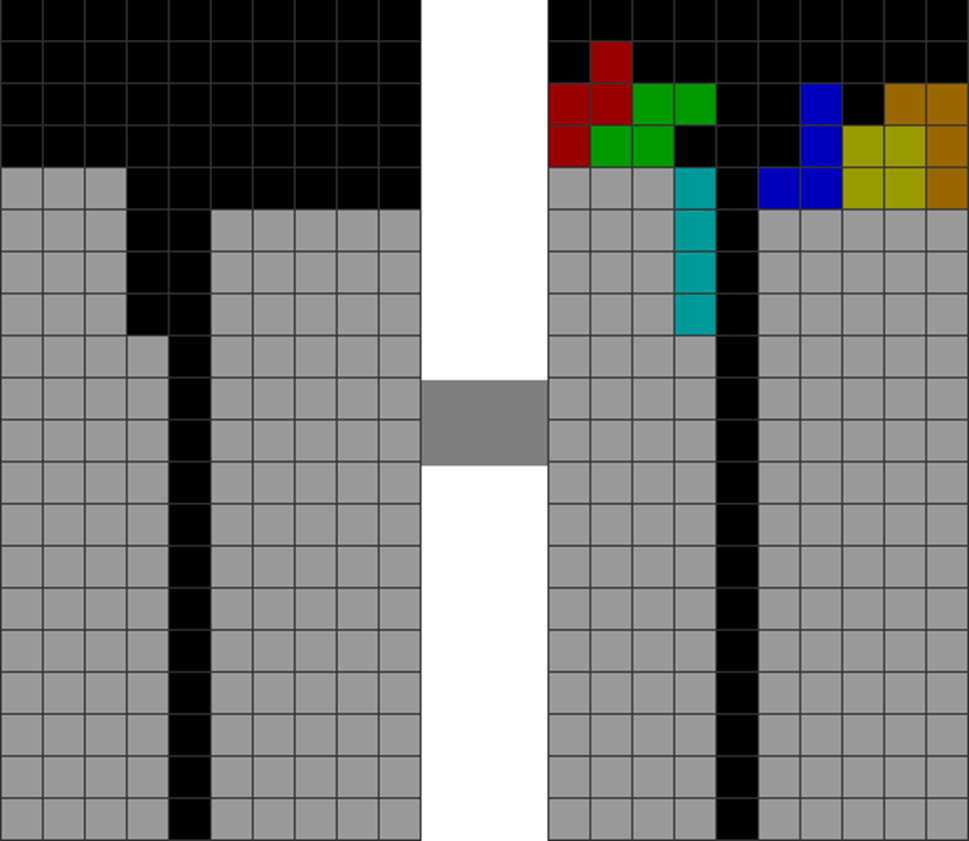
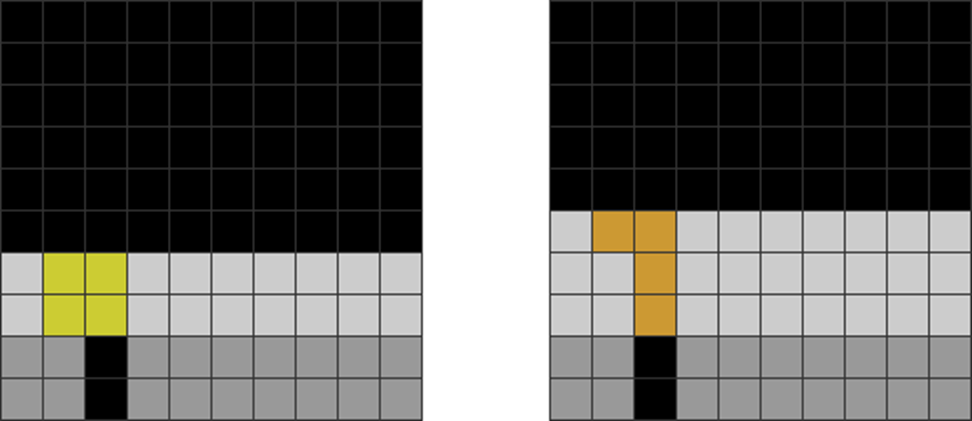
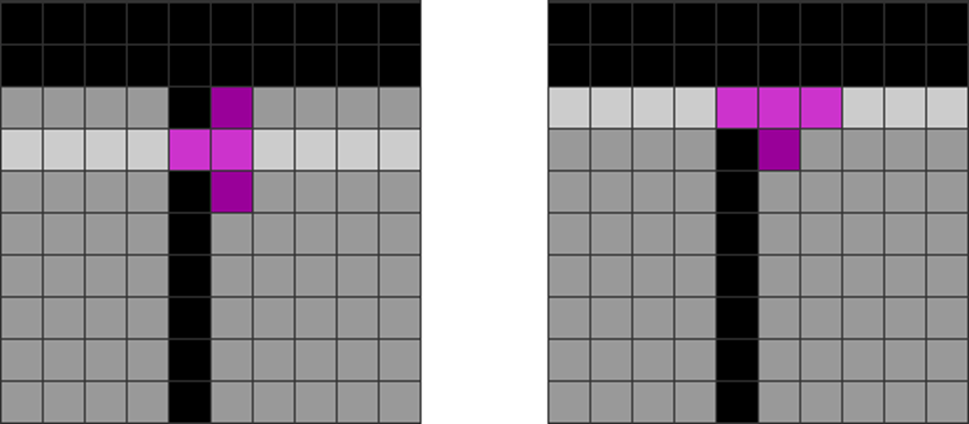
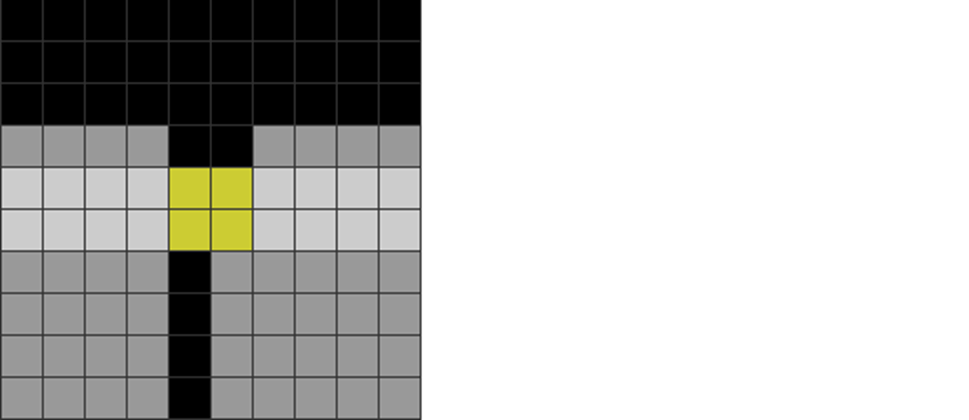
Skimming involves manipulating a field into a more desirable form using singles, doubles, or triples. This can involve a field that is easier for the player to downstack, make Tetrises, is cleaner, or make easier T-spin setups. Here’s an illustration:
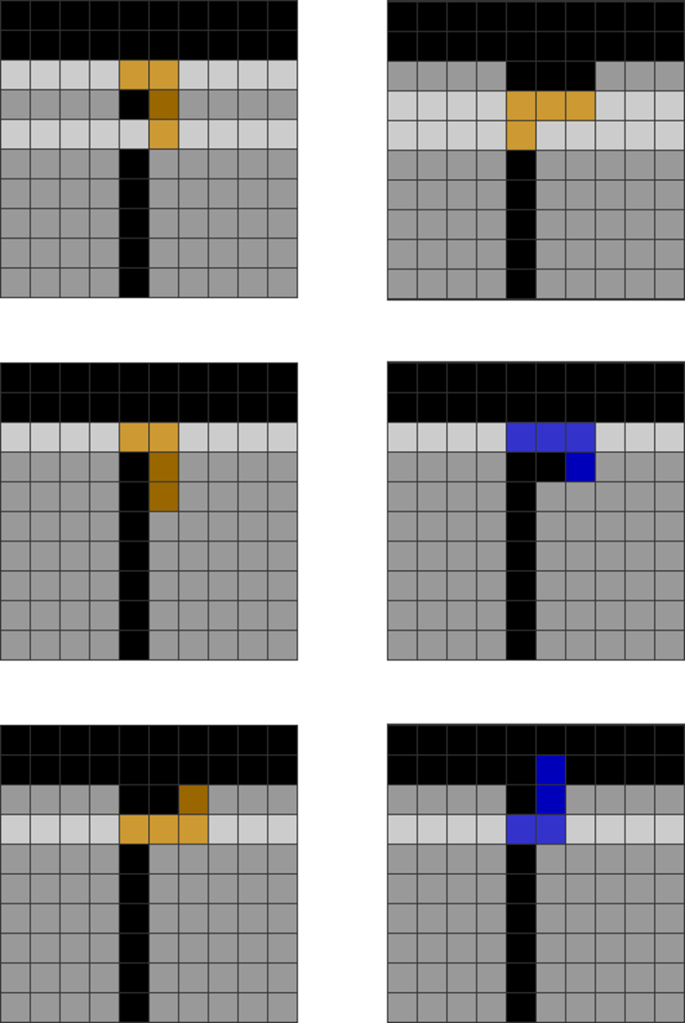
Diagram Set 10-1
1
2
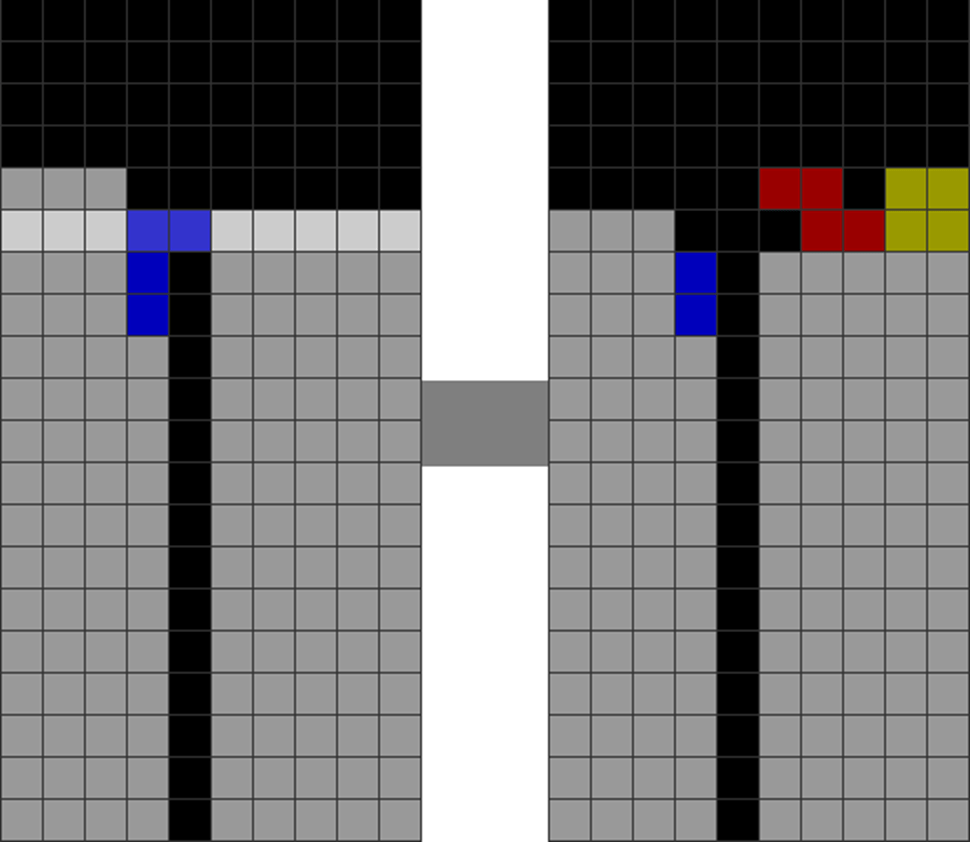
The player uses a T skim to create a single. This balances both sides of the stack, making a T-spin double follow-up possible.
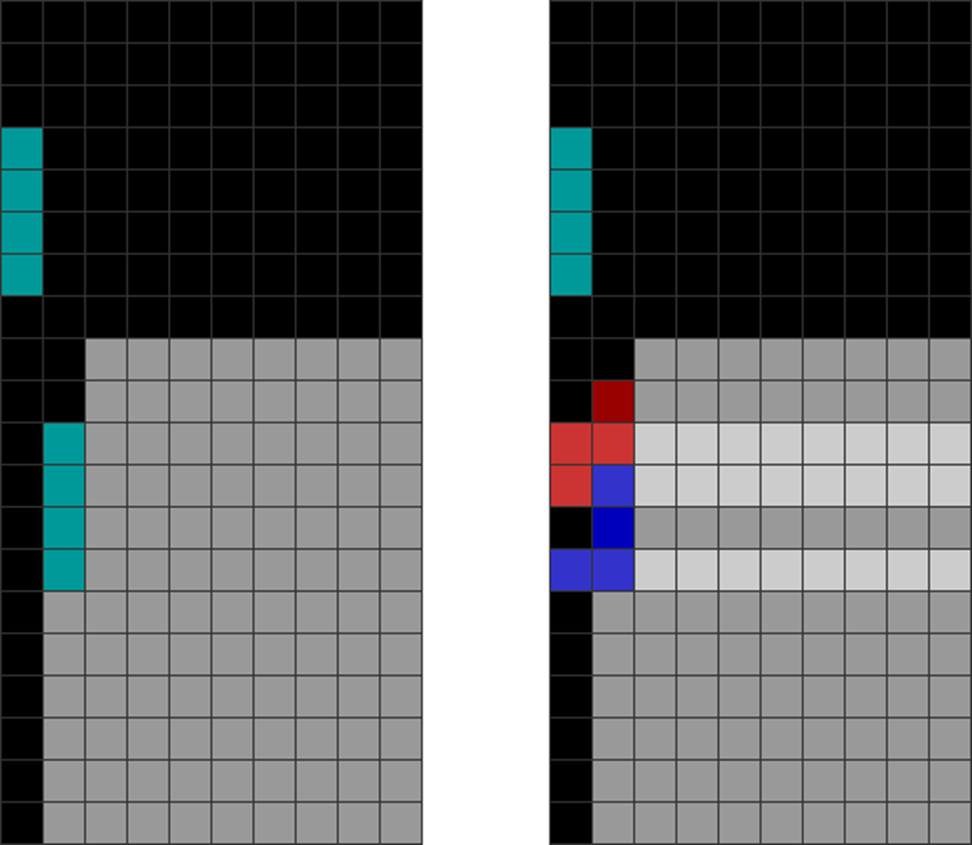
Diagram Set 10-2
1
2
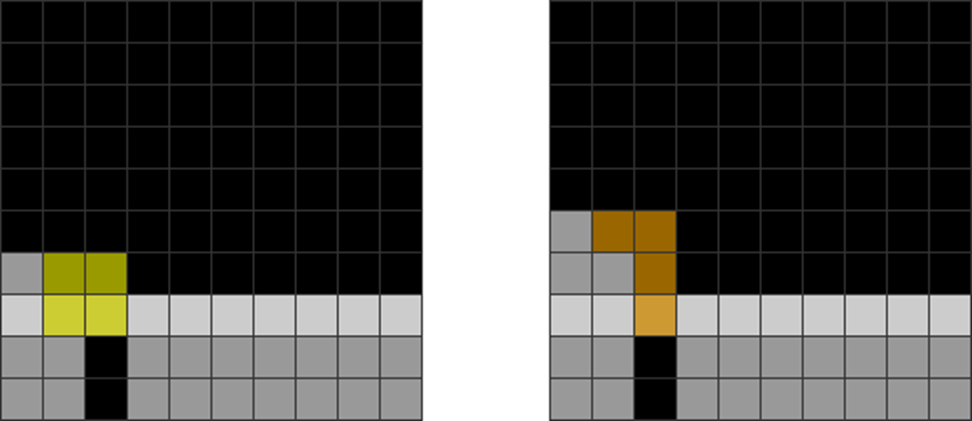
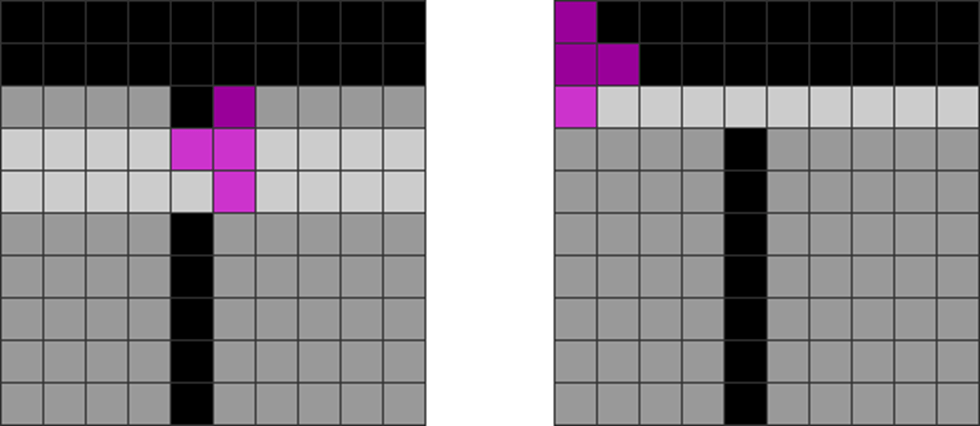
Same, with an L skim leading to an easy T-spin double.
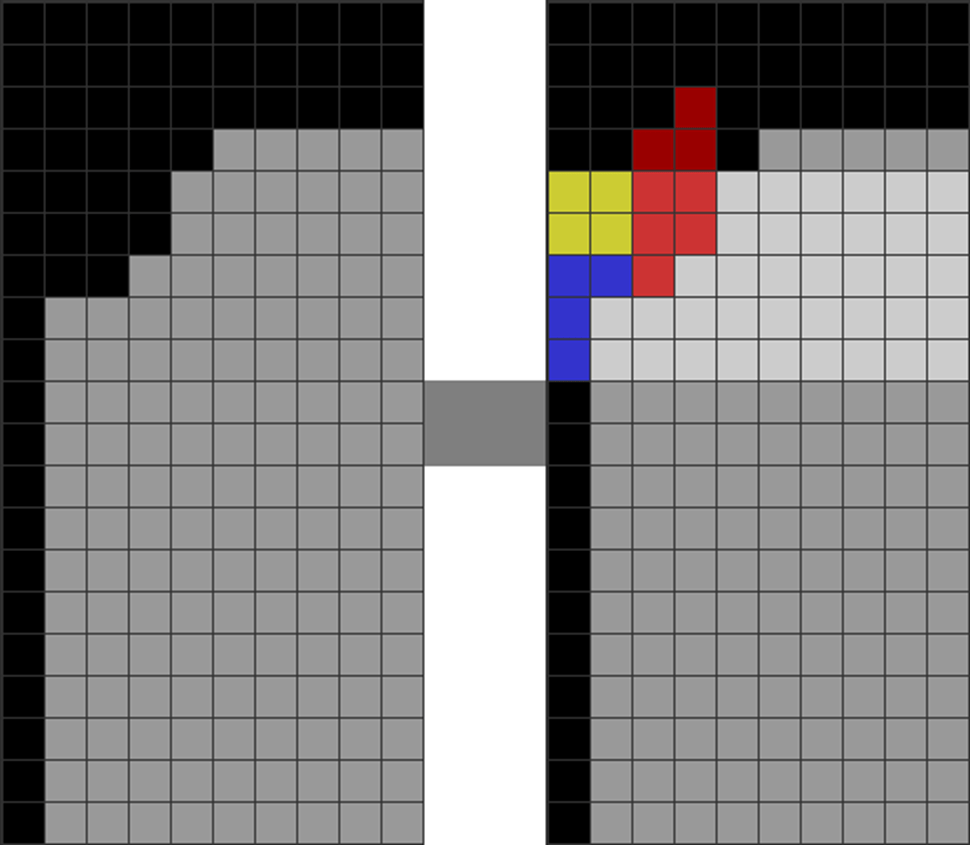
In these examples, the player uses a single, double, or triple line clear to alter the field’s shape, creating many new opportunities, such as T-spins or a safer field.
A) Principles of Skimming
Outstanding players only skim when they need to. This minimizes line clear delays and strategically shapes the field to create other opportunities.
There are some vital skimming principles:
1)Skimming is Mostly Defensive
Skimming is primarily a defensive act. Sometimes, you will face:
Diagram Set 10-3
1
2
This sequenceinvolves using an O to skim. The Z overhang is placed first, so when the O double completes, it leads to a forecasted T-spin double.
3
Alt. A
The T-spin double is ready.
Here, you may get topped out because of over-stacking. Therefore, you may have to use the former choice to skim with an O piece to get a T-spin.
Step 2’s skim is safer than Alt. A. Thus, skims are helpful for survival and getting rid of excessive pieces.
2)Watching the Opportunity Cost of Skimming
Sometimes, you have two choices:
Diagram Set 10-4
1
2
You must place seven pieces to sustain a back-to-back T-spin double. But the I piece to fill the side well may not come.
Diagram Set 10-5
1
2
This continues from the previous diagram set’s step 1. You may have to settle for this sequence with a skim to even out the two sides to get a T-spin double. You only need to place three pieces here without waiting for an I piece.
It’s sometimes better to skim in such situations, as getting a T-spin is quicker if you have an I-piece drought.
3)Doing Clean Skims
It’s best to choose clean skims over dirty ones. The below situation illustrates cleanliness:
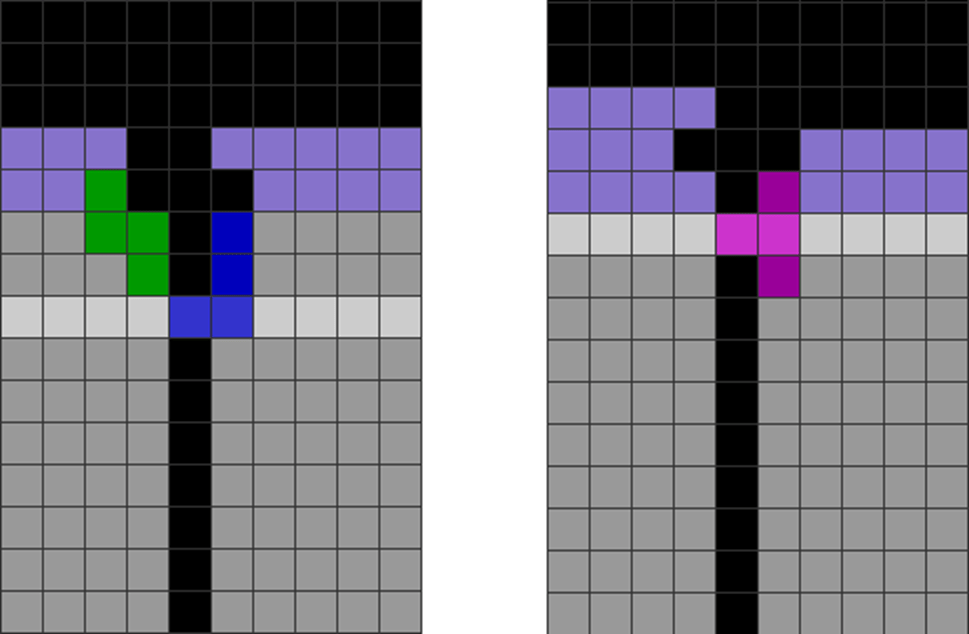
Diagram Set 10-6
1
2
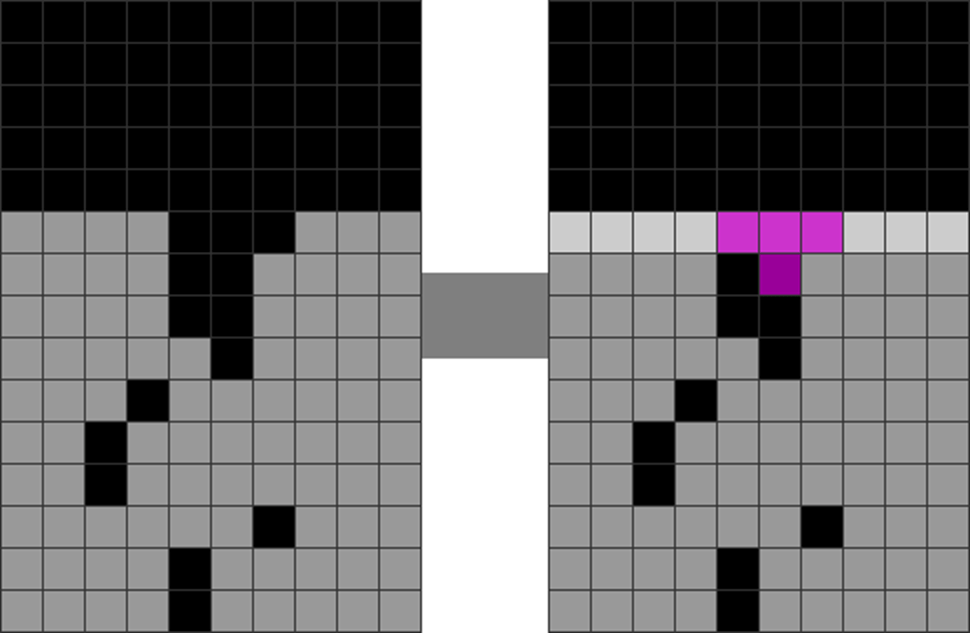
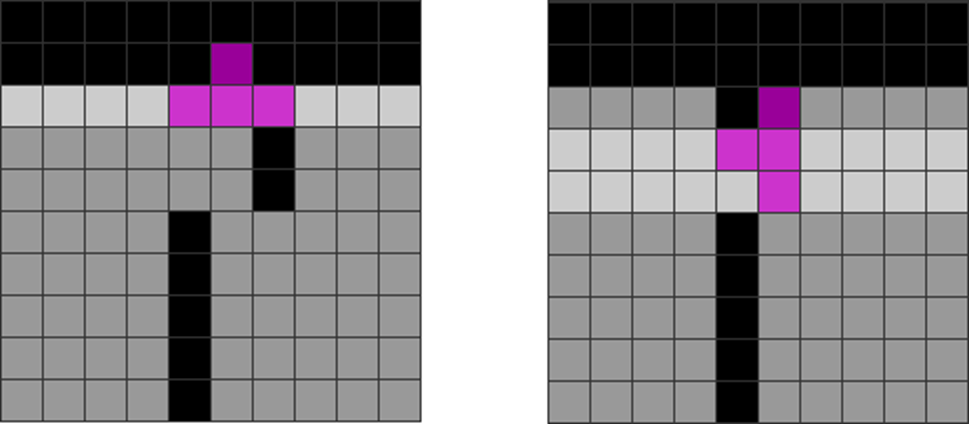
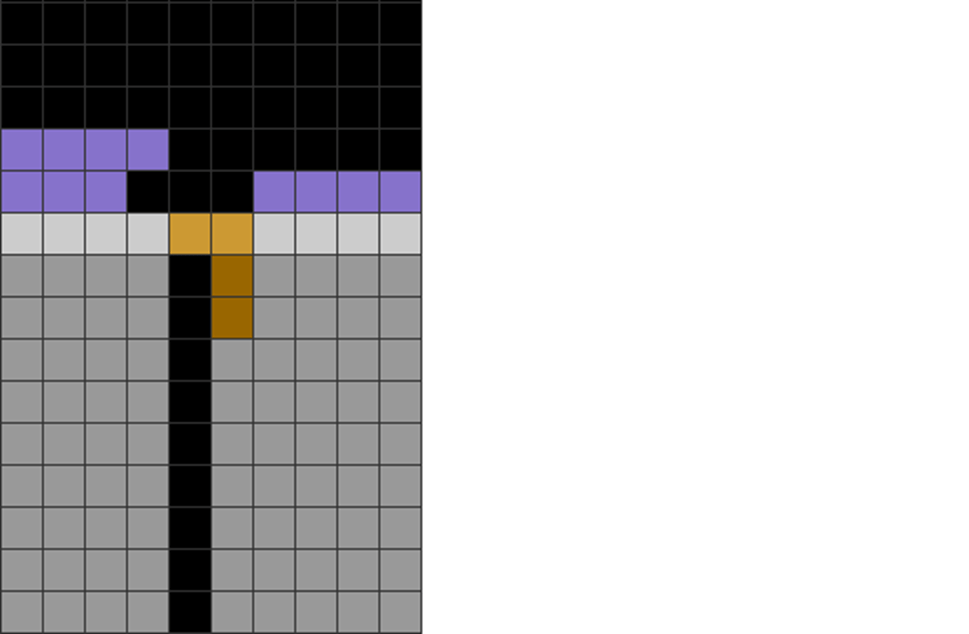
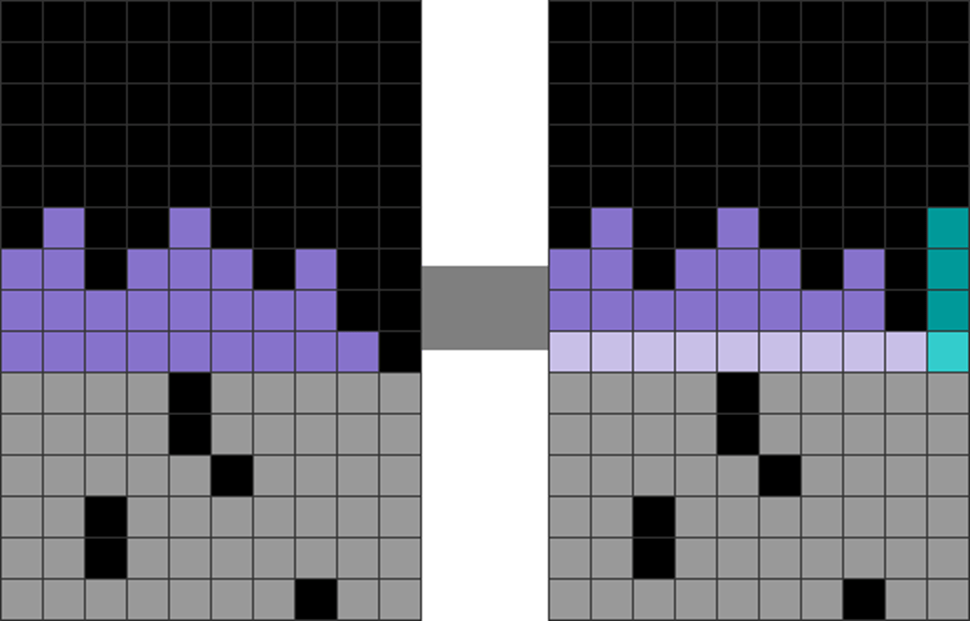
This is the starting field.
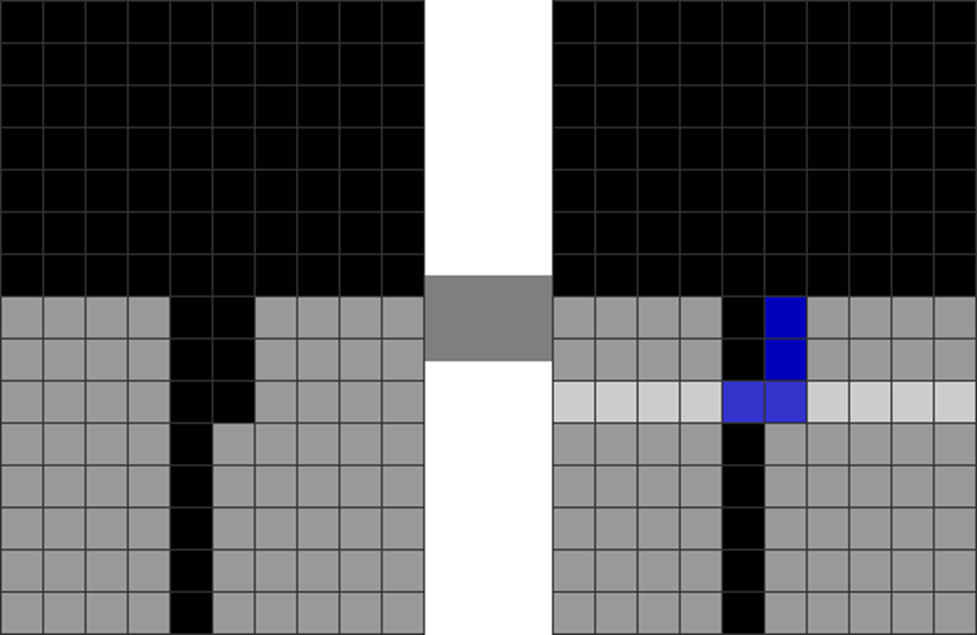
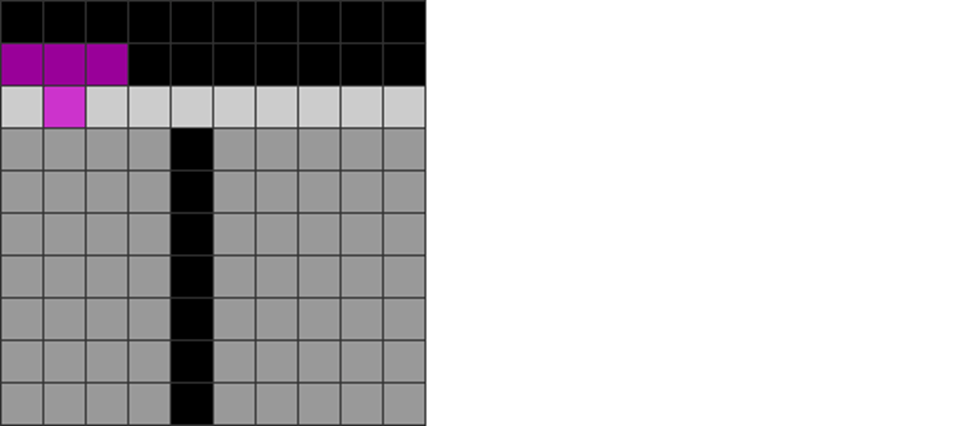
The player uses a horizontal T skim to create a single line clear.
3
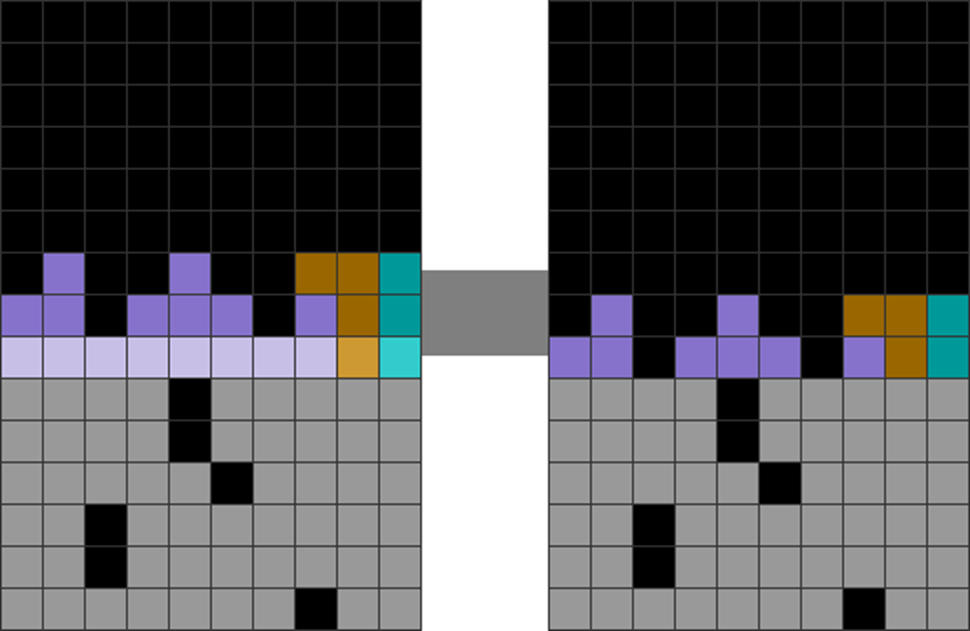
Alt. A
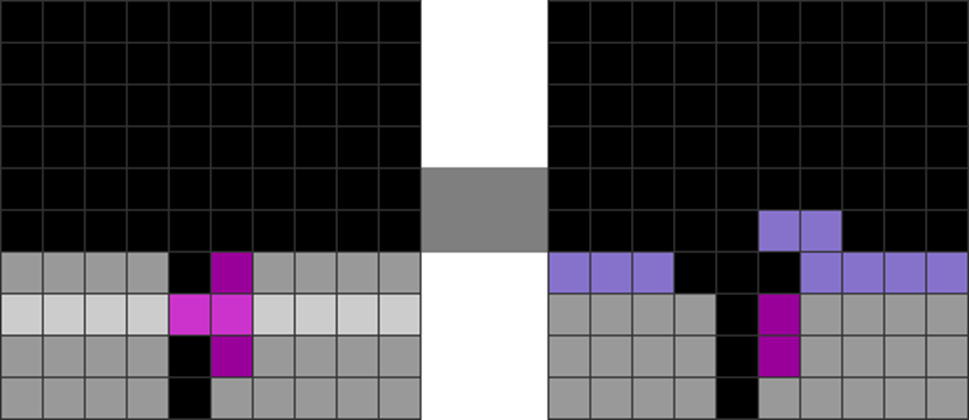
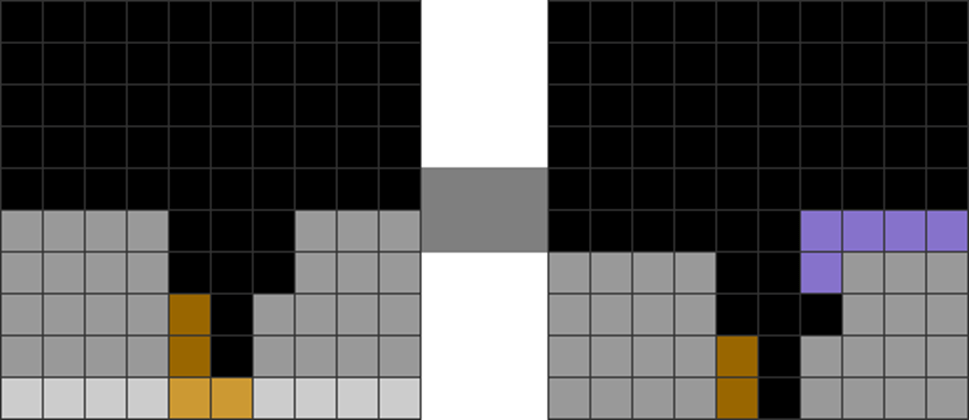
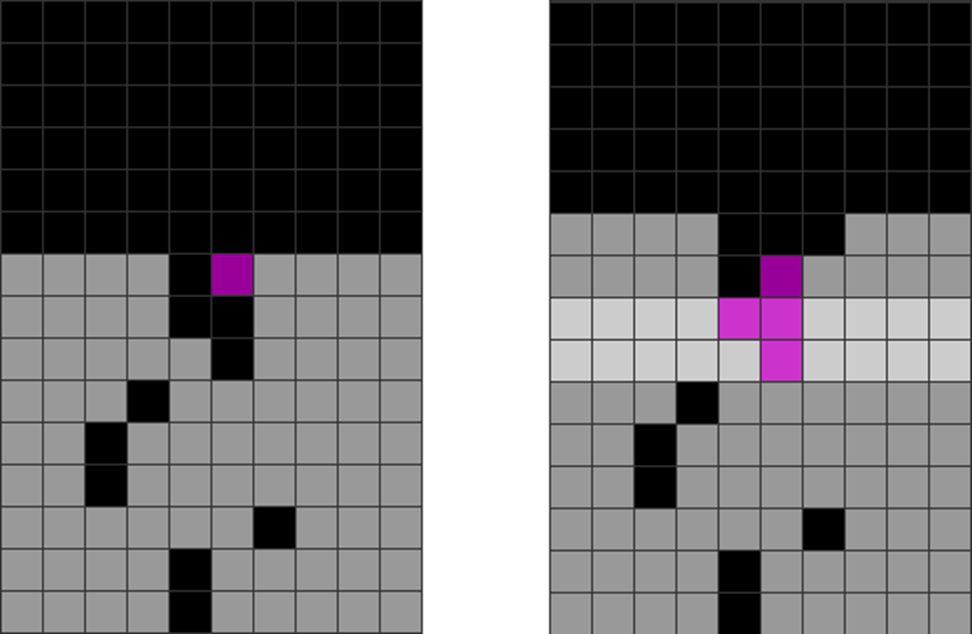
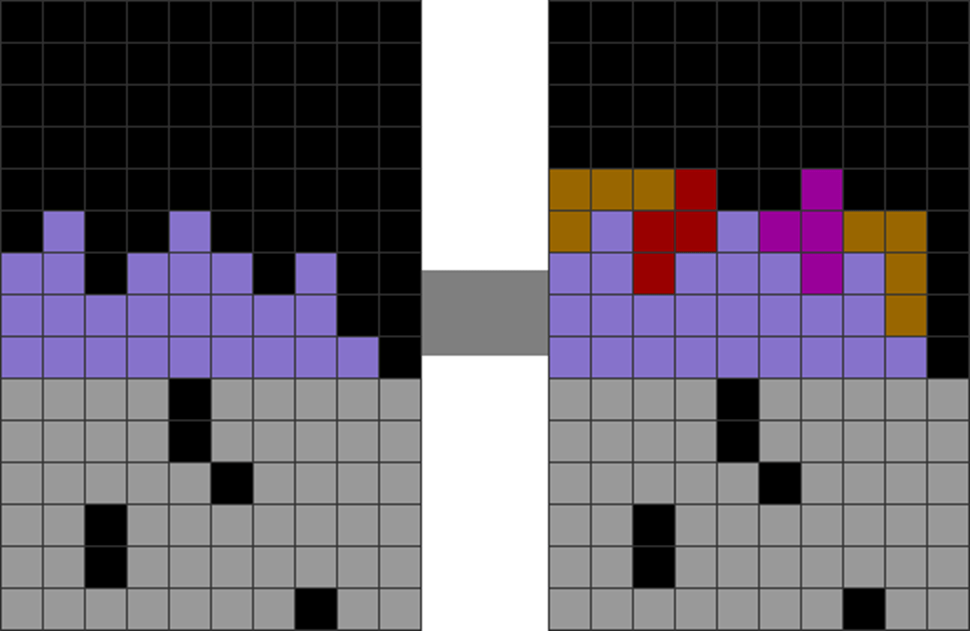
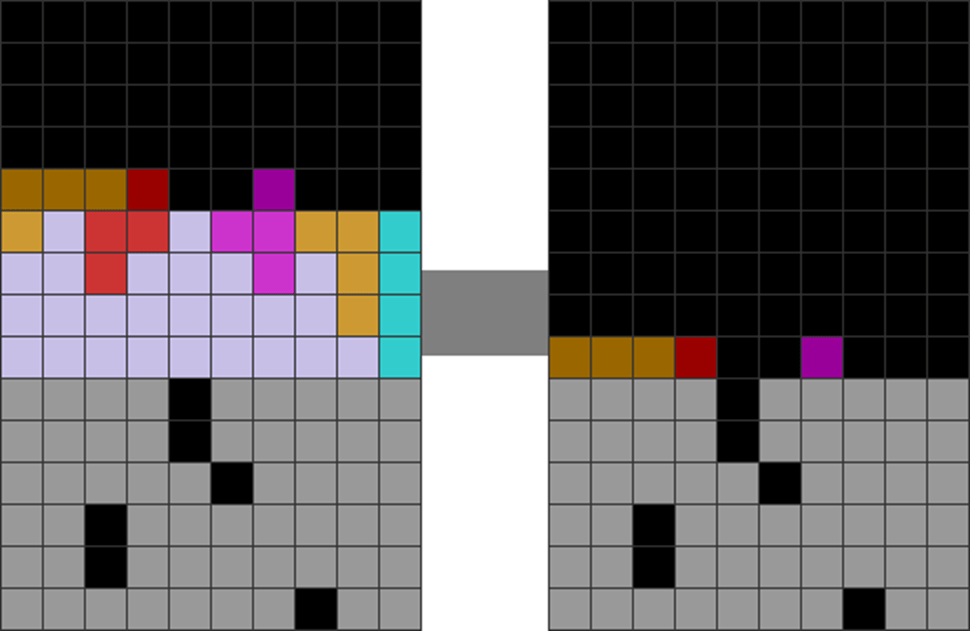
The aftermath shape is dirty as the residual purple block blocks the next garbage hole, creating a cavity that can’t be easily filled.
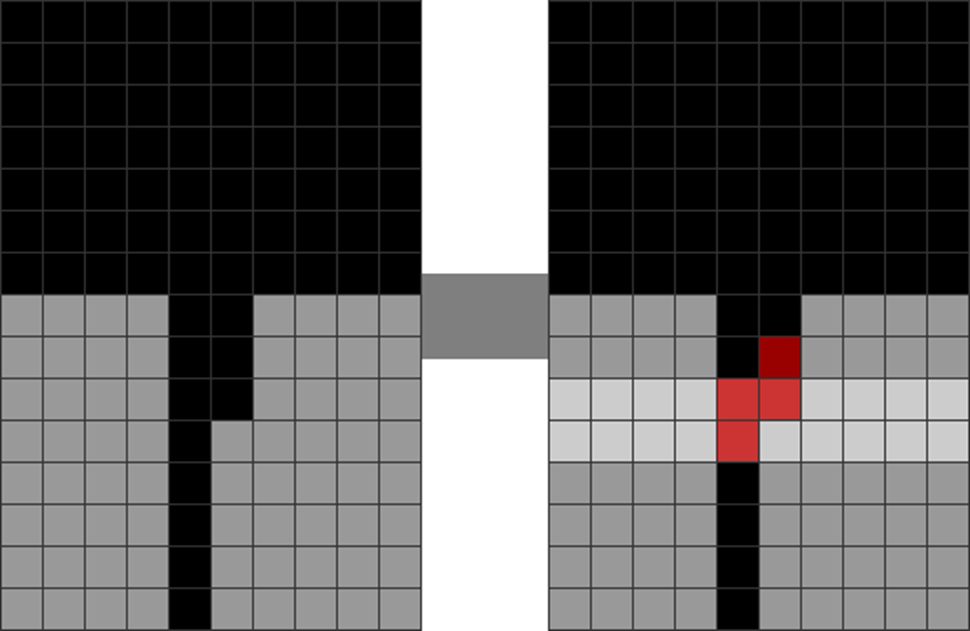
This alternative is much cleaner as it doesn’t leave any overhanging residues blocking the next garbage holes.
Make your doubles and triples as clean as possible while skimming. This means not leaving any residue upstack. See below:
Diagram Set 10-7
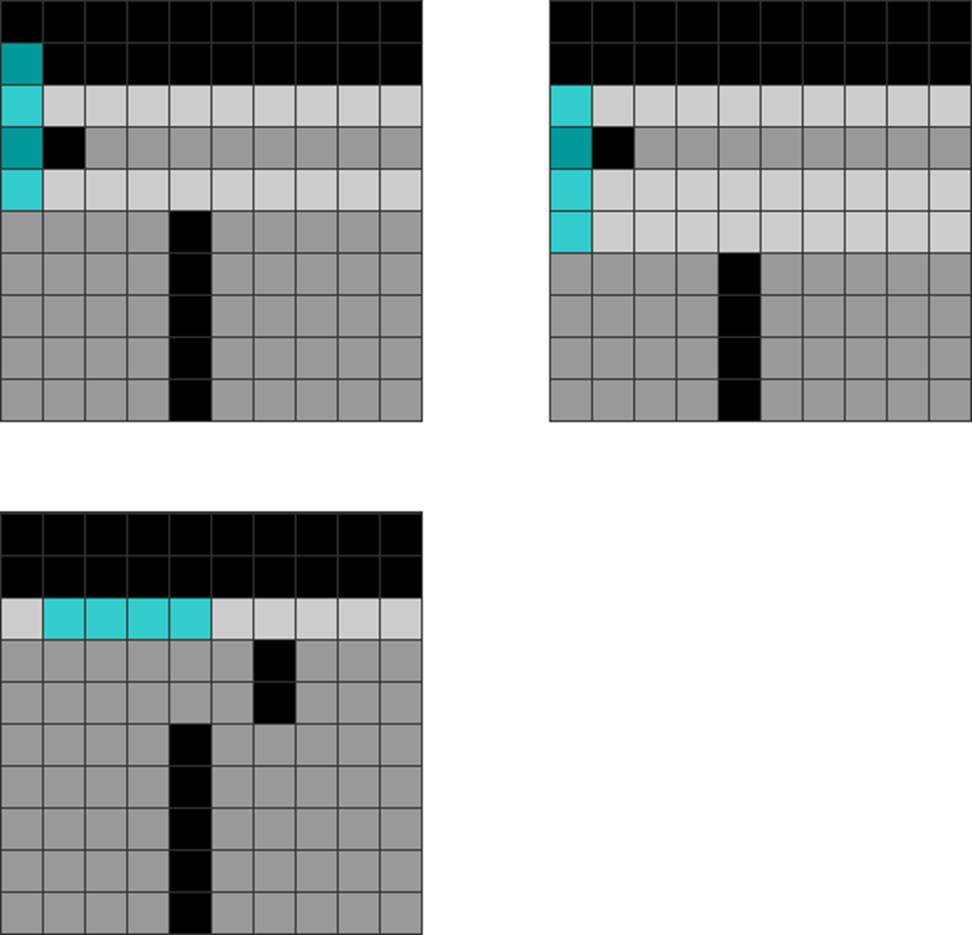
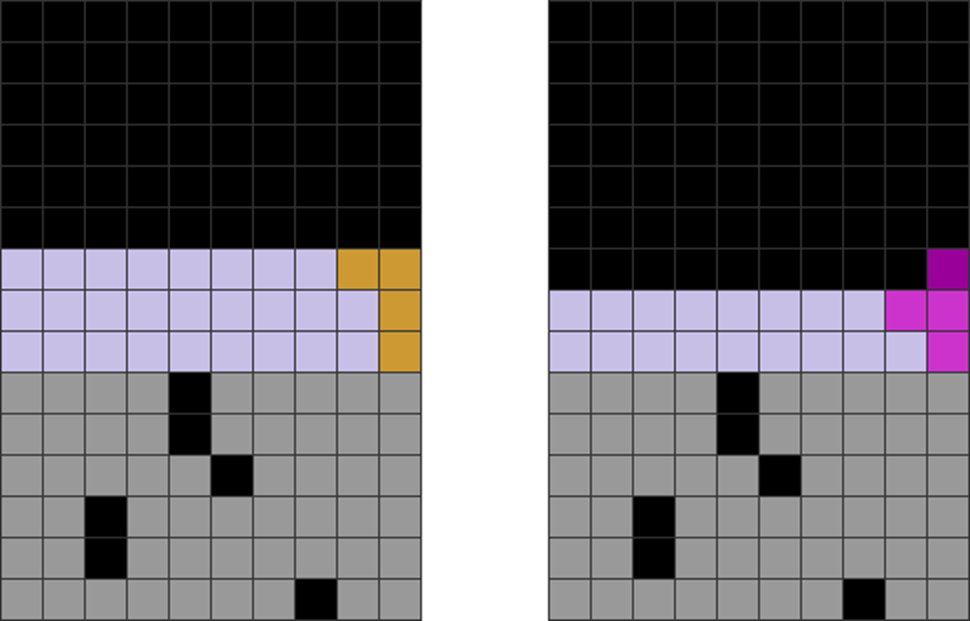
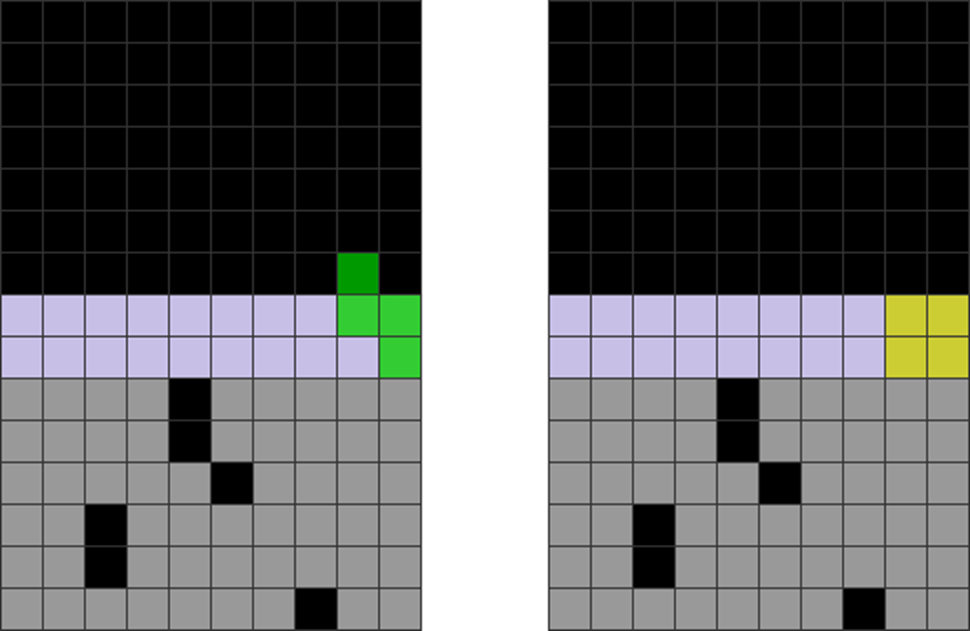
The two diagrams on top are clean, leaving no residue. However, the ones on the bottom require you to skim off the top layer before exposing the garbage hole.
The latter two examples incur line clear delay time and lead to many unnecessary singles, making it inefficient. Therefore, use clean doubles and triples to skim.
B)General Ways to Skim with Each Piece
All seven pieces have orientations that one can memorize to skim effectively. The general idea is to use the 7 tetrominoes to alter the height differences between two adjacent stacks using skims:
Diagram Set 10-8
1
2
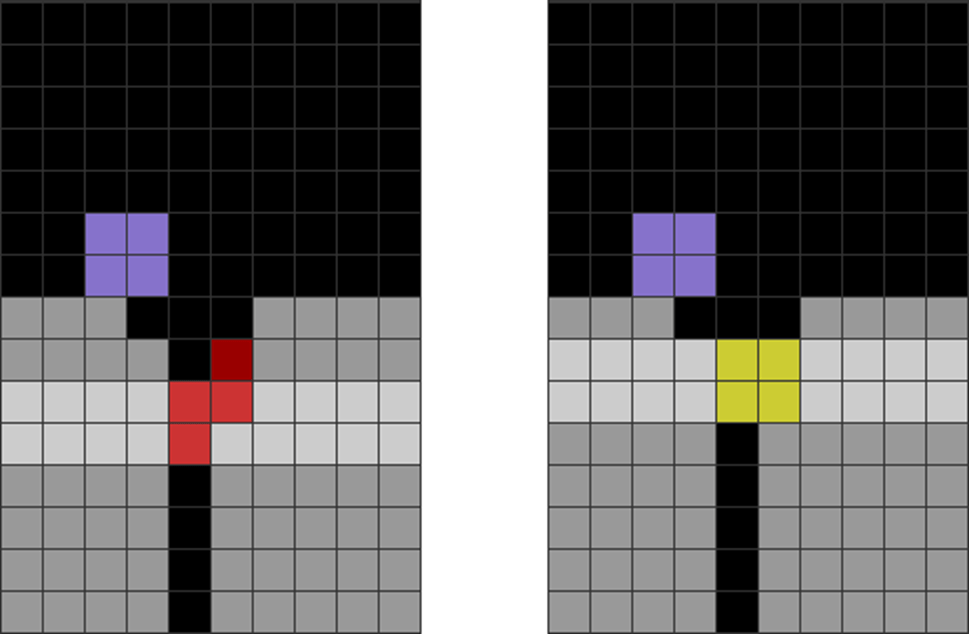
Using a J skim, both sides are evened out around column 5.
Diagram Set 10-9
1
2
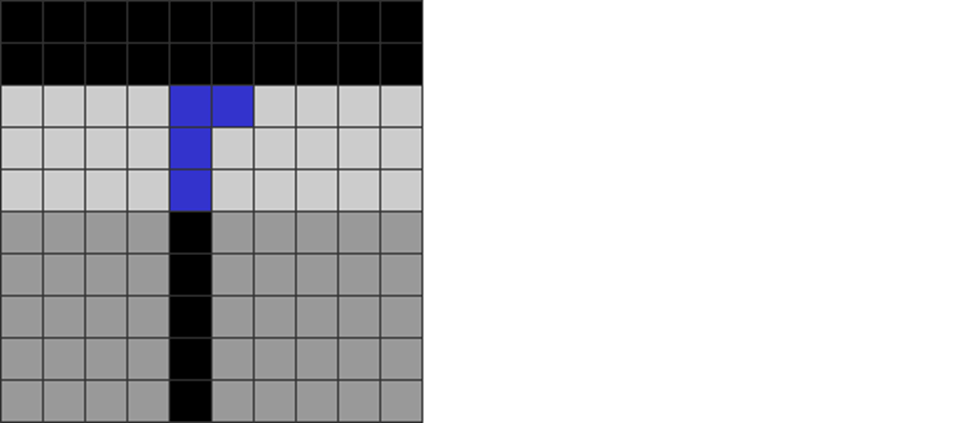
Using a Z skim causes both stacks to differ by a height of 1 around column 5.
Note how, in each sequence, the stacks on both sides initially differ by a height of 3. The skim alters the difference to the desirable number.
It’s mere arithmetic. Skim to adjust your two stacks’ heights to the appropriate difference using the right pieces.
Here are some configurations for all 7 minos:
L and J
Diagram Set 10-10
.
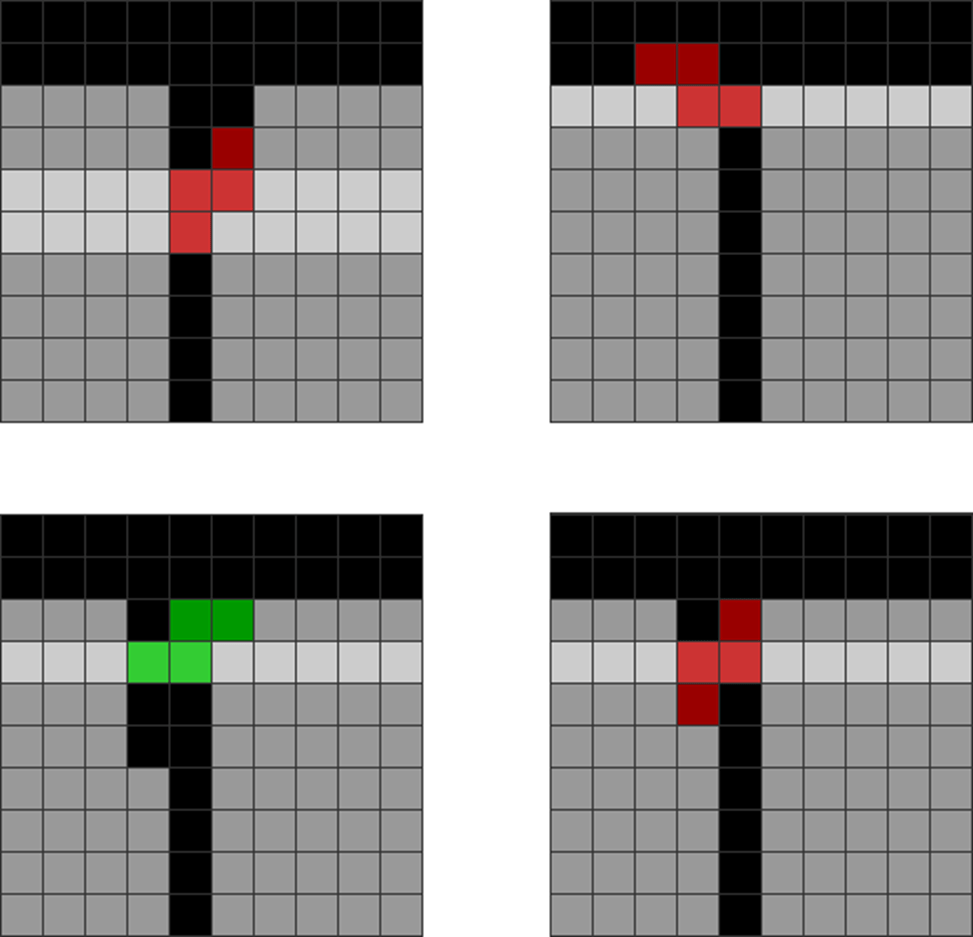
The L and J skims here alter the height difference of the stacks around the hole in column 5.
Ls and Js are the most versatile pieces to skim since they cover many orientations. They can alter the difference between two adjacent stacks’ heights by 1, 2, or 3.
Memorizing them is good not only for skimming but also for extending one’s downstack combo and fluency.
S and Z
Diagram Set 10-11
The S and Z skims here alter the height difference of the stacks around the hole in column 5.
While not as versatile as the L and J pieces, S and Z pieces have vertical and horizontal orientations that can be tricky to memorize for skimming. They can often alter the difference between two adjacent stacks’ heights by 1 or 2. Knowing these extends one’s skimming options a lot.
T
Diagram Set 10-12
T pieces, like the L and J pieces, have many orientations to skim. Ts can also switch holes on the first row’s far-right example,as the Downstacking chapter covers.
I
Diagram Set 10-13
I pieces are tricky for skims. They can be placed vertically or horizontally for a single.
O
Diagram Set 10-14
O pieces are the least flexible for skims as they have only one orientation.
C) Applications of Skimming Methods
Here are the most common ways to apply skimming methods in the mid-game.
1)Cleaning and Getting Rid of Excess Pieces
Sometimes, your field may be unclean, and you may have excess pieces. This happens when you have multiple S or Z pieces or I dependencies. As shown earlier, the latter occurs in Tetris 99, where garbage is clean.
Therefore, you sometimes must skim off these excessive pieces. Not doing so may lead to overstacking, such as too many vertically stacking S or Zs.
The most common and deadly piece dependency is an I-piece one. If you sense an I-piece drought, and clean garbage is just a few blocks beneath, it’s better to give up back-to-back bonus and skim downwards to get the clean garbage. Not doing so may cause you to over-stack.
Sometimes, you get into these situations:
Diagram Set 10-15
A
B
Placing the first I in the stack creates a super-clean line in column 1, sometimes leading to excessive I dependencies.
Without incoming Is, it may be better to skim a bit before the I arrives for a Tetris. This step gets rid of the excess Z and J pieces.
Here are some other ways to get rid of other kinds of excess pieces:
Diagram Set 10-16
1
2
The player builds a “well-like” pattern that tapers into a depression to the extreme left. He then skims off the top layers with Z, O, and J pieces.
2) Creating Quick T-spin Opportunities
Sometimes, you may be greedy and wish to sustain back-to-back bonus by making the required placements. However, it’s often not possible.
Hence, you are forced to make T-spin skims like the ones below, which break back-to-back bonus but make the T-spin fast:
Diagram Set 10-17
In the three examples, the player uses J, T, and L to skim and balance both sides of the stack. The player can then easily make a T-spin double with an overhang.
The most common use of skimming involves using the L, J, and T pieces to make a single that evens out two sides of a Tetris stack. This leads to more T-spin continuations.
S, Z, and O pieces can also make a double. However, excessive usage of anything more than a single is ill-advised, as it reduces efficiency.
Diagram Set 10-18
A
B
Using Z and O, the above two skims are highly common mid-game. They both shape the field into a T-spin double each.
These methods are best freestyled instead of being merely memorized.
3)Skimming off the Top-most Colored Blocks for Survival
Skimming is the art of clearing the upstacked colored blocks. To do this, it is advisable to skim them off, leaving no residues cleanly. Here are examples of not doing it well:
Diagram Set 10-19
1
2
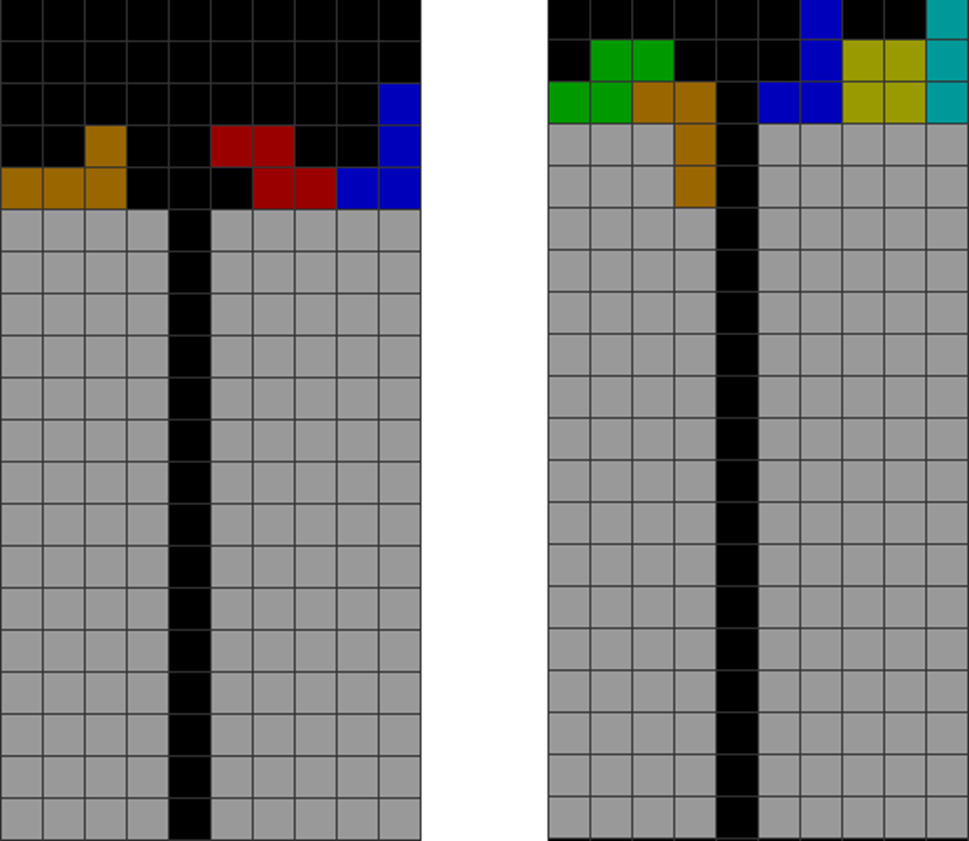
This field has significant jaggedness issues.
The player skims with a single, evening out a local jaggedness area.
3
4
He skims with another single, reverting to the original local jaggedness.
The field is still heavily jagged.
There are two ways to avoid unnecessary residues, as mentioned above. First, you can make perfect rectangles of 4 blocks tall like this:
Diagram Set 10-20
1
2
This is the same field as the last diagram set’s start.
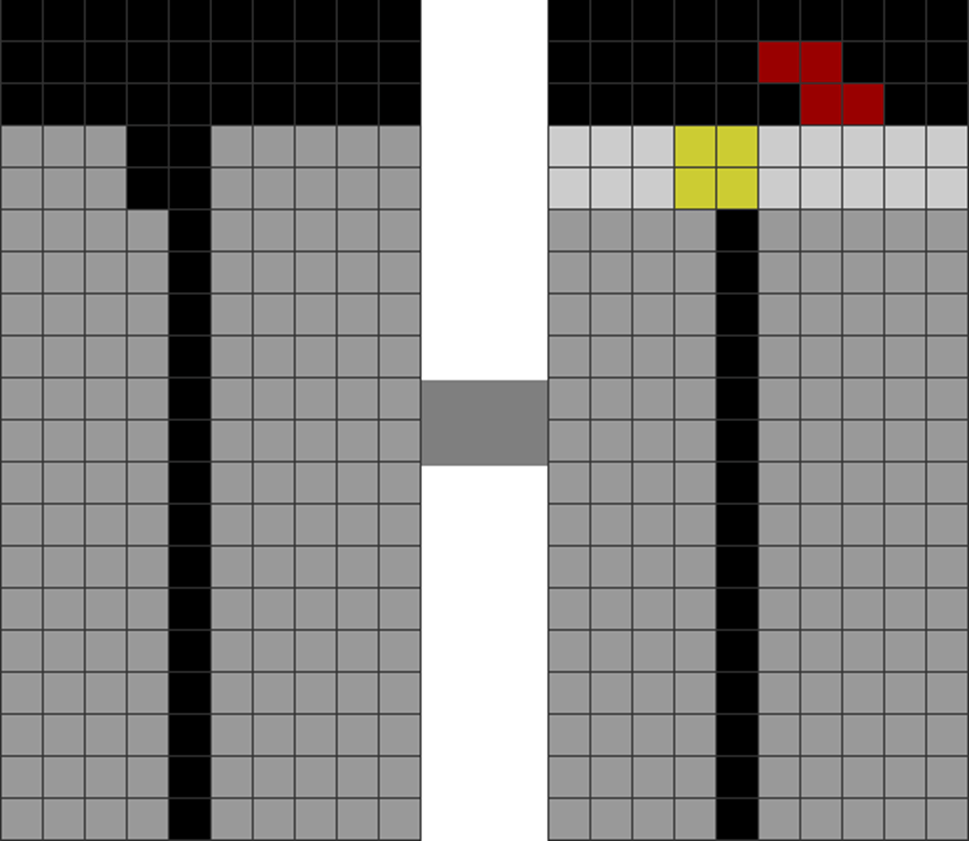
The player cleverly fills the cavity to make them as flat as possible. He uses a T piece to resolve jaggedness and flatten the stack.
3
4
He cleans up with a perfect Tetris.
The aftermath is clean, exposing the next garbage hole.
The second is to use clean doubles and triples like these, which both lead to an immaculate field without residues blocking the next garbage hole:
Diagram Set 10-21
Examples of using L, T, S, and O pieces to make clean doubles and triples. After the line clear, the garbage hole is exposed.
Doing so lets you skim the top, colored, upstacked layers off cleanly and expose the garbage hole afterward.
Summary and Conclusion
Skimming aids in escaping intractable situations and creates offensive and defensive options.
Concept
Summarized Rules-of-Thumb
Flow
Watch the opportunity cost of skimming, such as line clear delays. Skim off the top-layered blocks fast if you must downstack quickly.
Form
Make clean skims. Know each piece’s traits and the shape they create after each skim. Use skims to get rid of excessive pieces. Skims can create T-spin opportunities.
 How to Tetris