Sprint is a Tetris game mode that involves clearing as many lines as quickly as possible. Thus, the fastest way to do so is to make Tetrises clear four lines simultaneously while not doing any soft drops, T-spins, or the spins of other pieces.
There are many sub-modes. The most standard one is a 40-line sprint, which involves clearing 40 lines.
Sprint is a test of speed and the accuracy of one’s piece placement finesse.
Types of Practical Sprinting Methods
A) 9-0 Stacking
This sprinting method is the most common: stacking the first nine rows to the left and leaving the tenth column empty for Tetrises.
| Diagram Set 5-1 |
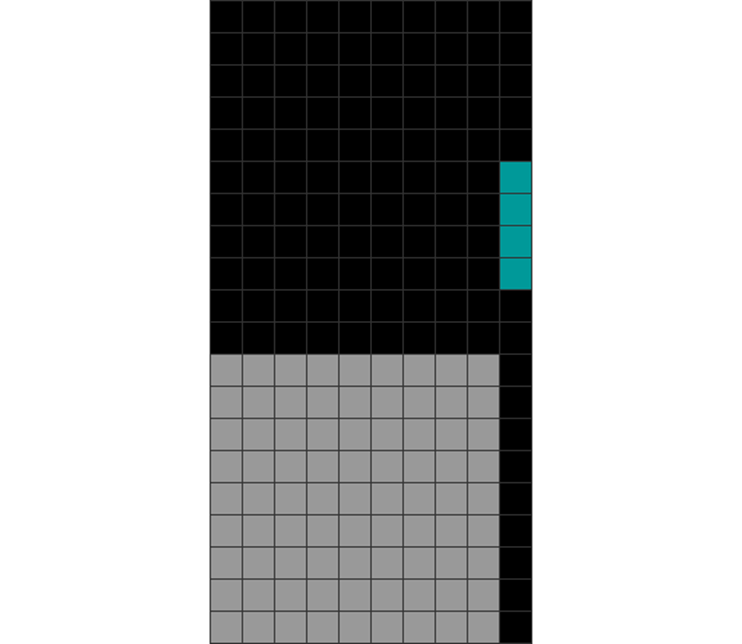
| The empty column is in the tenth column for the Tetris. The other nine columns are filled. |
Therefore, it’s called 9-0 stacking.
This is preferred over the mirrored version, or 0-9 stacking, with the Tetris hole on the extreme left (first column).
This is because L, J, T, S, and Z pieces are not asymmetric when they spawn. They spawn slightly to the left.
9-0 Stacking Sprint Openers
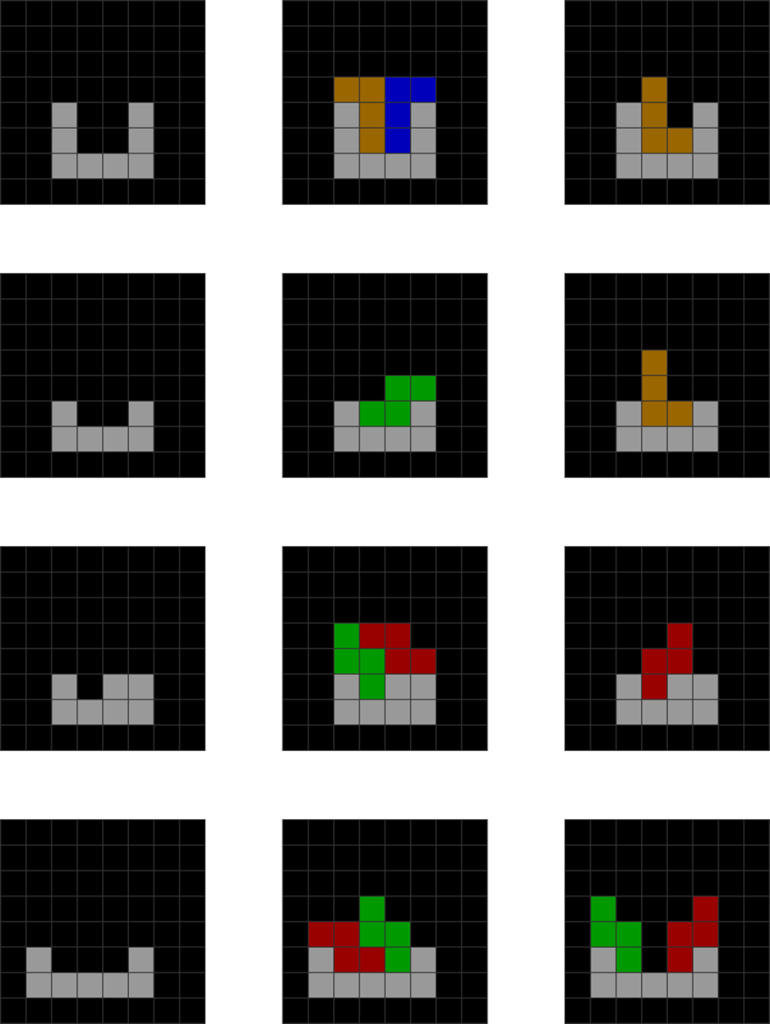
Here are several 9-0 stacking sprint ways to place some of your initial pieces. Memorizing and applying them leads to a faster start, saving precious seconds to get a better sprint score.
| Diagram Set 5-2 |
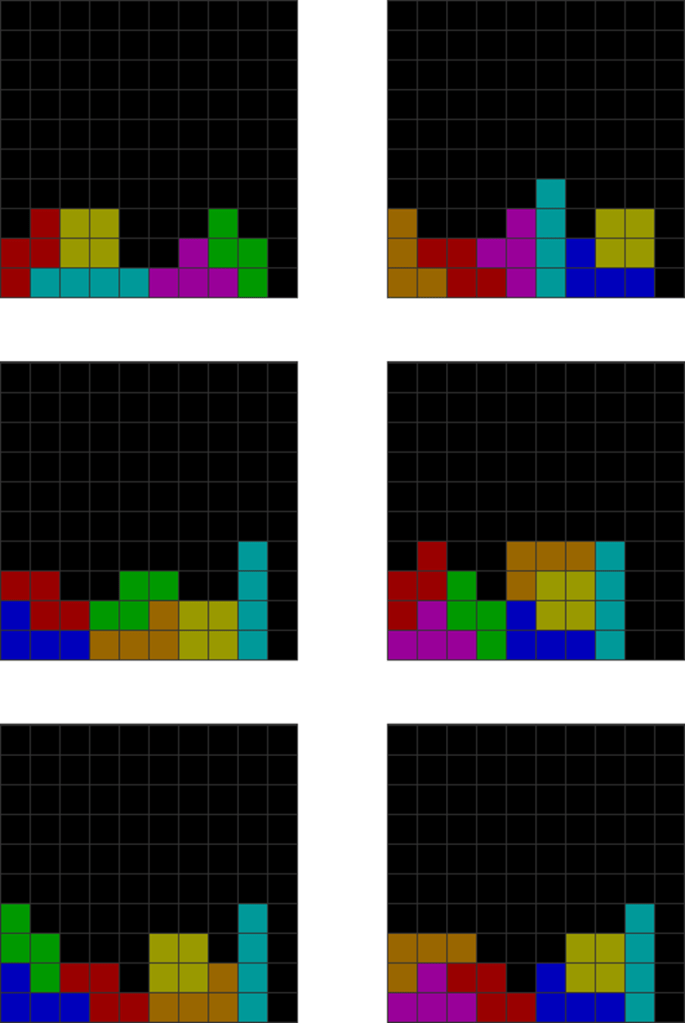
| These six openers are common ways of placing the first 6 or 7 pieces. |
Many players will restart the sprint if one gets an unfortunate early string of bad pieces, such as S and Z. A starting S and Z placement makes a pattern that requires a soft drop to fix, thus wasting a few seconds.
While many of these Sprint openers work, I recommend optimally choosing openers with minimal key presses per piece for the best sprint personal record. The opener involving horizontal L and J in the middle left diagram above is best for me.
The Core 9-0 Stacking Habits to Reduce Thinking Time
This sub-section comprises habits to streamline one’s gameplay. They are habits because you can reduce inefficient and unnecessary thinking time once your brain automates them. Let’s begin:
1) Filling Piece Dependencies First and Joining Pieces
You can play faster by first prioritizing the filling-in of piece dependencies. Here is an illustration:
| Diagram Set 5-3 |

| When you have a 3-wide gap above, you can fill it with horizontal L, J, and T pieces. |
This is a piece dependency.
| Diagram Set 5-4 |
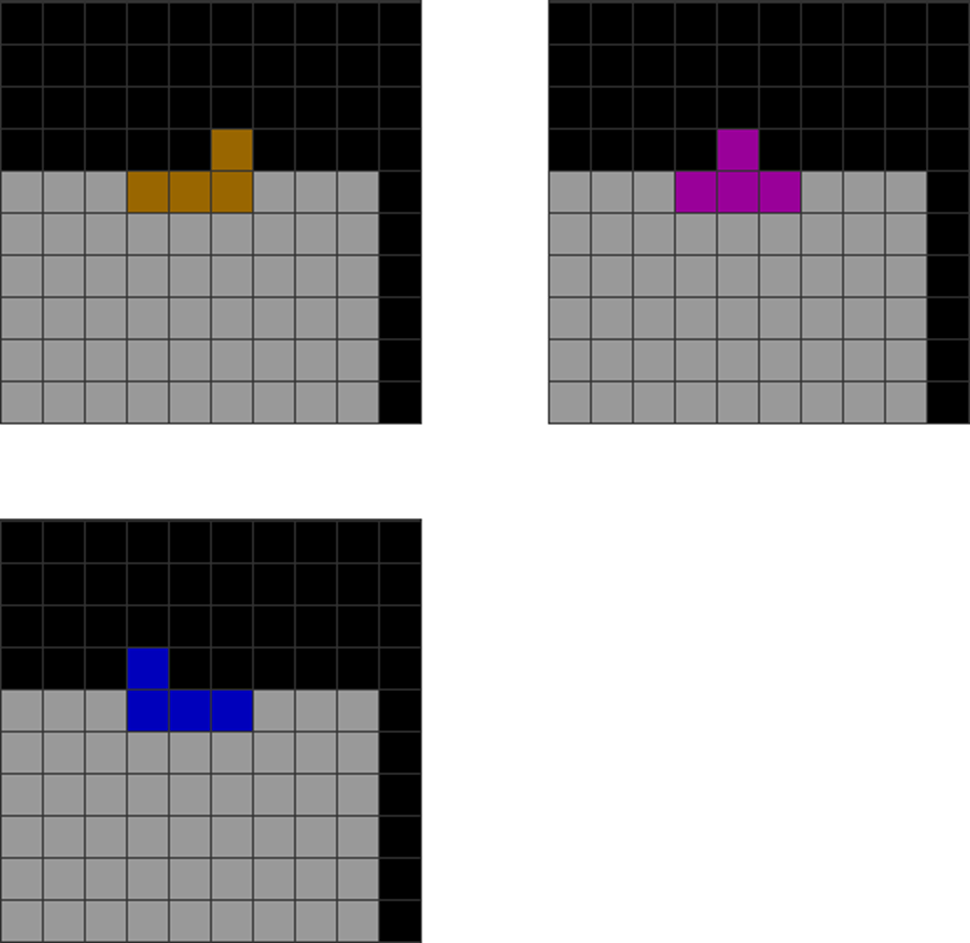
| Set: The above three examples show how a 3-wide gap can be filled with horizontal L, T, and J pieces. |
When you see a 2-wide gap, you can fill it with horizontal S, Z, or O pieces that are two blocks wide. I will leave this as an exercise for the reader to visualize.
Here comes another neat trick: joining pieces cleanly first. Here’s a real-life example:
| Diagram Set 5-5 | |
| 1 | 2 |
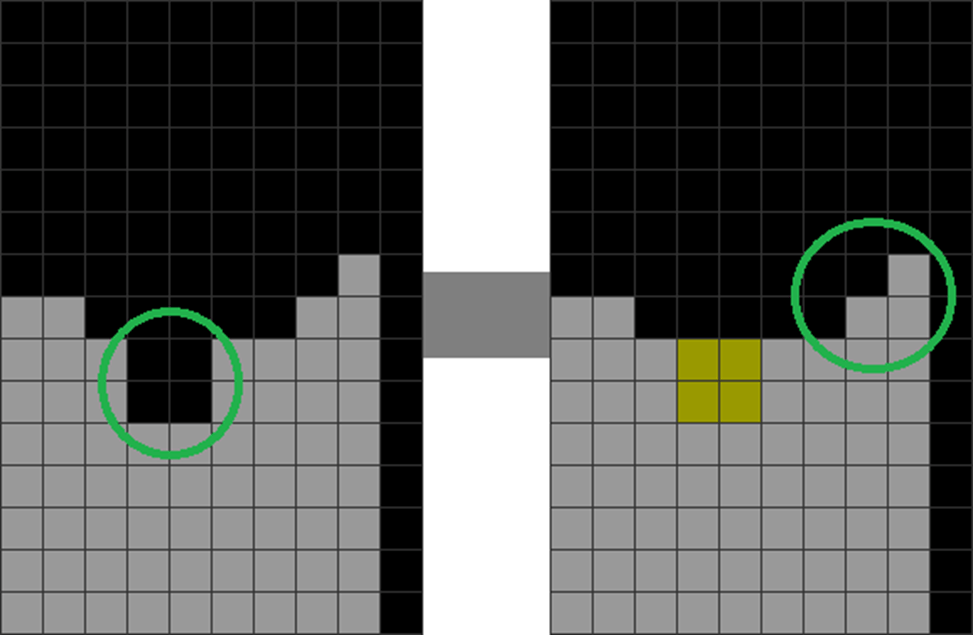
| You have an O-piece dependency in the green circle. | You fill it with an O. This creates an S-piece dependency in the new green circle. |
| 3 | 4 |
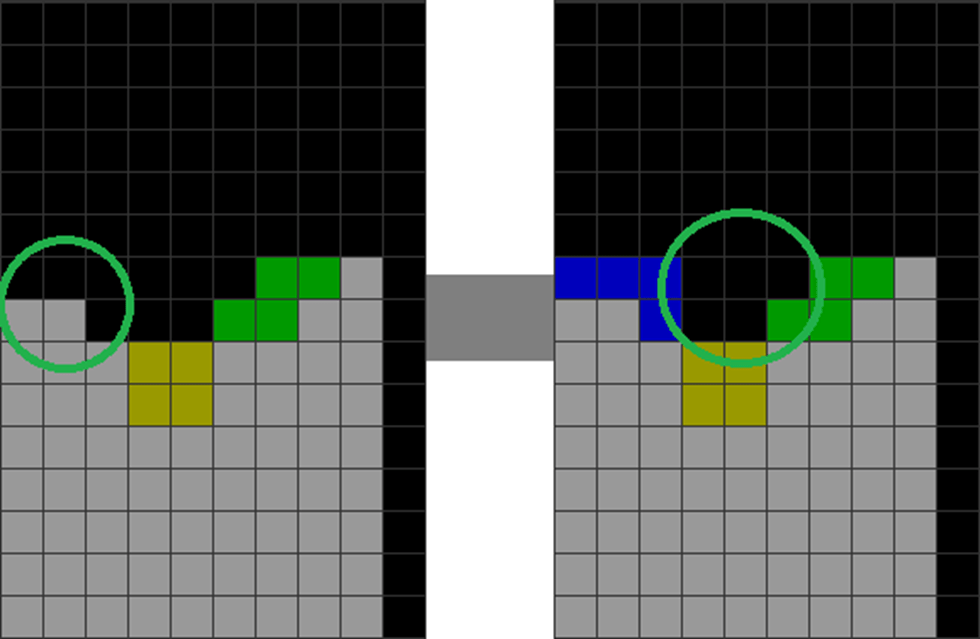
| You fill it with an S piece, creating a J dependency on the left, new green circle. | You fill it with a J. This creates a new O dependency in the middle green circle. |
The entire sequence joins pieces cleanly one by one by filling the piece dependencies, thus reducing thinking time.
2) Memorizing the Most Common Stacking Solutions
9-0 stacking has many mid-game patterns that you can memorize. With enough practice, you eventually encounter and learn most of them. The following shows how to fill certain shapes and cavities with specific pieces.
.
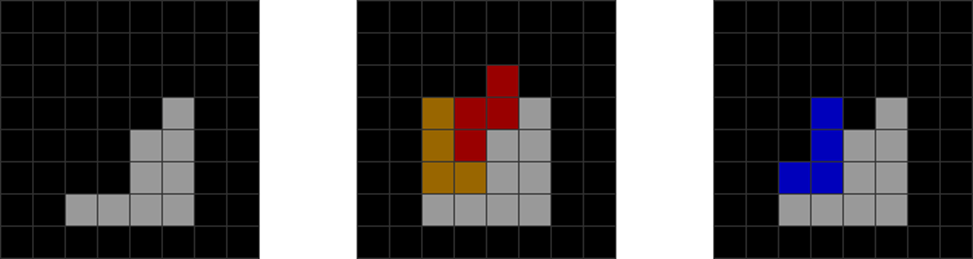
.

| These are the most common stacking patterns to solve specific field shapes. To read, column 1 is the starting condition, column 2 is the optimal way to stack the former pattern, and column 3 is the less optimized method. |
Thus, memorizing them to reduce thinking time is vital. However, they are not exhaustive.
3) Putting Pairs of Ts Together
Another quick guideline that one can use to stack quickly is simply putting pairs of Ts together next to each other, per the Managing Jaggedness chapter’s lessons later.
| Diagram Set 5-6 | |
| 1 | 2 |
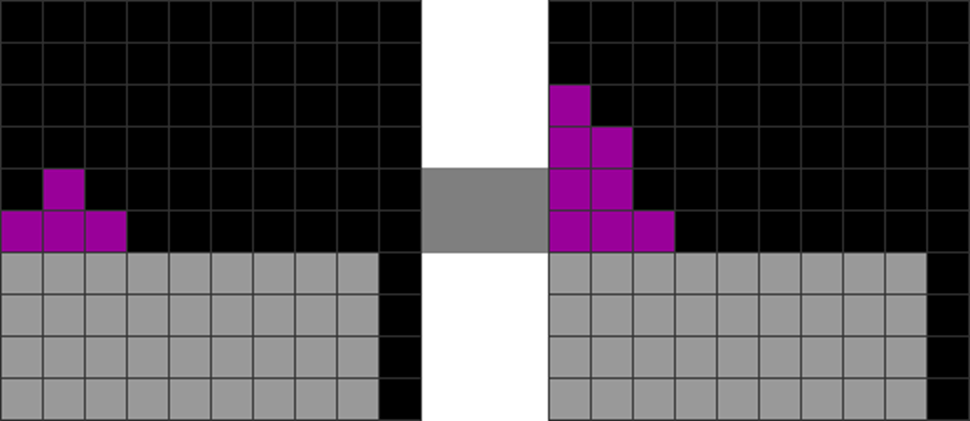
| Ts are often placed next to each other to immediately resolve the jaggedness caused by the first T placement. |
| Diagram Set 5-7 | |
| 1 | 2 |
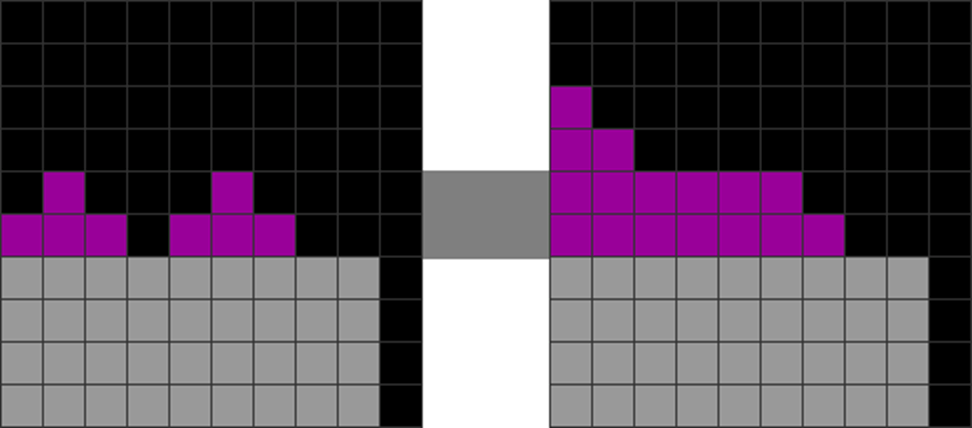
| Placing the second T elsewhere creates another jagged area. |
In set 5-7, the player must put up to 4 Ts to resolve the jaggedness of each of the first 2 T placements. The result is a jagged field that is difficult to resolve and slows down one’s brain.
Therefore, by habitually putting Ts together, your brain further reduces thinking time. It also resolves jaggedness simultaneously.
B) 6-3 Stacking
Once you have had a good handle of 9-0 stacking, transition to 6-3 stacking for sprinting, as it is slightly more efficient than the former.
6-3 Stacking Sprint involves leaving a hole in the seventh column from the left side. Thus, six columns are filled to the left and three to the right. Therefore, it’s called 6-3 stacking:
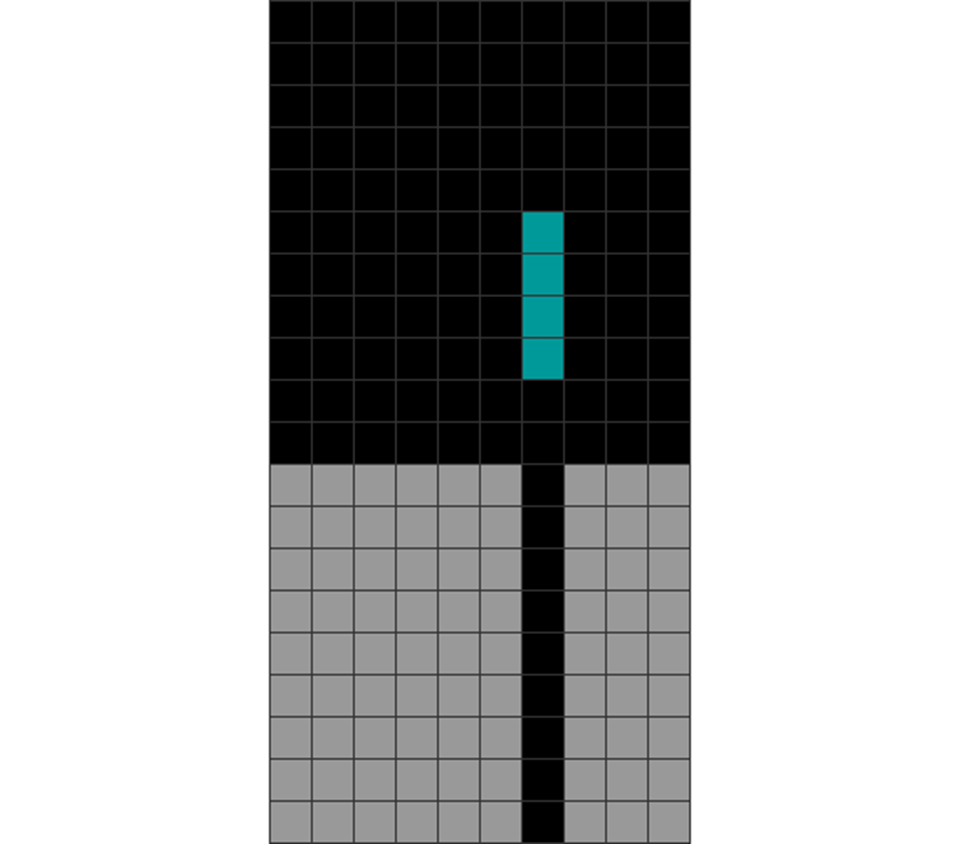
Quick 6-3 Stacking “Cheat”
Players have been using 9-0 sprint methods to get a good sprint score. Today, I shall show you just one quick “cheat” method, based on Yuimetal’s stacking style, that you ever need to learn to secure a super-fast sprint score.
This is based on a deterministic 6-3 stacking method.
Starting Bag
Ideally, you want an early T so that you can make this opener with the first seven pieces:

Then, you do this for the second bag:
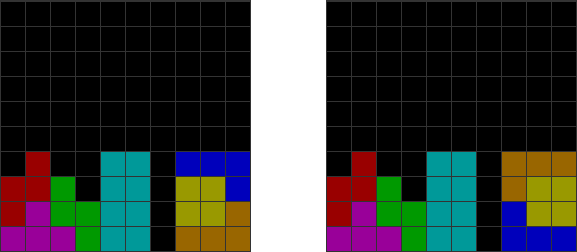
Note: Good catch! Thanks to Fortissimo and others for pointing out the error. Errata page for Books 1 and 2 updated!
Mid-Game
Now for the mid-game. Once you have finished the first two bags, you want to stack the far right (in lavender blocks) like this:
| Diagram Set 5-8 | |
| A | B |
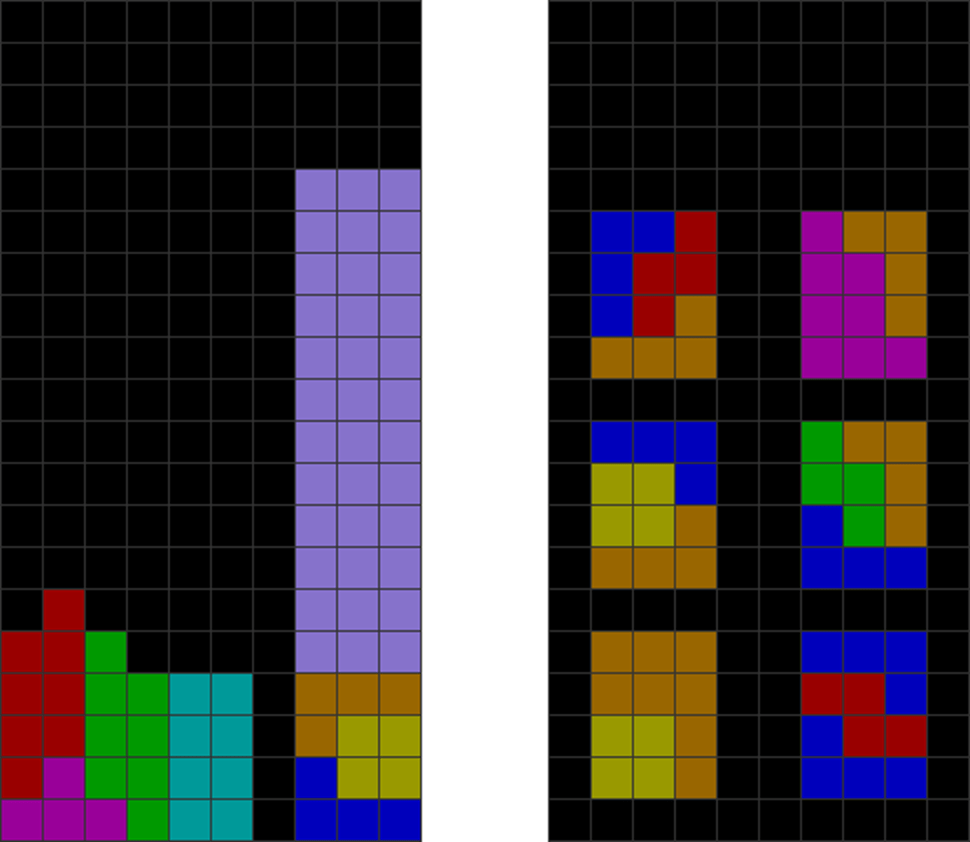
| The patterns on the far right’s 3-most columns comprise pieces that make 3×4 rectangles like LOJ. You can stack them in the lavender areas. | Here are six ways to configure three specific pieces to make 3×4 rectangles each. |
This is not exhaustive. However, you want to spam those easily memorizable patterns to make the last three columns. Now for the middle two columns:
| Diagram Set 5-9 | |
| A | B |
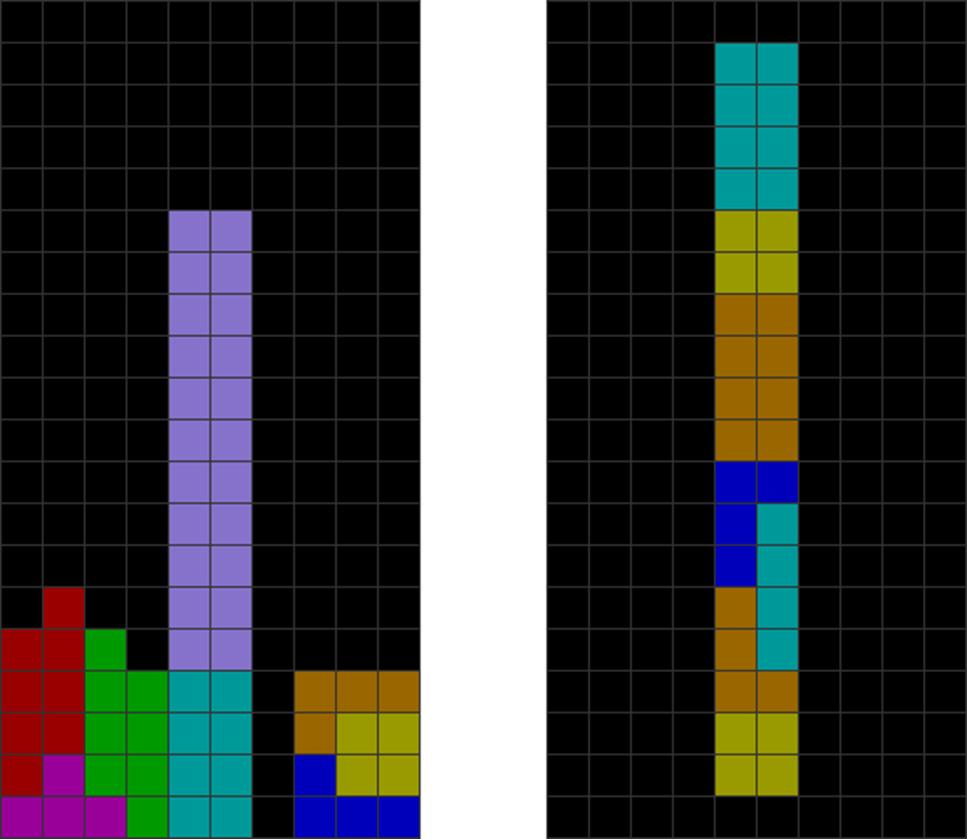
| The middle two columns in lavender (columns 5 and 6) can be stacked as shown in the right diagram. | See how O, L, J, and I can be stacked in a spammable and repeatable pattern. |
When you memorize such forms, you can easily create them. Finally, for the trickiest part involving the four left columns:
| Diagram Set 5-10 | |
| A | B |
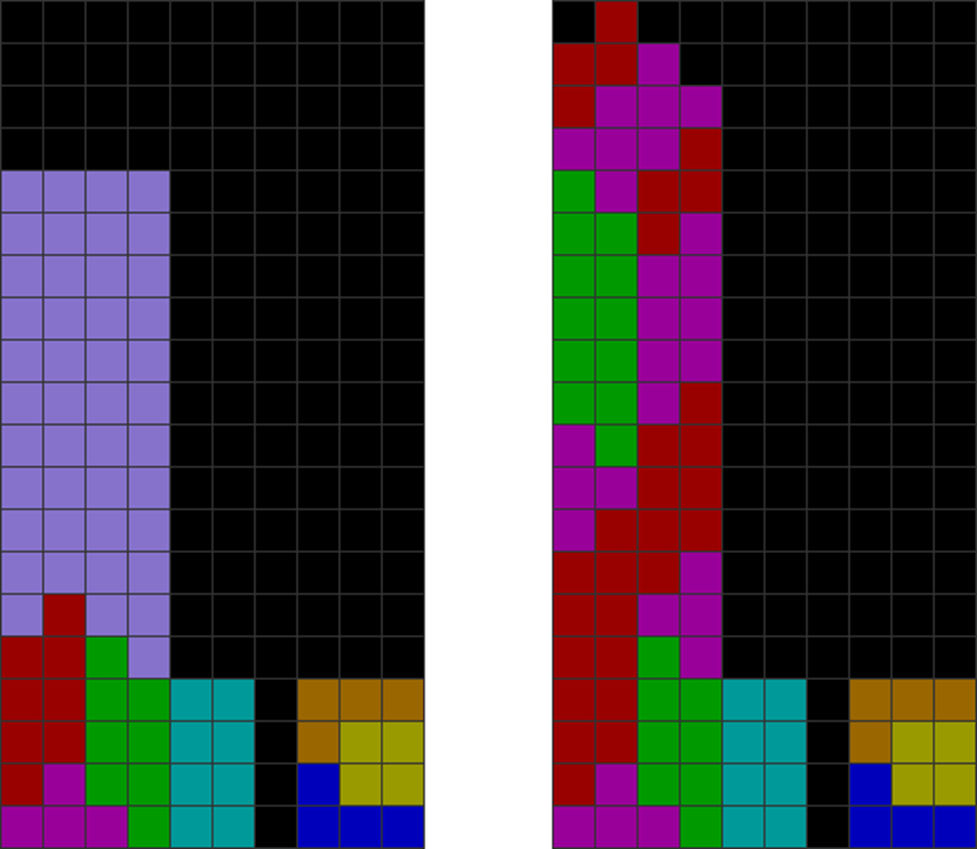
| You want to stack the first four columns (lavender blocks) properly. | This can be done using S, Z, and T pieces in the configuration here. |
This takes a bit of practice and pattern recognition. Note how the vertical S, Z, and T pieces overlap in an easily-repeatable pattern.
As far as possible, you want to sustain the three sets of mid-game patterns for the first four columns, the middle two columns, and the last three columns. This cuts down on processing speed, letting you go ultra-fast.
What If the Pattern Breaks?
If the pattern breaks like this, you can continue with several options:
| Diagram Set 5-11 | |
| 1 | 2 |
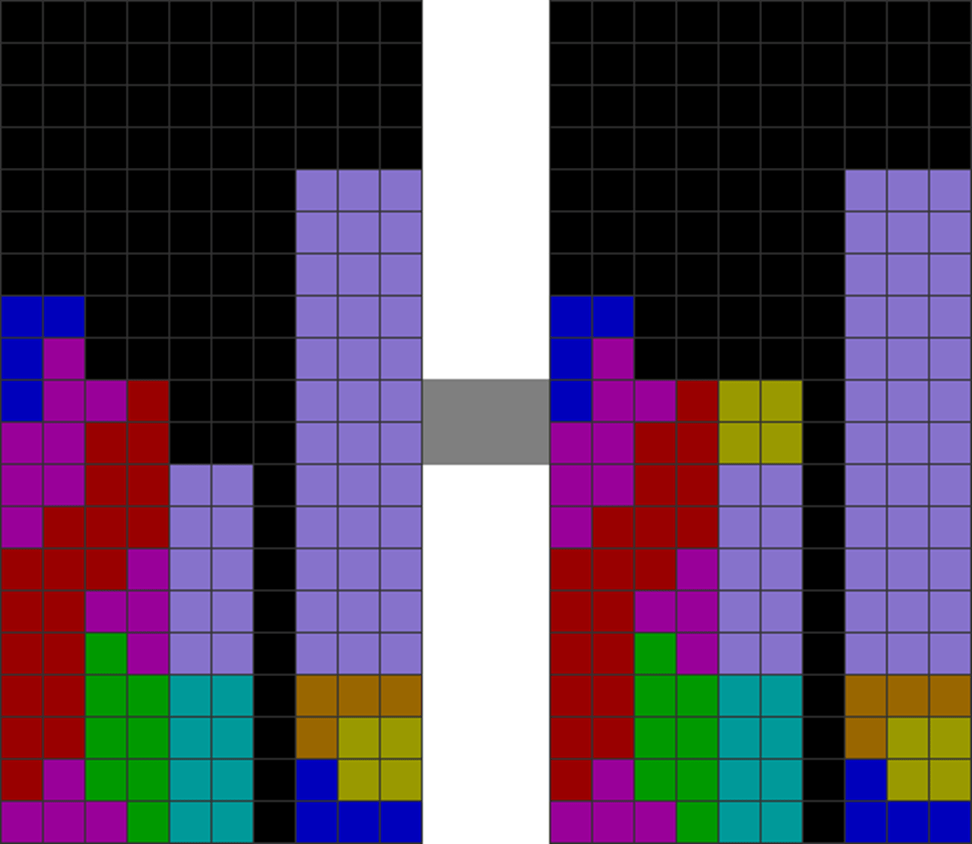
| The player breaks the repeatable vertical S, Z, and T pattern in columns 1 to 4. | He then freestyles by putting an O. |
| 3 |

| He continues freestyling by resolving jaggedness by putting pairs of Ts together. |
Thus, if the pattern breaks, freestyle stack with an easy trick: managing jaggedness. If the right field to the central hole is jagged, you put another T to even out its jutting parts. If the left field to the central hole is jagged, you put another T there to even out the jutting parts. Only put pairs of Ts on the hole’s left or right side.
Practice
After memorizing these forms, all you have to do is practice, practice, and practice.
Summary and Conclusion
Being fast in sprint does not mean you are fast in multiplayer or versus. While a quicker stacking speed contributes to overall speed, the decisions in versus are far more advanced and different. Many players who are fast in sprint can ironically be slow in versus.
| Concept | Summarized Rules-of-Thumb |
| Flow | Want to cheat? Spam Yuimetal’s deterministic 6-3 stacking method to get a good Sprint score. |
| Form | Memorize the common composite stacking patterns and solutions of pieces to reduce thinking time mid-game. Join pieces in a harmonious, less jagged, and less irregular manner to maximize stacking continuations. Fill piece dependencies fast.Join pieces when stacking. |
| Balance | Put pairs of Ts together to resolve jaggedness automatically. |
 How to Tetris