Just like Chess, Tetris has its rules and mechanisms. I will help you master the Tetris basics first.
A) Introduction to Official Guideline Tetris Games
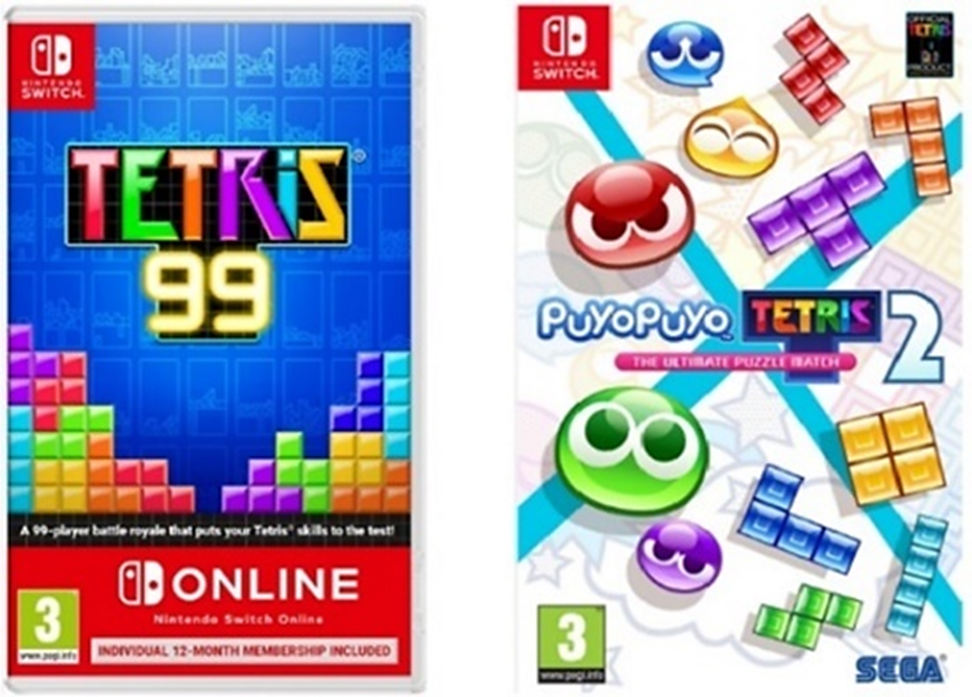

Recent guideline Tetris games are Puyo Puyo Tetris 1, Puyo Puyo Tetris 2, Tetris Effect, Tetris Effect: Connected, and Tetris 99.
Tetris Ultimate, Tetris Battle (for Facebook), and Tetris Friends used to exist until they were discontinued.
Non-guideline Tetris games are non-official ones that the Tetris company has not released. These involve games like Cultris 1, Cultris 2, Jstris, and TETR.IO.
The core difference is that guideline Tetris games usually have the Initial Rotation System (IRS) and Initial Hold System (IHS) off (except Tetris Effect, which can be turned on). They also have a spawn delay, slower soft drop speeds, and significant line clear delays. Last, their Delayed Auto-Shift (DAS) speed and Auto Repeat Rate (ARR) values are far slower. Thus, guideline Tetris games are slower and require more efficient placements and thought.
IRS, IHS, DAS, and ARR will be explained in this chapter.
Non-guideline Tetris games are speedier as their DAS and ARR values are far faster. Likewise, they typically have no line clear delays unless customized.
Modern Tetris is not just a solitary game. However, it has single-player modes like Sprint, Ultra, Marathon, and others:
- 40-line sprint is a mode where one tries to clear 40 lines quickly.
- Ultra is a mode where one tries to get the highest score using line clears in three minutes.
- Marathon is a mode where gravity starts slow and speeds up later. The goal is to last as long as possible to score high.
- Versus modes involve a 1 vs 1 match, a free-for-all 4-player match in Puyo Puyo Tetris or Tetris Effect, or a battle royale in Tetris 99, a 1 vs 98 battle royale. In such games, players send garbage to each other’s fields to top out each other.
B) Tetris Mechanisms
Tetris has many mechanisms to note before playing. Mastering these mechanics improves gameplay control.
1) The Tetrominoes
This game has seven basic Tetrominoes (Mino or Piece). Each tetromino is made of four blocks and has unique characteristics. Everything in Tetris comprises these seven essential pieces.
The name tetromino combines the prefix “tetra” (four from Ancient Greek Tetra) and “domino.”
| Diagram Set 1-1 |
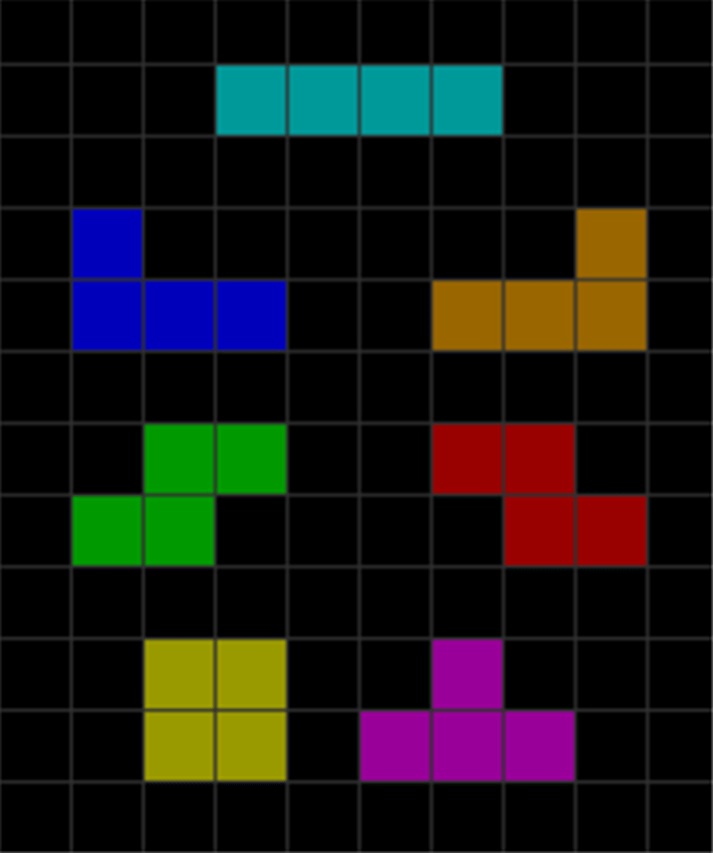
| The above shows the I (cyan piece), L (orange piece), J (blue piece), S (green piece), Z (red piece), O (yellow piece), and T (purple piece) pieces. |
They are named after the capital letters of the Latin alphabetical system because each mino looks like them. Thus, a T piece looks like a capital T. An I piece looks like a capital I.
2) The Basic Field
Tetris involves a 10×20 block field, 10 blocks wide and 20 blocks high:
| Diagram Set 1-2 |

| Each block in this 10×20 field can be empty or filled. Here, the black blocks typically mean they are empty. |
They can be filled using the 7 minos: the L, J, O, I, T, S, and Z pieces.
Whenever an entire row (a horizontal line of 10 filled blocks) has been filled with blocks, it will vanish, and the stack on top will move down by one row. This disappearing mechanism is known as a line clear.
You top out and lose the game when a new piece tries to appear but cannot fully fit in the playfield because the spawn area is blocked:
| Diagram Set 1-3 | |
| A | |
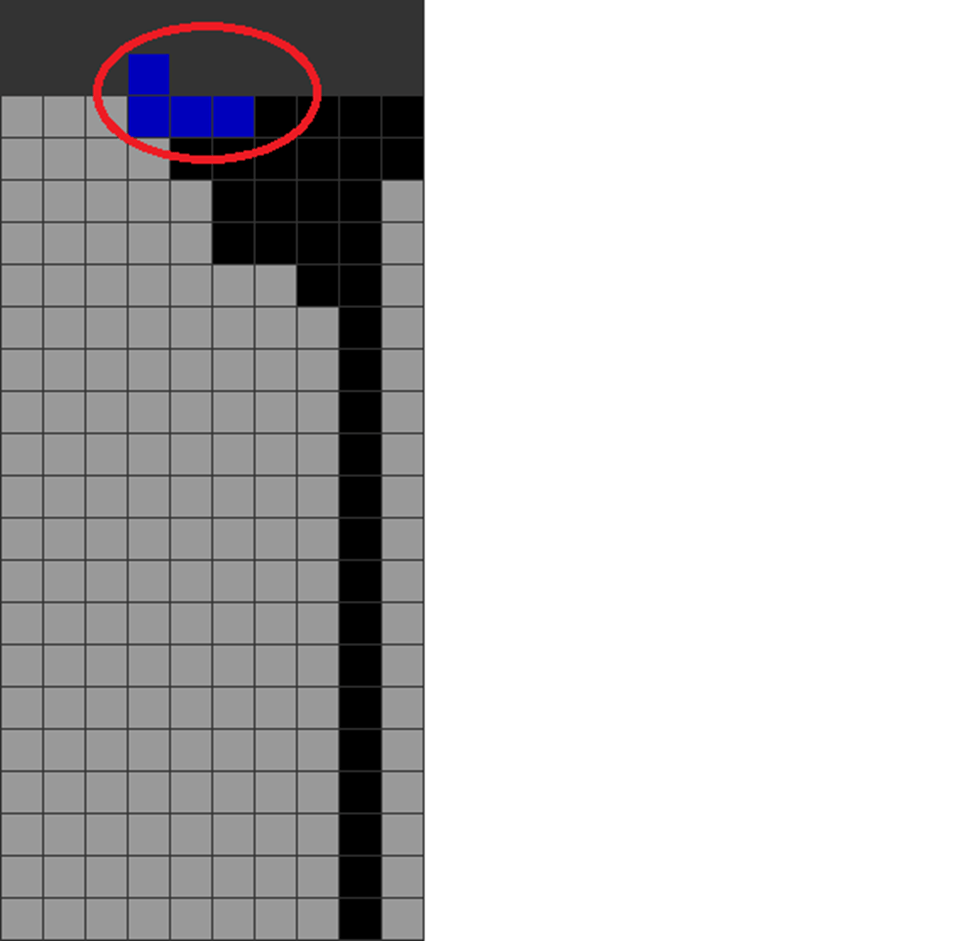
| The red-circled area marks the spawn zone (around row 20). If it’s blocked, the next piece can’t spawn and you top out. |
This area of intersection can vary across games. In Tetris Effect: Connected, the Zone mechanic allows stacking beyond the standard 20-row playfield. This enables advanced techniques like the Decahexatris and Perfectris.
In this book’s terminology, I will sometimes refer to a specific block as being in column 2 and row 3. This means the block is in the second column from the left and the third row from the bottom.
3) Stacking and Jaggedness
Stacking is placing your pieces to construct many shapes in a Tetris field.
To stack your field properly, one vital concept is needed: parity.
Parity is loosely defined as the jaggedness of a field. I will cover this more deeply later.
Here’s an illustration of its importance:
| Diagram Set 1-4 | |
| 1 | 2 |

| The field is parity-balanced (flat). This lets you stack pieces easily. The horizontal L, J, and O pieces do not cover holes. |
| Diagram Set 1-5 | |
| 1 | 2 |
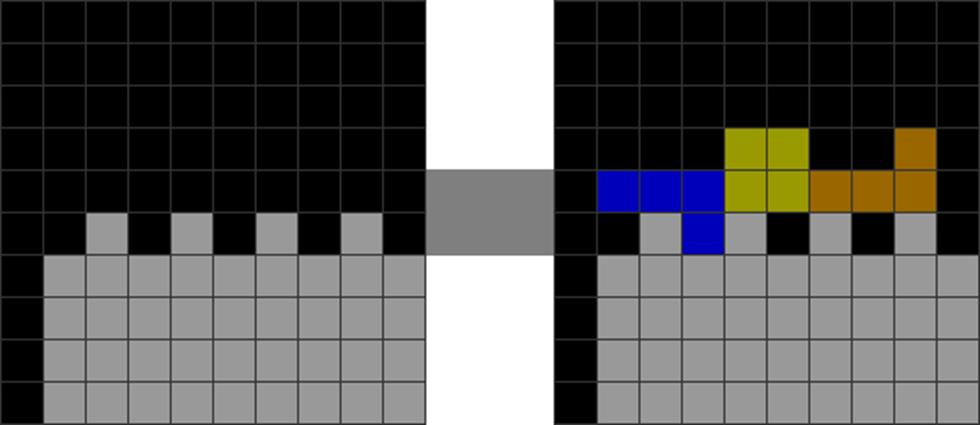
| The field is parity-imbalanced (jagged). This causes horizontal L, J, and O to have no places to put cleanly. They cover holes. |
The more parity-imbalanced (jagged) the field is, the more challenging it is to stack properly and cleanly.
Some pieces alter parity, such as the T piece, which can be a bane or a boon. Overall, good stacking requires the proper management of T pieces and parity.
4) Previews
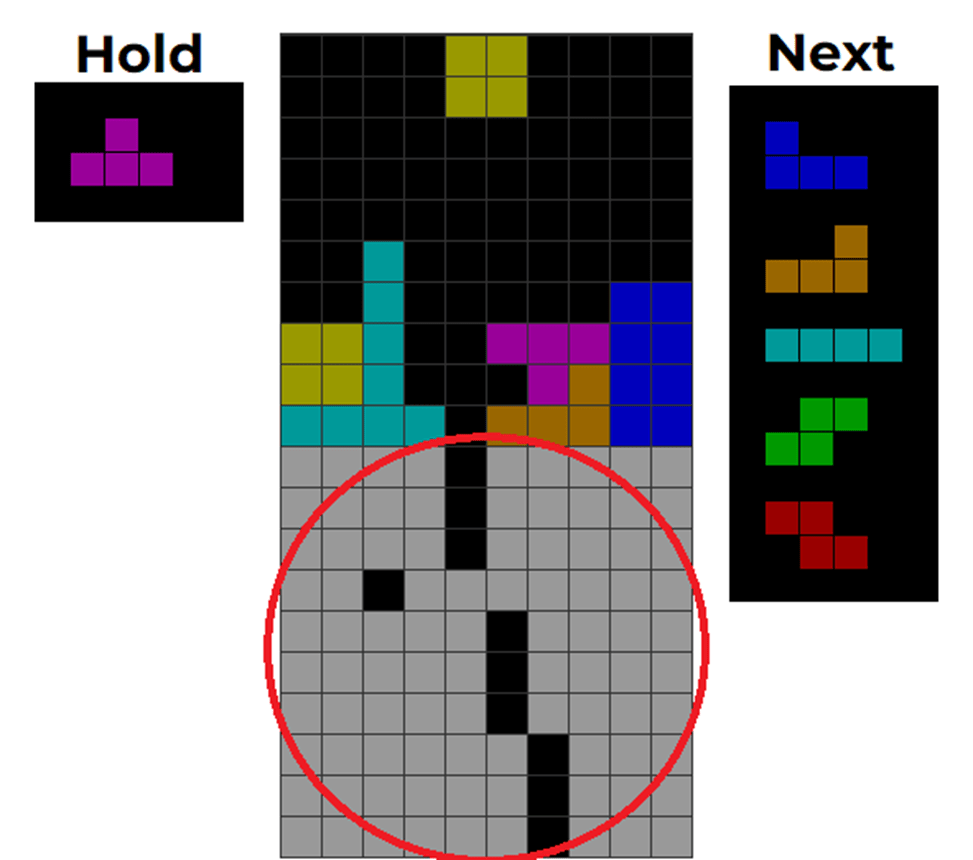
Below shows a standard Tetris field with the hold and preview columns beside it.
In Modern Tetris, you have a preview in the upper right corner of the 10×20 field (in the red circle here):
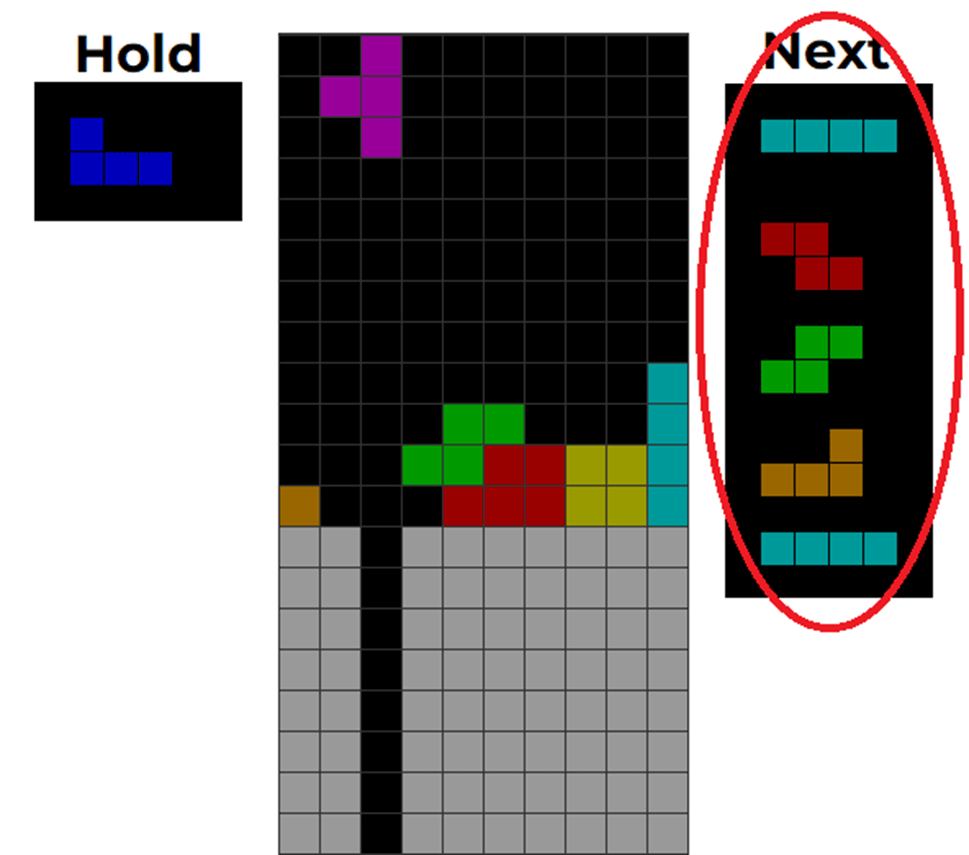
In some games, this preview may be on the top. This preview shows the incoming pieces chronologically: I, Z, S, O, L, and I, respectively.
The number of previews varies from 1 (in 3 versus Boss mode in Tetris Effect: Connected) to 6 in Tetris 99. Puyo Puyo Tetris 1 and 2 have five previews.
Knowing what pieces come next is crucial as it lets you plan many setups.
5) The Hold Function
The hold function, typically shown in the upper left corner of the field (red circle here), shows which piece you have held:

You use this by pressing the Hold key, which keeps one piece in the ‘hold,’ which can be activated later to pull it.
This function is vital as holding on to certain pieces, like the I and T pieces, helps you do T-spins or Tetrises.
When you press the hold button again after a new piece spawns, the mino in the hold function replaces your current falling piece. Thus, if you hold a T and hold it again later, it will be available for use.
6) The Falling Piece
In modern Tetris games, the falling piece spawns in the red-circled area of the field:
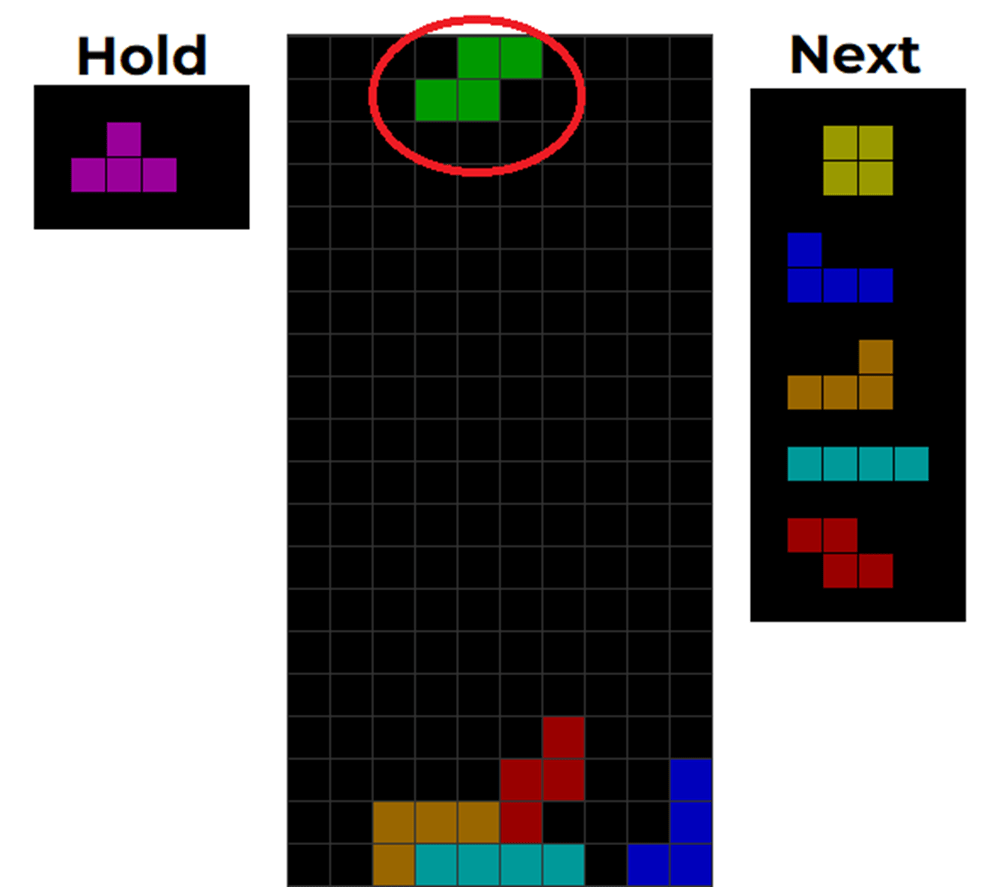
After it spawns, gravity will pull it down. Pieces from the preview or hold will appear chronologically as the falling piece.
You aim to control the falling pieces and stack them in the field.
7) 7-Piece Randomizer
In modern Tetris games, there is a 7-piece randomizer. This means that for every seven pieces, all seven kinds of tetrominoes will spawn precisely once each.
Every seven pieces or bag has the seven unique minos. However, the order of the seven will be jumbled randomly.
You can get S, Z, T, O, I, L, and J in the first bag and Z, S, J, I, T, O, and L in the second.
This reduces randomness, improving strategic planning.
In Modern Tetris games, you will never get 100-piece droughts where you must wait 100 pieces for a specific piece to repeat. You will never get 100-piece floods with 100 repetitions of one particular piece.
However, Classic Tetris has no 7-piece randomizer, making such droughts and floods possible.
8) Movement
| Diagram Set 1-6 | |
| 1 | 2 |

| The T piece spawns in its default column. The T piece will naturally fall to the bottom, depending on gravity. | The player presses “move right,” causing it to shift to the right by one block. |
| 3 | 4 |

| The player rotates left, causing it to rotate anti-clockwise. | To make it move faster down, pressing the soft drop key will serve this function. This function is essential for things like T-spins later. |
| 5 |
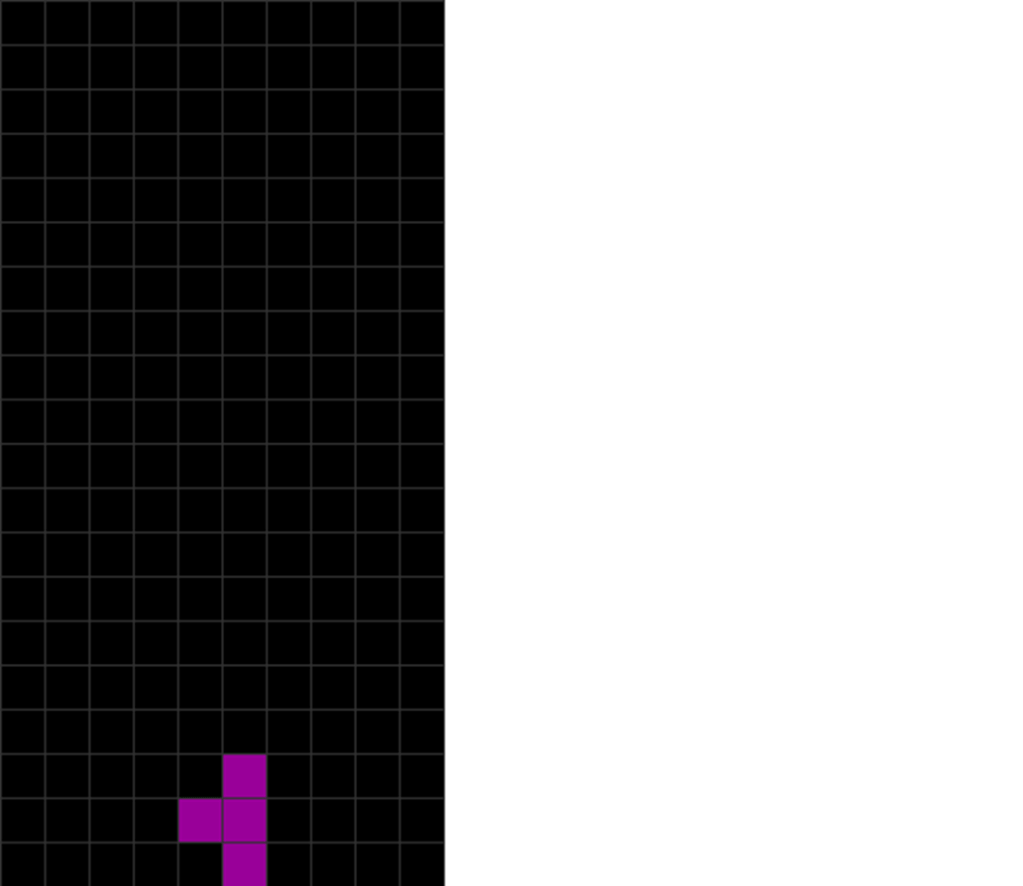
| This shows a faster way to get the pieces down: pressing the hard drop button, which causes it to reach the bottom immediately by bypassing gravity. |
The ghost piece is the outline of an unplaced mino:
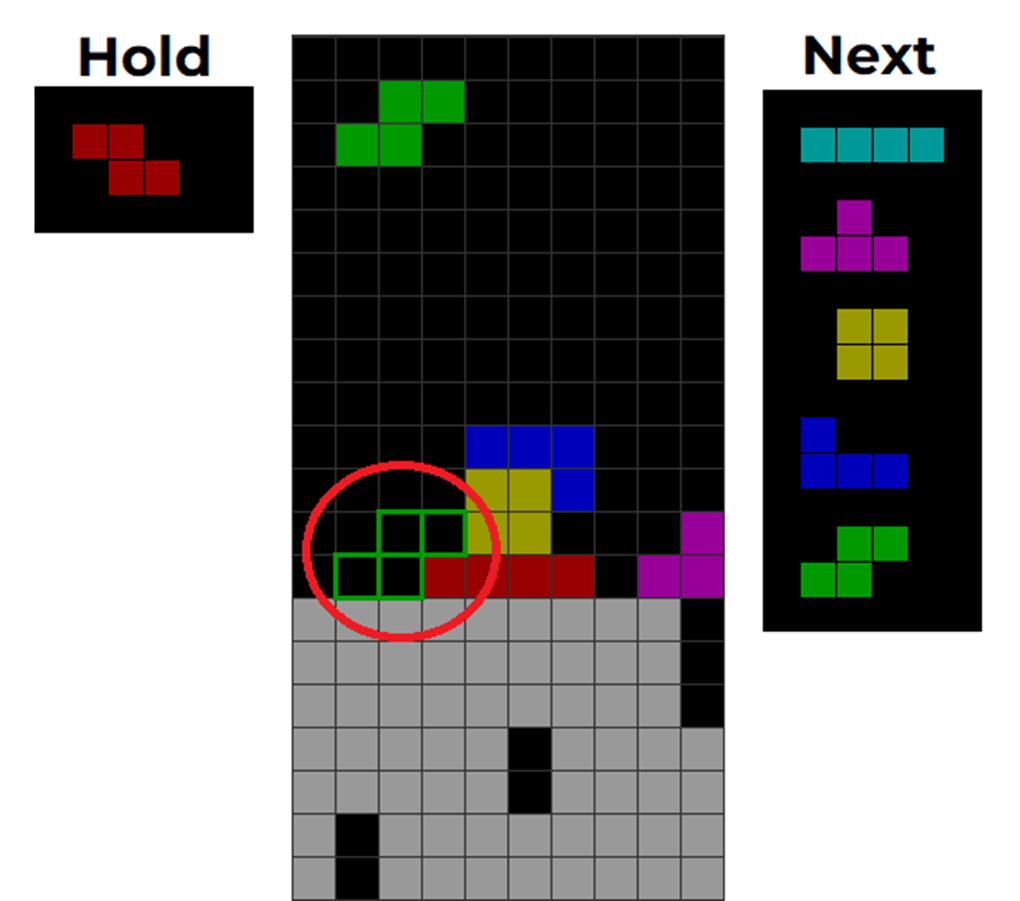
| The ghost piece (in the red circle) shows the outline of a piece before placing it down, allowing you to place pieces more accurately. |
The ghost function can be turned on and off in some Tetris versions.
Gravity varies across games and modes. In games like Tetris 99, gravity increases as the game progresses, making pieces fall much faster to the bottom. The higher the gravity, the faster pieces lock in place once they touch the bottom.
However, there is a minor delay before pieces lock, which some players abuse by ‘wiggling’ the pieces. This means moving them left and right or rotating them to defer the lockdown time.
You can move pieces quickly using the DAS (Delayed Auto-Shift) mechanism. DAS is the initial delay you must hold down a left or right movement key before the piece begins moving automatically. This saves lots of time from tapping left or right to move pieces.
| Diagram Set 1-7 | |
| 1 | 2 |
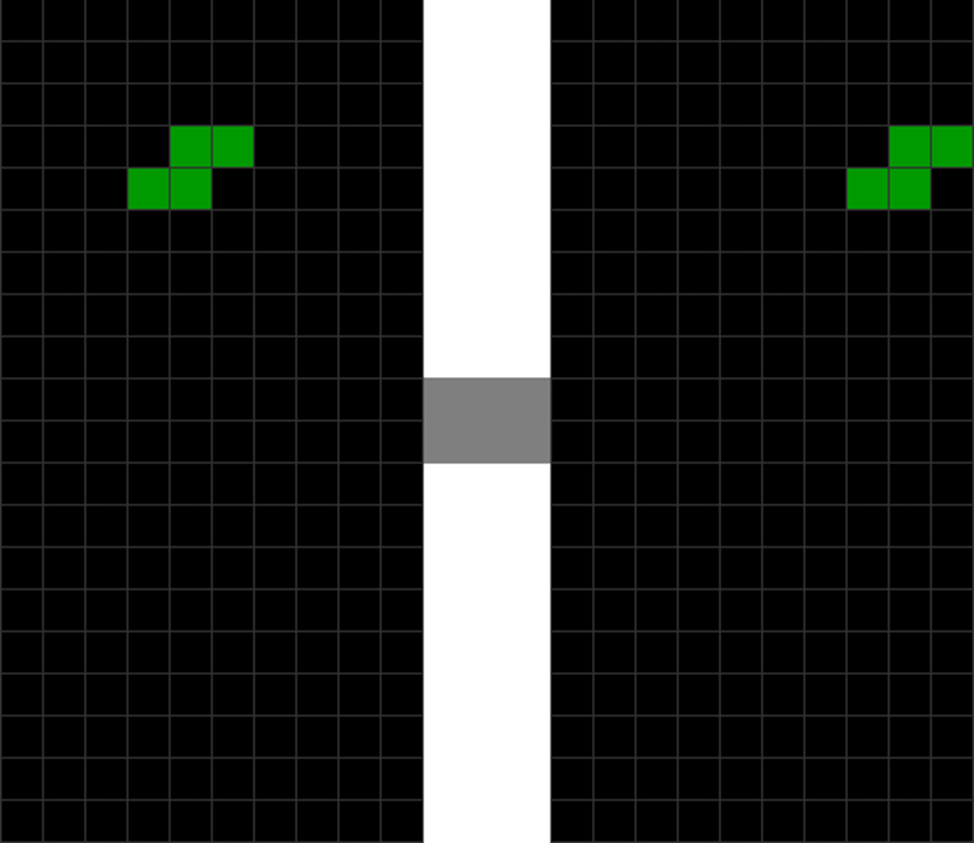
| The S piece spawns. | The player holds “move right,” which activates DAS after a brief interval. It then moves to the extreme right corner quickly, touching the wall. |
| 3 |
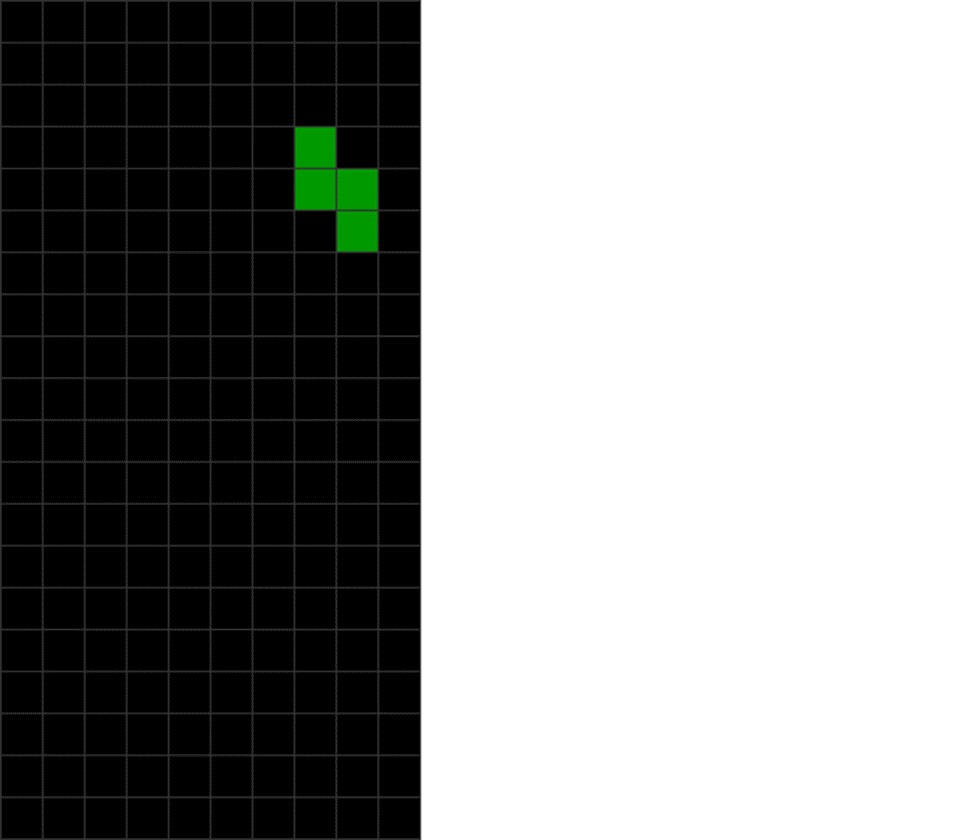
| The player can then issue new functions, such as rotate. |
The speed at which the piece moves after DAS activates is controlled by ARR (Auto Repeat Rate). ARR determines how rapidly the piece continues shifting once automatic movement begins.
The other mechanism to note is wall kicks. This occurs when a piece is moved to the extreme left or right. When you rotate a piece, a piece will ‘kick’ off from the walls. This is shown in the most recent diagram’s step 3, with the S piece kicking off the wall upon rotating.
Moving pieces to their required location with minimal key presses is important.
9) Line Clear Types and T-spins
Single:
| Diagram Set 1-8 | |
| 1 | 2 |
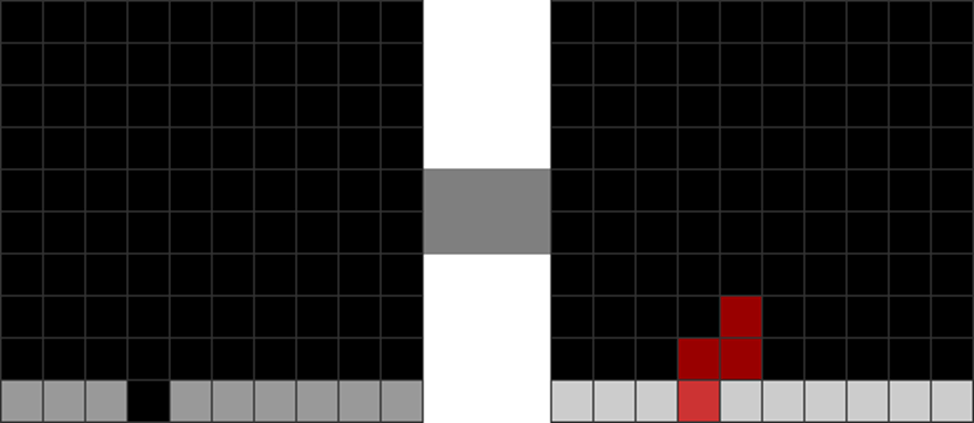
| 3 |
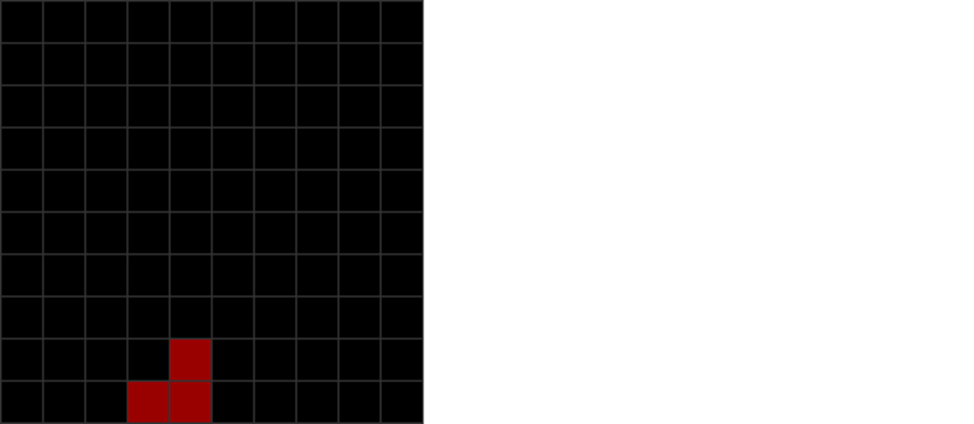
| A Z piece clears a single line in step 2, leaving only red blocks. A single line clear is called a single. |
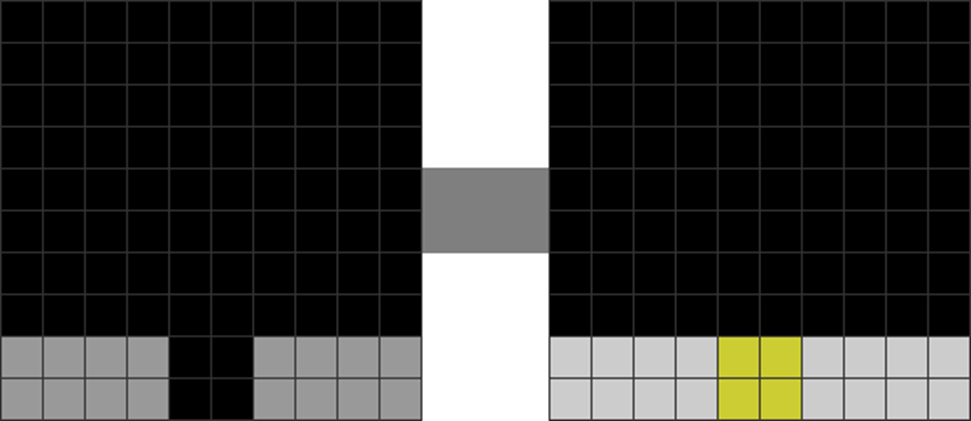
Double:
| Diagram Set 1-9 | |
| 1 | 2 |
| 3 |

| An O piece clears two lines in step 2, leaving an empty field. Two lines being cleared at once is called a double. |
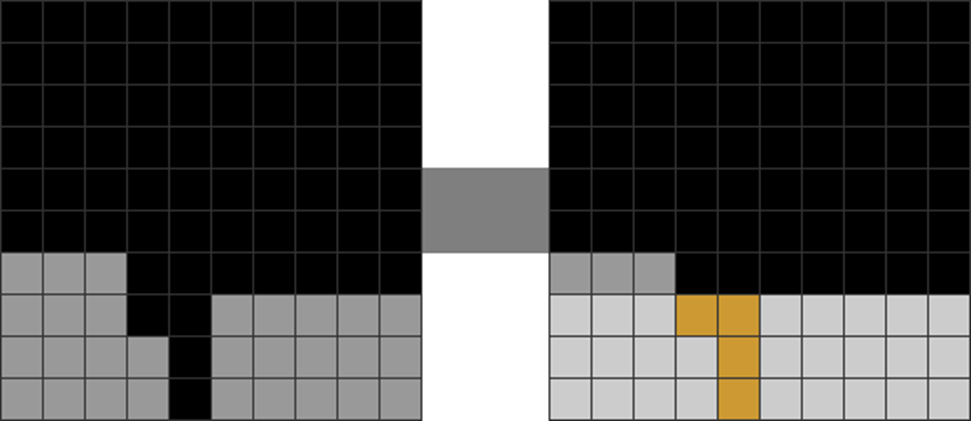
Triple:
| Diagram Set 1-10 | |
| 1 | 2 |
| 3 |

| This logic is generalized to triples. Here, an L piece clears three lines in step 2. |
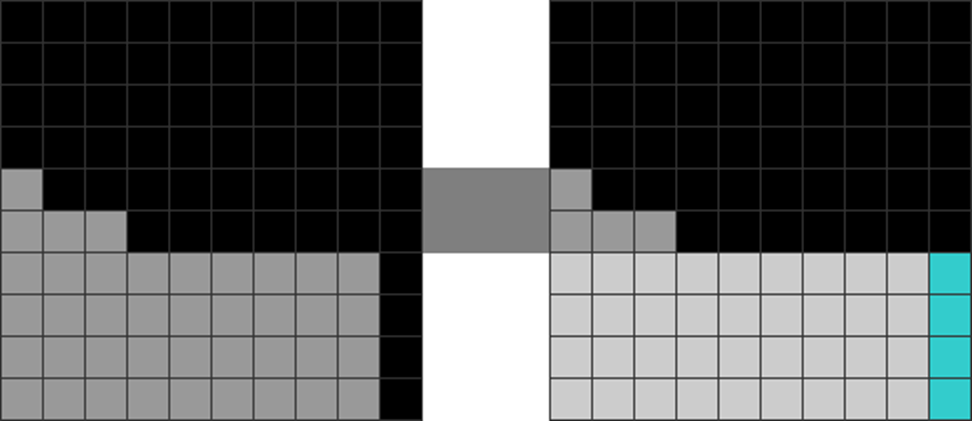
Quad/Tetris:
| Diagram Set 1-11 | |
| 1 | 2 |
| 3 |
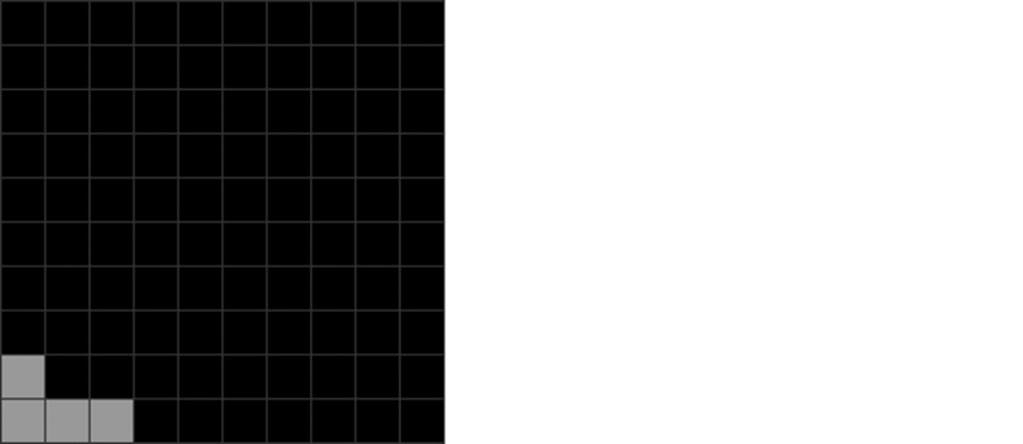
Whenever four lines disappear at once, especially with an I piece in step 2, this is called a Tetris or quad.
T-spins:
Whenever one, two, or three lines disappear because of a rotated T piece line clear, it is called a T-spin line clear:
| Diagram Set 1-12 | |
| 1 | 2 |

| This T-shaped cavity is a T-spin setup. | The player inserts a T piece inside the cavity, clearing two lines. |
| 3 |
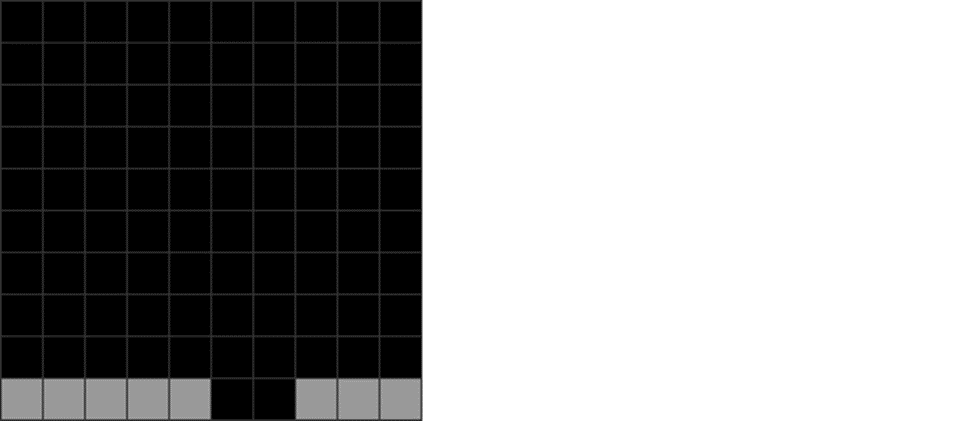
| You are left with this field. |
Because the above T-spin clears two lines, it is called a T-spin double. T-spin minis, singles, and triples exist, which I will cover later.
T-spins are vital because they are powerful offensive techniques that send significant garbage lines to your opponent.
In official guideline Tetris games, line clears incur a significant line clear delay. This is the time it takes for a line to vanish upon a line clear. In unofficial non-guideline Tetris games like TETR.IO, line clear delay is zero.
Minimizing line clear delays is vital for high-level Tetris gameplay.
10) Garbage and Downstacking
You can send garbage to the opponent whenever you do a double, triple, quad (Tetris), T-spin line clear, or combo.
Whenever you consecutively line clear, you may send extra damage, called combos, to the opponent. This means the line clears are joined and connected one line clear after another without breaking.
However, if you do more than one consecutive T-spin or Tetris, you incur a Back-to-back bonus (BtB or B2B). This sends an extra line of garbage in the next T-spin or Tetris until the streak is broken with a non-T-spin or non-Tetris line clear.
The amount of garbage sent varies for each game. However, typically, a double sends one line, a triple two lines, and a quad (Tetris) sends four lines. A T-spin single sends two lines, a T-spin double sends four lines, and a T-spin triple sends six.
Therefore, T-spins are roughly twice as efficient as a Tetris.
The garbage sent tables for combos, T-spins, and Tetrises will be shown later in this book.
The cleanliness or dirtiness/messiness of garbage sent is defined as how messy (scattered) or connected the garbage is.
This varies across games. In Tetris 99, garbage is clean. Thus, if an opponent sends a single attack of four garbage lines, the four will align as a single row.
However, in games like Puyo Puyo Tetris, each additional line past the first only has a 70% chance of alignment. In Tetris Effect: Connected versus mode, garbage is dirtier once a match reaches phase 3. This kind of scattered garbage is thus unclean or messy.
Here’s an illustration:
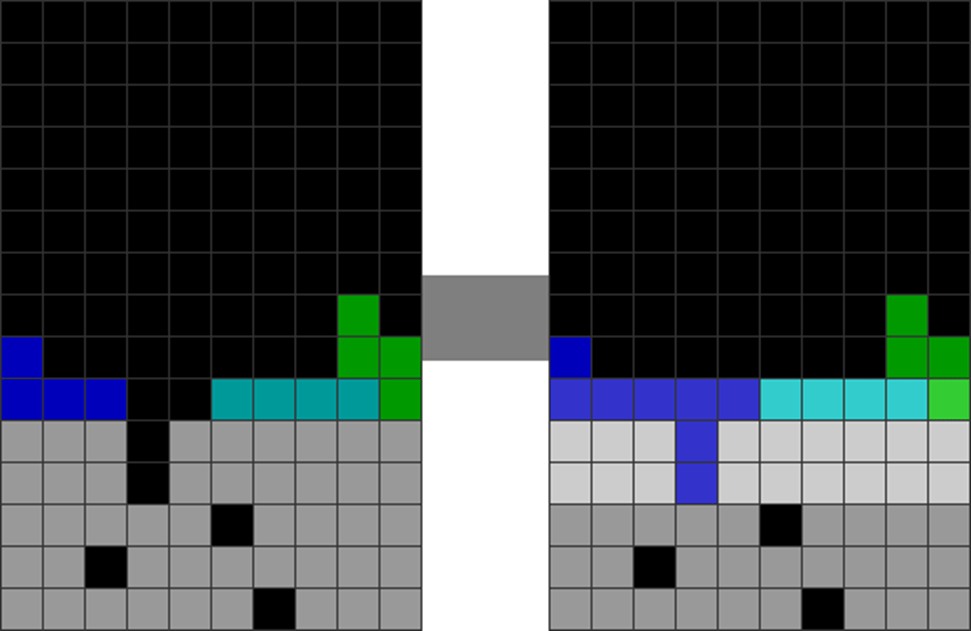
| Diagram Set 1-13 | |
| A | B |

| This field’s garbage is entirely clean. | This field’s garbage is mostly dirty. |
In most official Tetris games, especially Puyo Puyo Tetris’ (1 and 2) regular versus mode, Tetris Effect, and Tetris 99, each garbage row only has one hole.
Another mechanism to note is garbage blocking and garbage canceling.
In Tetris 99 or Tetris Effect: Connected, garbage will not be received as long as you consecutively clear lines without stopping once you start a line clear. This is called garbage blocking.
However, in Puyo Puyo Tetris, garbage is received almost immediately once you place a piece, meaning there is almost no delay.
However, while garbage is being received, you can negate some incoming garbage lines by creating some garbage to reduce the former’s impact. This is garbage canceling.
Thus, the former two games (Tetris 99 and Tetris Effect) allow for a more defensive and forgiving gameplay style. This is because there is more leniency and time to negate incoming garbage.
Downstacking is the ability of a player to dig down through colored or garbage lines to the bottom as far as possible:
| Diagram Set 1-14 | |
| 1 | 2 |
| This shows a starting field with a J-like cavity in the middle. | The player inserts a J piece into the cavity, triggering a triple line clear. |
| 3 | 4 |
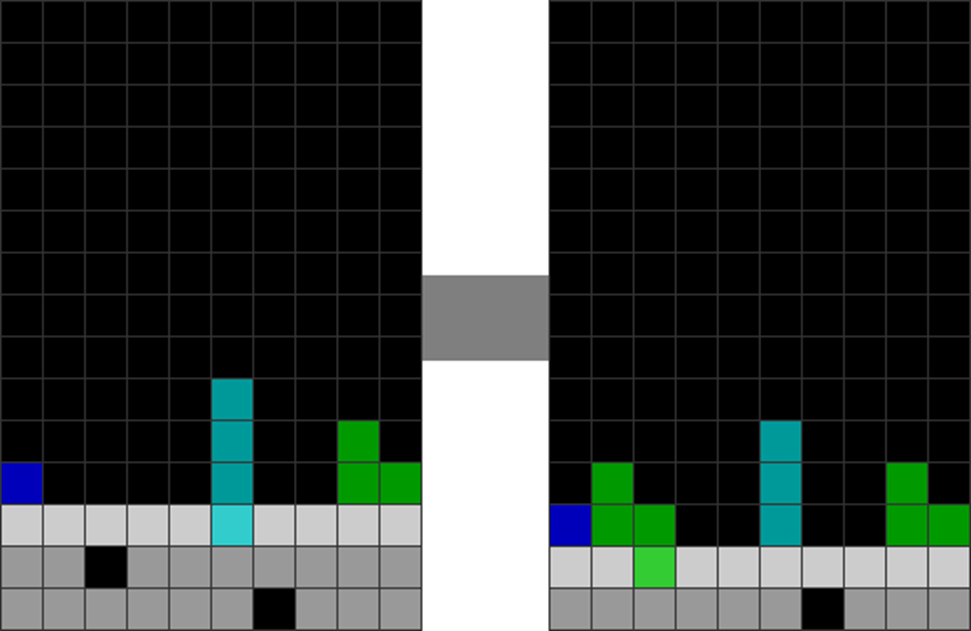
| The player continues the downstack sequence with an I piece to create a single line clear. | He inserts an S into the next garbage hole to create a single line clear. |
| 5 |
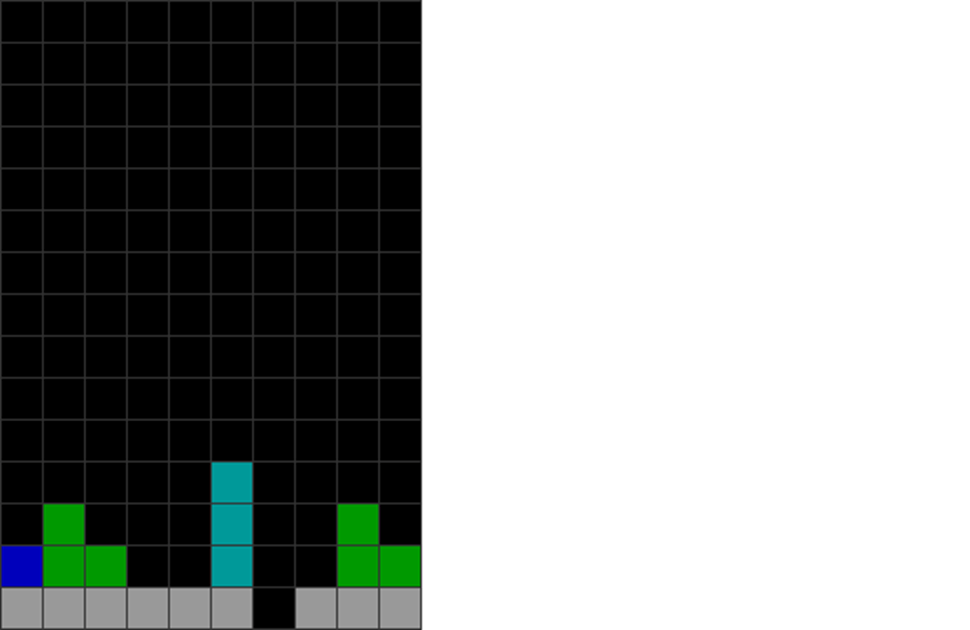
| This leaves the stack in step 5. |
Because all line clears connect without stopping, they trigger the combo bonus, sending more garbage than usual.
This is a vital multiplayer skill, as getting down is a defensive way of playing to negate an opponent’s garbage.
Summary and Conclusion
Below, I summarize the entire chapter:
Summarized Rules-of-Thumb
• Guideline Tetris games are official games released by The Tetris Company, such as Puyo Puyo Tetris, Tetris Effect, and Tetris 99. Non-guideline games, like Cultris and Jstris, are unofficial and often faster.
• Key differences between guideline and non-guideline Tetris games include differences in Delayed Auto-Shift (DAS), Auto Repeat Rate (ARR), line clear delays, and the Initial Rotation and Hold systems. Non-guideline games typically focus on speed with fewer delays.
• Game modes include single-player (Sprint, Ultra, Marathon) and multiplayer (Versus modes), with varying objectives such as clearing lines quickly or outlasting opponents.
• Tetris mechanics involve the basic tetrominoes, stacking strategies like parity, previews of upcoming pieces, and hold functions for strategic gameplay.
• Vital techniques include T-spins, DAS, ARR, and wall kicks, which are crucial for high-level play. Line clear types and their delays vary between games.
 How to Tetris