Questions related to the broader aspects of Tetris.
Questions
Why is Tetris a high-level strategy game, like Chess?
Despite nearly half a billion people worldwide playing Tetris, around 90-95% of them cannot create T-spins, according to my estimates.
In fact, most Tetris players are casual players. Only 5% of them become more serious players who can create more intermediate setups like the Super T-Spin Double (STSD):
| Diagram Set 1-1 | |
| 1 | 2 |
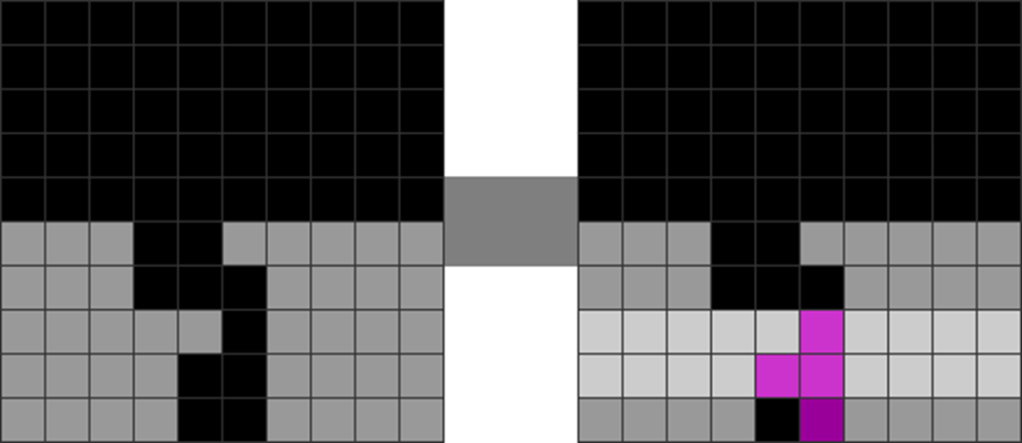
| This is an STSD setup. The first T-spin double is spun vertically. This then leaves a second T-spin double. |
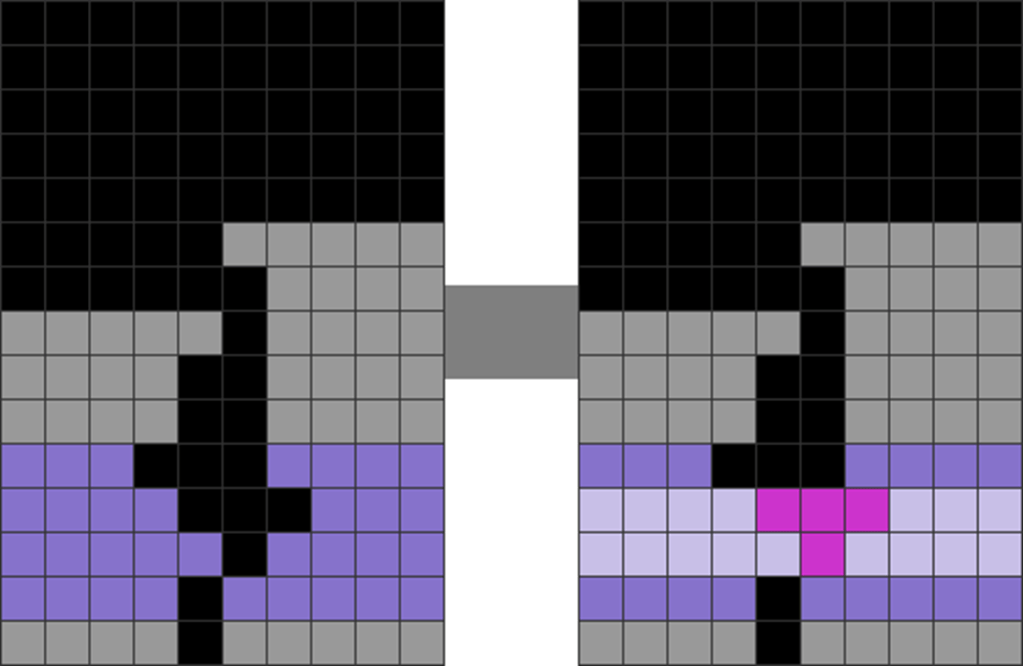
Even fewer players can make more advanced spliced methods such as these:
| 3 | 4 |
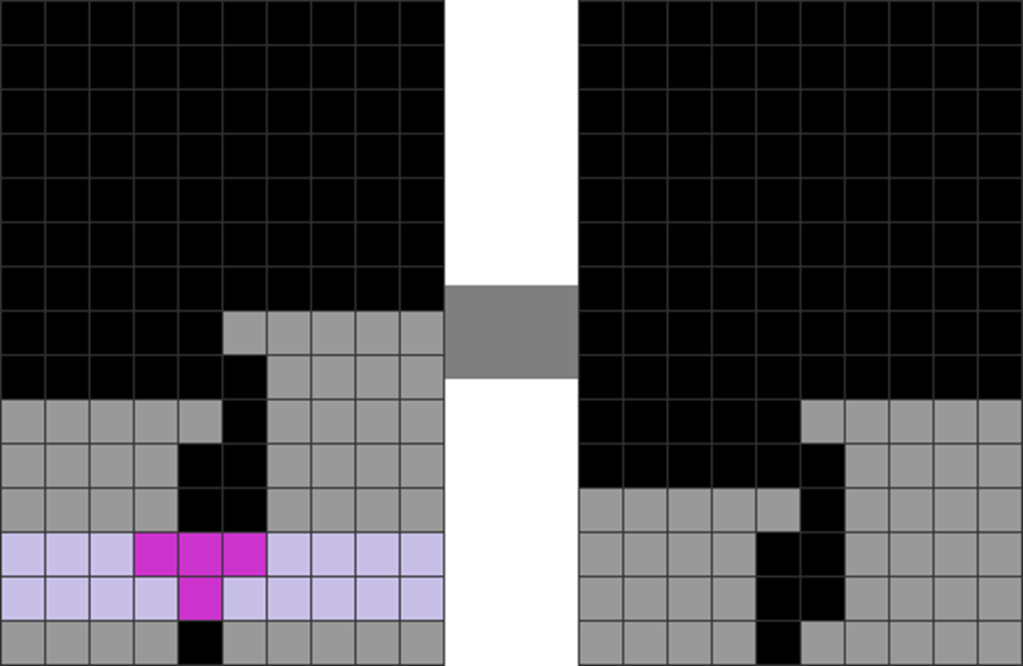
| After the second T-spin concludes, you are left with the STSD. |
Perhaps only 0.1-1% of players worldwide become experts in Tetris. The rest are casuals or intermediate players.
Hence, Tetris is often perceived as a super-casual game. What do most people think of when they hear the term “Tetris?” They think of this:
| Diagram Set 1-3 |
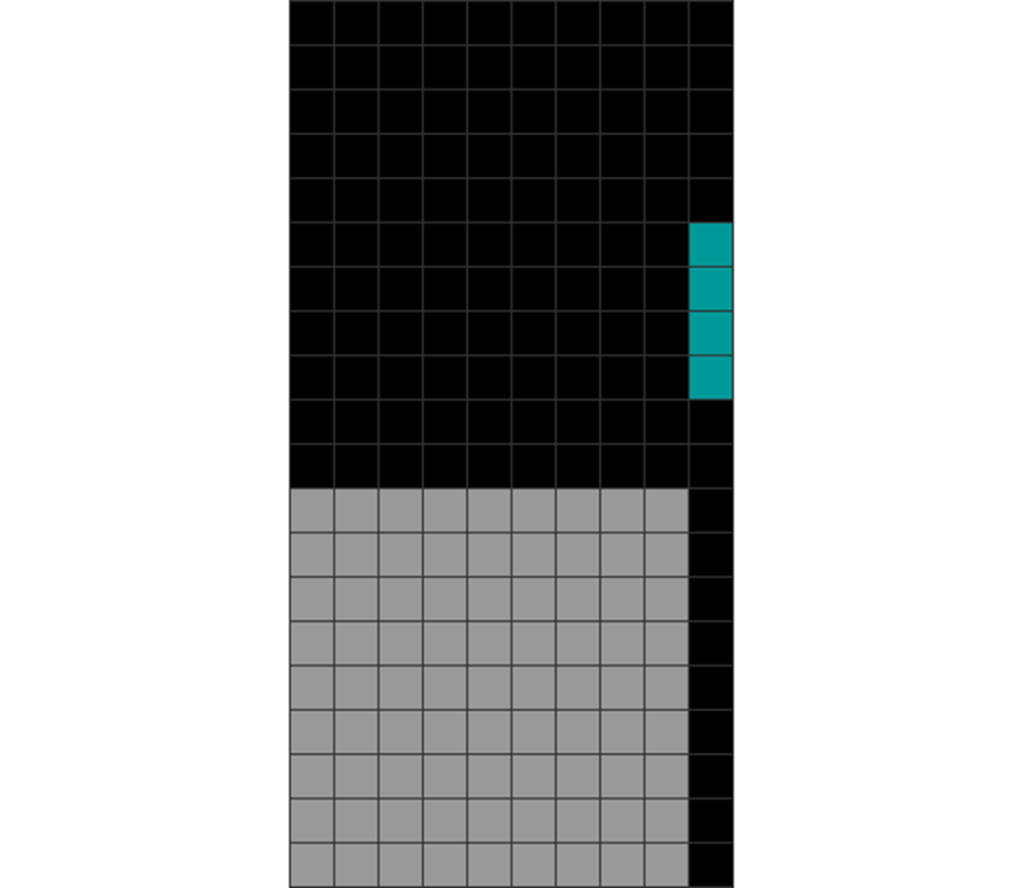
| The empty column is in the 10th column for the I piece to start a Tetris line clear. The other 9 columns are filled. |
They believe Tetris is simply about spamming quad line clears with the central hole in the right-most column of the field.
However, Tetris is far more than that.
Although it has not been covered as extensively by many guidebook authors as Chess, I strongly believe, with reasonable grounds, that it is as complex as Chess.
The sheer extensiveness of the analysis suggests as much: I have written nearly 2000 pages of Tetris guides across my 7 guidebooks, ranging from the beginner to the most advanced methods:
| Diagram Set 1-4 |
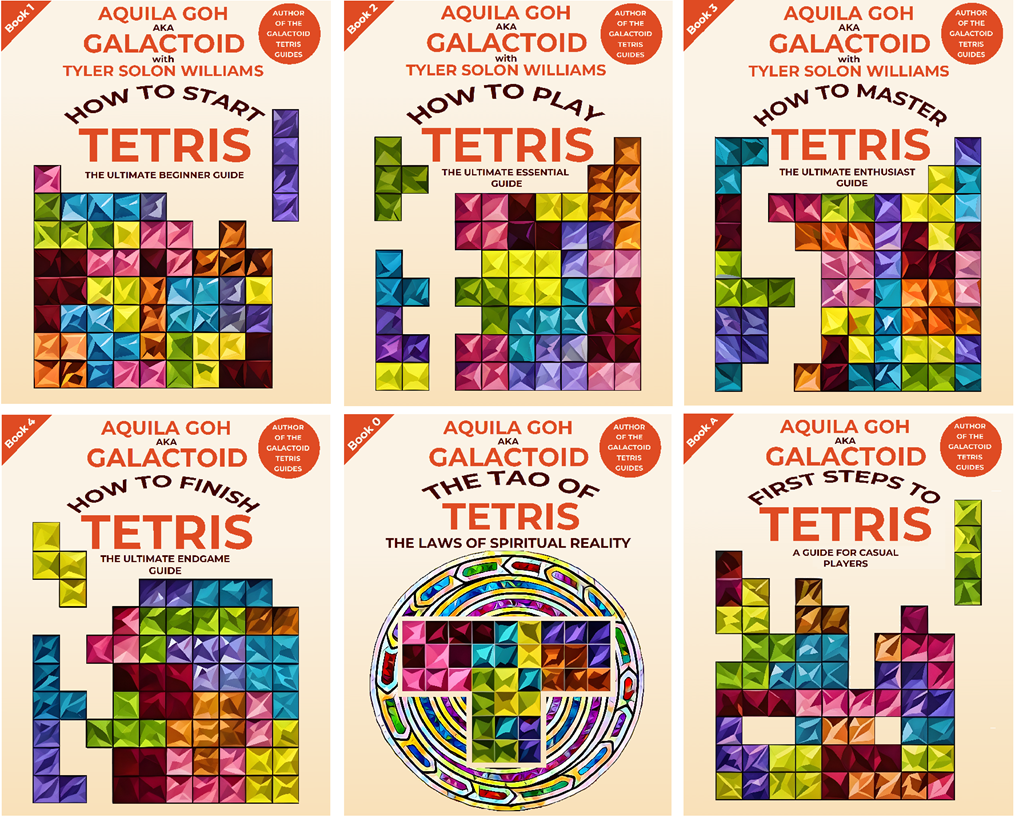
| These are my 6 other published Tetris books. |
If Tetris is not as complex as Chess, it would not be possible to write so deeply about it in such a prolific way.
Instead of appealing to my authority, I will give you some reasons why Tetris is nearly as complex as Chess:
First, the number of ways to permutate the 7 minoes to make setups spans in the tens of thousands.
This, alongside the 7-bag randomizer, adds indeterminacy, creating many novel mid-game situations one cannot merely memorize. One must figure out the optimal ways to handle them.
As I watch other high-level Tetris players like Flare play, I always realize there are new ways to approach the game. Despite having played and researched Tetris for 6 years, I still occasionally encounter methods I do not know.
Second, with the addition of all-spin bonuses in games like TETR.IO, Tetris’ skill ceiling has been increased even further.
And even at my skill level and knowledge, there is always something new to learn. The addition of new all-spin mechanisms alone was enough for me to justify writing Book 4, which is nearly 500 pages. A plethora of new all-spin methods were mapped out, such as these:
Hybrid spliced all-spin setups:
| Diagram Set 1-5 | |
| 1 | 2 |
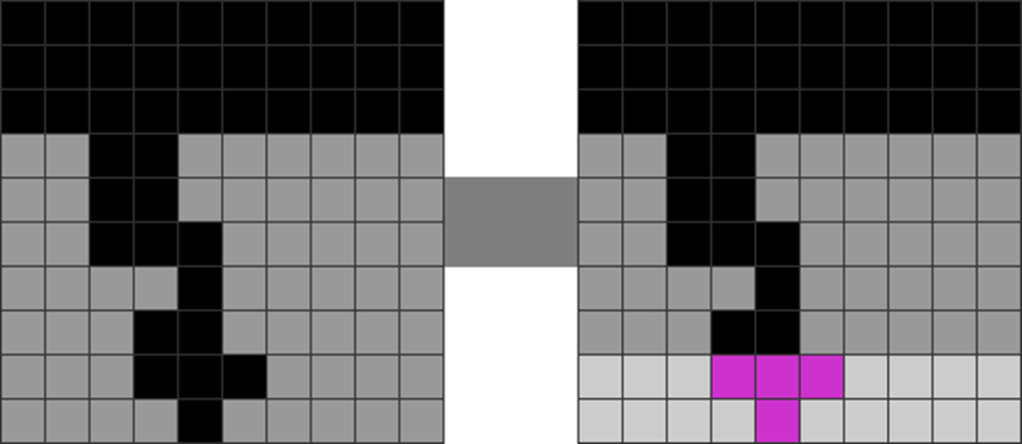
| Starting field. | A T-spin double finishes. |
| 3 | 4 |
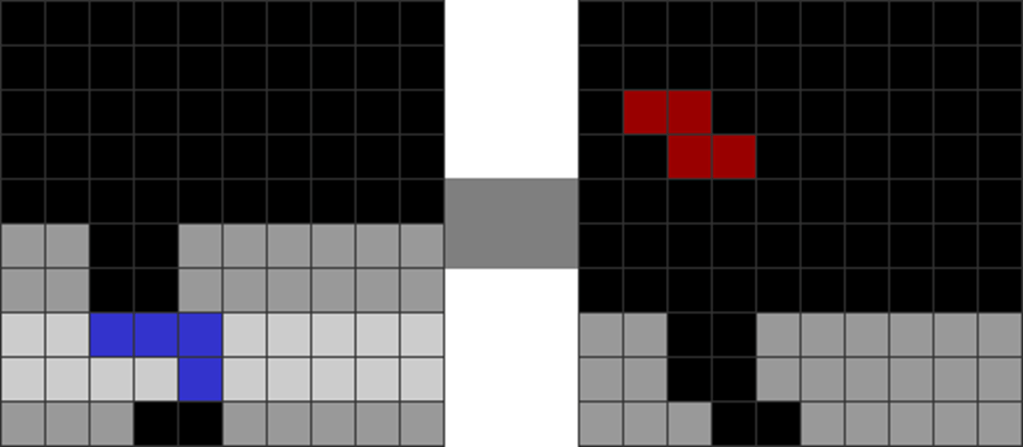
| A J-spin double finishes. | This leads to a Z-spin. |
Stackable all-spin setups:
| Diagram Set 1-6 | |
| 1 | 2 |
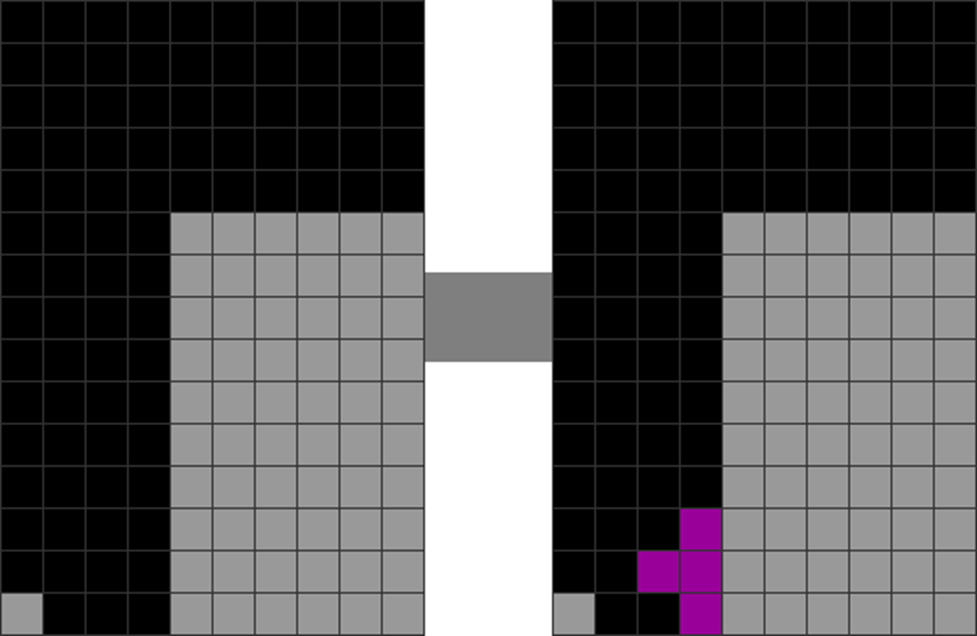
| Recognize this 1-residue 4-wide pattern on the left. | Put a vertical T. |
| 3 | 4 |
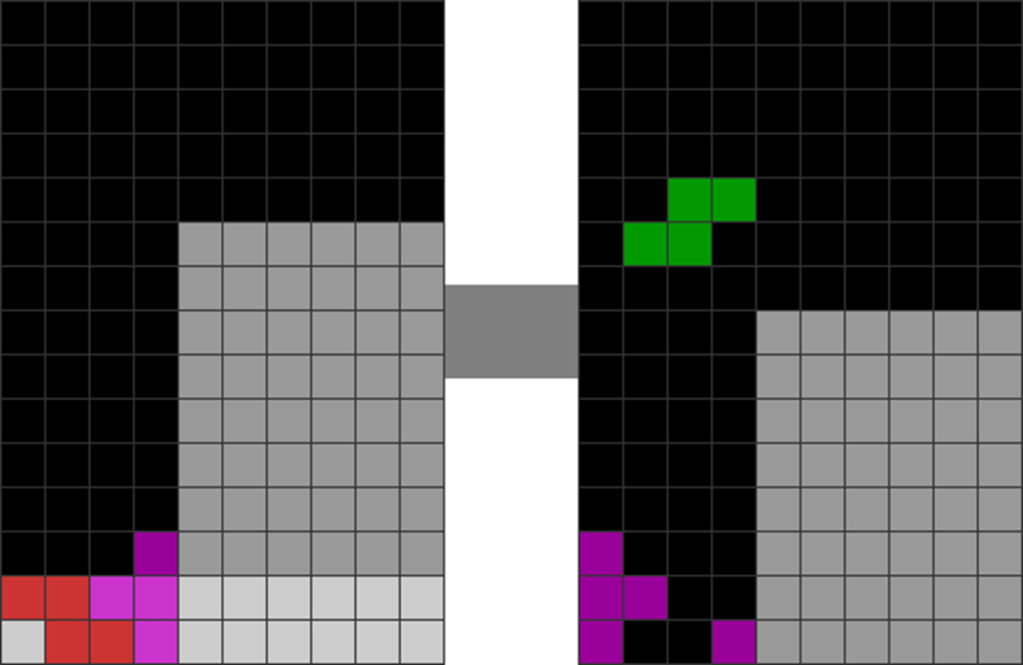
| Do a Z-spin double. | Put a vertical T. Now do an S-spin double. It then loops back to step 1’spattern. |
New mechanisms, such as the Zone mechanic from Tetris Effect: Connected, also complicate timing decisions.
The recent additions of Red Bull Tetris further change the meta strategies.
Who knows what new, future, official Tetris games can introduce that further add to its complexity? The extra depth that they introduce may be enough to justify a new 500-page guidebook.
Third, Tetris itself has many versions:
| Diagram Set 1-7 |
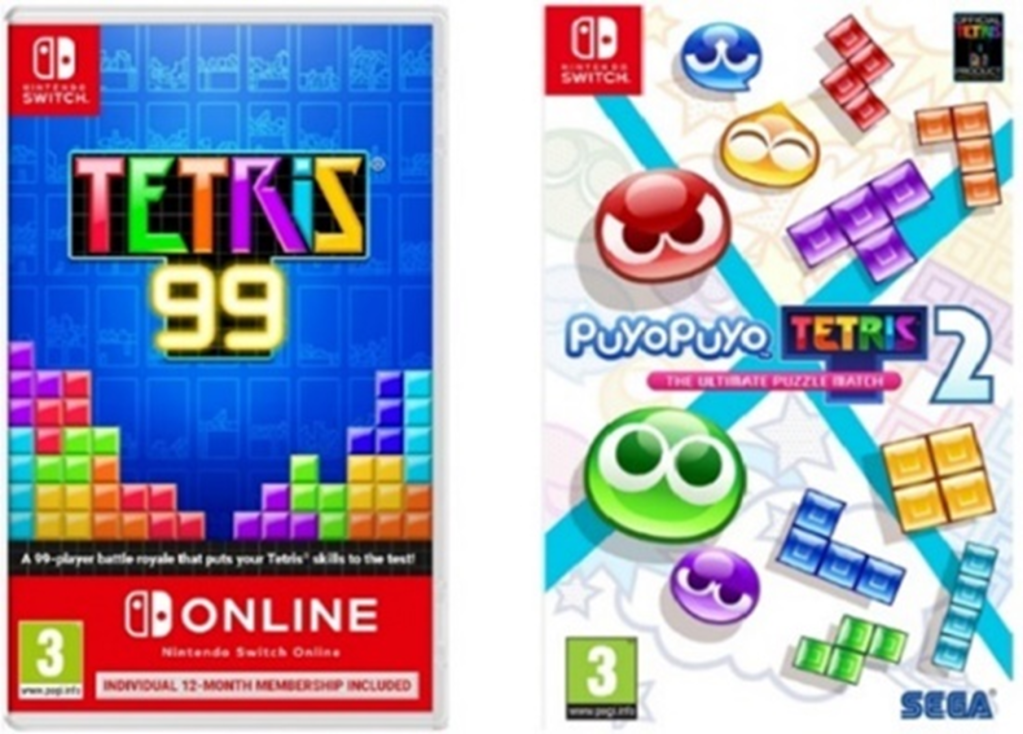
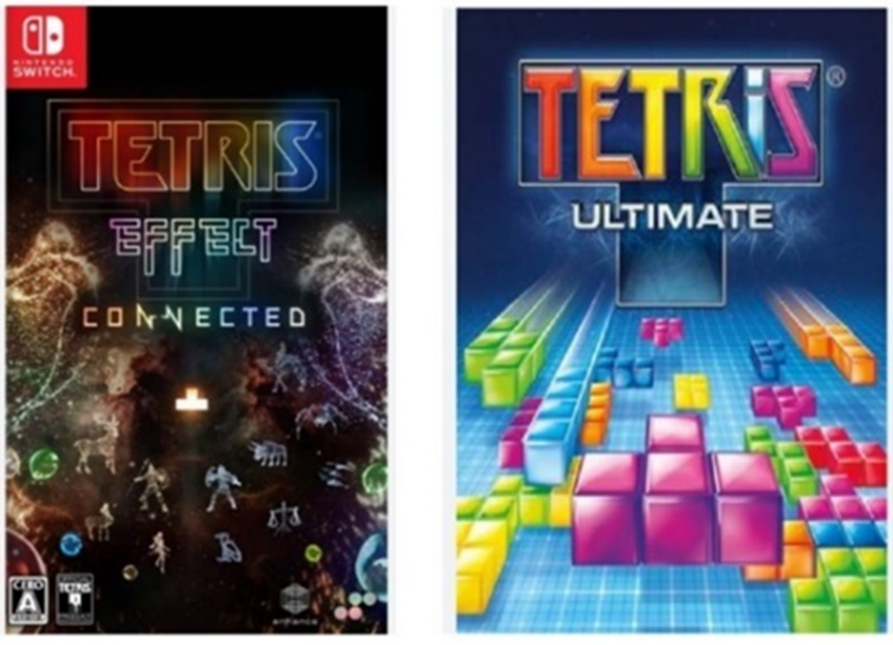
| Various official Tetris games: Tetris 99, Puyo Puyo Tetris 2, Tetris Effect: Connected, and Tetris Ultimate, respectively. |
Each Tetris game has its own unique way of playing, containing its own unique meta-strategies.
A meta-strategy that works in one Tetris variant may not apply to the next.
To conclude, this is why Tetris takes minutes to learn but a lifetime to master: it balances simplicity and complexity. This provides players with the full range of expression in Tetris: they can play it casually or hardcore, with their imagination as the only limit.
Why should you not force yourself to play Tetris during a burnout?
From my years of observation, many serious Tetris players often experience periods of burnout.
They may spend too much time grinding a 40-line sprint or ultra score. They may also spend too much time learning too many Tetris methods. They repeatedly grind the ranks to get a higher rating on Puyo Puyo Tetris or TETR.IO.
The result is that, after weeks or months of sustained output, they burn out, having reduced intellectual focus in Tetris.
However, many of these players (some of whom I know personally) continue to grind their way through the ranks. They stream on Twitch, and I can observe their explosive anger whenever they lose a match.
Something similar happened to me in my first year of playing Tetris, when I was trying to grind for at least a 70,000 score in Puyo Puyo Tetris’ ultra mode.
However, after years of playing, I realized it is simply not worth the psychological damage to keep playing when I was burned out or did not want to.
I would get agitated if I forced myself to perform, causing severe misdrops and bursts of anger.
Therefore, the solution I adopted was simple: whenever I played Tetris until I felt burned out, I would rest for weeks before continuing.
Ironically, after taking breaks, I would come back, and my performance would improve (after a day or 2 of warm-ups). My speed would increase naturally as well.
Most importantly, it would renew my desire to play Tetris.
Ultimately, slow and steady wins the race.
Why are there no “best” Tetris games?
Many intermediate players often fall into the trap of believing that their own version of Tetris is the “best” in the world. I have seen this occurring many times.
Some TETR.IO players believe their game is the “best” in the world because it has no speed limit. This means that one can set the handling to the fastest. When a piece spawns, holding “move left” zaps the piece to the field’s left side immediately. There is no delay, unlike games like Tetris Effect: Connected.
They also think that, because there are no line clear delays or spawn delays, the best players are those who play at 4 pieces per second with maximum efficiency.
However, this is a misconception. Games without line clear delays or significantly slower handling, like Puyo Puyo Tetris 2, prioritize strategic depth over tactical speed.
For instance, during line clear delays, players can use the time to plan out the most optimal downstack combo sequence for maximal garbage output:
| Diagram Set 1-8 | |
| 1 | 2 |
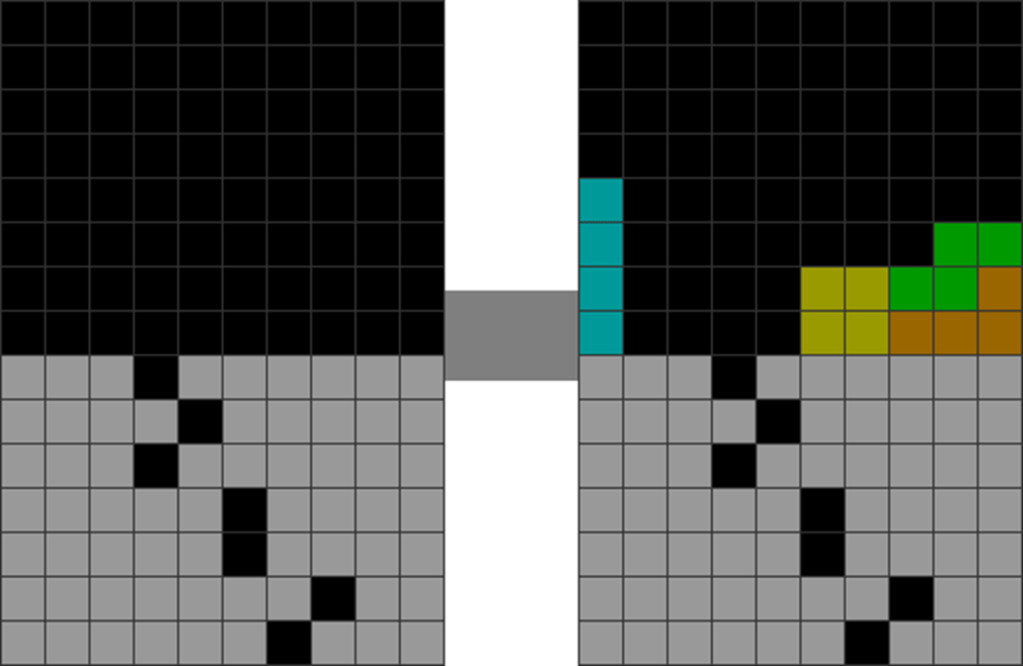
| Starting field. | The player upstacks a bit. |
| 3 | 4 |
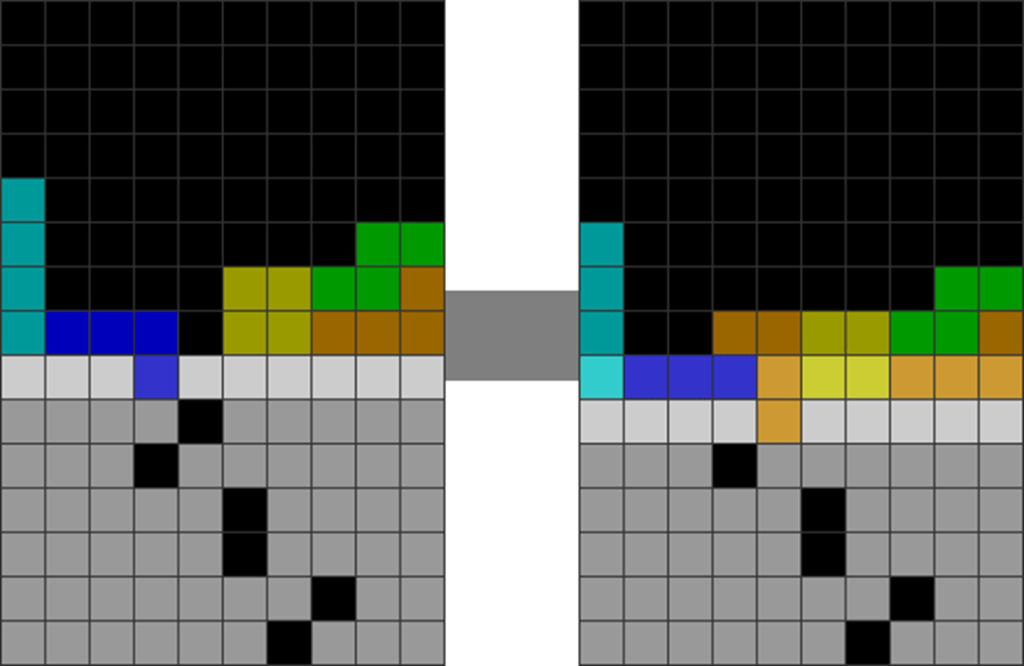
| He uses a J to skim and downstack, opening up the second garbage hole. He uses the line clear delay to plan. | The next garbage hole is downstacked with an L. He continues using the line clear delay to think. |
| 5 | 6 |
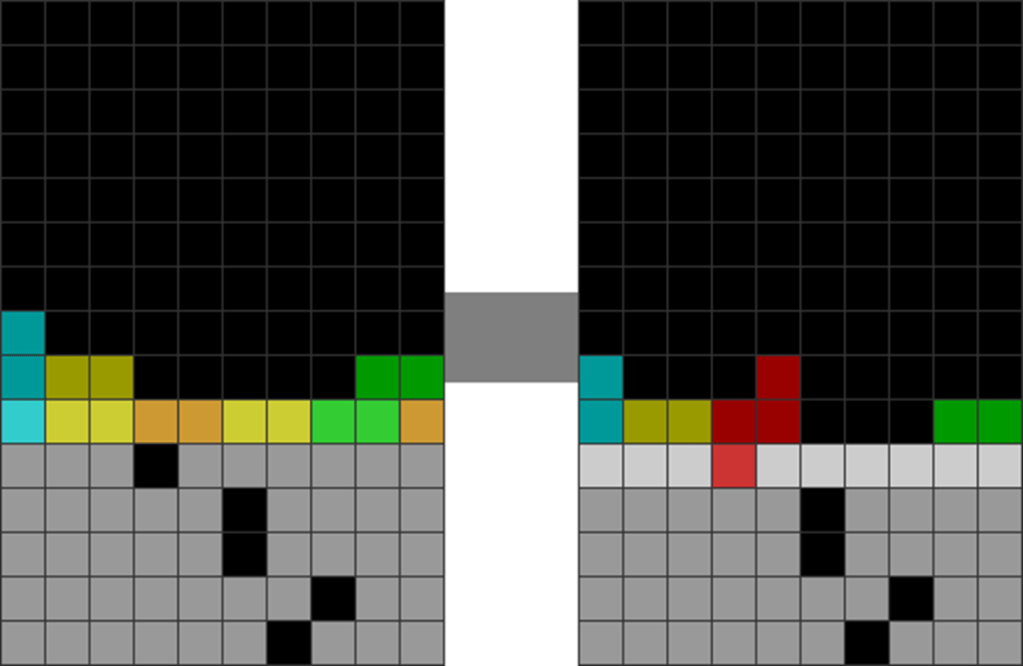
| Then, an O. He continues using the line clear delay to think. | Finally, a Z-skim opens the garbage hole in column 6. |
During line clear delays, he planned in the precious extra seconds, letting him choose a series of placements to maximize downstack combos.
Such games, hence, privilege efficiency over downstacking infinitely. In games like TETR.IO or Jstris, one can “infinite downstack” by skimming off the top layers with inefficient singles to get down to clean garbage:
| Diagram Set 1-9 | |
| 1 | 2 |
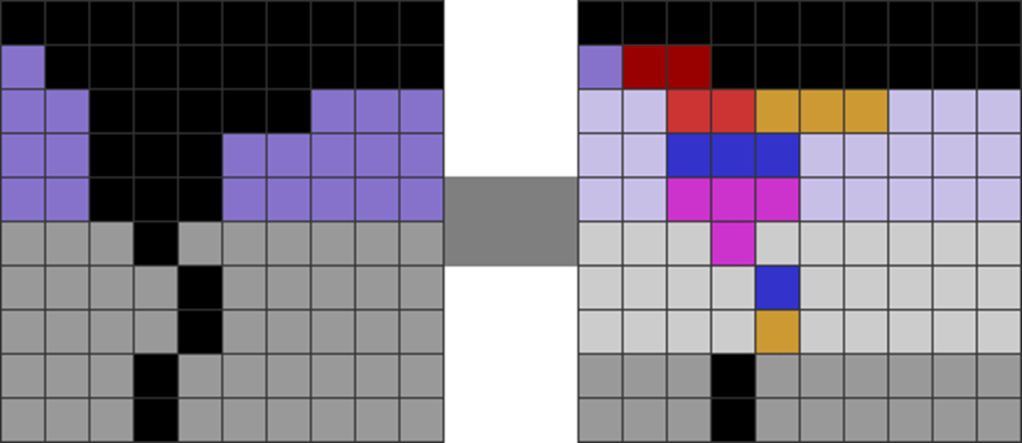
| Starting field. | The player “infinite downstacks” without line clear delay penalties. |
In step 2, because there is no line clear delay, the player can choose very inefficient skims that break back-to-backs or do not sustain combos.
However, doing this in official guideline Tetris games like Tetris 99 with line clear delays is a death trap, as you are buying your opponents the time to spike you while you dig down.
Other games, like NES Classic Tetris, may not have T-spins, dirty garbage, or back-to-back bonuses. However, they are simply a different Tetris experience,not better or worse.
In Classic Tetris, there is no 7-bag (or 7-piece) randomizer. This means that players cannot stack for severe piece dependencies like this:
| Diagram Set 1-10 | |
| A | B |
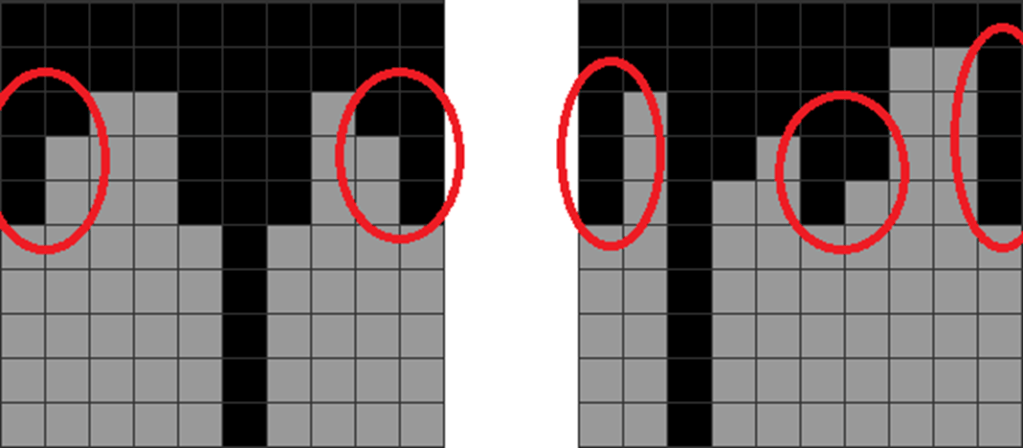
| The red-circled parts have many L- and J-dependencies. | The red-circled parts have many I- and Z-dependencies. |
The required pieces to fill the piece dependencies may never arrive. Hence, a player must stack in an open and flat manner that caters to maximal stacking follow-ups like this:
| Diagram Set 1-11 | |
| A | B |
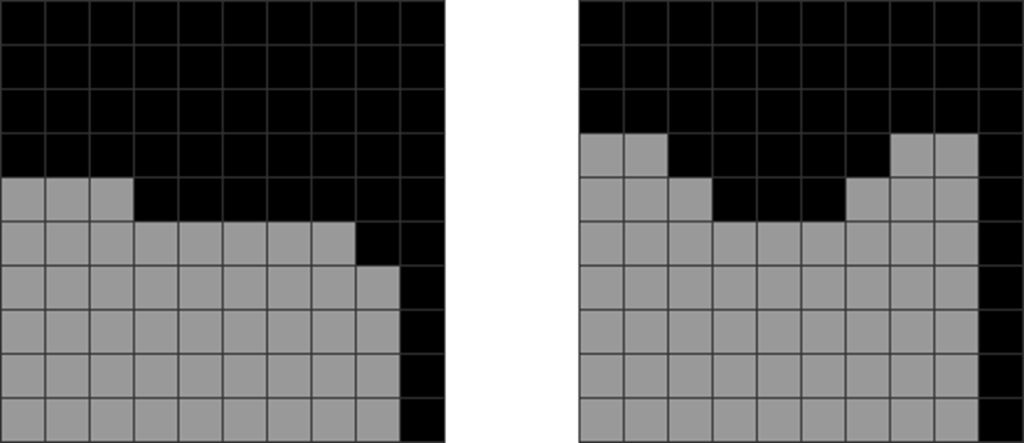
| An “open” field that has few field divisions or piece dependencies. | This caldera-shaped open field also maximizes stacking continuations. |
Then, other single-player Tetris modes allow players to complete feats such as 20 TSD (T-Spin Double) sprints. These include over-the-top T-spins like these:
| Diagram Set 1-12 | |
| A | B |
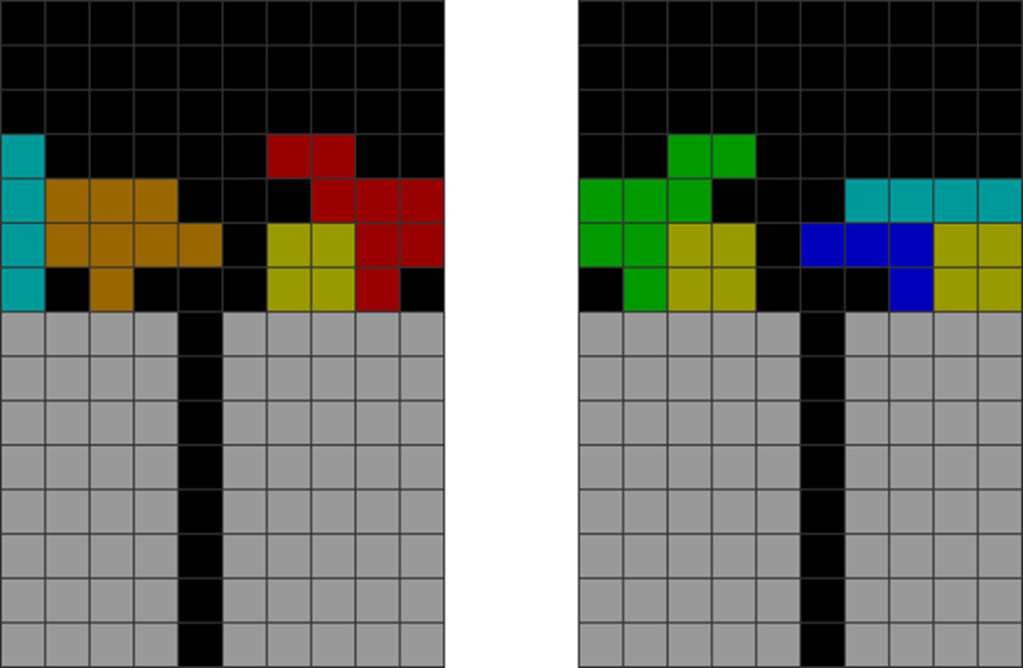
| Advanced T-spin prop setups. |
Others involve solo modes of using minos to make many kinds of shapes, like this:
| Diagram Set 1-13 | |
| A | B |
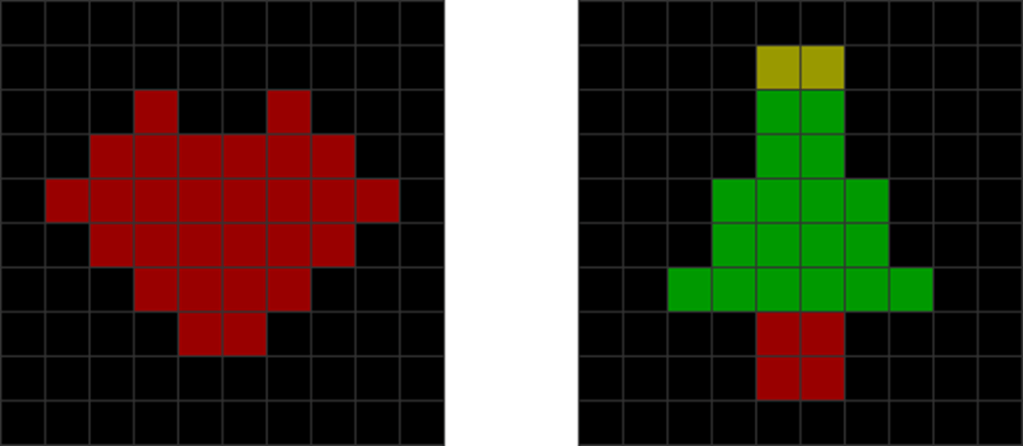
| In solo games, you can use minoes to make these floating artistic shapes. |
Each Tetris game, therefore, offers a different experience for different players.
There is no “better” or “worse” Tetris game.
There is only your preference.
Why is there not a single way to play Tetris?
This is a continuation of the last question.
Just like how there is no “superior” Tetris game, there is no “superior” way of playing Tetris.
Many players may equate high-level Tetris with an unstoppable winning streak in versus modes across games like TETR.IO or Puyo Puyo Tetris.
However, there are many other ways to play Tetris:
- One can play single-player Tetris modes like Puyo Puyo Tetris’ endurance mode.
- One can play 20 TSD (20 T-spin double) solo sprints without an opponent by making as many T-spin doubles as soon as possible.
- Some players that I know only do 40-line sprints using 6-3 stacking.
- A famous Tetris player, Oshisaure, prioritizes secret modes and having fun with exploring Tetris glitches.
- Some Tetris 99 players only use 4-wides or baiting methods.
- Others may grind Tetris Effect’s Journey or marathon modes for the world’s highest scores. I know of some who only play the latter mode for world records.
- Some players prioritize fancy T-spin setups, such as Yakine or me, even though traditionalists may view this gameplay style as dangerous.
- One famous player I know mainly does back-to-back perfect clear grinds.
- Others may mod Tetris to play with pentaminoes instead of tetraminoes.
Hence, there are not only many paths to the same mountain; there are many different kinds of mountains.
Playing Tetris is a matter of preference.
There are no “superior” modes to play it over others.
Any mode or playstyle that some groups privilege over others is merely a social, cultural, or psychological construct that exists solely in one’s mind. They are subjective.
Why is there truly no one single “best” Tetris player?
Many people may see Jonas Neubauer as the “best Tetris player” ever. In fact, as of Feb 2026, googling that up will have Google’s AI tell you it is the case (because the AI has zero media literacy or critical thinking skills).
Jonas is a skilled player — a Classic Tetris player. However, it does not mean he is at the same skill level in other games, such as modern Tetris.
Syakegohan and Flare are excellent players in Puyo Puyo Tetris. They are considered among the top players in Guideline Tetris. However, this may not mean they excel in all Tetris games.
Likewise, JimothyJimothy and Nilgiri hold the world record for the most consecutive perfect clears. However, it does not mean this skill is transferable to other areas.
Players like Yakine are considered the best at T-spins, but they can sometimes be beaten by players who prioritize downstacking in games like Jstris.
Some players may be “universalists,” such as Ajanba or Fortissimo. However, given that one can only be in one place at any time, generalists who aspire to be good in all Tetris games may be beaten by specialists in specific versions.
Hence, there is no way to assert that a player is the “best” or “top” Tetris player worldwide.
It depends on the specific game, skill domain, or game mode.
Why are the top Tetris players so young?
When one observes Tetris tournament news, it becomes apparent that many top Tetris players are very young.
Flare, a top Puyo Puyo Tetris player, is only a teenager. Amemiya became the top dog in this game in his late teenage years. Many Classic Tetris experts, such as dogplayingtetris, are teenagers.
Players who are far older are less likely to be top players.
Why is it so?
To explain this, we need to discuss the rise and fall of cognitive domains across the lifespan and their relevance to Tetris.
In Tetris, several cognitive areas are most vital to the game:
- Spatial awareness and fluid reasoning
- Reflexes or processing speed
- Working memory
- Long-term memory
Long-term memory allows one to learn many mid-game Tetris setups. However, the first 3 are most important, as they give you the immediate cognitive bandwidth to glance at the field and quickly work out and create the most optimal setup.
Players with higher reflexes or spatial awareness can do this with great facility.
Younger players have more of the top 3 key abilities, which gives them an edge over older players. This is because most of these dimensions decline with age.
Although older people benefit from greater wisdom, social comprehension, vocabulary size, general knowledge, abstraction, and theoretical synthesis, these are not relevant faculties in an actual game of Tetris.
One might benefit from these for writing Tetris books, formulating Tetris theories, or teaching, but they do not contribute to the reflexes needed in an actual live Tetris game.
Younger players are also more curious and likely to experiment with and learn new techniques. And they do not have a job.
These factors, hence, give them an edge over older players, whose reflexes slow down with age.
Hence, it is not because every generation of Tetris players is “better” than the previous one, but partly because older generations have slowed down.
Why is Classic Tetris so brutal sometimes compared to modern Tetris?
Classic NES Tetris refers to the most popular version that is used in many tournaments worldwide now:
| Diagram Set 1-14 |
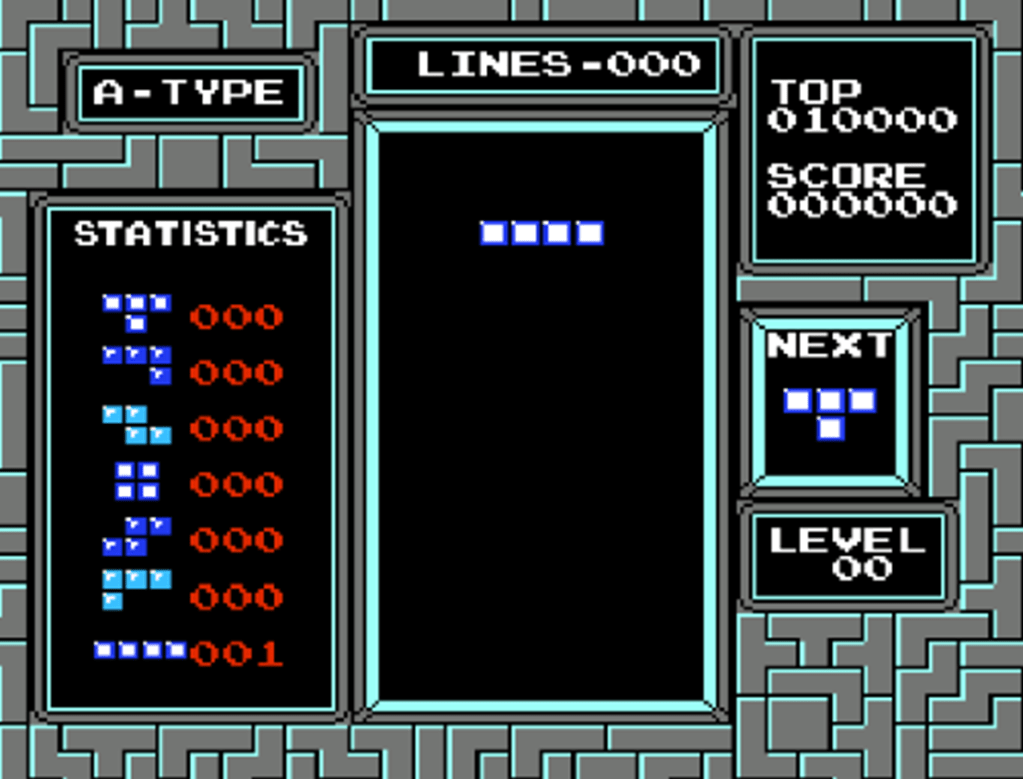
| Classic NES Tetris. |
In this version of Tetris, there are no 7-bag (7-piece) randomizers or hold functions. It also only has 1 preview, and you cannot “wiggle” your pieces to prevent them from being placed (in modern Tetris, pressing the movement or rotate keys can stall a piece from being locked into position, giving you more time to think).
For all these reasons, Classic Tetris is considerably more brutal, as you have less room for error.
With fewer previews and no holds, you must make use of what little you have.
Most importantly, without a 7-bag randomizer, you can get piece floods or piece droughts:
| Diagram Set 1-15 | |
| 1 | 2 |
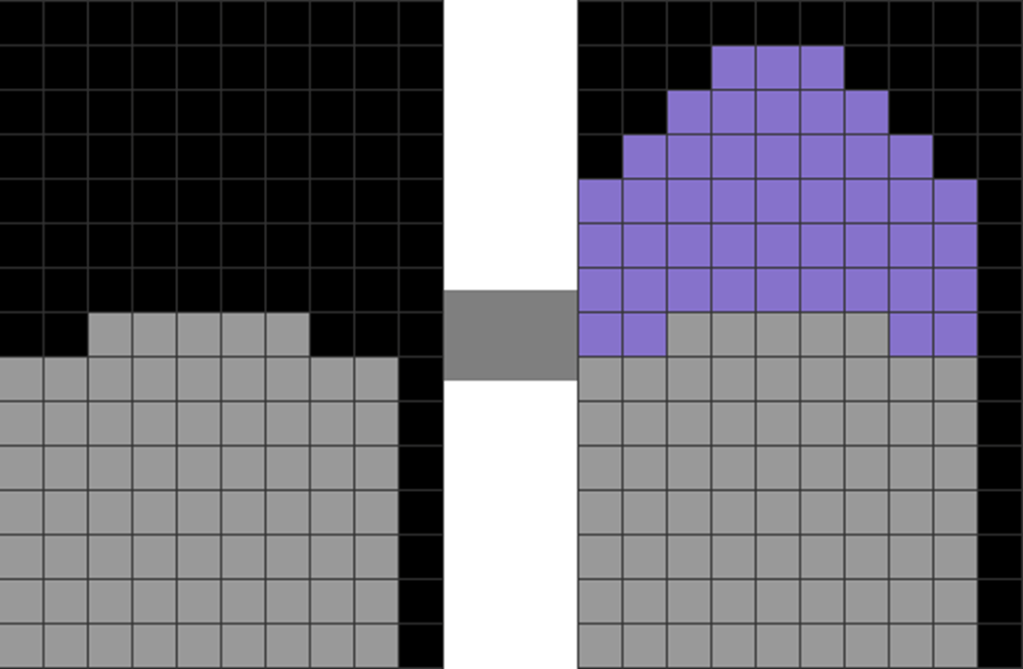
| Starting field, ready for a Tetris line clear. | The I pieces do not arrive. Hence, the player overstacks. |
Here, a player gets into an I-piece drought, meaning that the I piece does not arrive after many pieces. He can hence overstack and top out while waiting for the I pieces to come.
| Diagram Set 1-16 | |
| 1 | 2 |
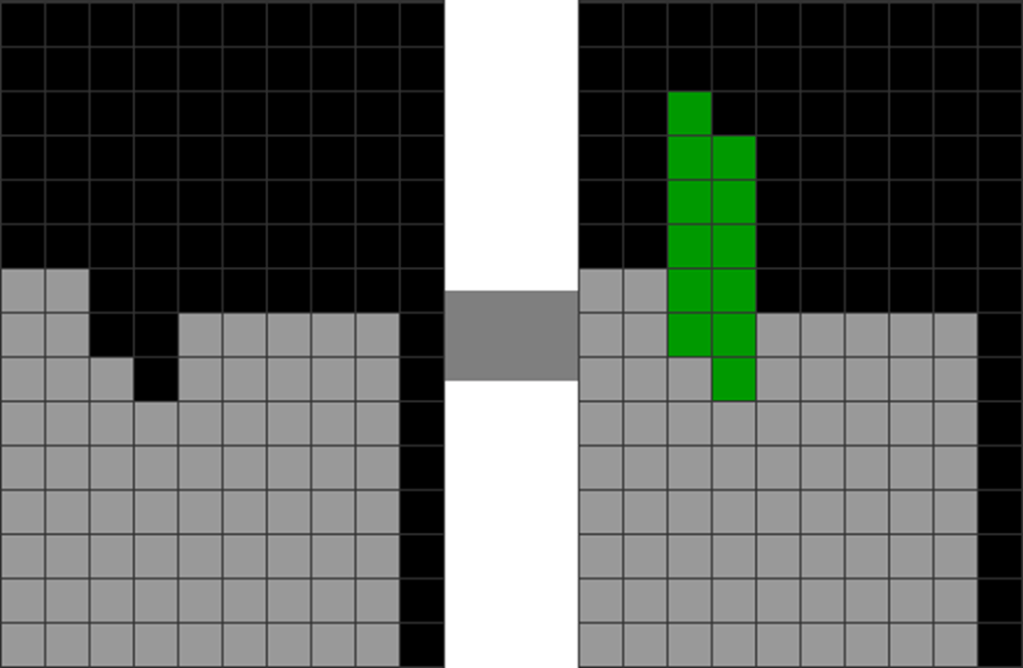
| Starting field. | The player gets a triple S-piece flood, forcing him to overstack. |
Here, a player gets an S-piece flood, meaning a chain of many consecutive S pieces. He is forced to stack the S pieces vertically, leading to overstacking in the middle, which becomes lethal late-game as higher gravity takes effect.
Hence, a player in Classic Tetris has to stack broadly to maximize stacking possibilities like this:
| Diagram Set 1-17 | |
| A | B |
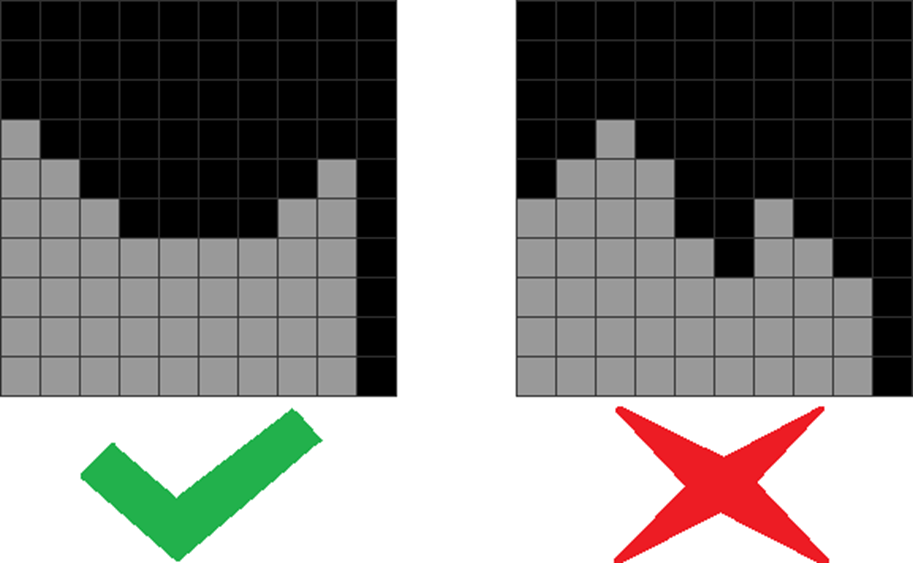
| This field is open, allowing for more stacking continuations. | This field is divided, has many mounds, and is jagged, minimizing stacking follow-ups. |
This is unlike modern Tetris, which is far more forgiving with many previews, the hold function, the 7-bag randomizer, and the “wiggle” function.
 How to Tetris